
Every offer you write starts with the same number. So does every assignment fee and every rehab budget.
Get that number 10% wrong and the profit you penciled in is gone before you reach the closing table. So what is ARV in real estate, and how do you calculate one you can actually defend? Here’s the math, start to finish, on one worked example you can copy for your next deal.
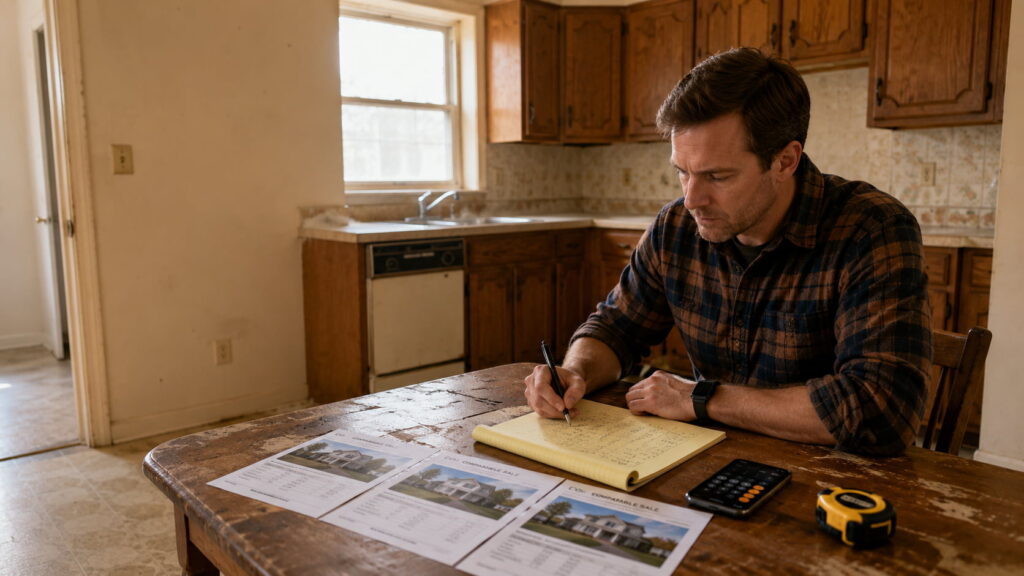
The ARV work happens before the offer: comps, a notepad, and a number you can defend.
In this guide:
- What Is ARV in Real Estate?
- The ARV Formula: How to Calculate After Repair Value
- The 70% Rule: Turning ARV Into a Maximum Offer
- ARV for Wholesalers: The MAO Formula
- ARV vs. Market Value vs. Appraised Value
- Common ARV Mistakes That Kill Deals
- What ARV Has to Do With Your Marketing Budget
- FAQs About ARV
What Is ARV in Real Estate?
ARV (after repair value) is the estimated market value of a property after planned renovations are complete. It’s based on recent sold prices of comparable, already-renovated homes nearby, not the property’s current as-is condition. Investors, wholesalers, and hard-money lenders use ARV to set offers, assignment prices, and loan amounts.
Almost everyone in the deal runs on this number. Flippers use it to set the resale target. Wholesalers price their assignment against it. BRRRR investors need it for the refinance appraisal. And hard-money lenders lend against a percentage of it, which means their appraiser will check your math.
One thing to keep straight: ARV is a forecast, not a fact. The house isn’t worth that number yet. It’s worth that number if the renovation gets done and if your comps were honest. Which is why the calculation matters more than the definition.
The ARV Formula: How to Calculate After Repair Value
The textbook formula is simple: ARV = the property’s current value + the value added by renovations. Nobody credible calculates it that way.
In practice, operators skip the theory and work backwards from comps: what did renovated houses like this one actually sell for? That’s the whole method, done in three steps.
Take the example we’ll carry through this article: a distressed 3-bed, 2-bath that needs a full cosmetic rehab, in a neighborhood where renovated houses sell around $300K.
Step 1: Pull the Right Comps
Pull 3–5 sold comps, not active listings, from the last 3–6 months, within about a mile, in the same bed/bath and size band.
Then the filter that separates a real ARV from a hopeful one: the comps must be in renovated condition. The #1 rookie error is comping a future-renovated house against as-is sales. You’re estimating what the house will be worth after the work, so the comps have to reflect houses after the work.
Where operators pull them: MLS access through an investor-friendly agent, county public records, and the listing portals. Any of the three works; the discipline is what matters.
Step 2: Adjust for the Differences
No comp matches your subject exactly. Adjust for square footage, lot size, garage, and condition delta between each comp and your post-renovation subject.
Then run the sanity check: price per square foot times your subject’s footage. If renovated comps trade around $200/sqft and your subject is 1,500 sqft, you should land near $300K. If your adjusted comps say $340K, one of your comps is lying to you.
Step 3: Settle on a Defensible Number
Average your adjusted comps and lean conservative. The test isn’t whether the number works in your spreadsheet. It’s whether it survives someone else’s.
A hard-money lender’s appraiser runs this exact exercise on an ARV appraisal before funding a rehab loan. If your $300K only holds up with the one outlier comp from the nicer street, the appraisal comes back at $280K and your deal math breaks in escrow, not on paper.
With a defensible ARV in hand, the next question is what to pay for the house.
The 70% Rule: Turning ARV Into a Maximum Offer
This is the part you came for: turning the ARV into a buying decision.
Maximum purchase price = (ARV × 0.70) − repair costs
The 30% you’re holding back isn’t greed. It has to cover your profit, holding costs, closing costs on both ends, commissions on the resale, and the surprises behind the drywall. Margins are thin enough that the buffer is doing real work: the median flip returned $65,981 in gross profit in 2025, the lowest return on investment since 2008 (ATTOM). Gross, before holding and closing costs. The buffer is where your actual profit lives.
A Worked Example, Start to Finish
Run our 3/2 through it:
| Step | Number |
|---|---|
| ARV (from renovated comps) | $300,000 |
| × 70% | $210,000 |
| − Repair estimate | $50,000 |
| Maximum offer | $160,000 |
Now the reason this article opened with a 10% warning. Say you buy at $160K, spend the $50K, and the true ARV was $270K, not $300K. Your gross spread just fell from $90K to $60K. One estimating error cost $30K, and every dollar of it comes out of the profit line, not the budget line.
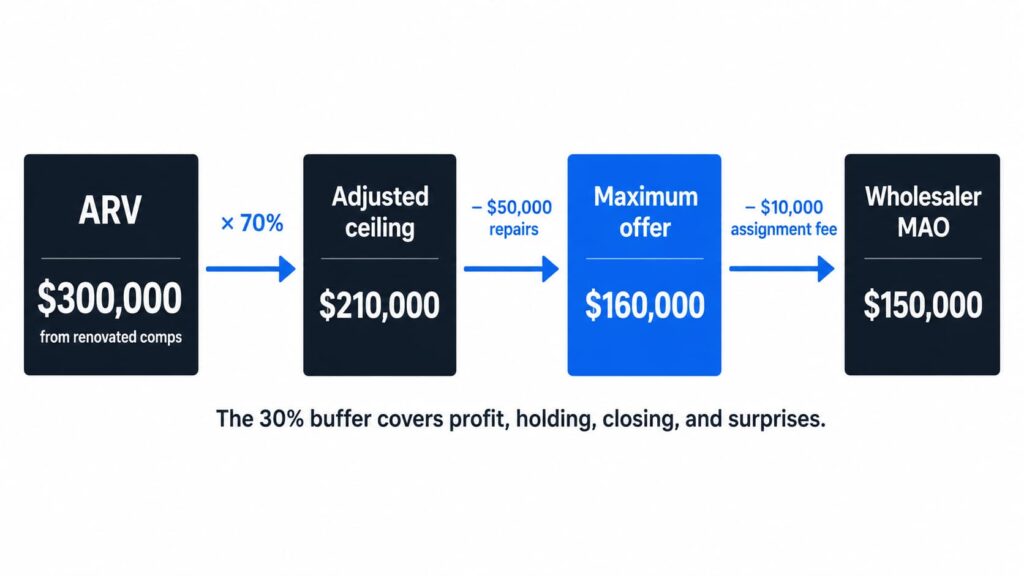
One estimating error at the ARV block flows through every number to its right.
When the 70% Rule Breaks
The rule is a screen, not a law of physics, and there are three places it bends:
Hot or expensive markets. In metros where renovated inventory moves fast, operators buy at 75–85% of ARV because 70% offers never win. Thinner spread, faster velocity.
Sub-$100K houses. Thirty percent of a small number isn’t enough dollars. On a $90K ARV, the buffer is $27K before repairs, and fixed costs (closing, utilities, insurance) don’t shrink because the house was cheap.
Buy-and-hold. If you’re keeping the property, cash flow and refinance math matter more than the flip spread. The 70% rule screens flips; it doesn’t underwrite rentals.
Adjust the percentage to your market. Keep the discipline.
ARV for Wholesalers: The MAO Formula
If you’re wholesaling, your version of the math adds one line:
MAO = (ARV × 70%) − repairs − your assignment fee
Extend the example: $210K minus $50K in repairs minus a $10K fee puts your maximum allowable offer at $150K. Lock it up higher than that and you’re negotiating your own fee down at disposition. The fee itself is worth protecting: the national average assignment fee is about $13,000 per a survey of 1,000+ wholesalers, with the working average nearer $10,000 once newer operators are included (Real Estate Bees).
Here’s what generic ARV explainers miss: your end buyer runs the same 70% math you just did. Your ARV doesn’t have to convince you. It has to convince the cash buyer you’re assigning to, and his lender’s appraiser after that. An inflated ARV doesn’t die at the contract stage; it dies at disposition, after you’ve spent the marketing money to find the deal. If you’re building toward that business, here’s how to start wholesaling real estate the right way.
ARV vs. Market Value vs. Appraised Value
Same house, three different numbers. Here’s the fast version:
| Term | What it measures | Who produces it |
|---|---|---|
| As-is market value | What the house sells for today, in its current condition | The market, via as-is comps |
| Appraised value | A licensed appraiser’s opinion of value; can be as-is, or “subject to completion” (an ARV appraisal) for rehab loans | Licensed appraiser |
| ARV | Future value after planned repairs, based on renovated comps | The investor, verified by an appraiser on rehab loans |
Offers built on the wrong one of these three lose money. You buy against as-is value, you borrow against appraised value, and you profit against ARV.
Common ARV Mistakes That Kill Deals
Every one of these has killed real deals. Most operators have made at least one:
- Comping against unrenovated sales. As-is comps produce an as-is number, not an ARV. You just valued the house you’re buying, not the house you’re selling.
- Using active listings instead of solds. Asking prices are opinions. Sold prices are facts.
- Stale comps in a shifting market. A comp from six months ago in a cooling market bakes in a value that’s already gone.
- Over-improving for the street. A $350K renovation standard on a $280K street still sells for $280K. The neighborhood sets the ceiling, not your finish schedule.
- Taking the seller’s or a guru’s ARV at face value. Whoever hands you an ARV has an incentive attached to it. Run your own comps, every time.
- Ignoring holding-time risk. Every extra month of holding eats the spread the 30% buffer was protecting. A right ARV with a wrong timeline still loses.
What ARV Has to Do With Your Marketing Budget
Everything above is spread discipline: what the deal is worth, minus what it costs, equals what you keep. The same math runs your marketing, one level up.
The ARV spread defines what a deal nets. What a deal nets defines what a seller lead is worth. And what a lead is worth defines what you can afford to pay per lead, by channel. If your average close nets $25–$30K off the spread, those aren’t equal choices: pay-per-click for motivated sellers runs $20–$100 per click before a click ever becomes a lead (Real Estate Bees), while one Florida cash buyer’s organic leads from Google cost $161 each and declining monthly (BASEO client data). A lead that takes several $20–$100 clicks and a $161-and-falling lead are two different businesses at the closing table.
That’s why operators who run Google Ads for real estate still build the organic channel underneath it, and why comparing how to get motivated seller leads channel by channel is worth an afternoon. If you want the numbers for your own market, a free written audit from BASEO’s SEO team for cash home buyers includes exactly that deal-math projection. Comp your lead sources the way you comp houses.
FAQs About ARV
What does ARV mean in real estate?
ARV stands for after repair value: what a property should sell for once its planned renovation is finished. It’s calculated from recent sales of similar, already-renovated homes nearby. Flippers, wholesalers, and rehab lenders all price their side of a deal against it.
How do you calculate ARV?
Pull 3–5 sold comps from the last 3–6 months within about a mile, in renovated condition and the same bed/bath and size band. Adjust each for square footage, lot, and condition differences, then average them. Cross-check with price per square foot times your subject’s footage.
What is the 70% rule in real estate?
The 70% rule says pay no more than 70% of ARV minus repair costs for a flip. The 30% held back covers profit, holding costs, closing costs, and surprises. It’s a screening tool, not a guarantee, and operators adjust the percentage in hot or very cheap markets.
Is ARV the same as appraised value?
No. ARV is the investor’s own comp-based forecast of post-renovation value. Appraised value is a licensed appraiser’s opinion, produced either as-is or “subject to completion” for rehab loans. Lenders order that ARV appraisal precisely to check the investor’s number before funding.
What percentage of ARV do cash buyers pay for a house?
Commonly 50–70% of ARV, depending on repairs and the market. The math explains the range: 70% of ARV minus repair costs is the standard ceiling, so a house needing light work prices near the top and a heavy rehab pushes the offer toward the low end.
Do lenders use ARV?
Yes. Hard-money and rehab lenders lend against a percentage of ARV rather than the purchase price, which is what makes fix-and-flip financing work. They verify the number with a subject-to-completion appraisal, so an inflated ARV usually surfaces before funding, not after.
Final thoughts
ARV isn’t the number you hope the house is worth. It’s the number you can defend with renovated comps, and every other figure in the deal (your max offer, your MAO, your rehab budget, your marketing spend) inherits its accuracy.
Before your next offer, run the three steps on the actual lead in front of you. Then run the same discipline on what you paid to get that lead in the first place, because the spread doesn’t care whether you lose it at the purchase or at the marketing line.
If you want to see what your own site could produce, the audit is free, written, delivered in about 2 business days, and yours to keep. No call required. Get your free site audit →
Leave a Reply