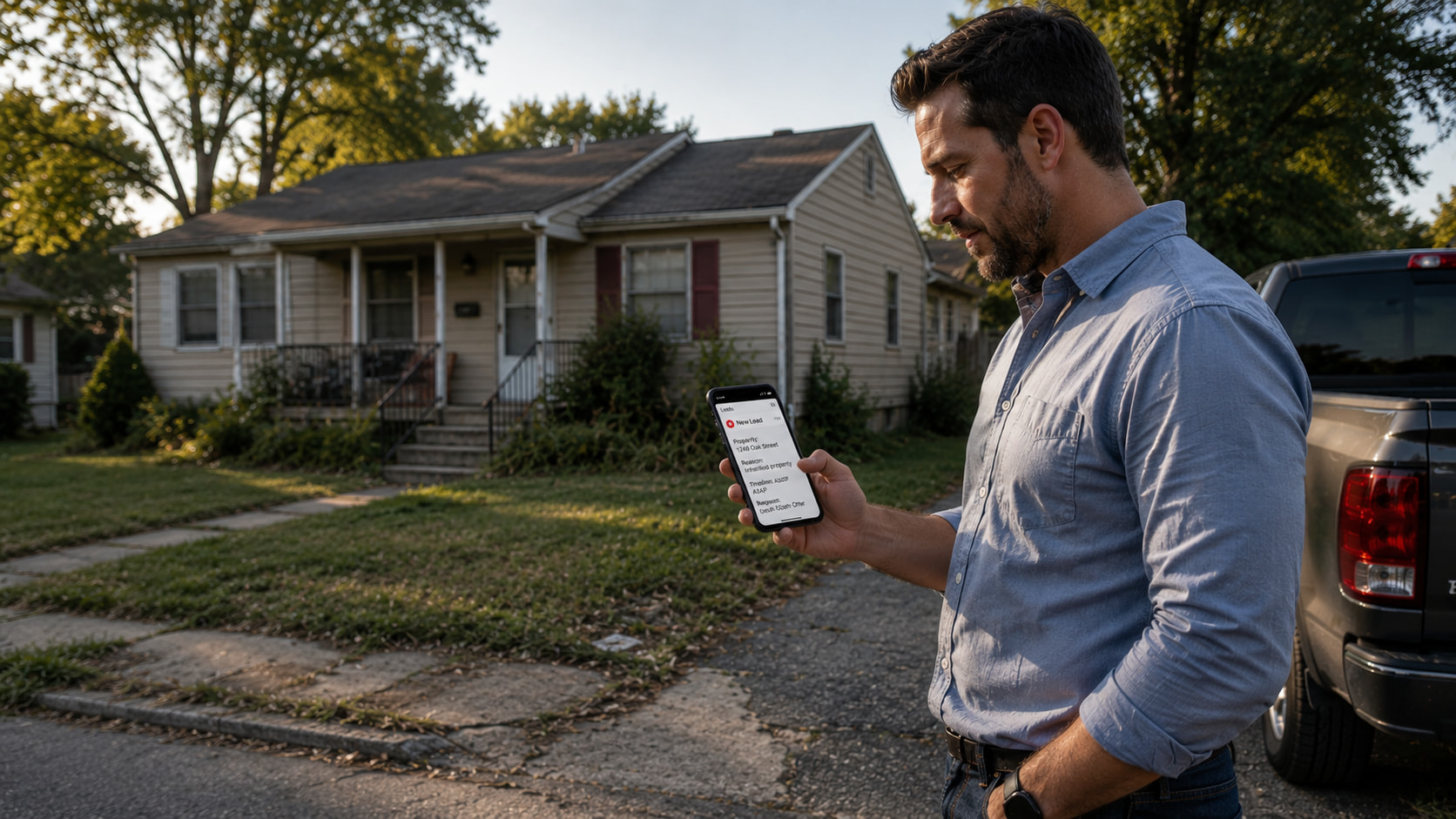

A cash buyer reads a fresh motivated-seller lead outside a property he’s evaluating.
Most articles about real estate leads are written for an agent chasing buyers. If you buy houses for cash, the lead that pays your bills looks nothing like that. A real estate lead is anyone who has shown interest in buying, selling, or renting property, and for an investor, the one worth chasing is a seller who could become your next deal. This guide covers what real estate leads actually are, the types worth knowing, where investor leads come from, and, more useful than any of that, which leads actually close.
What Is a Real Estate Lead?
A real estate lead is a person who has shown interest in buying, selling, or renting property. For a real estate investor, the most valuable lead is a motivated seller: an owner with a reason to sell fast, who could become your next deal. That interest is what separates a lead from a name on a list.
“Shown interest” means something concrete. They filled out a form on your site, replied to a piece of direct mail, raised their hand on an ad, or asked you for a cash offer. Each of those is a lead because the person did something.
Here’s where the investor definition splits from the agent definition. An agent prizes buyer leads and listing leads, people ready to shop or sell on the open market. You don’t. For a cash buyer, the seller with a property and a problem is the lead that turns into money. The buyer for that house is easy to find later. So while the word “lead” covers buyers and sellers alike, your pipeline lives or dies on seller leads, and the best of those are real estate investor leads with real motivation behind them.
Leads vs. Prospects vs. Deals: Clearing Up the Confusion
Most lead content uses “lead,” “prospect,” and “deal” like they mean the same thing. They don’t, and knowing the difference tells you where to spend your time.
The progression runs suspect to lead to prospect to deal. A suspect is a property or owner that might fit, before any contact. A lead is initial interest: they responded to you. A prospect is a qualified lead, one with a property, real motivation, and a timeline. A deal is a contract under negotiation.
Walk it through a wholesale example. You mail a probate list, and an heir calls back. That call is a lead. You get her on the phone, and she tells you she’ll sell the inherited house at a discount and wants it done in 30 days. Now she’s a prospect. You sign a purchase agreement and start lining up your end buyer. Now it’s a deal. The right questions to ask motivated sellers are what move a lead to a prospect, and they save you from working contacts that were never going to close.
The Main Types of Real Estate Leads
Real estate leads get sorted three ways: by direction (inbound or outbound), by temperature (cold, warm, or referral), and by role (buyer or seller). Those categories overlap, and any single lead sits in all three at once. For investors, the axis that predicts profit cuts across all of them: seller motivation. The four breakdowns below are the ones worth knowing, and if you want the full map, see our guide to the types of real estate leads.
Buyer Leads vs. Seller Leads
A buyer lead is someone who wants to buy. For an investor, that’s the cash buyers on your disposition list, the end buyers you assign a contract to or sell a flip to. Useful, but rarely the bottleneck.
A seller lead is an owner considering a sale. This is the acquisition side, and it’s where the deal starts. Find a good enough deal and a buyer is never the hard part.
That’s why in investing the seller lead rules. An agent splits attention between buyers and listings; you put the weight on sellers, because the seller leads that matter to investors are the ones that create deals in the first place.
Inbound vs. Outbound Leads
Inbound leads come to you. Someone searches Google, finds your site or your Google Business Profile, and reaches out. These come from SEO, PPC, a Carrot-style site, and referrals. They convert faster because the person raised their hand first.
Outbound leads are the ones you go get. You reach the owner before they’ve thought about you: cold calling, direct mail, SMS, driving for dollars. More work per contact, but you control the volume.
The trade-off is simple. Inbound brings higher intent and lower volume. Outbound brings higher volume and more friction. Neither is “better,” and most operators who want steady deal flow run both, though the leads you can get without cold calling tend to cost less per deal over time.
Cold, Warm, and Referral Leads
Temperature describes how much relationship exists before the first real conversation. A cold lead has no prior relationship with you. A warm lead has had some interaction or at least knows your name. A referral lead was sent to you by someone they trust, and it’s the highest-quality of the three.
The numbers back that up. In the National Association of Realtors’ 2025 data, 43% of buyers found their agent through a referral, and referral leads convert far higher than leads bought from a portal. Trust arrives before the first call, so there’s less convincing to do.
For a cash buyer, referrals come from other wholesalers, agents, attorneys, and your own past closings. A seller you treated fairly two years ago is a referral source. So is the probate attorney who sends you the family that just wants the house gone.
Motivated Seller Leads (What Investors Actually Want)
A motivated seller lead is an owner with an urgent reason to sell. Not someone testing the market, someone who needs a specific problem solved on a timeline. These are the leads that make an investing business work.
The common motivation triggers:
- Foreclosure or pre-foreclosure
- Probate or an inherited property
- Divorce
- Tax liens or tax delinquency
- A vacant or distressed property
- A tired landlord with problem tenants
- A job relocation on a deadline
Why is this the most profitable lead type? Because a motivated seller trades price for speed and certainty. They’ll take a cash offer below after repair value (ARV) to close fast and skip the listing process, and there’s far less competition than on an MLS listing everyone can see. The deal math is real: home flips in Q3 2025 cleared a median $60,000 gross profit at a 23.1% ROI (ATTOM), and wholesale assignment fees average roughly $13,000 nationally (Real Estate Bees). Neither works without a motivated seller on the other side.
One caution: a property address with a name attached is data, not a lead. What makes it a lead is verified intent, an owner who has confirmed they want to sell (iSpeedToLead). Chasing lists of addresses is how investors burn months. Chasing verified motivation is how they close. If you want the channel-by-channel breakdown, here’s how to get motivated seller leads.
Where Real Estate Investor Leads Come From
Investor lead sources aren’t “run some Facebook ads.” They’re specific, and they split into channels you push out and channels that pull sellers in.
On the outbound and data side:
- Direct mail to segmented lists (absentee owners, high-equity, distressed)
- Driving for dollars, spotting distressed properties in person
- Public records: pre-foreclosure filings, probate, divorce, evictions, tax delinquency, code violations
- Skip tracing to find the owner’s number, then cold calling or SMS
Data platforms like PropStream, DealMachine, BatchLeads, PropertyRadar, and REsimpli exist to pull and stack these lists, and the county records behind them are the raw material (PropStream, Probate Mastery).
On the inbound and owned side:
- PPC and Google Local Services Ads (LSA) for sellers searching right now
- SEO plus a Carrot-style site so you rank when a seller types “sell my house fast”
- Google Business Profile for the local map results
- Referrals from agents, attorneys, and past sellers
- Auctions and foreclosure sales
Outbound fills the top of the funnel fast. Inbound compounds and tends to bring higher-intent sellers, since they came looking for you. Most serious operations run both, and pull from more off-market sources as they scale. If you’re weighing the paid side, our breakdown of Google Ads for real estate has the real cost-per-lead numbers.
What Makes a Lead “Good”? Quality Signals That Predict a Close
Not every lead deserves the same effort. A “good” lead is one that shows the signals that predict a close, and they stack in this order:
- Verified motivation: a real, stated reason to sell
- Timeline: are they trying to sell in about 30 days, or “someday”?
- Equity and financial situation: is there room for a discount that works for both of you?
- Property condition: distressed and as-is favors a cash buyer
- Speed-to-contact: how fast you actually reach them after they raise their hand
The message underneath all five: quality beats volume. The difference between investors closing consistently and those grinding comes down to lead quality, not lead count.
Run it through your own math. It takes roughly 15 to 30 quality leads to close a single deal (iSpeedToLead), so a smaller pile of verified-intent sellers will out-close a giant list of cold addresses every time. Chase the signals, not the row count.
How Real Estate Leads Convert (Benchmark Numbers)
Conversion rates vary wildly by source, and knowing the spread keeps you from overpaying for the wrong leads.
| Lead source | Typical conversion | What it means |
|---|---|---|
| Referral / sphere | 14–20%+ | Trust arrives before the first call |
| Organic search | ~3.2% | Intent-rich, they came looking |
| Paid search (PPC) | ~1.5% | Broader traffic, needs tighter follow-up |
| Online / portal leads | 0.4–1.2% | Low intent, often shared with others |
| Blended lead-to-close | 2–5% | Segment by source before you judge it |
Across all blended sources, real estate leads close at roughly 2–5% (Conversion Realtor), and the overall marketing conversion rate sits near 4.7%, with organic search at 3.2% and paid search at 1.5% (Promodo). The gap that matters is at the edges: portal leads convert at 0.4–1.2%, while referrals land at 14–20% or more. Same hour of your time, ten to twenty times the odds.
For investors, there’s a translation step. Motivated-seller channels like direct mail and PPC get measured on cost per deal, not cost per lead. Investor PPC campaigns run a cost per lead of about $28 to $65 (Promodo), but the number that decides whether a channel is working is what a closed deal costs you, not what a lead costs. A pile of cheap leads that never close is more expensive than a few pricey ones that do. When you’re ready to work the ones you have, here’s how to convert leads in real estate.
How to Prioritize and Follow Up With Leads
A good lead poorly worked is a lost deal. Four habits separate operators who close from operators who leak leads.
Move fast. Intent decays quickly, and the first person to call a fresh lead usually wins it. Many operators aim to respond in under five minutes during working hours (Roof AI), because a seller who filled out three forms is talking to whoever answers first.
Score by motivation and timeline. Your first dial each morning should go to the highest-motivation, shortest-timeline lead, not the one that came in most recently.
Run a multi-touch cadence. Call, then SMS, then email, spread across several days. One attempt and out is how most leads die.
Don’t kill a “no” too early. Circumstances change, and a meaningful share of deals close on later follow-ups, so a soft “no” belongs in a nurture sequence, not the trash. A simple CRM for real estate investors keeps those follow-ups from slipping.
Should You Generate or Buy Your Leads?
Every investor hits this fork: pay for leads someone else generated, or build a channel that generates your own.
Buying leads is fast. You turn on the spend and leads show up. The catch is that most bought leads are shared with other investors and priced per lead, so you’re renting access and competing on who calls first.
Generating your own leads through channels you own (SEO and AI search, PPC and Local Services Ads, Google Business Profile) is slower to build but compounds. Organic leads cost 83% less than PPC leads and close about twice as profitably, and mature content brings cost per lead down to $7–$30 (Visionary Marketing). The asset keeps producing after you stop paying for each click.
The decision usually comes down to stage. Brand-new and you need a deal this month? Buy leads and run outbound to prime the pump. Established and tired of renting your deal flow? Build the owned channel so the phone rings without a permanent ad bill. Those owned inbound channels, the ones that keep getting cited in AI Overviews and ranking for seller searches, are exactly what BASEO builds for cash buyers.
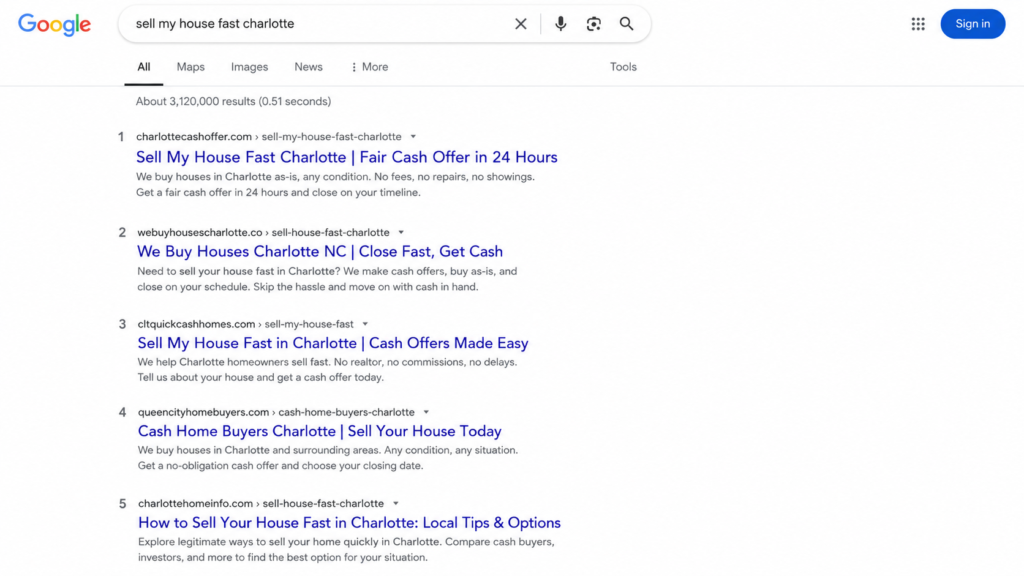
When your own site ranks for “sell my house fast,” inbound seller leads come to you instead of a portal you rent.
Turn Your Lead Flow Into a Predictable Pipeline
The profitable lead is a motivated seller, and the reliable ones come from channels you own. SEO and AI search build compounding inbound over time, while PPC, Local Services Ads, and your Google Business Profile carry the phone early, so you’re not waiting months for the first lead.
That inbound motivated-seller engine is what BASEO builds for cash home buyers: the fast channels working while the organic asset compounds underneath. If you want to see which owned channels would bring motivated sellers to you, that’s what the free audit is for. Written, delivered in about 2 business days, no call required, and yours to keep.
Frequently Asked Questions
Short answers to the questions investors ask most about real estate leads.
What are leads in real estate?
Real estate leads are people who have shown interest in buying, selling, or renting property. For investors, the most valuable leads are motivated sellers, owners with a reason to sell quickly. Leads come from ads, direct mail, referrals, online searches, and public records.
What is a motivated seller lead?
A motivated seller lead is a property owner with an urgent reason to sell: foreclosure, probate, divorce, tax liens, relocation, or a distressed property. These leads accept below-market cash offers and close fast, making them the most profitable lead type for real estate investors.
What are the two main types of real estate leads?
The two main types are buyer leads (people looking to purchase) and seller leads (owners looking to sell). Leads are also grouped as inbound versus outbound, and by temperature: cold, warm, or referral. For investors, seller leads drive most deals.
How much do real estate leads cost?
Lead cost varies by source: shared online leads can run a few dollars each, while exclusive motivated-seller leads or direct-mail campaigns cost more per lead but close at higher rates. Investors should measure cost per closed deal, not cost per lead.
What is a good conversion rate for real estate leads?
Across all sources, agents convert about 2–5% of leads. Online and portal leads convert at just 0.4–1.2%, while referrals convert far higher at 14–20%+. For investors, judge lead quality by cost per deal and speed-to-contact rather than raw conversion percentage.
What’s the difference between a lead and a prospect?
A lead is any contact who has shown initial interest. A prospect is a qualified lead: they have a property, real motivation, and a timeline. Prospects are closer to becoming a deal, so they deserve faster follow-up and higher priority.
Leave a Reply