
The best CRM for investors isn’t a sales CRM with a real estate label slapped on it. You’re buying a machine that moves a skip-traced seller lead through follow-up, into a contract, and out to a cash buyer. This list ranks nine platforms for that exact workflow, not for agents chasing listings or fund managers tracking LPs. For each one you get the pricing, the standout feature, and who it’s actually built for.

An investor CRM lives or dies on one job: turning a raw seller lead into a closed deal.
What Makes a CRM “Best” for Real Estate Investors?
A CRM earns a spot on this list on five things, in this order.
First, investor data tools: skip tracing, list stacking, and driving for dollars built in, not bolted on. Second, multi-channel outreach: SMS, email, ringless voicemail, direct mail, and a dialer under one roof. Third, a deal pipeline plus a buyer or disposition list, so you can track a motivated seller from first call to the closing table and hand the contract to a cash buyer. Fourth, automation and speed-to-lead. Fifth, pricing that matches your team size.
Generic sales CRMs miss the first two entirely. That’s the whole gap. Skip-traced outreach closes 2–5% of the owners you contact, against under 0.5% for cold calling random homeowners (Goliath, 2026). A CRM that can’t skip trace or stack lists is making you do the highest-value work somewhere else, then re-import it. That’s why where your leads come from matters more than the logo on the login screen.
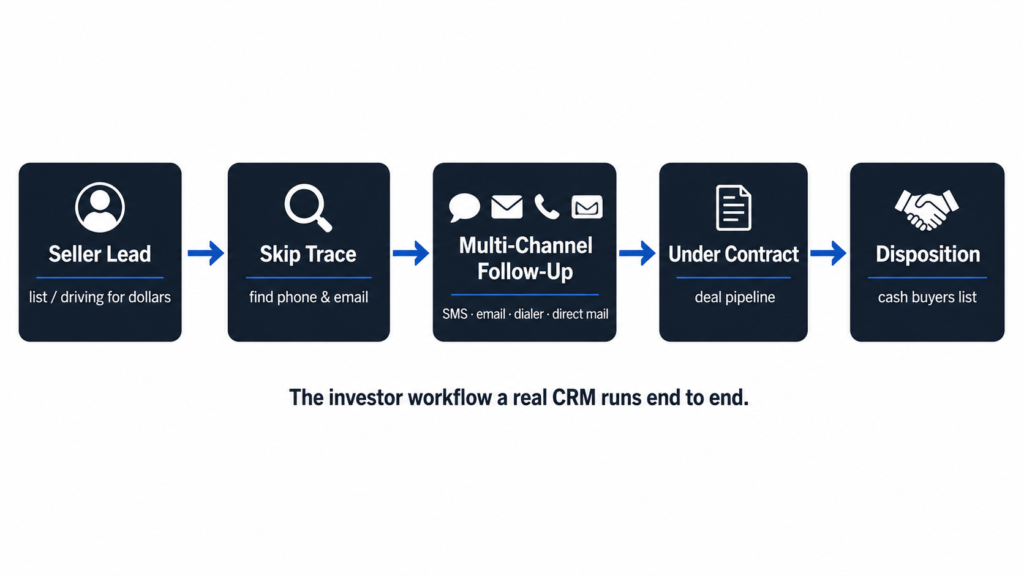
The five stages an investor CRM has to run, in order. Skip most sales CRMs at stage two.
Quick-Comparison Table: The 9 Best Investor CRMs
Here’s the skim view. Full verdicts, pricing, and best-fit users are below. On mobile, scroll the table sideways to see every column.
| CRM | Best For | Skip Tracing Included? | Starting Price/mo | Free Trial/Plan |
|---|---|---|---|---|
| REsimpli | All-in-one for wholesalers & flippers | Yes (10k–50k credits/mo) | From $99 (billed annually; $149 monthly) | 30-day free trial |
| REI BlackBook | Automation & follow-up sequences | Limited | $97 | Free trial |
| FreedomSoft | Pre-built system out of the box | Via data add-on | From ~$147 (billed annually) | Trial / demo |
| PropStream | Property data & list building | Pay-per-use ($0.12/record; free on higher tiers) | $99 ($81 annual) | 7-day free trial |
| Podio (+ add-ons) | Custom-built workflows | No (via add-ons) | Free plan + low-cost paid | Free plan |
| Wise Agent | Budget pick for solo investors | No | $49 ($499/yr) | Free trial |
| Salesforce | Large, custom enterprise teams | No | $25/user (Starter) | Free trial |
| HubSpot CRM | Free starter CRM | No | $0 (free tier) | Free forever plan |
| Zoho CRM | Multi-user teams on a budget | No | $0 up to 3 users; $14/user paid | Free plan |
The 9 Best CRMs for Real Estate Investors
The list runs from the most investor-specialized, all-in-one platforms down to the general-purpose CRMs, so you can stop reading once you hit your profile. For a wider field, see our full breakdown of CRMs for real estate investors.
1. REsimpli: Best All-in-One for Wholesalers & Flippers
REsimpli is the tool most likely to replace four to six other subscriptions. Under one login you get list building, skip tracing, driving for dollars, the CRM itself, drip and SMS, a dialer, e-sign, a website, and even accounting. It was built by an investor for investors, and it shows in the KPIs it tracks.
Pricing starts at $99/month billed annually, or $149 month-to-month, with Pro around $299 and Enterprise around $599 (REsimpli). Skip tracing is bundled: roughly 10,000 credits a month on Basic, 20,000 on Pro, and 50,000 on Enterprise, so the data you’d normally pay per record for is already in the box.
Pros: everything in one place, included skip-trace credits, and reporting built around deals instead of vanity metrics. Cons: it’s more than a solo investor who just needs a Rolodex wants, and there’s a learning curve. Best for wholesalers and flippers doing real volume who want to consolidate their stack.
2. REI BlackBook: Best for Automation & Follow-Up Sequences
REI BlackBook handles lead capture, contact management, and a deal pipeline, with built-in phone and SMS, automated follow-up sequences, and a solid mobile app. Its standout is Profit Dial, a call-tracking phone system that gives each marketing channel its own number so you can see cost per deal by channel instead of guessing.
Pricing runs $97, $197, and $297 per month across its tiers (KDS Development).
Pros: strong automation and a deep marketing and education ecosystem around the product. Cons: data and skip tracing aren’t as deeply bundled as REsimpli, so you’ll likely pair it with a data source. Best for investors who live and die on nurture automation and follow-up.
3. FreedomSoft: Best Pre-Built System Out of the Box
FreedomSoft gives you proven, pre-built wholesaling campaigns and workflows that work on day one. Lead generation, CRM, and comping come as a package, so you’re not staring at a blank canvas wondering how to build a pipeline from scratch.
Pricing starts around $147/month billed annually for up to six users, with a higher tier near $197/month. Confirm the current number on freedomsoft.com before you commit, since tiers shift.
Pros: minimal setup, ideal for someone who wants a system, not a project. Cons: the interface feels dated next to newer tools. Best for wholesalers who want a turnkey playbook and don’t care about a flashy UI.
4. PropStream: Best for Property Data & List Building
PropStream is more data platform than full CRM, but it’s a fixture in the investor stack for a reason. You get nationwide property intelligence, owner contact info, and filters for equity, tax status, and vacancy, plus built-in list building and marketing. It’s how a lot of investors find off-market properties before anyone else does.
Pricing is $99/month for Essentials, dropping to about $81 on an annual plan. Skip tracing runs $0.12 per record and is free on the higher tiers (PropStream).
Pros: best-in-class lists and comps. Cons: it’s light on pipeline and automation, so most people pair it with a true CRM. Best for investors whose bottleneck is finding and pulling targeted lists.
5. Podio (with add-ons): Best for Custom-Built Workflows
Podio isn’t a real estate CRM out of the box. It’s a flexible workspace that a large community of wholesalers has turned into one using add-ons like GlobiFlow for automation and SmrtPhone for the dialer. If you want total control over how your pipeline works, this is the blank slate.
It offers a free plan and low-cost paid tiers, though the add-ons stack costs on top.
Pros: fully customizable, cheap at the base, and backed by a huge library of REI templates. Cons: it’s do-it-yourself, so you build it and you maintain it, and the setup time is real. Best for technical investors or teams who want to engineer their own system.
6. Wise Agent: Best Budget Pick for Solo Investors
Wise Agent is an approachable, low-cost CRM for beginners and solo wholesalers with simple contact and pipeline needs. At $49/month (or $499/year) for up to five users on a shared login, it keeps overhead near zero (Capterra).
Pros: cheap, easy to learn, and known for responsive support. Cons: it’s not investor-specialized, so there’s no skip tracing or list stacking, and it leans toward agents. Best for brand-new investors who want a real CRM without paying for tools they won’t use yet.
7. Salesforce: Best for Large, Custom Enterprise Teams
Here’s the honest take: Salesforce is the most powerful and customizable CRM on this list, and it’s overkill for almost every investor reading this. There’s no native skip tracing, no list stacking, no driving for dollars, and no REI KPIs. You’d build all of that yourself.
Pricing runs $25 to $350-plus per user per month, and a real implementation commonly lands between $10,000 and $150,000-plus once you factor in setup and customization (tech.co; Folio3).
Pros: near-infinite customization that scales to huge organizations. Cons: cost, complexity, and zero out-of-the-box REI tooling. Best for large investment firms and funds with developers on staff. For a solo operator, a specialized tool beats this every time.
8. HubSpot CRM: Best Free Starter CRM
HubSpot’s free tier is the real thing: contact management, email, and a pipeline at no cost, usable as a bare-bones wholesaling CRM to get started. It’s polished, and it scales as you grow.
Pros: genuinely free, clean to use, and easy to upgrade later. Paid plans start around $15 per user per month when you need more. Cons: no REI-specific data tools, and the paid tiers get expensive fast. Best for investors who want to validate a process before paying for specialized software.
9. Zoho CRM: Best for Multi-User Teams on a Budget
Zoho CRM is free for up to three users and cheap beyond that, with solid automation and customization for the price. Paid plans run from $14 per user per month on Standard up to $52 on Ultimate (Costbench).
Pros: low-cost multi-user access and a flexible platform. Cons: it’s generic, so it needs configuration to fit investing, and there’s no native skip tracing. Best for small teams that want several seats without the specialized-software price tag.
Investor CRM vs. Agent CRM: Why the Difference Matters
Most “best CRM” lists blur these together. They shouldn’t, because they solve opposite problems.
An agent CRM is built for the retail side: buyer and seller clients, MLS integration, listing pipelines, showings, and closings. An investor CRM is built for the cold side: generating motivated-seller leads, marketing to distressed owners, skip tracing, list stacking, and dispo to a cash-buyer list.
Run your investing business on an agent CRM (or a generic sales CRM) and you spend your life bolting on tools it was never designed to hold. That’s the real answer to “why not just use Salesforce or HubSpot.” You can, but you’ll rebuild the investor workflow by hand.
| An agent CRM optimizes for | An investor CRM optimizes for |
|---|---|
| Buyer & seller clients, MLS | Cold motivated-seller lead generation |
| Listing & showing pipelines | Skip tracing & list stacking |
| Closings and commissions | Direct mail, cold calling, RVM outreach |
| Client nurture | Dispo to a cash buyers list |
If cold outreach is your engine, you already know the tradeoffs of doing it the hard way. Here’s how to get leads without cold calling if you’re rethinking that channel.
Must-Have Features for a Real Estate Investor CRM
Three features separate a real investor CRM from a contact list with a nice logo. Hold every tool above against this checklist before you pay for anything.
Skip Tracing & List Stacking
Skip tracing is how you find a property owner’s phone number and email from an address. List stacking is how you merge several distress lists (tax delinquent, absentee, high equity, pre-foreclosure) and dedupe them by address, so the owners who show up on multiple lists rise to the top as your highest-motivation leads.
The numbers justify the obsession. Skip-traced outreach closes 2–5% versus under 0.5% for cold calling random owners (Goliath). Stacked leads convert 3–5x better than single-list leads, and combinations like tax-delinquent plus absentee plus high-equity can hit 5–8% (REsimpli). Skip tracing itself runs about $0.12 a record (PropStream). When these live inside the CRM, a traced contact flows straight into a sequence instead of sitting in a spreadsheet waiting for a re-import.
Multi-Channel Follow-Up (SMS, Email, Direct Mail, Dialer)
Deals are won on follow-up, and follow-up is won on speed and persistence. Your CRM should run automated drip across SMS, email, ringless voicemail, and direct mail, with a power dialer built in or integrated. Speed-to-lead decides who gets the deal: leads worked within five minutes are far more likely to qualify, and the first investor to call usually wins the seller. A single tool that sequences all of it is how you convert more of them without dropping a lead through the cracks.
Deal Pipeline & Disposition Tools
A good pipeline shows every deal moving through clear stages: lead, under contract, closed. Just as important is the buyer side, a cash-buyer list you can market a contract to when it’s time to dispo. Add basic accounting and KPI tracking (marketing spend per deal, cost per lead, ROI) and the CRM stops being a contact list and starts being the dashboard for a business. This is the difference between storing leads and running numbers.
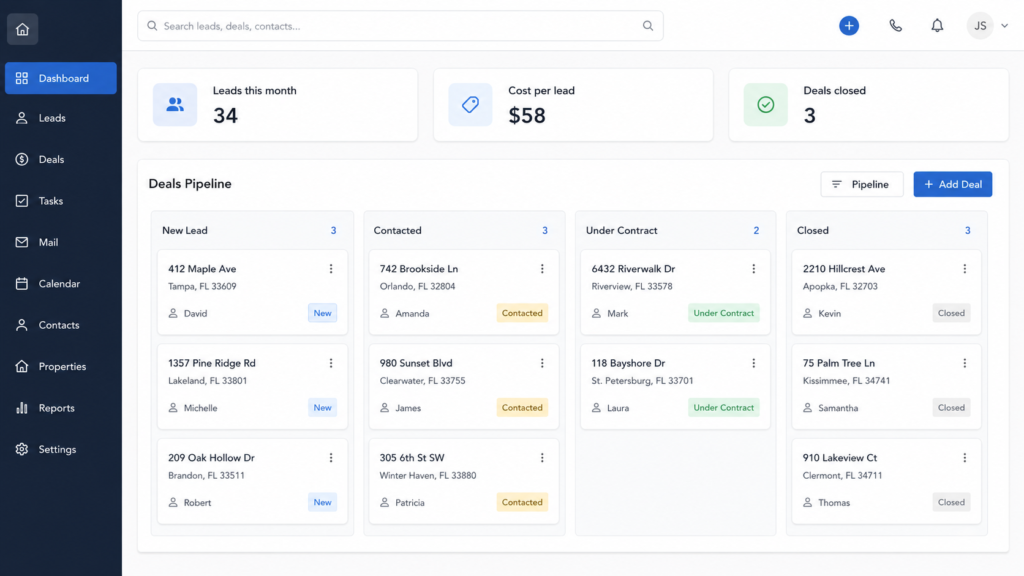
A pipeline plus cost-per-lead tracking is what turns a contact list into a business you can steer.
How to Choose the Right CRM for Your Volume & Budget
Match the tool to your deal volume and your budget, not to whatever a YouTube ad pushed at you. Here’s the short version by profile:
- Brand-new or low budget → start free with HubSpot or Zoho, or spend about $49 on Wise Agent.
- Solo wholesaler or flipper wanting all-in-one → REsimpli.
- Automation-focused → REI BlackBook.
- Data or list bottleneck → PropStream.
- Technical DIY team → Podio.
- Large firm with developers → Salesforce.
The math is simple once you’re doing volume. An all-in-one like REsimpli pays for itself the moment it replaces three or more standalone subscriptions, and the single login saves the hours you’d lose stitching tools together. If you want the setup side, here’s how to actually use a CRM once you’ve picked one.
One thing no comparison table will tell you: the CRM only pays off if leads are actually flowing into it. A perfect pipeline with nothing in the top is an expensive spreadsheet.
Ready to Turn More Leads Into Deals?
The best CRM in the world can’t rank you on Google, and it can’t put a motivated seller in front of you. It organizes and works the leads you already have. Filling the top of the funnel is a different job.
That’s the part BASEO handles. We build the organic and AI-search channel (and run motivated-seller PPC alongside it) that gets cash buyers found when a seller searches “sell my house fast” or asks ChatGPT who buys houses in their city. It’s an organic lead channel you own, feeding the CRM you just picked, so motivated sellers find you instead of your competitor.
If you want to see where your site stands, the audit is free, written, no call required, and yours to keep.
Frequently Asked Questions
What is the best CRM for real estate investors?
REsimpli is widely rated the best all-in-one CRM for real estate investors because it bundles skip tracing, list stacking, a dialer, drip campaigns, and accounting in one platform from around $99/month billed annually. The right choice still depends on your deal volume, team size, and budget.
Do real estate investors need a CRM?
Yes. Any investor working more than a handful of leads needs a CRM. It organizes seller leads, automates follow-up, and tracks deals through your pipeline. Without one, leads fall through the cracks and follow-up, where most deals are actually won, becomes inconsistent and easy to forget.
Is there a free CRM for real estate investors?
Yes. HubSpot CRM offers a genuinely free plan, and Zoho CRM is free for up to three users. Both work as starter CRMs, but neither includes investor-specific tools like skip tracing or list stacking, so most active investors upgrade to specialized software.
How much does a real estate investor CRM cost?
Most investor CRMs run about $49 to $299 per month depending on features and users. Budget tools like Wise Agent start near $49/month, while all-in-one platforms such as REsimpli range from roughly $99 to $599/month. Enterprise Salesforce builds can cost far more once setup is included.
Can I use Salesforce or HubSpot for real estate investing?
You can, but both are general sales CRMs and lack native skip tracing, list stacking, and driving-for-dollars tools investors rely on. They work as a starting point, though most active investors switch to REI-specific software that includes those workflows out of the box.
What’s the difference between a CRM and skip tracing software?
Skip tracing software finds a property owner’s phone number and email; a CRM stores and manages those contacts, automates outreach, and tracks deals through your pipeline. The best investor platforms combine both, so traced numbers become callable leads instantly instead of sitting in a spreadsheet.
Leave a Reply