Learning how to find off-market properties is the difference between fighting 15 offers on the MLS and negotiating one-on-one with a seller nobody else has met. And knowing how to find off-market properties matters more than most investors think: around 1.2 million U.S. homes sold off-market in 2024, according to a BatchService analysis published by ResiClub, and in one small OfferMarket survey of 50 investors, 40% said their last purchase was an off-market deal. Below: 9 methods, with the cost, time, and results to expect from each.

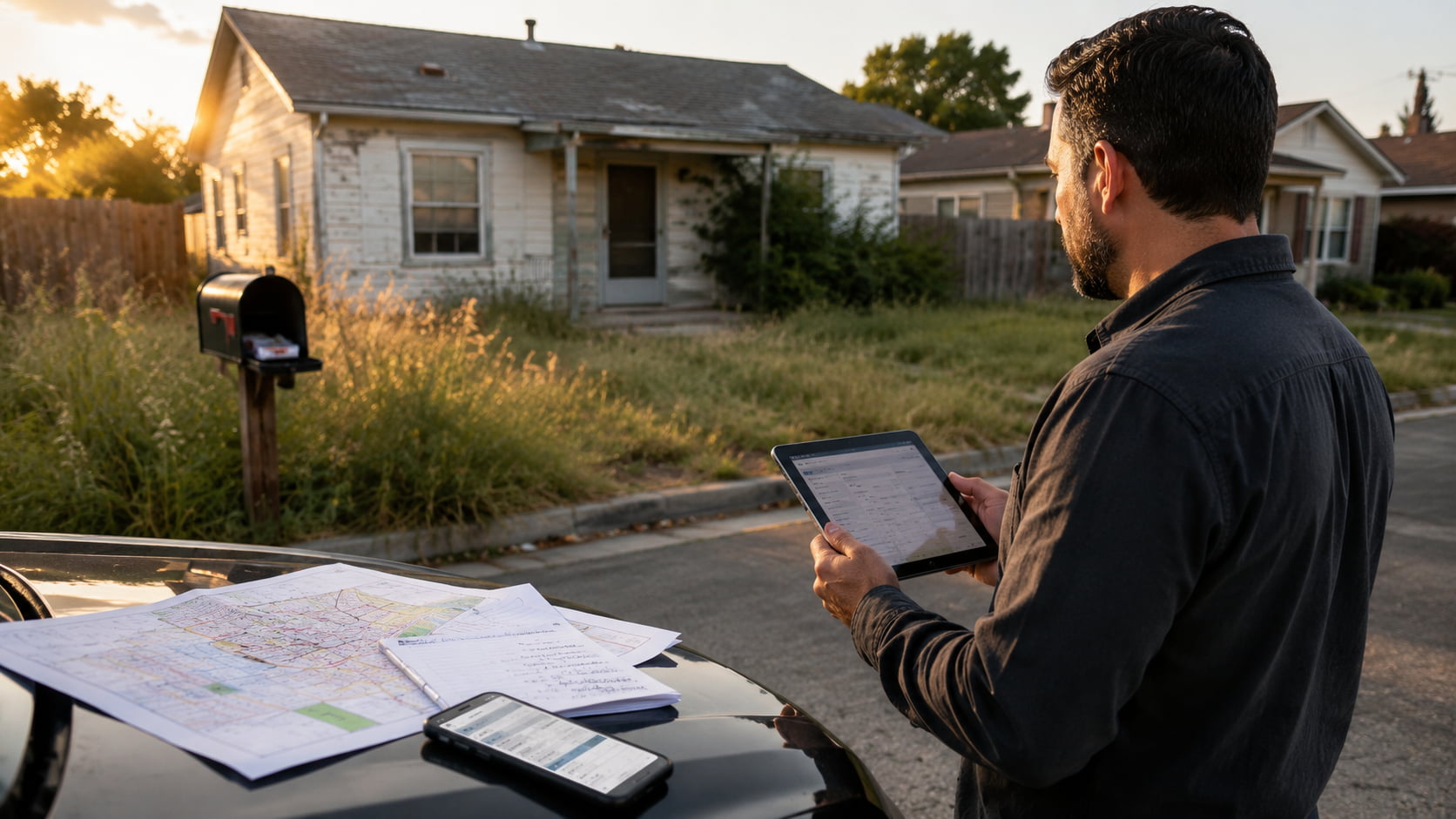
The best deals rarely have a sign in the yard. Most off-market opportunities look exactly like this: a tired house nobody has listed yet.
Table of contents
- What are off-market properties?
- Are off-market deals legal in 2026?
- 9 ways to find off-market properties
- How to evaluate an off-market deal before you make an offer
- Pros and cons of buying off-market properties
- Make off-market sellers come to you
- Frequently asked questions about off-market properties
What are off-market properties?
Off-market properties are homes that sell, or can be sold, without ever being listed on the MLS or public portals like Zillow. Also called pocket listings or private listings, they trade through direct outreach, agent networks, and investor relationships instead of public marketing.
The vocabulary matters when you talk to agents. An office exclusive is filed with the MLS but shared only inside the listing brokerage, an arrangement NAR’s listing policies explicitly allow when the seller wants privacy. A pocket listing is the looser, older term for any listing an agent markets quietly instead of publicly.
Why would a seller skip the open market? Four reasons come up again and again: privacy (common with luxury homes), speed, a distressed property the owner doesn’t want photographed, or a life event like divorce or an estate settlement that needs a quiet, fast sale.
Are off-market deals legal in 2026?
Yes. Buying and selling homes off-market is completely legal in 2026.
The confusion comes from rules that apply to agents, not to you. Under NAR’s Clear Cooperation Policy, a Realtor who publicly markets a listing must put it on the MLS within one business day. Sellers who want privacy can use an office exclusive, and since March 2025 there’s a “delayed marketing” option that holds a listing back from portals for a set period.
The industry is still fighting over this inventory. Compass and Zillow spent months in federal court over private listing networks before Compass dropped its lawsuit in March 2026 once Zillow loosened its listing-access rules. That fight tells you how valuable pre-market inventory has become.
Here’s what matters for you as a buyer: none of those rules bind an investor who contacts an owner directly. Knocking on a door, mailing a letter, or calling an absentee owner is legal everywhere. The only compliance rules you personally need to respect are the calling rules covered in method 7.
9 ways to find off-market properties
The methods below run from lowest to highest effort and investment. Serious investors don’t pick one; an effective off market property search usually combines 2–3 channels running at the same time. How to access off-market properties consistently is a volume game: more conversations with owners, more motivated seller leads, more deals.
1. Work with an investor-friendly real estate agent
Not every agent can help you here. You want one who already works foreclosures, REO, and distressed sales, and who closes with investors regularly. Ask how many investor transactions they did last year; the answer tells you everything.
A connected agent can surface “coming soon” listings, temporarily off-market and withdrawn properties, expired listings, and inventory inside private listing networks like Compass’s. They can also pull foreclosure listings before the auction crowd shows up.
Cost: $0 upfront. The agent earns a commission at closing, which means this channel costs you nothing until a deal actually closes.
2. Network with wholesalers and other investors
A wholesaler puts distressed properties under contract and assigns that contract to a buyer like you. It’s the fastest way to get off-market properties without running any marketing yourself: the wholesaler already spent the money finding the seller.
Getting on buyers lists is simple. Show up at local REIA meetings, join the active investor groups on Facebook and BiggerPockets, and tell every wholesaler you meet exactly what you buy: areas, price range, condition. Understanding how wholesaling works from the inside helps you vet the contracts you’re handed.
The trade-off is the fee. The average wholesale assignment fee runs about $13,000 nationally, with a typical range of $3,000–$25,000 by market (Real Estate Bees). You’re paying for someone else’s marketing. Sometimes that math works; run it per deal.
3. Use off-market property search platforms and data tools
Modern off market property search runs on data platforms. They let you filter every property in a county by the signals that predict a sale: absentee owner, high equity, years of ownership, pre-foreclosure status, tax delinquency. Then they give you the owner’s contact info.
| Tool | Starts at | Built for |
|---|---|---|
| PropStream | ~$99/month | Property data, list building, skip tracing (~$0.10–$0.15 per record) |
| DealMachine | ~$49–$99/month | Driving for dollars app plus automated mail |
| BatchLeads | ~$119/month | List building with skip tracing included |
| Mashvisor | varies by plan | Rental analysis plus an off-market marketplace |
| Redfin “Coming Soon” | free | Pre-MLS listings in markets Redfin covers |
Pricing per the 2026 comparisons at Jamil Academy and NextAutomation; note PropStream acquired BatchLeads in 2025, so expect the lines between them to blur.
One warning: the tool gives you the lead, not the deal. The investors who close from these lists are the ones with a follow-up system, usually an investor CRM, working every contact for months.
4. Drive for dollars
Driving for dollars is the lowest-cost method on this list: gasoline and time. You drive target neighborhoods and write down every property that looks like its owner has stopped caring.
What you’re looking for:
- Overgrown grass and dead landscaping
- Boarded or broken windows
- A stuffed mailbox or piled-up newspapers
- Visible code violation notices
- Blue tarps, sagging gutters, peeling paint
Look up each owner in county records, or use an app like DealMachine that pulls ownership while you’re parked outside. Then start the outreach: get the first letter out within days, and keep touching that owner over the next 2–3 months. One letter almost never does it; a consistent follow-up cadence is what turns a note on a clipboard into a contract.
Consistency beats intensity here. One or two driving sessions a week, every week, builds a proprietary list nobody else has.
5. Run direct mail campaigns
Direct mail still works for finding off-market properties, but only if you go in with real numbers. Postcards cost roughly $0.40–$0.70 per piece printed and mailed (REsimpli), so a 3,000-piece campaign runs about $1,500–$2,000. Response rates on investor campaigns to motivated sellers typically land between 0.5% and 2% (Ballpoint Marketing): call it 5–20 calls per 1,000 pieces.
The list matters more than the letter. The proven targets: absentee owners, high equity combined with 10+ years of ownership, and out-of-state landlords.
On format, yellow letters (handwritten-style, personal) tend to pull more calls but cost more per piece; postcards are cheaper and survive being flipped over. Test both.
The mistake that kills this channel is mailing once. Direct mail is a repetition game: the same list, touched every 4–6 weeks, until the phone rings.
6. Mine public records: probate, pre-foreclosure and tax delinquency
Public records point to motivated sellers before any listing exists. That’s the entire edge: you’re reading the paperwork that precedes a sale.
Four sources are worth checking every month. Probate filings at the county court signal an inherited property the family may not want. Notices of default and lis pendens mark owners entering foreclosure; understanding what pre-foreclosure means for a buyer tells you exactly where in the timeline you’re stepping in, and whether you’ll need to buy the foreclosure with cash. Tax delinquency lists show owners who’ve stopped paying the county. Code violations flag properties the city is already chasing.
You can pull all of it at the county recorder or clerk’s office for free, or pay an aggregator like PropStream or Foreclosure.com to compile it.
One note on probate: lead with empathy, always. You’re writing to a family in grief, not a spreadsheet row. The investors who win probate deals are the ones who don’t act like it’s a transaction on day one.
7. Cold call and skip trace absentee owners
Build the list first: pull absentee owners from a data tool or county records. Then skip trace it, which just means finding the owner’s phone number and email; the big platforms charge roughly $0.10–$0.15 per record.
The call itself is three lines:
- “Hi, am I speaking with the owner of [address]?”
- “Have you thought about selling it?”
- “No problem. Can I leave you my number in case that changes?”
That’s it. You’re not closing on the phone; you’re hunting for the rare owner who says “actually, yes.” If cold calling makes your skin crawl, there are ways to get leads without cold calling, and when an owner does engage, having the right questions to ask motivated sellers ready is what separates a conversation from a contract.
Compliance is not optional: check numbers against the Do Not Call registry and read up on TCPA rules before you dial strangers. The fines are real.
8. Build a referral network: contractors, property managers and attorneys
This is the channel almost nobody works seriously, which is exactly why it produces. The big guides mention it in passing and move on.
Think about who sees distress before it becomes a listing. Contractors walk through houses with abandoned repairs and owners who are done. Property managers know which tired landlord is one bad tenant away from selling the whole portfolio. Probate and divorce attorneys sit across from people who need to sell, on a deadline, with zero interest in showings.
Make the arrangement explicit: a referral fee per closed deal where your state allows it, or reciprocity, meaning you send them work too. The contractor who brings you a deal should be your first call for the rehab. Do that twice and you have a scout network that costs you nothing up front.
9. Target expired, withdrawn and FSBO listings
Expired listings are the only lead type with proven motivation baked in: these sellers already raised their hand, listed publicly, and failed to sell. The motivation didn’t disappear when the listing did.
Get them through an agent with MLS access or the data tools from method 3. The approach is everything, because 40 agents called that seller the week the listing expired. Don’t be number 41 offering to relist. Offer what the agents can’t: a cash offer, as-is, on the seller’s timeline.
For-sale-by-owner (FSBO) sellers are the same conversation from a different door. Find them on Craigslist, Facebook Marketplace, and yard signs in your farm neighborhoods.
How to evaluate an off-market deal before you make an offer
Here’s the part most guides skip: an off-market deal has no listing data, no list price, no disclosure package. There’s no market price attached to it, so you either run your own numbers or you overpay.
Start with the after repair value. Pull sold comps from the last 90 days, same neighborhood, similar size and age, and be brutal about condition adjustments. If ARV math is new to you, the ARV and 70% rule guide walks through the full formula.
Then apply the 70% rule to set your maximum allowable offer:
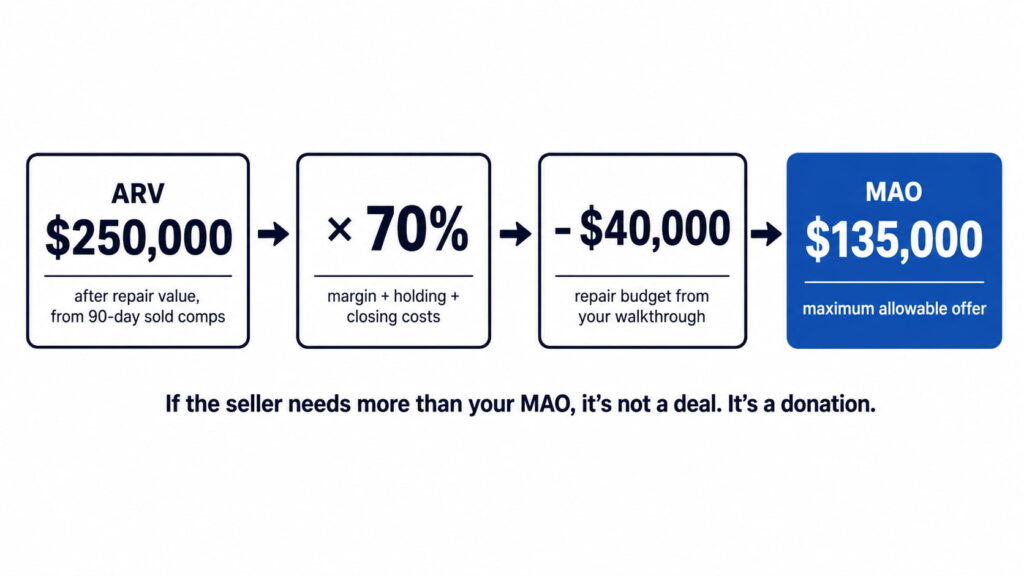
The 70% rule on a $250K ARV house: $250,000 × 0.70 − $40,000 in repairs = a $135,000 maximum offer.
Run the example: a house with a $250,000 ARV and $40,000 in needed repairs gives you $250,000 × 0.70 − $40,000 = $135,000. That’s your ceiling, and the 30% you held back is your margin, holding costs, and closing costs, not extra room to negotiate away.
Budget repairs from an actual walkthrough, not from the seller’s description. And before you sign anything, verify title and liens; off-market is where surprise mortgages, tax liens, and heir disputes like to hide.
The margin you’re protecting is real. Homes sold on the MLS fetched 17.5% more than comparable off-MLS sales from 2019 through early 2023, per a Bright MLS and Drexel University study of over 1 million transactions. That gap is exactly why off-market can leave room for you, and with the median flip returning $60,000 gross at a 23.1% ROI in Q3 2025, the lowest since 2008 (ATTOM), the purchase price is where your profit is made or lost.
Pros and cons of buying off-market properties
The honest trade: off-market buying means paying less and competing less, in exchange for working harder per deal. Zillow’s research found off-market homes sell for about 1.5% less nationally, and the gap widens to 3.7% in states like California and New York (HousingWire).
| Pros | Cons |
|---|---|
| Less competition; often you’re the only offer | More time and effort to find each deal |
| No bidding wars driving the price up | Less data to value the property |
| Negotiable pricing (~1.5% less on average, more in CA/NY) | Easy to overpay without your own comps |
| Flexible closings on the seller’s timeline | Some owners aren’t actually motivated to sell |
If you’re allergic to marketing and follow-up, buy from wholesalers and pay the fee. If you want the full margin, build the channels above and treat the extra work as what you’re paid for.
Make off-market sellers come to you
Every method above is outbound: you chasing the seller, paying in months of letters, calls, and windshield time. There’s a tenth channel that runs in the other direction.
Motivated sellers search. They type “sell my house fast” plus their city into Google, and increasingly they ask ChatGPT who buys houses for cash near them; one Carrot user traced 26 of his 45 weekly leads to ChatGPT. A seller who finds you that way and calls you directly is an off-market deal by definition: no MLS, no agents, no competing offers. That’s the seller leads pipeline that keeps producing while you sleep.
Building it means a real page for every city you buy in, pages for the situations sellers are actually in (probate, foreclosure, divorce, inherited), and content structured so AI engines cite you when a seller asks. That’s the channel BASEO builds, and because BASEO works only with cash home buyers, it already knows your keywords and your seller situations. If you want to know what that channel would look like on your site, the free written audit shows you, no call required.
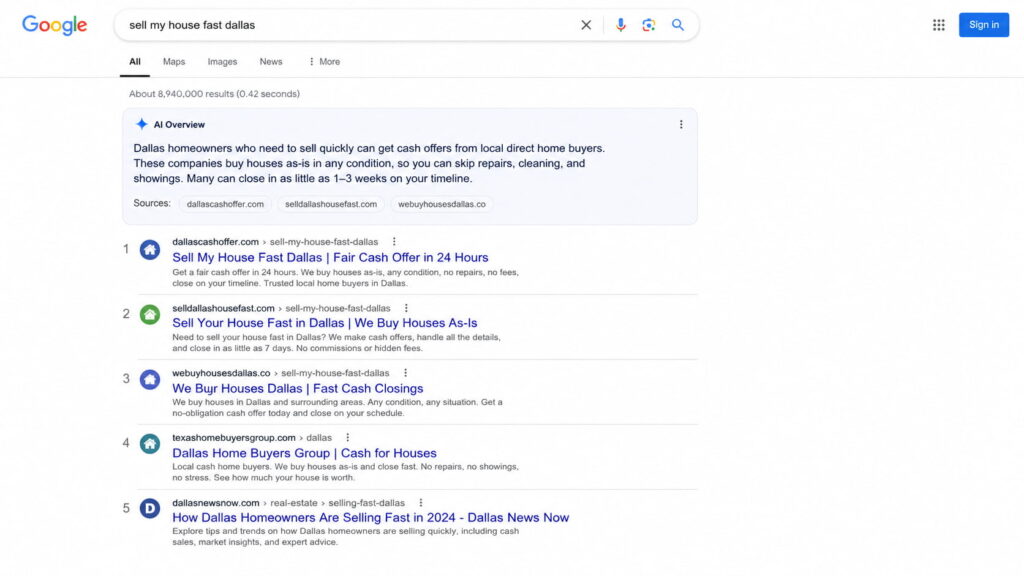
Where sellers actually start: Google and, increasingly, the AI answer above the results. The cash buyers cited there get the call before anyone mails a postcard.
Frequently asked questions about off-market properties
The questions investors ask most about finding and buying off-market homes.
Why do sellers sell off-market?
Sellers go off-market for privacy, speed, or convenience. Common reasons include avoiding showings and staging, keeping the sale price private (common with luxury homes), settling a divorce or estate quickly, or offloading a distressed property without a public price-cut history hurting negotiations.
Do off-market properties sell for less?
Usually, yes. Zillow research found off-market homes sell for about 1.5% less nationally, and a Bright MLS/Drexel University study found on-MLS homes sold for 17.5% more. Less competition means less bidding pressure, which is exactly why investors target off-market deals.
What percentage of homes sell off-market?
Estimates vary by method. NAR data puts homes sold without an MLS listing near 11% in a typical year, while a BatchService analysis counted about 1.2 million off-market sales in 2024, with Texas and Florida leading. Either way, it’s a market too big to ignore.
How do I find the owner of an off-market property?
Look up the address in your county assessor or recorder’s public records; ownership is public information. If the owner’s mailing address differs from the property (an absentee owner), use a skip tracing service to find their phone number or email for direct outreach.
Does “off market” on Zillow mean the home is for sale?
No. On Zillow, “off market” simply means the home isn’t currently listed for sale, not that it’s available through private channels. Some off-market homes can still be bought if you contact the owner directly, but the label itself doesn’t signal intent to sell.
Final thoughts
Off-market deals aren’t found; they’re manufactured. The investors who buy consistently off-market run 2–3 of these channels every week, and they run the ARV and 70% rule math before they fall in love with a price.
Pick two channels this month, work them for 90 days, and track your cost per lead and cost per deal like you track rehab budgets. And while your outbound machine warms up, start building the channel where the seller finds you, because that pipeline compounds while direct mail resets to zero every campaign. If you want to know exactly what your site would need to catch those searches in your market, that’s what the audit is for. Free, in writing, delivered in about 2 business days. No call required, yours to keep either way.
Leave a Reply