An iBuyer (short for “instant buyer”) is a technology company that uses algorithms to make near-instant, all-cash offers on homes and buys them directly from homeowners. The model was built by Opendoor and Offerpad.
A motivated seller in your market typed “sell my house fast” last night and had a cash offer in 24 hours. It came from an algorithm, not from you. That’s what iBuyers do, and this guide breaks down how they price, what they actually pay, what they charge, and the sellers they will never touch.
The house an iBuyer’s algorithm rejects is the one a local buyer builds a deal around.
The i is for instant. An iBuyer is a company that buys houses directly and fast, using its own cash or Wall-Street-backed funds, then resells them (NAR). The whole model is built on speed and volume.
That’s the part worth sitting with. An iBuyer is a public company running a spread-and-volume machine, not a local investor who knows which streets flood and which block is about to turn. It isn’t an agent, and it isn’t a traditional flipper. It’s real estate technology buying at scale, and that scale is exactly why it behaves so differently from you.
How Do iBuyers Work?
The business model is a cousin of your own: buy the house, do light cosmetic work, resell for a spread. The difference is appetite. An iBuyer wants clean houses it can turn quickly, not a rehab. Two pieces make the machine run: the pricing algorithm and the seller-facing process.
The Automated Valuation Model (AVM)
An iBuyer doesn’t send a person to walk the house first. It uses an AVM (software that prices a house from data, not a walk-through), cross-referencing recent comps, market trends, and property records to price the home sight unseen.
That’s why the offer is fast, 24 to 48 hours, and why it’s brittle. An algorithm can’t see the foundation crack, the tenant who won’t leave, or the 1978 kitchen. When Zillow tried to scale this, it shut the whole division down because forecasting home prices proved far less predictable than the model assumed (Stanford GSB).
Those blind spots are your edge. The house the AVM misprices or refuses is the one you buy right, which is the same reason off-market properties stay profitable for operators who actually see them in person.
The Step-by-Step iBuyer Process
Here’s the funnel your competitor is running against you:
Enter the address and home details on the iBuyer’s website.
Receive a preliminary algorithmic cash offer within 24 to 48 hours.
Pass a virtual or quick in-person inspection, which can revise the offer down (the “final offer” haircut sellers complain about).
Sign and pick a closing date, as fast as 7 to 14 days or out to about 90.
Watch the iBuyer resell after light cosmetic work.
Step 3 is the opening. When a seller’s “instant” offer gets cut after the inspection, a firm number from a real person starts looking a lot better.
How Much Do iBuyers Pay for a House?
iBuyers pay roughly 70% to 85% of a home’s fair market value. That’s better than the classic “We Buy Houses” cash offer of 50% to 70%, and well below what a patient retail sale would clear. Speed and certainty cost the seller equity.
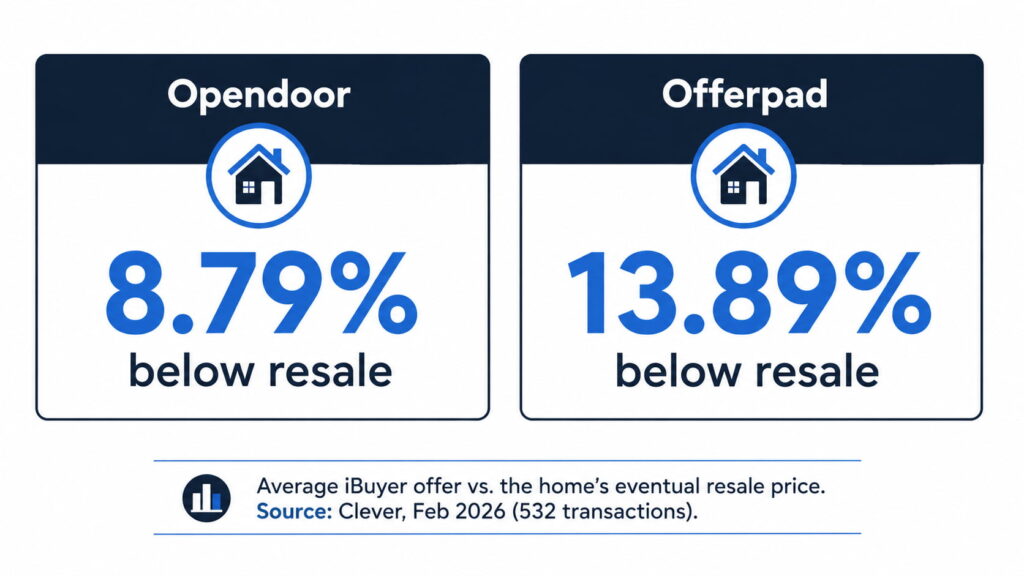
The cleanest recent number: a February 2026 Clever analysis of 409 Opendoor sales and 123 Offerpad sales (May 2023 through June 2025) found Opendoor offers averaged 8.79% below the home’s eventual resale value, and Offerpad averaged 13.89% below (Clever).
Run it on a $350,000 house. At 8.79% under, that’s about $31,000 left on the table before a single fee. The gap between Opendoor and Offerpad alone, on the same house, is roughly $17,000. That spread is the iBuyer’s margin, and it’s the room you have to move faster, negotiate as a human, or take a house the algorithm won’t.
The 8.79% vs. 13.89% gap is why even two national iBuyers aren’t the same offer.
iBuyer Fees Explained
On top of the below-market offer comes the service fee. Opendoor’s runs about 5% of the sale price, plus standard closing costs (Clever). On paper that looks like a traditional agent commission, which usually totals 5% to 6% and is split between the two sides (Opendoor).
Here’s what sellers miss: the fee doesn’t replace the discount. It stacks on top of it. The seller eats the below-market price and the service fee, and once repairs and closing costs are added, the all-in bite can reach low double digits.
What the seller gives up
iBuyer
Traditional sale
Offer vs. market value
70%–85% of value
~100% (market price)
Service fee / commission
~5% + closing costs
~5%–6% commission, split
Repairs deducted
Yes, after inspection
Negotiated case by case
Stacks discount + fee?
Yes, both
No, commission only
The discount is the quiet cost. The fee is the loud one. A seller staring at both is a seller who will listen to a leaner offer from someone local.
Top iBuyer Companies in 2026
Two national players dominate. Opendoor is the largest iBuyer in the US, operating in more than 50 markets. Offerpad is second (HomeLight). Those are the algorithmic buyers most sellers mean when they say “iBuyer.”
A second group gets lumped in but works differently: trade-in and “power buyer” programs like Orchard and Knock help a seller buy their next house before selling the old one. That’s a financing product, not a pure instant-cash flip.
And a third group is the one you actually fight in your market: franchise cash-buyer brands like HomeVestors and the countless “We Buy Houses” operators. People search “iBuyer” and land on these, but they’re a separate category, and it’s your category.
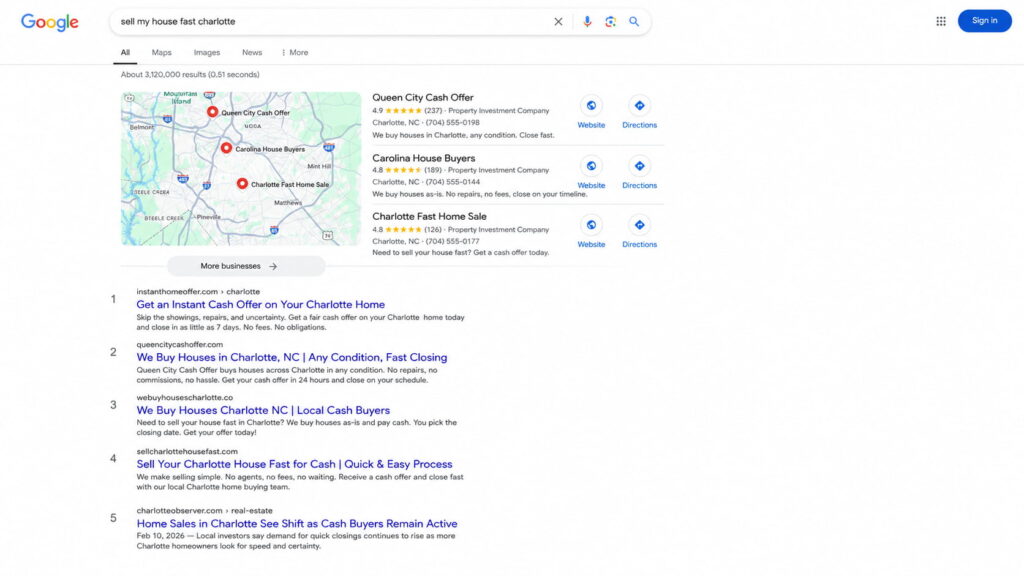
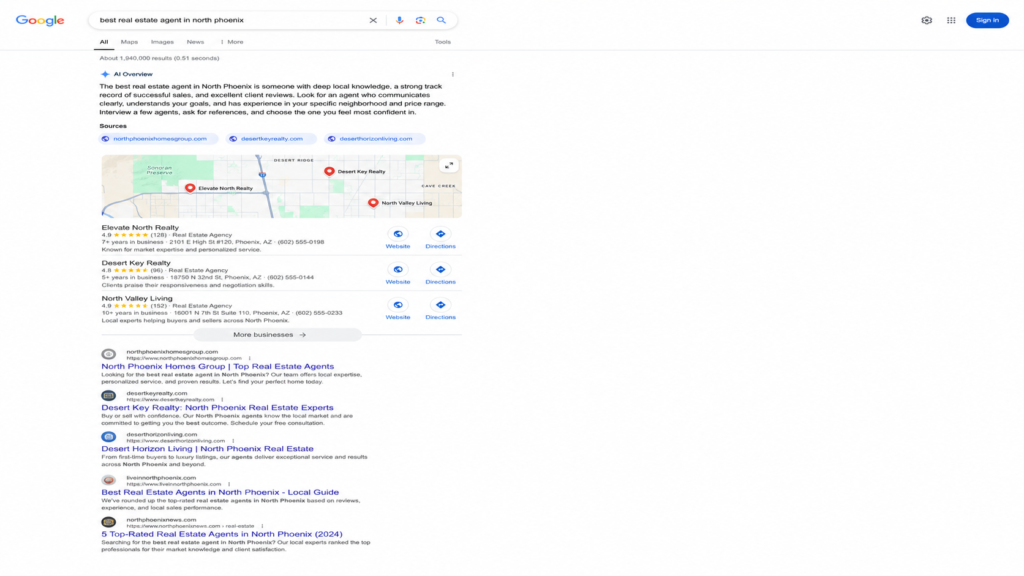
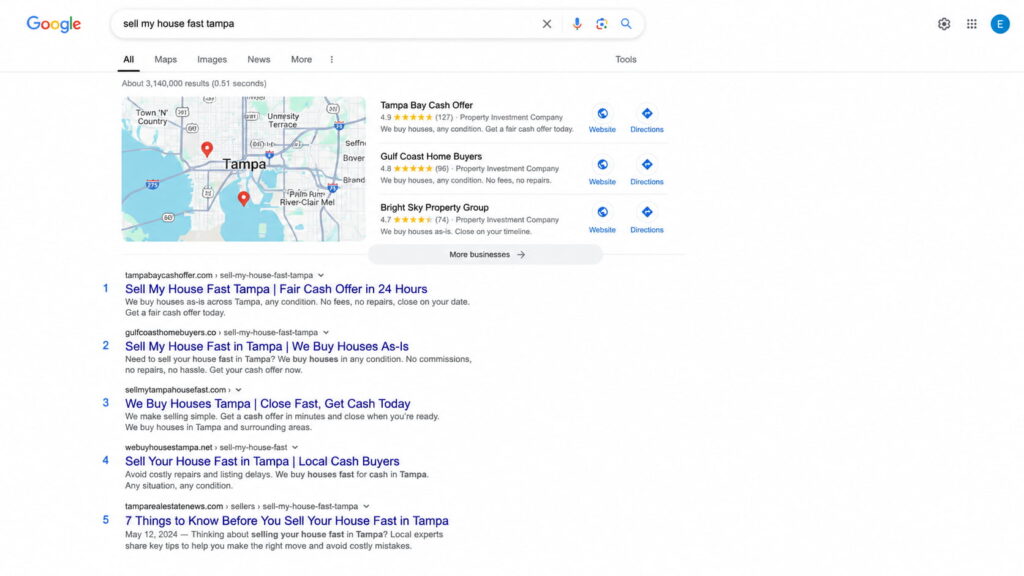
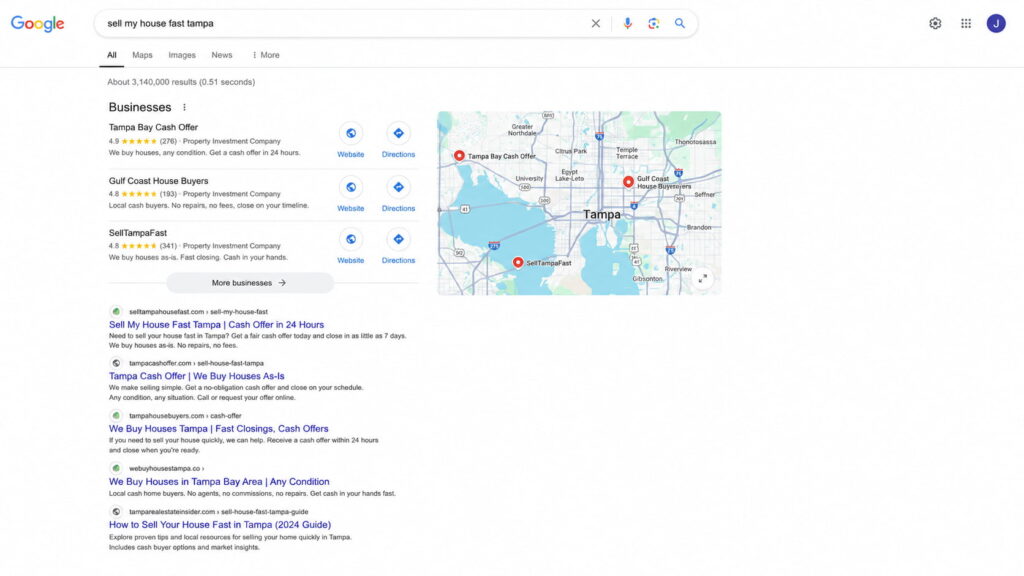
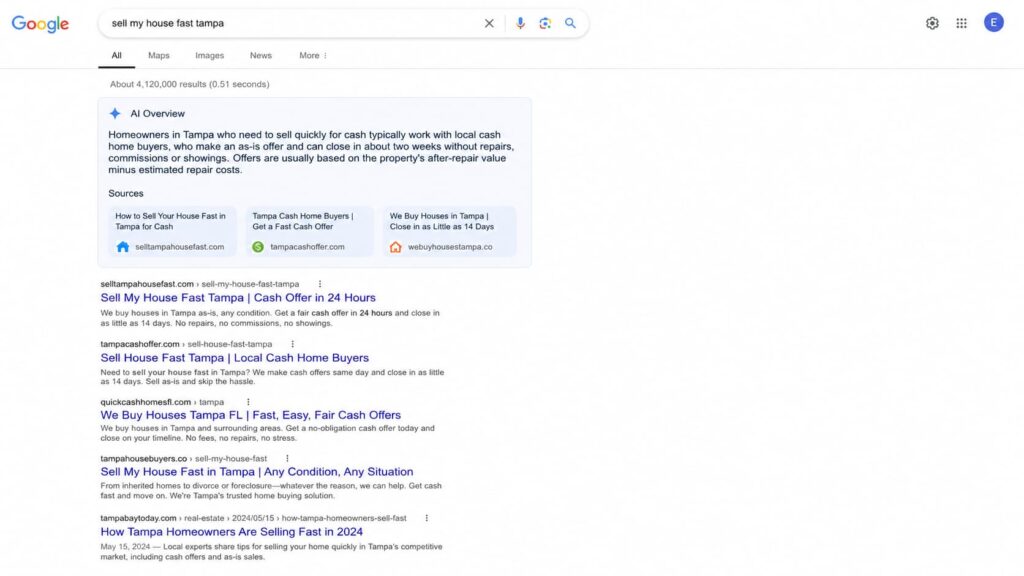
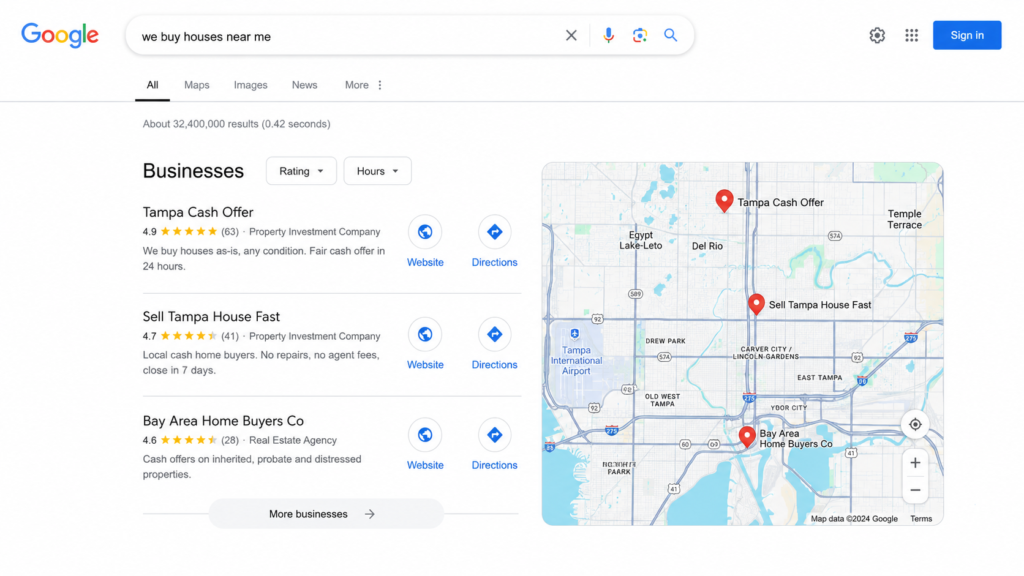
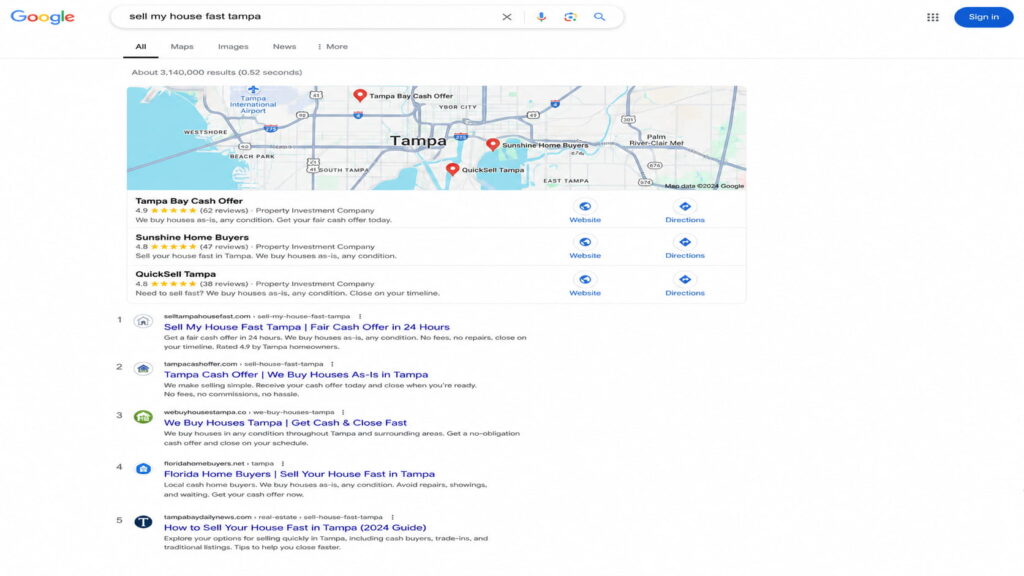
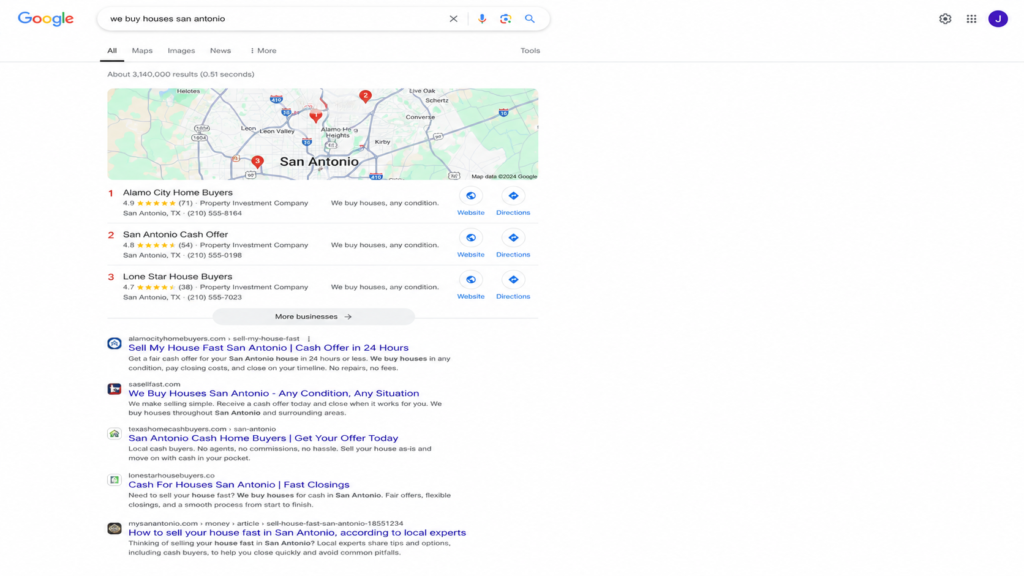
The same search returns a national iBuyer and the local buyers competing for that seller. Whoever ranks gets the call.
One more piece of context: the model is narrower than the headlines suggest. Zillow shut down Zillow Offers in November 2021, and Redfin wound down RedfinNow the next year (Stanford GSB). Two well-funded companies decided the math didn’t work. That fragility is worth remembering when you size up the competition.
Pros and Cons of the iBuyer Model
The model is genuinely good at a few things and genuinely bad at others. Knowing exactly which is how you find your lane.
What the iBuyer model does well:
Closes fast, often in 7 to 14 days.
Delivers a certain, all-cash offer with no financing contingency.
Skips showings, staging, and open houses.
Asks for no repairs before closing.
Lets the seller choose the closing date.
Where the model breaks down:
Pays below market, 70% to 85% of value.
Stacks a ~5% fee on top of that discount.
Feels impersonal, an algorithm and a portal, no negotiation.
Only wants good-condition homes.
Only operates in a handful of live metros.
Read the second list again as a map. Below-market plus a fee means a leaner local offer can still win on net proceeds, the cost-per-deal math that actually decides a channel. Good-condition-only and few-metros means every ugly house and every off-map deal is yours by default.
iBuyers vs. Cash Home Buyers: What’s the Difference?
This is the distinction that matters most to you, because you’re one side of it. An iBuyer is an algorithmic corporation that buys good-condition homes in select metros. A local cash home buyer is a real investor who buys any condition, negotiates as a person, usually closes at least as fast, and charges no service fee.
Factor
iBuyer (Opendoor, Offerpad)
Local cash home buyer
Who makes the offer
An algorithm (AVM), sight unseen
A real investor who sees the house
Condition accepted
Good condition only
Any condition, including distressed
Service fee
~5% + closing costs
Typically none
Negotiation
Take-it-or-revised-offer
Real, human, flexible terms
Market coverage
~50+ metros, limited
Wherever the buyer operates
Speed
7–14 days
Often as fast or faster
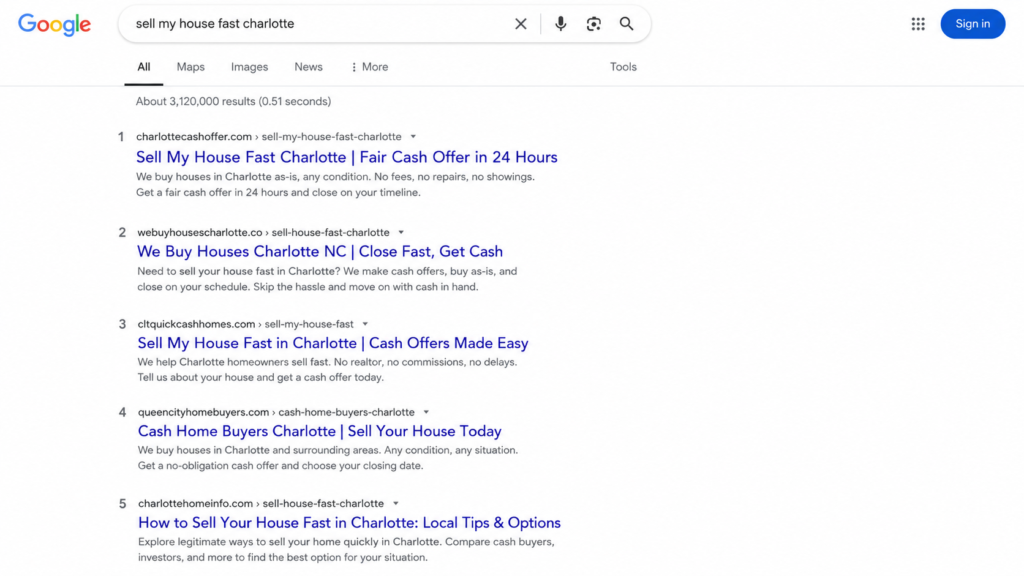
Every row is an advantage the local buyer has. But it only counts if the seller can find you. When a homeowner searches “sell my house fast” or asks ChatGPT who buys houses in their city, the buyer who shows up is the buyer who gets the call. Being that name, in Google’s results and in AI answers, is exactly the visibility BASEO builds for cash buyers. That’s how the any-condition, no-fee, real-human advantage actually reaches the seller, instead of losing them to whoever gets cited in AI answers first.
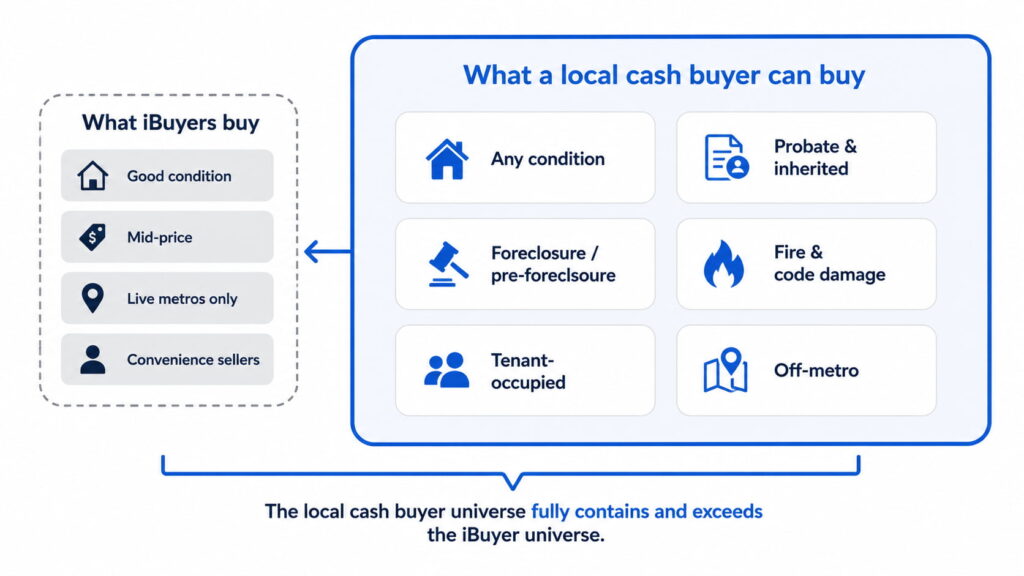
The iBuyer’s box is small on purpose. Everything outside it is the local operator’s territory.
Where iBuyers Compete With You, and Where They Don’t
iBuyers compete hard for one kind of deal: the clean, mid-priced house in a metro they cover, owned by a seller who wants convenience more than top dollar. If that’s the deal, expect an instant offer in the mix.
Everywhere else, they don’t show up. That absence is your acquisition map:
Probate and inherited houses that need clearing out and work.
Tired-landlord rentals with tenants still in them.
Anything outside the iBuyer’s metro list.
Those sellers are searching too, often with more urgency than the convenience seller. They just call whoever they find, which is why building inbound seller leads for exactly these situations matters more than matching an algorithm on price.
How to Win the Sellers iBuyers Can’t
The sellers an iBuyer rejects don’t stop looking. They open Google, they ask ChatGPT who buys houses in their city, and they contact the first credible local buyer they find. The deal goes to whoever is visible.
That visibility is the SEO channel BASEO builds for cash home buyers: original landing pages for every market you actually buy in, and content structured so AI search cites you when a seller asks. The goal is simple, that you’re the local name that shows up for the probate, foreclosure, and as-is searches iBuyers ignore, and that every one of those searches has a path to get motivated seller leads into your pipeline.
Frequently Asked Questions
A few quick answers to the questions operators run into most about iBuyers.
Do iBuyers pay fair market value?
Not usually. iBuyers typically pay 70% to 85% of a home’s fair market value, then charge a service fee of around 5%. A February 2026 Clever analysis found Opendoor offers averaged about 8.79% below the home’s eventual resale value. The seller trades equity for speed and certainty.
Are iBuyers legitimate?
Yes. iBuyers like Opendoor and Offerpad are legitimate, publicly known companies that buy homes directly with cash. But “legitimate” doesn’t mean “best price.” An iBuyer offer should always be compared against a local cash buyer or a traditional sale before anyone signs.
How fast can an iBuyer close?
Fast. Most iBuyers make a cash offer within 24 to 48 hours and can close in as little as 7 to 14 days, though the closing date can often be pushed out to about 90 days for flexibility. A local cash buyer can sometimes close even faster.
What’s the difference between an iBuyer and a real estate agent?
An iBuyer buys a home directly with an algorithm-based cash offer, so there are no showings and no waiting for a buyer. A real estate agent lists the home on the market to find a buyer, which usually gets a higher price but takes longer and involves commissions.
The bottom line
iBuyers are a narrow algorithm. They buy clean, mid-priced houses in a handful of live metros, they pay 70% to 85% of value, and they charge a fee on top of the discount. Those limits aren’t a footnote. They define the territory that belongs to a local buyer: any condition, any situation, anywhere you operate.
The sellers iBuyers won’t touch are searching right now, and the deal goes to whoever they find first. If you want to know which of those sellers are searching in your market, who’s ranking for them today, and where you’re invisible, that’s what the free audit is for. It covers your site, your competitors, and your market, and it uses the same real estate SEO that brings deals, not just traffic. Written, in about 2 business days. No call required. Yours to keep.
A cash buyer reads a fresh motivated-seller lead outside a property he’s evaluating.
Most articles about real estate leads are written for an agent chasing buyers. If you buy houses for cash, the lead that pays your bills looks nothing like that. A real estate lead is anyone who has shown interest in buying, selling, or renting property, and for an investor, the one worth chasing is a seller who could become your next deal. This guide covers what real estate leads actually are, the types worth knowing, where investor leads come from, and, more useful than any of that, which leads actually close.
What Is a Real Estate Lead?
A real estate lead is a person who has shown interest in buying, selling, or renting property. For a real estate investor, the most valuable lead is a motivated seller: an owner with a reason to sell fast, who could become your next deal. That interest is what separates a lead from a name on a list.
“Shown interest” means something concrete. They filled out a form on your site, replied to a piece of direct mail, raised their hand on an ad, or asked you for a cash offer. Each of those is a lead because the person did something.
Here’s where the investor definition splits from the agent definition. An agent prizes buyer leads and listing leads, people ready to shop or sell on the open market. You don’t. For a cash buyer, the seller with a property and a problem is the lead that turns into money. The buyer for that house is easy to find later. So while the word “lead” covers buyers and sellers alike, your pipeline lives or dies on seller leads, and the best of those are real estate investor leads with real motivation behind them.
Leads vs. Prospects vs. Deals: Clearing Up the Confusion
Most lead content uses “lead,” “prospect,” and “deal” like they mean the same thing. They don’t, and knowing the difference tells you where to spend your time.
The progression runs suspect to lead to prospect to deal. A suspect is a property or owner that might fit, before any contact. A lead is initial interest: they responded to you. A prospect is a qualified lead, one with a property, real motivation, and a timeline. A deal is a contract under negotiation.
Walk it through a wholesale example. You mail a probate list, and an heir calls back. That call is a lead. You get her on the phone, and she tells you she’ll sell the inherited house at a discount and wants it done in 30 days. Now she’s a prospect. You sign a purchase agreement and start lining up your end buyer. Now it’s a deal. The right questions to ask motivated sellers are what move a lead to a prospect, and they save you from working contacts that were never going to close.
The Main Types of Real Estate Leads
Real estate leads get sorted three ways: by direction (inbound or outbound), by temperature (cold, warm, or referral), and by role (buyer or seller). Those categories overlap, and any single lead sits in all three at once. For investors, the axis that predicts profit cuts across all of them: seller motivation. The four breakdowns below are the ones worth knowing, and if you want the full map, see our guide to the types of real estate leads.
Buyer Leads vs. Seller Leads
A buyer lead is someone who wants to buy. For an investor, that’s the cash buyers on your disposition list, the end buyers you assign a contract to or sell a flip to. Useful, but rarely the bottleneck.
A seller lead is an owner considering a sale. This is the acquisition side, and it’s where the deal starts. Find a good enough deal and a buyer is never the hard part.
That’s why in investing the seller lead rules. An agent splits attention between buyers and listings; you put the weight on sellers, because the seller leads that matter to investors are the ones that create deals in the first place.
Inbound vs. Outbound Leads
Inbound leads come to you. Someone searches Google, finds your site or your Google Business Profile, and reaches out. These come from SEO, PPC, a Carrot-style site, and referrals. They convert faster because the person raised their hand first.
Outbound leads are the ones you go get. You reach the owner before they’ve thought about you: cold calling, direct mail, SMS, driving for dollars. More work per contact, but you control the volume.
The trade-off is simple. Inbound brings higher intent and lower volume. Outbound brings higher volume and more friction. Neither is “better,” and most operators who want steady deal flow run both, though the leads you can get without cold calling tend to cost less per deal over time.
Cold, Warm, and Referral Leads
Temperature describes how much relationship exists before the first real conversation. A cold lead has no prior relationship with you. A warm lead has had some interaction or at least knows your name. A referral lead was sent to you by someone they trust, and it’s the highest-quality of the three.
The numbers back that up. In the National Association of Realtors’ 2025 data, 43% of buyers found their agent through a referral, and referral leads convert far higher than leads bought from a portal. Trust arrives before the first call, so there’s less convincing to do.
For a cash buyer, referrals come from other wholesalers, agents, attorneys, and your own past closings. A seller you treated fairly two years ago is a referral source. So is the probate attorney who sends you the family that just wants the house gone.
A motivated seller lead is an owner with an urgent reason to sell. Not someone testing the market, someone who needs a specific problem solved on a timeline. These are the leads that make an investing business work.
The common motivation triggers:
Foreclosure or pre-foreclosure
Probate or an inherited property
Divorce
Tax liens or tax delinquency
A vacant or distressed property
A tired landlord with problem tenants
A job relocation on a deadline
Why is this the most profitable lead type? Because a motivated seller trades price for speed and certainty. They’ll take a cash offer below after repair value (ARV) to close fast and skip the listing process, and there’s far less competition than on an MLS listing everyone can see. The deal math is real: home flips in Q3 2025 cleared a median $60,000 gross profit at a 23.1% ROI (ATTOM), and wholesale assignment fees average roughly $13,000 nationally (Real Estate Bees). Neither works without a motivated seller on the other side.
One caution: a property address with a name attached is data, not a lead. What makes it a lead is verified intent, an owner who has confirmed they want to sell (iSpeedToLead). Chasing lists of addresses is how investors burn months. Chasing verified motivation is how they close. If you want the channel-by-channel breakdown, here’s how to get motivated seller leads.
Where Real Estate Investor Leads Come From
Investor lead sources aren’t “run some Facebook ads.” They’re specific, and they split into channels you push out and channels that pull sellers in.
On the outbound and data side:
Direct mail to segmented lists (absentee owners, high-equity, distressed)
Driving for dollars, spotting distressed properties in person
Skip tracing to find the owner’s number, then cold calling or SMS
Data platforms like PropStream, DealMachine, BatchLeads, PropertyRadar, and REsimpli exist to pull and stack these lists, and the county records behind them are the raw material (PropStream, Probate Mastery).
On the inbound and owned side:
PPC and Google Local Services Ads (LSA) for sellers searching right now
SEO plus a Carrot-style site so you rank when a seller types “sell my house fast”
Google Business Profile for the local map results
Referrals from agents, attorneys, and past sellers
Auctions and foreclosure sales
Outbound fills the top of the funnel fast. Inbound compounds and tends to bring higher-intent sellers, since they came looking for you. Most serious operations run both, and pull from more off-market sources as they scale. If you’re weighing the paid side, our breakdown of Google Ads for real estate has the real cost-per-lead numbers.
What Makes a Lead “Good”? Quality Signals That Predict a Close
Not every lead deserves the same effort. A “good” lead is one that shows the signals that predict a close, and they stack in this order:
Verified motivation: a real, stated reason to sell
Timeline: are they trying to sell in about 30 days, or “someday”?
Equity and financial situation: is there room for a discount that works for both of you?
Property condition: distressed and as-is favors a cash buyer
Speed-to-contact: how fast you actually reach them after they raise their hand
The message underneath all five: quality beats volume. The difference between investors closing consistently and those grinding comes down to lead quality, not lead count.
Run it through your own math. It takes roughly 15 to 30 quality leads to close a single deal (iSpeedToLead), so a smaller pile of verified-intent sellers will out-close a giant list of cold addresses every time. Chase the signals, not the row count.
How Real Estate Leads Convert (Benchmark Numbers)
Conversion rates vary wildly by source, and knowing the spread keeps you from overpaying for the wrong leads.
Lead source
Typical conversion
What it means
Referral / sphere
14–20%+
Trust arrives before the first call
Organic search
~3.2%
Intent-rich, they came looking
Paid search (PPC)
~1.5%
Broader traffic, needs tighter follow-up
Online / portal leads
0.4–1.2%
Low intent, often shared with others
Blended lead-to-close
2–5%
Segment by source before you judge it
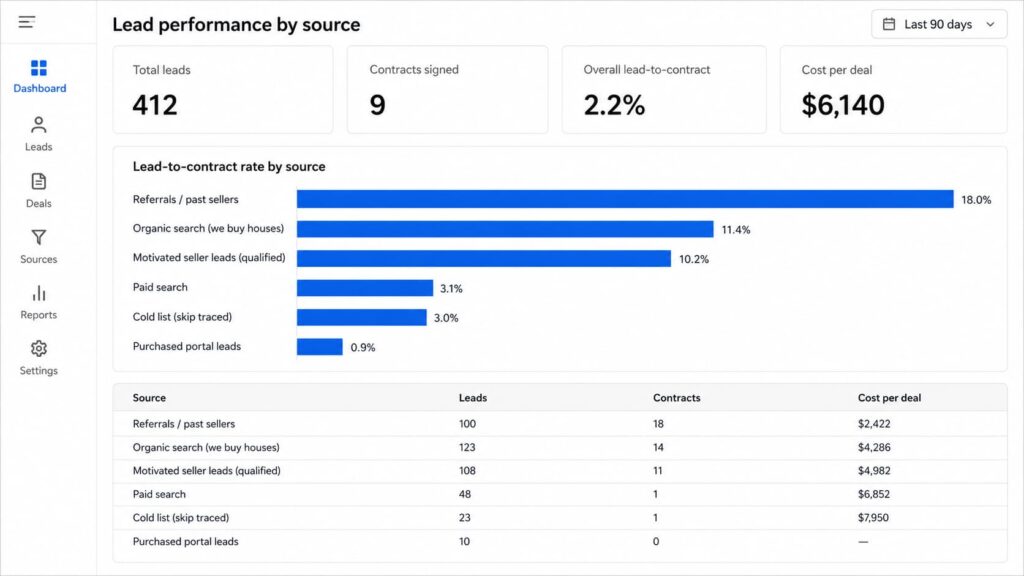
Across all blended sources, real estate leads close at roughly 2–5% (Conversion Realtor), and the overall marketing conversion rate sits near 4.7%, with organic search at 3.2% and paid search at 1.5% (Promodo). The gap that matters is at the edges: portal leads convert at 0.4–1.2%, while referrals land at 14–20% or more. Same hour of your time, ten to twenty times the odds.
For investors, there’s a translation step. Motivated-seller channels like direct mail and PPC get measured on cost per deal, not cost per lead. Investor PPC campaigns run a cost per lead of about $28 to $65 (Promodo), but the number that decides whether a channel is working is what a closed deal costs you, not what a lead costs. A pile of cheap leads that never close is more expensive than a few pricey ones that do. When you’re ready to work the ones you have, here’s how to convert leads in real estate.
How to Prioritize and Follow Up With Leads
A good lead poorly worked is a lost deal. Four habits separate operators who close from operators who leak leads.
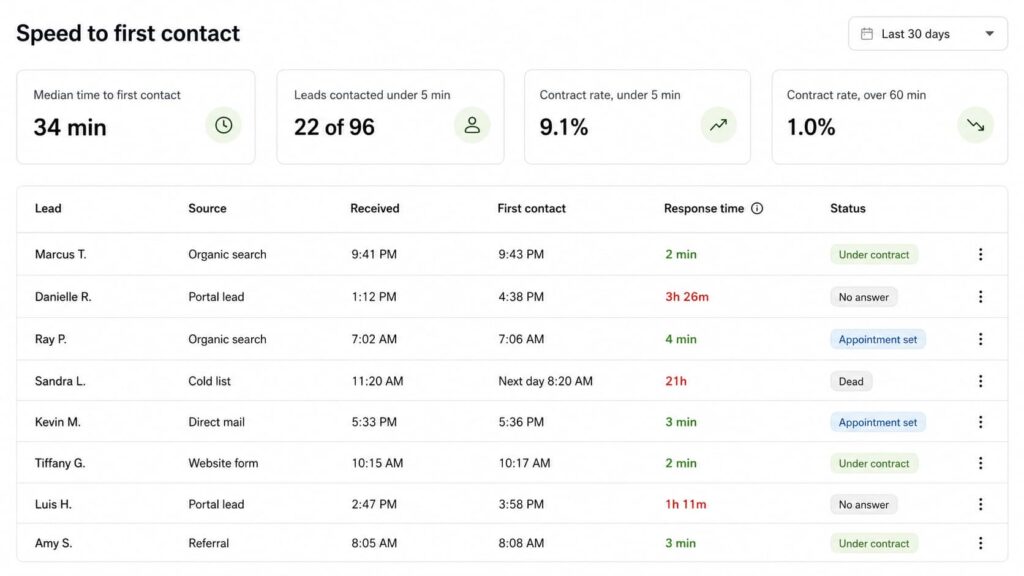
Move fast. Intent decays quickly, and the first person to call a fresh lead usually wins it. Many operators aim to respond in under five minutes during working hours (Roof AI), because a seller who filled out three forms is talking to whoever answers first.
Score by motivation and timeline. Your first dial each morning should go to the highest-motivation, shortest-timeline lead, not the one that came in most recently.
Run a multi-touch cadence. Call, then SMS, then email, spread across several days. One attempt and out is how most leads die.
Don’t kill a “no” too early. Circumstances change, and a meaningful share of deals close on later follow-ups, so a soft “no” belongs in a nurture sequence, not the trash. A simple CRM for real estate investors keeps those follow-ups from slipping.
Should You Generate or Buy Your Leads?
Every investor hits this fork: pay for leads someone else generated, or build a channel that generates your own.
Buying leads is fast. You turn on the spend and leads show up. The catch is that most bought leads are shared with other investors and priced per lead, so you’re renting access and competing on who calls first.
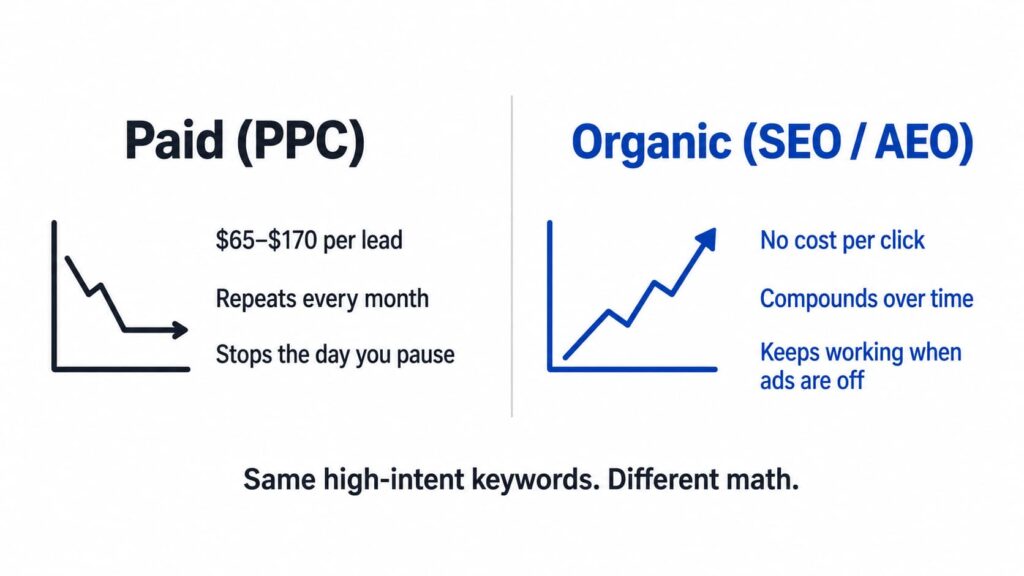
Generating your own leads through channels you own (SEO and AI search, PPC and Local Services Ads, Google Business Profile) is slower to build but compounds. Organic leads cost 83% less than PPC leads and close about twice as profitably, and mature content brings cost per lead down to $7–$30 (Visionary Marketing). The asset keeps producing after you stop paying for each click.
The decision usually comes down to stage. Brand-new and you need a deal this month? Buy leads and run outbound to prime the pump. Established and tired of renting your deal flow? Build the owned channel so the phone rings without a permanent ad bill. Those owned inbound channels, the ones that keep getting cited in AI Overviews and ranking for seller searches, are exactly what BASEO builds for cash buyers.
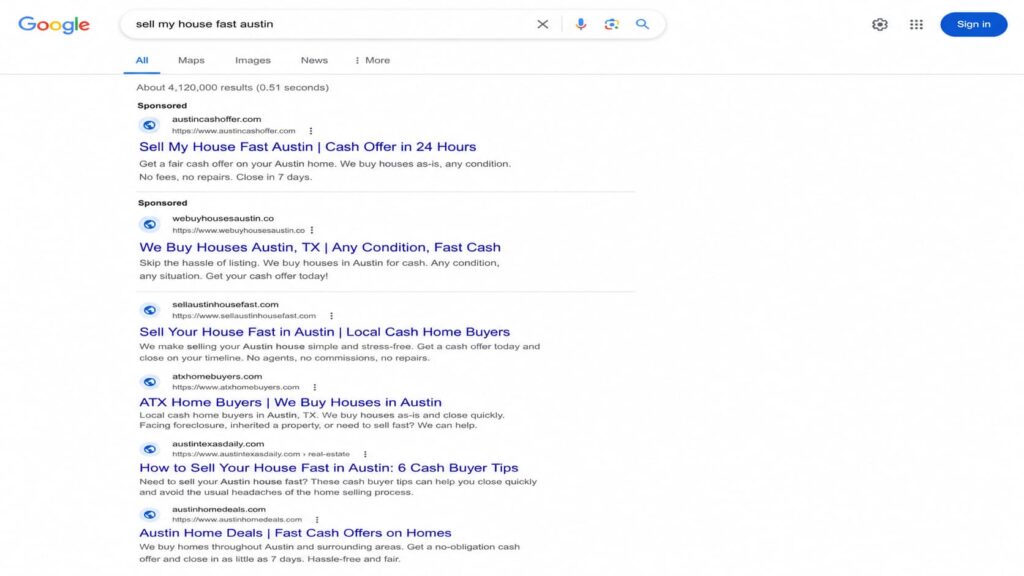
When your own site ranks for “sell my house fast,” inbound seller leads come to you instead of a portal you rent.
Turn Your Lead Flow Into a Predictable Pipeline
The profitable lead is a motivated seller, and the reliable ones come from channels you own. SEO and AI search build compounding inbound over time, while PPC, Local Services Ads, and your Google Business Profile carry the phone early, so you’re not waiting months for the first lead.
That inbound motivated-seller engine is what BASEO builds for cash home buyers: the fast channels working while the organic asset compounds underneath. If you want to see which owned channels would bring motivated sellers to you, that’s what the free audit is for. Written, delivered in about 2 business days, no call required, and yours to keep.
Short answers to the questions investors ask most about real estate leads.
What are leads in real estate?
Real estate leads are people who have shown interest in buying, selling, or renting property. For investors, the most valuable leads are motivated sellers, owners with a reason to sell quickly. Leads come from ads, direct mail, referrals, online searches, and public records.
What is a motivated seller lead?
A motivated seller lead is a property owner with an urgent reason to sell: foreclosure, probate, divorce, tax liens, relocation, or a distressed property. These leads accept below-market cash offers and close fast, making them the most profitable lead type for real estate investors.
What are the two main types of real estate leads?
The two main types are buyer leads (people looking to purchase) and seller leads (owners looking to sell). Leads are also grouped as inbound versus outbound, and by temperature: cold, warm, or referral. For investors, seller leads drive most deals.
How much do real estate leads cost?
Lead cost varies by source: shared online leads can run a few dollars each, while exclusive motivated-seller leads or direct-mail campaigns cost more per lead but close at higher rates. Investors should measure cost per closed deal, not cost per lead.
What is a good conversion rate for real estate leads?
Across all sources, agents convert about 2–5% of leads. Online and portal leads convert at just 0.4–1.2%, while referrals convert far higher at 14–20%+. For investors, judge lead quality by cost per deal and speed-to-contact rather than raw conversion percentage.
What’s the difference between a lead and a prospect?
A lead is any contact who has shown initial interest. A prospect is a qualified lead: they have a property, real motivation, and a timeline. Prospects are closer to becoming a deal, so they deserve faster follow-up and higher priority.
Your leads spike after a good month, then go quiet. You post a listing, hope it sells, and repeat. That is not a plan. It is guessing.
A real estate marketing plan fixes that: a repeatable system for winning listings and buyers instead of posting and praying. This guide covers both plans you actually need, the yearly business plan that grows your brand and the listing plan you present to sellers. Let’s build it.
What Is a Real Estate Marketing Plan? (And Why Every Agent Needs One)
A real estate marketing plan is a documented strategy that lays out your goals, budget, target audience, and the channels you will use to attract buyers and sellers and win listings. It turns scattered activity into a system you can measure and repeat.
Why it matters: without one, you market when you have time and go quiet when you get busy. A written plan keeps you visible and focused on the numbers that feed your gross commission income (GCI): your brand, your target market, and steady lead generation.
The stakes are simple. Per the National Association of REALTORS’ 2025 Profile of Home Buyers and Sellers, 88% of buyers still purchase through an agent and 52% found the home they bought online. The search almost always starts online, but the deal still closes through an agent. Your plan has to win in both places. For the channel-by-channel version, our marketing for real estate agents playbook ranks them by what makes the phone ring.
Business Marketing Plan vs. Listing Marketing Plan for Sellers
Here is the confusion behind “real estate marketing plan for sellers.” There are two different documents, and you need both.
The first is your annual business marketing plan. It grows your brand and your pipeline across the whole year. The second is your listing marketing plan for sellers, a per-property plan you present in the listing appointment to show a seller exactly how you will market their home.
Attribute
Business marketing plan
Listing marketing plan (for sellers)
Purpose
Grow your brand and pipeline
Market one property and win the listing
Audience
All future buyers and sellers in your market
One seller, in the listing appointment
Timeframe
The full year
The life of that listing, usually weeks
What’s inside
Goals, budget, channels, content calendar, KPIs
CMA and pricing, prep, photography, MLS, syndication, open houses, weekly reporting
Both are covered below. Build the business plan first, then use the steps to shape a repeatable listing plan.
How to Build a Real Estate Marketing Plan in 9 Steps
Think of these nine steps as a sequence, not a menu. Each one feeds the next, so work through them in order.
Set SMART goals and choose your niche
Research your market and competitors
Define your ideal client and personas
Craft your unique value proposition and brand
Choose your marketing channels
Set your marketing budget
Build a 12-month content calendar
Define KPIs and a tracking system
Review, measure, and adjust
1. Set SMART Goals and Choose Your Niche
“Get more clients” is not a goal. It is a wish. SMART goals are specific, measurable, achievable, relevant, and time-bound.
Turn the wish into targets you can track:
Close 5 new listings in Q1.
Add 300 emails to my database by June.
Host 2 open houses a month and collect 10 buyer leads at each.
Then pick a niche or farm area: geographic (three ZIP codes you know cold), a price point, or a buyer type. Focus beats being a generalist: a tight niche makes your marketing cheaper and your reputation easier to build.
2. Research Your Market and Competitors
You cannot market a market you do not understand. Pull the local numbers first: days on market, absorption rate, median price, and who is actually buying in your farm area. Most of this lives in your MLS, and public records fill the gaps.
Then run a competitive audit. Which agents dominate the yard signs? Who shows up first on Google and in the map pack? Who runs social and direct mail, and who does not? A comparative market analysis (CMA) tells you how to price. A competitive analysis tells you where the open lane is.
Look for the gap. If three agents own social but nobody ranks for “[your town] homes for sale,” that search traffic is sitting there unclaimed. Knowing which real estate keywords buyers and sellers actually type is how you find those lanes first.
3. Define Your Ideal Client and Buyer/Seller Personas
A persona is a one-page sketch of the client you want more of. Build one to three, no more, or your message gets muddy. For each, write down demographics, their pains, fears, dreams, and where they spend time online.
A filled-in example:
First-time buyer, “Renting Rachel,” 29. Renting and tired of it. Fears overpaying and getting outbid. Dreams of a yard and a fixed monthly payment. Lives on Instagram and TikTok, reads Zillow at night, trusts short videos over brochures.
That single sketch decides your channels and message. Rachel needs first-time-buyer Reels and a patient email series, not a glossy luxury postcard.
4. Craft Your Unique Value Proposition and Brand
Your unique value proposition (UVP) is one sentence: who you serve and why you are the better choice. If a seller cannot tell you apart from the other three agents they interviewed, price becomes the only lever, and you lose.
Use this fill-in-the-blank formula:
I help [who] [get what outcome] without [the pain they fear].
Two examples:
“I help first-time buyers in North Phoenix win homes without overpaying.”
“I help downsizing families sell for top dollar without the stress of prepping the house themselves.”
Then make the brand consistent: same name, colors, headshot, and tagline across your site, social, signs, and email. Consistency is what makes people remember you after the third touch instead of the thirtieth.
5. Choose Your Marketing Channels
You do not need every channel. You need three or four you can run consistently, matched to the personas from Step 3.
Pick where your ideal clients already are: first-time buyers reward short-form video and a strong Google presence, downsizers may respond to direct mail and referral events. The full breakdown is in the next section. For now, do a few channels well instead of all of them badly.
6. Set Your Marketing Budget (How Much Should You Spend?)
Most agents spend 5% to 10% of their gross commission income (GCI) on marketing. New agents, agents in growth mode, and anyone in a competitive market often push to 10% to 15%, and some go as high as 20% to build market share, according to Tom Ferry.
Run the math on your own number. If you expect $300,000 in GCI, 10% is a $30,000 annual budget, or $2,500 a month. That is what you have to split across your three or four channels.
If you are new with no budget to speak of, do not force paid spend. Lean on time-based tactics first: work your sphere of influence, host open houses, and post consistent local content on organic social. Those cost hours, not dollars, and they build the database everything else compounds on. Reinvest your first commissions into the channels already bringing you leads, then scale the budget as the GCI grows.
7. Build a 12-Month Content Calendar
A calendar is how you stop scrambling. Map your content to the seasons and the listing cycle. Spring is buyer season, fall is a listing push, January is planning and market-update content.
A sample month:
Week
Topic
Channel
1
Local market update: prices and days on market
Blog + email + Reel
2
New “just listed” property
MLS, social, postcards
3
Neighborhood spotlight or walking tour
YouTube Short + blog
4
Client win or testimonial + open house recap
Social + email
The trick that saves your week: repurpose one listing into everything. One shoot becomes MLS photos, a walkthrough video, a Reel, an email, and a blog post. One asset, five channels.
8. Define KPIs and a Tracking System
If you do not track it, you are guessing. Pick the key performance indicators (KPIs) that matter per channel: website traffic and rankings, leads generated, cost per lead, appointments booked, closings, and return on investment.
You do not need fancy software to start. A real estate CRM plus a simple spreadsheet is enough. The one rule you cannot skip: attribute every lead to its source. When you know a $40 postcard set produced a listing and $500 of boosted posts produced nothing, next quarter’s budget writes itself. Tracking also shows you where leads leak, which is where a system to convert your leads earns its keep.
9. Review, Measure, and Adjust
Your plan is a living document, not a poster you write once and forget. Review it monthly and do a deeper pass each quarter. Double down on what converts, and cut what does not.
A simple quarterly review checklist:
Which channel produced the most leads and closings?
What was my cost per lead by channel?
Which goals did I hit, and which slipped?
What am I cutting, keeping, or testing next quarter?
Four questions, once a quarter. That is the difference between a plan that grows and a plan that gathers dust.
High-ROI Real Estate Marketing Channels for 2026
These are the channels producing the best return for agents right now, ranked by payoff.
SEO & AEO: Getting Found on Google and AI Search
This is the channel most agents underbuild, and the one that compounds. An IDX-enabled, mobile-first website plus an SEO-driven blog and location pages builds traffic you own, not traffic you rent. Paid ads stop the day you stop paying. A page that ranks keeps working for years.
There is a new layer to it now. Buyers ask ChatGPT and read Google AI Overviews for agent recommendations and neighborhood questions before they ever fill out a form. Answer Engine Optimization (AEO) means structuring your content and your Google Business Profile so those AI answers cite you instead of a competitor. Clear questions, clear answers, and a complete, active profile are what make a page quotable.
This owned channel, ranking on Google and getting cited by AI search, is the one BASEO focuses on for real estate. The starting points are the same whether you do it yourself or hire it out: fix the SEO on your real estate website, publish local pages worth ranking, and set your profile up to rank in AI Overviews. For the agent-specific walkthrough, see our guide to SEO for realtors, and if you are still choosing a platform, start with an IDX-ready website builder.
Short-Form Video and Social Media
Short-form video is the highest-payoff social play for agents: Reels, TikTok, and YouTube Shorts. The agents winning here are not the most polished, they are the most consistent.
Three content ideas you can shoot this week:
A 45-second listing walkthrough that opens with the best feature.
A neighborhood tour: the coffee shop, the park, the school, the commute.
A “3 things first-time buyers get wrong” education clip.
Match the platform to the persona. First-time buyers live on TikTok and Instagram, while move-up and downsizing sellers skew toward Facebook and YouTube. Shoot once, cut for each platform.
Email Marketing and Database Nurture
Your database is the highest-ROI asset you own, and email is how you keep it warm. Email returns roughly $36 for every $1 spent, per Litmus, because you are talking to people who already know you.
Segment the list so the message fits: past clients get referral and home-value touches, active buyers get new listings and market shifts, and your broader sphere gets a monthly newsletter. Keep the cadence simple: a monthly newsletter plus market updates when something in your area actually changes. The goal is to be the agent they think of first, not the one who only calls when they need a referral.
Paid Ads: Google, Meta, and Local Services Ads
Paid ads make sense when you have a specific job for them: promoting a new listing, generating buyer or seller leads on demand, or retargeting people who already visited your site. Google Ads for real estate and real estate Facebook ads each have their place, and Local Services Ads put you at the top of Google with a “Google Screened” badge.
Two rules keep paid from becoming a money pit. First, track cost per lead religiously, because a channel you cannot measure is a channel you cannot manage. Second, do not lean on paid before your organic foundations exist, or the ads just pay to expose a weak site and an empty Google Business Profile.
Traditional Marketing That Still Works
Digital does not replace local trust, it stacks on top of it. Yard signs, just-listed and just-sold postcards, door hangers, open houses, and sphere events still work because real estate is local and face-to-face.
Treat traditional as the complement, not the whole plan. A just-sold postcard hits harder when the neighbor has already seen your Reels and your name in the map pack.
How to Build a Listing Marketing Plan for Sellers
This is the plan you present to a seller to win the listing and then market the home. It is your single best differentiator in a listing appointment, because 91% of sellers hire an agent and marketing the home is one of their top reasons for choosing one.
Pre-Listing: CMA, Pricing, and Home Prep
Everything starts with the comparative market analysis (CMA). It is the pricing backbone, the data that tells the seller what the home is really worth and protects you both from an overpriced listing that sits.
Then find the story. Interview the seller about the home’s unique selling features: the renovated kitchen, the corner lot, the school district. They know things the MLS sheet never will. Finish with honest prep recommendations: the repairs, decluttering, and staging that move the needle, prioritized by return.
Listing Launch: Photography, Staging, and the MLS
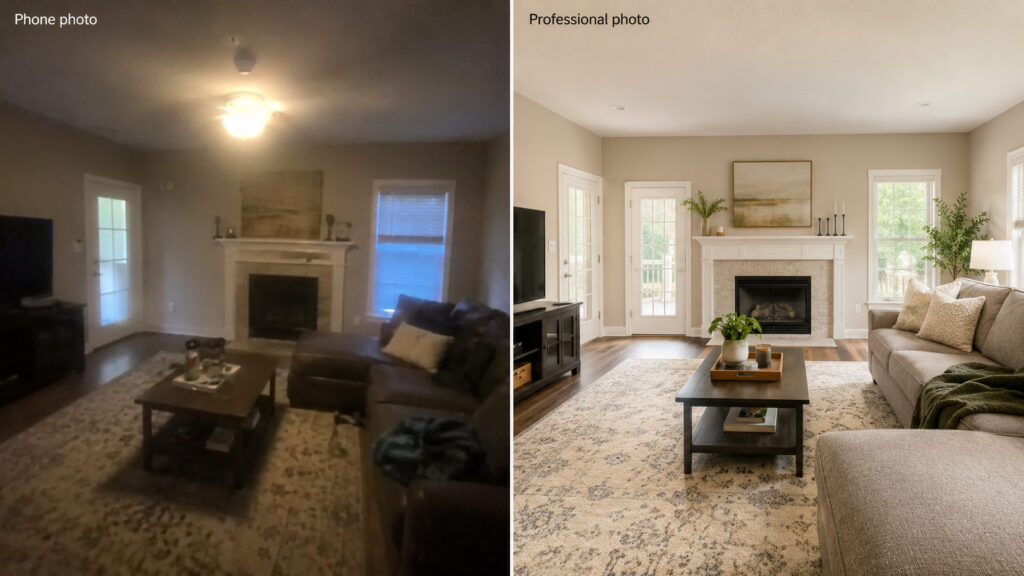
Professional photography is non-negotiable. Buyers judge your listing online before they ever step inside: 85% of buyers rank photos as the most important feature of an online listing, and homes with professional photos sell faster and for more than those shot on a phone.
Build the full launch package around those photos: a 3D or virtual tour, a walkthrough video, and listing copy that sells the lifestyle, not just the square footage. Then get the MLS entry right. Accurate fields, every feature filled in, and keyword-rich descriptions, because the MLS feeds every portal a buyer will search.
Amplification: Syndication, Social, and Open Houses
Listing on the MLS and hoping is the “post and pray” trap. The MLS is the start, not the finish. Your job is to push the listing everywhere the buyer is looking.
That means portal syndication to Zillow and Realtor.com, social promotion across your channels, and an email blast to your buyer database and your agent network. Then work the open house: a well-run event with real follow-up turns neighbors into leads and gives your seller proof you are working. Every channel you add is another shot at the right buyer seeing the home in its first week, when traffic is highest.
Seller Communication and Weekly Reporting
Here is the differentiator most agents skip: a weekly seller update, every week, even when it is quiet. Silence makes sellers nervous, and nervous sellers fire agents. A short, consistent report builds trust and manages price expectations when the market is slow.
A sample weekly report:
Online views and saves across the portals
Showings booked and completed
Buyer and agent feedback, summarized
Inquiry and offer counts
Your recommendation for the week: hold, adjust price, or add marketing
Five lines. It takes ten minutes and it is the reason sellers refer you long after the sale.
The 7 Ps of Real Estate Marketing
The 7 Ps are a marketing framework that helps you position, price, and promote a home. They come from Booms and Bitner (1981), who extended the classic four Ps into a services marketing mix:
Product: the home and how you present it (staging, photography, condition).
Price: your pricing strategy, anchored by the CMA.
Place: where the listing appears (MLS, portals, social, open houses).
Promotion: the marketing that drives eyes to it (ads, email, video).
People: you, your team, and the service the client experiences.
Physical Evidence: your brand, signage, reviews, and proof you deliver.
Process: how smoothly the transaction runs from offer to closing.
If your budget is tight, prioritize People and Process first. They cost time, not money, and they are what earn the reviews and referrals that make every other P cheaper.
5 Real Estate Marketing Plan Mistakes to Avoid
The top guides skip the failure modes. These are the five that quietly kill an agent’s plan, and the fix for each.
No budget or tracking. Marketing “when you feel like it” with no cost-per-lead data means you never know what works. Fix: set a GCI-based budget and attribute every lead to its source.
Too many channels done poorly. Being mediocre on six platforms beats no one. Fix: pick three or four, run them consistently, and add more only once those hum.
“Post and pray” listings. Dropping a home on the MLS with phone photos and hoping is not a listing plan. Fix: run the full launch package, professional photos, syndication, social, and an email blast.
Inconsistent branding. A different logo, color, and headshot everywhere means no one remembers you. Fix: one look, one voice, every channel.
Treating the plan as one-and-done. A plan written in January and never reopened is a diary, not a strategy. Fix: review monthly, adjust quarterly, and cut what does not convert.
Turn Your Marketing Plan Into Rankings and Leads
A plan only pays off if buyers and sellers actually find you, and that is exactly where SEO and AI search come in. A converting, IDX-enabled website that ranks on Google and gets cited by AI is the compounding channel most agents leave on the table.
If you want to see where your website and Google presence stand today, get a free, written audit from BASEO. No call required, and it is yours to keep.
Real Estate Marketing Plan FAQs
Quick answers to the questions agents ask most when building a plan.
What should a real estate marketing plan include?
A real estate marketing plan should include SMART goals, a defined niche and target audience, a unique value proposition, chosen marketing channels, a budget, a content calendar, and KPIs to track results. Agents also add a listing marketing plan showing how they will market each property for sellers.
How much should real estate agents spend on marketing?
Most agents spend 5% to 10% of their gross commission income (GCI) on marketing. New agents and those in growth or competitive markets often invest 10% to 15%, and sometimes up to 20%. For example, an agent earning $300,000 in GCI at 10% would budget about $30,000 a year.
What are the 7 Ps of real estate marketing?
The 7 Ps of real estate marketing are Product, Price, Place, Promotion, People, Physical Evidence, and Process. They expand the classic four Ps into the services marketing mix, helping agents position, price, and promote listings to sell homes faster and for more money.
What is a listing marketing plan for sellers?
A listing marketing plan for sellers is the property-specific strategy an agent presents in a listing appointment. It covers pricing via a CMA, home prep and staging, professional photography, MLS and portal syndication, social promotion, open houses, and weekly seller reporting to market that home and win the listing.
How do I create a marketing plan as a new real estate agent?
New agents should start with free, time-based tactics: work your sphere of influence, host open houses, post consistent local content on social media, and build an email database. Set one or two SMART goals, pick three or four channels, and reinvest 10% to 15% of early commissions into marketing.
Every deal you close starts as a lead. The only real question is whether you rent that lead or own the channel it comes from. Buy property leads and the phone rings this week, but the flow stops the day you stop paying. Build your own and it takes longer, but it compounds into a source no competitor can outbid. This guide covers every lead type, what each one costs, and which channel fits your capital, timeline, and experience.
The moment a lead lands is the moment the business feels real. Where that lead came from decides whether it happens again next month.
A real estate investor lead is a property, or the person who owns it: a seller with a reason and the ability to sell off-market, or a cash buyer for your deals. Unlike a retail agent’s listing lead, motivation is the whole variable. A name on a list becomes a lead only when the owner has a reason to sell.
That’s the line that separates investor lead gen from everything an agent does. Agent leads want top-of-market price and a full-service sale that can take months. Your seller wants speed and certainty, an as-is offer, and to be done. A distressed property owned by someone with a deadline is a lead. The same property owned by someone who’s just curious is a data point.
The 2 sides of investor lead gen: seller leads vs. buyer leads
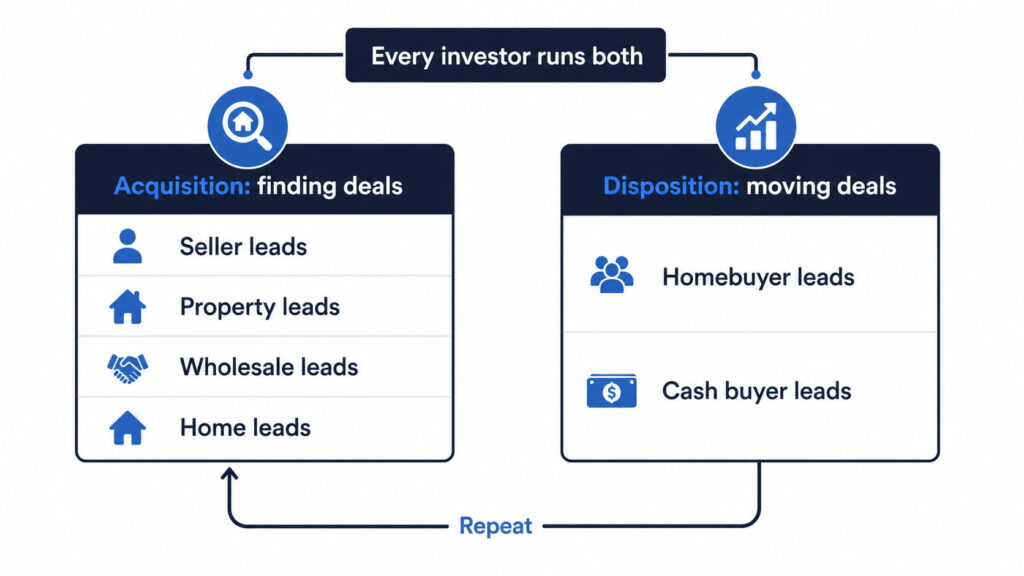
Every investor runs two engines at once. Acquisition finds the deals, and disposition moves them.
Acquisition is the hard one, and it’s where most of this guide lives. It covers seller leads, property leads, wholesale leads, and home leads: all the ways you find an owner willing to sell below retail. Disposition is the other side, the homebuyer and cash buyer leads you need to assign a contract or sell a flip.
Most operators obsess over acquisition and neglect the buyer list until they’re stuck holding a deal. If you’re wholesaling real estate, both engines have to run. The rest of this guide breaks down each type, and the hub near the end links every one in depth.
The two engines every investor runs. Neglect either one and deals stall.
Types of motivated seller leads (and how motivated each is)
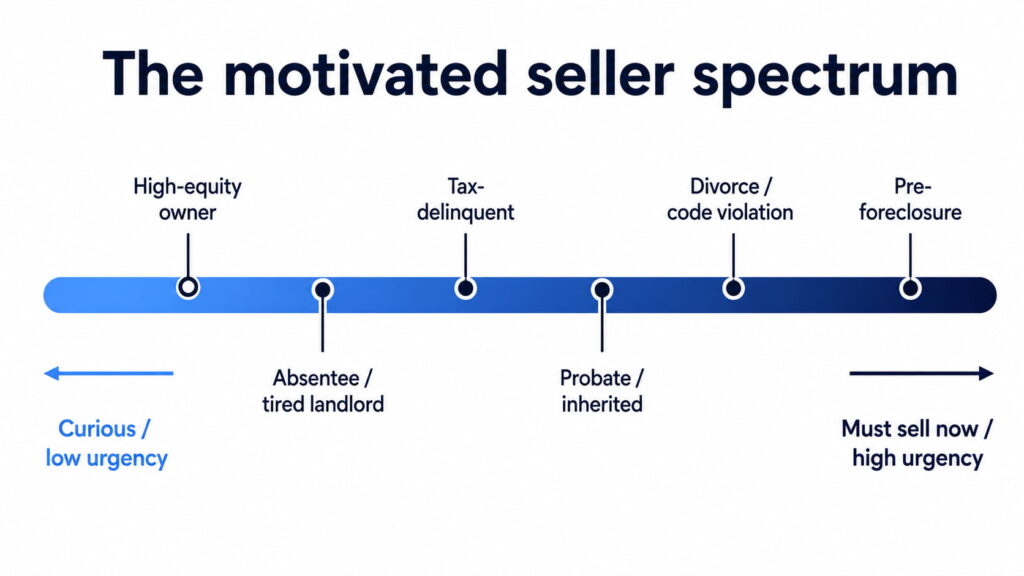
Motivated seller leads sit on a spectrum, not a switch. Some owners are curious. Some have an auction date. The whole game is spending your time and money where the motivation is real.
The top-converting lists in 2026 don’t just hand you names anymore. They’re AI-scored, ranking owners by equity, ownership length, and mortgage age, then stacking distress signals like tax delinquency, probate, and divorce on top (iSpeedToLead). When a property is vacant and tax-delinquent and owned by an out-of-state landlord, the odds the owner actually wants out climb fast (PropStream). Here’s how the main types stack up by urgency.
Motivation is a spectrum. Spend your marketing budget toward the right end of this bar.
Pre-foreclosure & foreclosure leads
These are the most urgent leads you’ll find. The owner is racing an auction date, and every week that passes tightens the vise. The records come from county notices of default, which are public. The catch is timing: a perfect list a week too late is worthless, so speed to the owner beats volume every time. If you work this space, learn where to find foreclosure listings and understand the pre-foreclosure timeline cold before you knock.
Probate & inherited property leads
These are heirs who never asked for the house. They’re often out of state, often sitting on high equity because the property was owned free and clear for decades, and rarely emotionally attached to keeping it. The source is probate court filings. The one rule that matters here: someone died, so your outreach has to be patient and respectful, not a hard pitch. Handled with care, these are some of the best deals in the business.
Absentee owner & tired landlord leads
An absentee owner is anyone whose mailing address doesn’t match the property address, and a lot of them are landlords who are done. One bad tenant, a special assessment, or a few years of rising costs turns a buy-and-hold into a headache the owner just wants gone. You pull these from title company data or the county assessor, matching owner address against property address to spot the non-owner-occupied ones.
High-equity & free-and-clear leads
An owner with no mortgage has the most room to negotiate, because there’s no loan balance forcing a floor on the price. That flexibility is real, but equity alone rarely creates urgency. A paid-off house owned by a happy retiree isn’t going anywhere. These leads convert best when high equity is paired with another trigger, like probate or a code violation, so treat equity as an amplifier, not a signal on its own.
Tax-delinquent, divorce & code-violation leads
These are the situational distress signals, and each one maps to a public record you can pull. Tax-delinquent owners show up on county tax rolls and are often ready to walk away from a bill they can’t cover. Divorce filings sit in court dockets, where two people frequently need to sell and split fast. Code violations come from municipal code enforcement, flagging owners staring down repair bills they don’t want. Each is a reason to sell, not just a name on a list.
How to generate real estate leads: free methods
Free doesn’t mean effortless. It means you pay in time and hustle instead of dollars. These are the channels that cost nothing but sweat, ranked roughly from warmest to slowest to pay off (Real Estate Skills):
Referrals from probate attorneys, agents, contractors, wholesalers, and property managers. The cheapest leads that exist, because a warm intro skips the entire step where a cold seller decides whether you’re legit.
Driving for dollars: physical signs of distress (overgrown yards, boarded windows, tarped roofs) added to a list you work.
FSBO and expired listings: owners already trying to sell without an agent, who’ve told you they’re motivated.
Networking and REI meetups: relationships that quietly feed deals for years.
Organic social: presence that builds a buyers list and keeps you top of mind.
SEO and content: the only free method that compounds.
That last one is the difference-maker. Driving for dollars stops the day you stop driving, but a page that ranks for how a stressed owner searches keeps sending motivated seller leads for years after you publish it. It’s also the channel most investors do worst, because a template site doesn’t rank. Building SEO that actually brings deals is exactly what BASEO does for cash buyers, and it’s the one free channel that turns effort today into inbound you own tomorrow. If cold outreach isn’t your thing, there are plenty of ways to get leads without cold calling on this list.
How to generate real estate leads: paid methods
Paid methods buy you the one thing free methods can’t: speed to your first lead. You open the tap, leads come. The tradeoff is that the tap closes the moment you stop paying.
Direct mail is still the workhorse of investor acquisition. You pay per piece, and your list quality decides whether it’s profitable or a money pit. Cold calling and SMS move high volume if you have thick skin and stay on the right side of the compliance rules. Buying lead lists gets you instant volume, but those leads are usually shared and only as good as the underlying data.
Then there’s paid search. Google Ads for real estate puts you at the top of the “sell my house fast” results the instant your campaign goes live. It isn’t cheap: “we buy houses cash” keywords run about $2.50 to $5.00 per click with an investor cost per lead around $28 to $65 (Promodo), and the most contested “sell house fast” terms hit $12 to $63 a click in competitive markets (Webrageous). Local Services Ads sit even higher on the page and charge per lead instead of per click. Facebook ad campaigns offer cheaper clicks but colder intent, which makes them better for building a buyers list and retargeting than for catching a seller mid-crisis.
Buying leads vs. generating your own: the real cost
Here’s the decision that actually matters, and it isn’t which vendor to pick.
Buying leads gives you instant flow. It also hands you a lead that’s shared or rented, priced to rise as more investors bid on the same list, and gone the second your card gets declined. Every lead you buy is a lead a competitor can buy too. You’re renting attention, and the rent goes up every year.
Generating your own is slower to start and worth more at the finish. A page you rank is inbound that can’t be resold to the investor across town. The math backs it up: organic leads cost 83% less than PPC leads and close about twice as profitably, with mature content bringing cost per lead down to $7 to $30 (Visionary Marketing). The shortcut most investors try, a template site, is exactly why they don’t rank: more than 30% of top “we buy houses” sites run near-identical Carrot template content, so Google can’t tell you apart and ranks none of you well (Carrot).
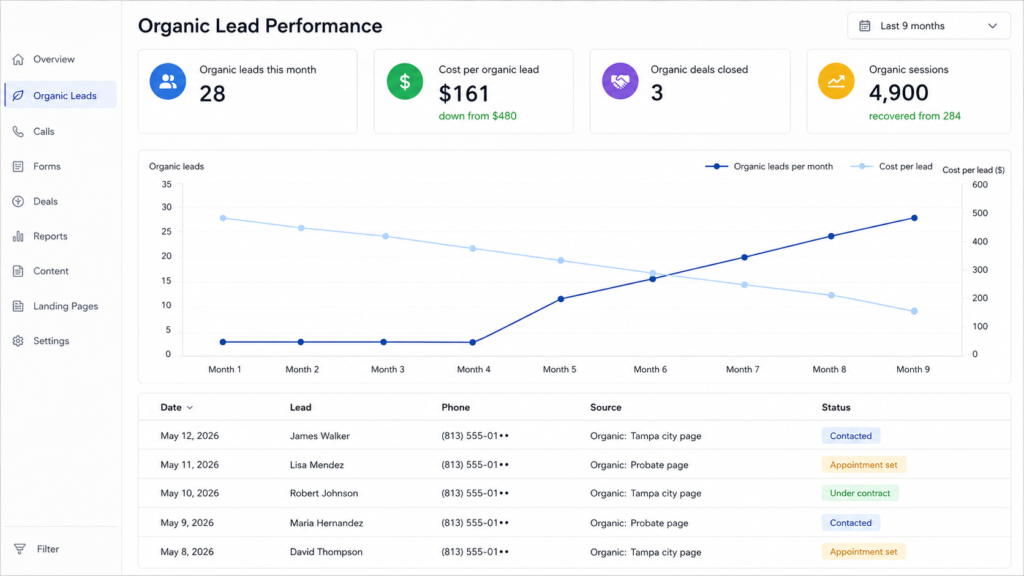
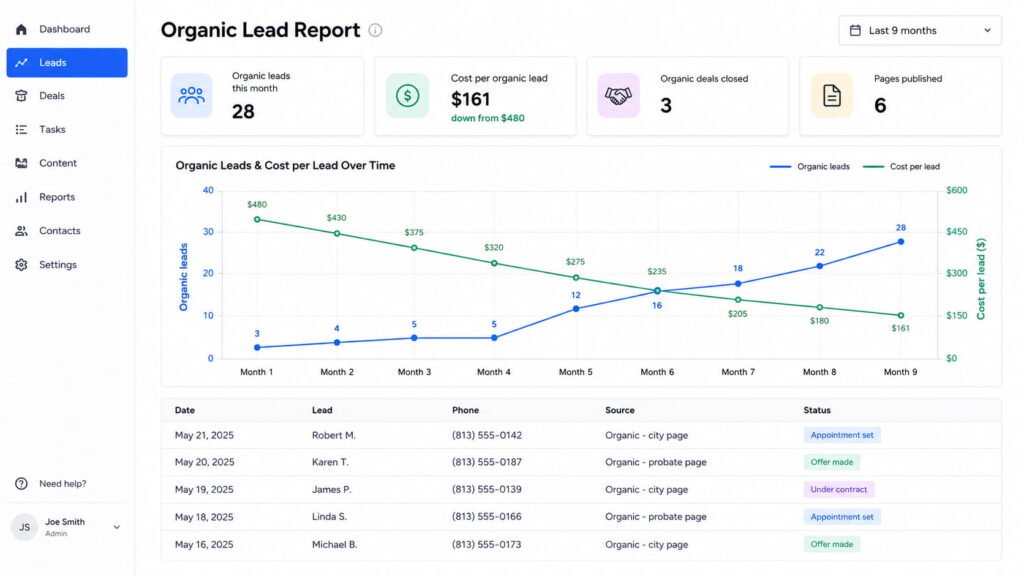
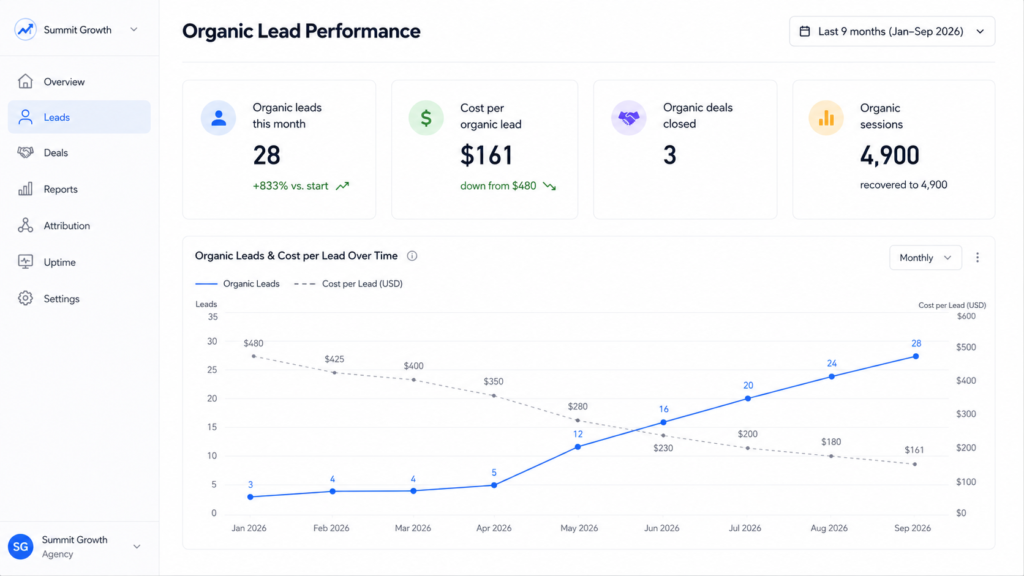
The smart play isn’t either/or. It’s bi-velocity: run PPC and Local Services Ads for leads this week while original city pages and seller-situation content compound into a channel you own. Paid buys speed. Owned buys durability. That’s the model BASEO builds, the organic engine that keeps producing while the paid spend can shrink as it takes over. One Florida cash buyer went from 3 to 28 motivated seller leads a month in nine months on that approach, in the same market, with no extra ad spend (BASEO client data).
Rented leads (bought)
Owned leads (generated)
Speed to first lead
Days
Months
Exclusivity
Shared or resold
Yours alone
Cost over time
Rises with competition
Falls as content matures
When you stop paying
Leads stop
Leads keep coming
Who else can buy it
Any competitor
No one
How much do real estate leads cost?
Prices swing wildly, and the number on the invoice is the least useful one. Motivated seller leads run from about $25 to $40 for shared national leads, up to roughly $80 to $120 for county-level exclusives, and $300 or more for premium exclusive leads in high-value markets (UndervaluedX, US Lead List). Done-for-you services price distressed seller leads from around $66 each (HouseCashin).
The number that actually matters is cost per closed deal, not cost per lead. A $300 exclusive lead that closes beats twenty $25 shared leads that never answer the phone. Cheaper leads come with more competition and more contacts to close; exclusive leads cost more up front and take fewer touches. Here’s the range by source, as of 2026.
For contrast, agent-focused leads price differently: paid social runs $5 to $30, Google buyer leads $20 to $60, and Zillow or realtor.com leads $100 to $300 (Ylopo). Those chase retail buyers and sellers, not the motivated, off-market owner you want.
Choosing lead channels by capital, time & experience
There’s no universal right answer, only the right answer for where you are right now. Match the channel to your capital, your timeline, and how many deals you’ve actually closed.
If you have no capital but time to hustle, start with sweat equity: driving for dollars, working referrals, chasing FSBOs, and laying the SEO groundwork by claiming your Google Business Profile and publishing your first city and situation pages. If you have some capital and need the phone to ring this quarter, PPC, Local Services Ads, and a tight direct mail campaign will get you there faster than anything organic can. If you’re scaling, the move is an owned SEO and AI-search base with a paid blend layered on top, and you measure all of it by cost per deal, not leads generated.
The through-line across all three: whatever you’re spending on today, always be building the owned asset in the background. The point of good lead conversion and a CRM to track everything is to make sure none of these leads, bought or earned, slips through the cracks.
Explore each lead type in depth
Every lead type in this guide deserves its own playbook, so go deeper on the one that fits your niche. Start with seller leads for the full breakdown of finding motivated owners. Dig into property leads to work distressed properties by situation and public record. Study wholesale leads if you’re assigning contracts and need both sides of the deal. Learn home leads for the residential acquisition angle. And build out homebuyer leads so you’ve got a cash buyers list ready the moment a contract needs a home. Each one is a channel you can specialize in and own.
Own your lead channel instead of renting it
Step back and the whole guide points one direction. Every lead you buy is a lead a competitor can also buy. You’re renting attention, and the landlord raises the rent every year.
A page that ranks for “sell my house fast” in your city is different. It sends you exclusive inbound leads around the clock, and no competitor can buy that spot out from under you. The channel is booked when it’s yours. That now includes AI search: one Carrot user pulled 26 of his 45 weekly leads straight from ChatGPT (Carrot), because being the answer an AI cites is the new front page. Getting your pages cited in AI Overviews is a channel most investors haven’t even noticed yet.
That owned channel, original city pages, seller-situation pillars, and AI-search optimization, is what BASEO builds for cash home buyers, with PPC and Local Services Ads keeping the phone ringing while the organic side compounds. You get speed now and durability later, from one team that only works your niche.
Owning the #1 spot for “sell my house fast [your city]” is a lead a competitor can’t outbid you for.
Frequently asked questions
What is the best source of real estate leads?
There’s no single best source, it depends on your capital and timeline. Referrals convert cheapest, direct mail and PPC deliver the fastest volume, and SEO builds the only channel you fully own. Most successful investors run two or three sources at once and measure cost per closed deal, not per lead.
Are paid or free real estate leads better?
Paid leads deliver speed; free leads deliver ownership. Buying lists gets you talking to sellers this week but the flow stops when spending stops. Free channels like referrals and SEO take longer but compound and can’t be outbid. The strongest strategy combines both.
How much do motivated seller leads cost?
Motivated seller leads typically run from about $25 for shared national leads to $100+ for county-level and $300+ for exclusive leads, as of 2026. Price rises with exclusivity, motivation, and market competition. Judge leads by cost per closed deal, not the sticker price.
How do beginners get their first real estate lead?
Beginners get their first lead fastest through free, high-effort methods: driving for dollars, contacting FSBO and expired listings, and asking their network for referrals. These need time, not money. Meanwhile, start building an SEO page so inbound leads compound over the following months.
Final thoughts
Leads aren’t a product you buy once and forget. They’re the output of a channel, and the durable move is owning that channel while paid keeps the phone ringing until it compounds. Rent for speed, own for the long run, and judge every dollar by cost per deal instead of the sticker on the lead.
Before you spend another dollar on a lead list, it’s worth knowing which channel your market and budget actually reward. We work only with cash home buyers, so a free audit already knows your competitors, your keywords, and the seller situations in your market. It shows you exactly what’s holding your site back and what your top competitor built instead. Free, in writing, delivered in about 2 business days. No call required, and it’s yours to keep.
The website is the salesperson that never sleeps. When it ranks, sellers find it on their own.
The right real estate investor website turns Google searches into motivated-seller and cash-buyer leads around the clock, without you touching an ad account. This guide compares the 8 best platforms on price, lead capture, and the thing every other list skips: how well they actually rank. A full comparison table and a custom-vs-templated breakdown are below.
A real estate investor website is a lead-generation site built to capture motivated-seller and cash-buyer information through simple forms, so an investor or wholesaler gets inbound deals instead of chasing them. It is not a Realtor’s site.
An agent’s MLS or IDX site lists homes for retail buyers to browse. An investor site does the opposite job: it gets a stressed seller to raise their hand and request a cash offer, then drops that lead into your pipeline.
The core job is blunt. Rank on Google for the searches sellers actually type, then convert those visitors into motivated seller leads while you sleep. Everything else, the design, the copy, the CRM, serves that one outcome. Which is exactly why the platform you pick matters more than most investors think, and why comparing real estate website builders on looks alone is a mistake.
What to Look For in an Investor Website
Before the rankings, here is the checklist to score each platform against. Six factors decide whether a site rings the phone or just sits there.
Lead capture that converts. Look for two-step forms that ask for the property address first and contact details second. Sellers finish those more often than a single wall of fields.
SEO and AEO foundation. Page speed, mobile layout, clean structure, and schema markup (labels that tell Google what the page is) decide whether you rank, and whether AI answers cite you. This is where most template sites are thin. One Carrot user reported getting 26 of 45 weekly leads from ChatGPT (Carrot), so AI search belongs on the checklist now, not next year.
CRM and integrations. Does it connect to Podio, Zapier, and your email or SMS tools, so a lead gets worked instead of dying in an inbox? A good CRM for real estate investors is half the battle.
Customization vs. cookie-cutter templates. Can you look different from the competitors running the same template, or is your site a clone with a different logo?
Pricing and contract flexibility. Month-to-month beats locked-in. Watch for setup fees.
Support. When a form breaks on the morning a lead comes in, you want real help, not a ticket queue.
That is the rubric. Every platform below is scored against it, and the ranking runs from best all-around value down to the specialty picks. If you want to go deeper on the ranking side, here is how to do SEO for a real estate website.
The 8 Best Real Estate Investor Websites
The list is ordered by overall value for a typical investor. “Best” still depends on your budget and goals, which is why the checklist above matters. No filler, straight to the picks.
What an investor site is fighting for: the first page for “sell my house fast [city].”
1. Carrot (Best Overall for SEO)
Carrot is the category leader for investors who care about ranking. It has been purpose-built for cash buyers and wholesalers since 2013, and the platform’s whole pitch is conversion data plus built-in SEO tooling: automated location pages, keyword tools, rank tracking, and call tracking baked in.
It integrates with the tools investors actually run, including Forefront/InvestorBase, Podio, Zoho, REIPro, and smrtPhone, and it has one of the largest user bases in the niche.
Pricing starts around $84/month billed annually (about $1,009 a year) for the Starter plan, or roughly $119/month month-to-month. There is no setup fee and a 30-day money-back guarantee (Carrot). An AI Suite add-on runs $99/month if you want the automation features.
The strengths: proven conversion templates, the best built-in SEO tools in the category, and a deep template library. The catch is that same template library. Those layouts are shared across thousands of investor sites, so a seller can land on your page and then see the exact same design on a competitor’s site (RealEstateBees). Carrot itself reports that 30%+ of top-ranking “we buy houses” sites use near-identical template content (Carrot). That is the trade-off, and it sets up the custom-vs-templated question later.
2. LeadPropeller (Best Budget Option)
LeadPropeller is the affordable, investor-built option. It was made by wholesalers, and it shows: two-step lead forms, quick setup, buyer and seller site types, and a base of 1,000+ investors.
Pricing starts at $49/month for the Starter plan, with Professional at $79/month and a Franchisor tier at $299/month (RealEstateBees).
The wins are price, simplicity, and a fast launch. The trade-offs: templates are more generic, the CRM is lighter (it connects to basic email tools like Mailchimp and AWeber rather than a full investor stack), and both integrations and support are thinner than Carrot’s. The ideal user is a new wholesaler on a tight budget who needs a lead site live this week.
3. REI/kit (Best All-in-One for Wholesalers)
REI/kit bundles the website with a full marketing suite: CRM, email, SMS, direct mail, and deal analysis in one login. Site setup is close to two clicks, with pre-built templates and content plus motivated-seller lead tools.
There is a free tier, and paid plans run $57.60/month (Marketing Starter), $93.60/month (Success), and $183.60/month (Scale) (RealEstateBees).
For a wholesaler who wants tools bundled instead of stitched together, it is a strong pick, especially if you are still learning how to start wholesaling real estate. The downside is the flip side of “all-in-one”: the broad feature set can be more than a pure lead site needs, and you pay for tools you may not use.
4. REI BlackBook (Best for CRM + Automation)
REI BlackBook is for the investor who leads with operations. If your priority is a CRM, follow-up automation, and marketing workflows, with the website attached rather than the star, this fits. You get phone and SMS tools, pipeline management, and a website builder in one place.
Pricing runs $97/month for Solo ($81 billed annually), $197/month for Team, and $297/month for Executive, with a 14-day free trial (REI BlackBook).
The strength is deep automation and all-in-one operations for a growing team. The trade-offs: a steeper learning curve, and a website that is clearly secondary to the CRM. If your bottleneck is follow-up rather than traffic, that order is fine. If you want to get the follow-up side right, here is how to use a CRM for real estate.
5. DealMachine + InvestorFuse (Best for Deal Pipeline)
These two get named in a lot of “investor website” lists, so it is worth being precise: neither is actually a website builder. DealMachine is a driving-for-dollars and list-building app for outbound sourcing (DealMachine). InvestorFuse is an investor CRM, or “lead conversion system,” that was acquired by Carrot in 2022 and now runs as CarrotCRM (InvestorFuse).
They earn a spot here because deal flow is not only inbound. If your model runs on driving for dollars and list stacking, these tools manage the pipeline that your website leads flow into. You just pair them with a real lead-capture site from the list above.
If you want one login that bundles an SEO website with the deal pipeline, look at an all-in-one like REsimpli, which packages a lead-capture site, CRM, and driving-for-dollars in a single platform (RealEstateBees). The point of this category is integration: inbound web leads and outbound sourcing working from the same pipeline.
6. WordPress + Investor Theme (Best DIY)
The self-hosted route is WordPress plus a real-estate-investor theme (Winning Agent Pro is a common one) on cheap hosting. Hosting runs roughly $3 to $15/month, the theme is a one-time or annual cost, so practical all-in is about $10 to $30/month.
The upside is real: full control, low monthly cost, no shared template, and you own the asset and its SEO equity outright. Nobody can raise your rent or retire your layout.
The downside is that you build and maintain it. There is no investor-specific lead logic out of the box, and it is slower to launch than a two-click builder. The ideal user is a tech-comfortable investor who wants a unique, ownable footprint and does not mind doing the work to get it.
7. Wix / Squarespace (Best for Simple Brand Sites)
Wix and Squarespace are general website builders. For an investor who mainly wants a clean brand presence with a basic contact form, they are easy, cheap, and genuinely good-looking. Business plans run roughly $16 to $36/month depending on tier.
What they are not is a lead-generation machine. There are no investor-specific conversion features, and SEO control is weaker for the competitive keywords that matter, like “we buy houses [city].” Treat these as fine for credibility, a place to look real, not as the tool that will rank you against dedicated cash-buyer platforms.
8. Custom-Built SEO Site (Best for Long-Term Organic Growth)
A custom, agency-built site is the pick when a template stops being enough. That happens when you are competing hard for local organic and AI-answer rankings, when you need a layout no competitor shares, and when you want the site engineered around keyword architecture and schema from day one instead of bolted on later.
The strengths are the ones no template can match: a unique design with no duplicate-template trust problem, full control over SEO and AEO, content that scales as you add markets, and an asset you own. The costs are honest too: a higher upfront investment and the need for a capable partner.
This is the lane BASEO works in. We build custom, SEO- and AEO-engineered sites for cash home buyers, with a unique page for every market you buy in rather than a swap-the-city-name template, because duplicated pages are exactly what Google penalizes. If you are weighing this route, it is worth understanding what real SEO services for real estate investors include and how to pick the best SEO company for real estate before you commit.
Comparison Table: Pricing & Features at a Glance
Platform
Best For
Starting Price
Lead Capture
SEO Control
CRM / Integrations
Carrot
SEO overall
~$84/mo (annual)
Strong, 2-step
Strong, built-in tools
Deep (Podio, Zoho, REIPro, smrtPhone)
LeadPropeller
Budget
$49/mo
Good, 2-step
Basic
Light (email only)
REI/kit
All-in-one wholesalers
Free / $57.60/mo
Good
Moderate
Full suite (email, SMS, mail)
REI BlackBook
CRM + automation
$97/mo
Good
Moderate
Deep CRM + phone/SMS
DealMachine + InvestorFuse
Deal pipeline
Varies (pair with a site)
Via paired site
N/A (pipeline tools)
CRM + D4D sourcing
WordPress + theme
DIY control
~$10–$30/mo
DIY (plugin)
Full, you control it
Any (via plugins)
Wix / Squarespace
Simple brand site
~$16–$36/mo
Basic
Limited
Basic
Custom-built SEO site
Long-term organic
Custom build / retainer
Custom
Full, engineered
Custom
Prices were accurate at publish. SaaS pricing shifts often, so confirm the current number with each provider before you buy.
Templated vs. Custom: The Hidden SEO Cost Nobody Mentions
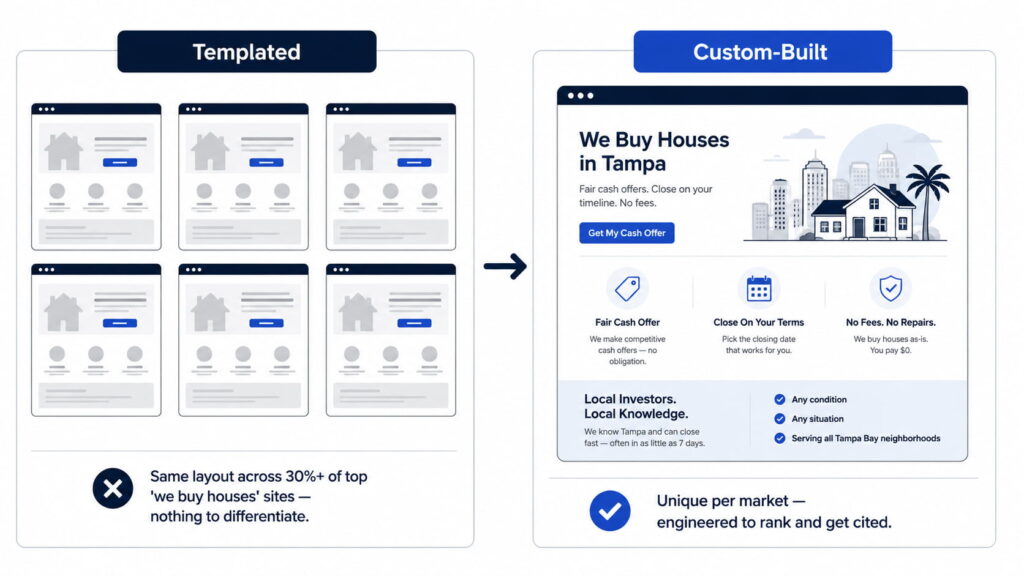
Here is the part the other lists leave out. When hundreds of investors run the same template, their sites share near-identical structure and copy. A seller comparing two “we buy houses” sites in the same city sees the same layout twice. That quietly erodes both trust and differentiation, and in a competitive market it can cap how well any of you ranks.
This is not a fringe worry. Carrot reports that more than 30% of top-ranking “we buy houses” sites use near-identical template content (Carrot).
More than 30% of top-ranking “we buy houses” sites run near-identical template content. Google has to pick one of you, and it often picks none of you.
The risk got sharper in 2024. Google’s March 2024 core update introduced the Scaled Content Abuse policy, which targets large amounts of unoriginal content “no matter how it’s created” (Google Search Central). Swap-the-city-name pages are the textbook example. When your pages do not differentiate, Google has no reason to prefer yours, and that shows up as flat rankings and weak E-E-A-T signals.
AI search raises the stakes again. AI Overviews now appear on nearly half of all searches, and Google rolled AI Mode out to US searchers in 2025 (Carrot). Answer engines cite distinctive, well-structured pages. Near-identical templates give them nothing to prefer, so you stay out of the citation. If you want to be the site that gets pulled into those answers, here is how to get cited in AI Overviews.
A custom site solves this by being built around your keywords for real estate investors, your markets, and clean schema, with unique content on every page. That is what BASEO builds for cash buyers: a distinct page for each market you operate in, engineered to rank and to get cited, not a clone of the site down the street.
To be fair to templates: they are the right call when speed and budget matter most, and plenty of investors do well on them. Custom wins when you are serious about local SEO and AEO and want a footprint no competitor can copy.
Not sure whether your template is costing you rankings in your market? That is exactly what a free audit answers: it shows you where you stand against your top local competitor and what is holding the site back. Get your free site audit →
Templated sites blur together. A custom build is the only one Google and AI answers can tell apart.
How Much Does a Real Estate Investor Website Cost?
A real estate investor website costs about $40 to $100/month on a template builder like Carrot or LeadPropeller, and roughly $10 to $30/month for a DIY WordPress site (hosting plus a theme). A custom, SEO-built site is a larger upfront or monthly retainer investment, and full done-for-you marketing that pairs SEO with ads commonly starts around $2,500/month.
That done-for-you number is a market range, not a quote from any one agency. Industry SEO retainers most commonly run $1,500 to $5,000/month across providers (GoodFirms).
Now the math that matters. The national average wholesale assignment fee is about $13,000 (Real Estate Bees). One closed deal covers years of any subscription on this list, or several months of a serious custom build. Framed that way, the question is not “what does the site cost,” it is “how many extra deals does it need to bring me,” and for most investors that answer is one. If you also run paid, the cost picture for Google Ads for real estate is worth reading alongside this.
How to Choose the Right One for Your Business
Match the tool to your situation, not to whichever platform gets called “best” the loudest.
New or on a tight budget: LeadPropeller or a WordPress DIY build.
Want more leads and built-in SEO tools fast: Carrot.
Want a website plus a full marketing stack in one login: REI/kit or REI BlackBook.
Running a heavy sourcing pipeline: pair DealMachine or InvestorFuse (or an all-in-one like REsimpli) with a real lead-capture site.
Competing hard for local organic and AI-answer rankings: a custom-built SEO site.
The winning move is honest about where you are. A brand-new wholesaler and a veteran fighting for the top of a competitive metro do not need the same site, and forcing either into the other’s tool wastes money.
Get a Website Built to Rank, Not Just to Exist
Most investor websites exist. Far fewer rank. A pretty page that never shows up on Google is just a business card that costs a monthly fee.
BASEO builds custom, SEO- and AEO-engineered sites for cash home buyers, designed to bring motivated sellers and cash buyers to you organically. The approach is bi-velocity: quick wins from paid search and your Google Business Profile while the organic asset compounds underneath, so you are not waiting in silence for months.
We work only with cash home buyers, so a free audit already knows your competitors, your keywords, and the seller situations in your market. Some operators run all of this themselves and do fine. If you would rather spend that time closing deals, that is where we come in.
Want to see exactly what is holding your site back? The audit is free, written, delivered in about two business days, and yours to keep. No call required. Get your free site audit →
Frequently Asked Questions
The following answers are formatted for FAQ snippets. Add FAQPage schema on publish.
Do real estate investors need a website?
Yes. A website lets motivated sellers and cash buyers find you on Google 24/7 and submit their info through lead-capture forms, giving you inbound leads that don’t depend on paid ads. It also builds credibility and becomes an owned asset that compounds in value as it ranks.
How much does a real estate investor website cost?
Template builders like Carrot or LeadPropeller run roughly $40-$100 per month. A DIY WordPress site costs about $10-$30 per month in hosting. Custom, SEO-built sites require a larger upfront or retainer investment, while full done-for-you marketing (SEO plus ads) typically starts around $2,500 per month.
Is Carrot worth it for real estate investors?
For most investors, yes. At under $1,000 per year you get conversion-optimized templates and strong SEO tools, and a single closed deal can cover years of the subscription. The main drawback is shared templates. Other investors may use the same layout, which can weaken trust and differentiation.
What is the best website builder for real estate investors?
Carrot is the best overall for investors who want conversions plus built-in SEO tools. LeadPropeller wins on budget, REI/kit is strongest as an all-in-one for wholesalers, and a custom-built site is best when you’re competing hard for local organic and AI-answer rankings.
How do investor websites generate motivated seller leads?
They rank in Google for searches like “sell my house fast [city],” then convert visitors with two-step lead-capture forms and clear calls to action. Submitted leads flow into a CRM for follow-up. The stronger the site’s SEO and conversion design, the more qualified leads it produces.
Your problem probably isn’t lead generation. It’s that the leads you already paid for are sitting in a CRM with no next action on them.
This is how to convert leads in real estate as an investor: a cash buyer, a wholesaler, a flipper. Not an agent with listings. You get benchmarks by lead source, a six-question seller script, and a 90-day follow-up cadence you can copy on Monday.
What “lead conversion” actually means for a real estate investor
An agent converts a lead into a client. You don’t have clients. You have a signed contract or you have nothing.
That changes what you’re counting. Your funnel has six stages:
Lead: a name and a number came in.
Contact: you actually spoke to a human.
Appointment: you saw the property or ran a real offer conversation.
Offer presented: a number left your mouth.
Contract signed: this is the conversion.
Closing: the money moves.
Most investors quietly count stage 3 as a win. A booked appointment feels like progress, so it goes in the win column and the week feels productive. It isn’t a conversion. It’s a lead that hasn’t died yet.
The number that matters is lead to contract, and it depends almost entirely on what kind of lead you started with. Goliath Data puts well-qualified motivated seller leads at 10% to 15%, which works out to roughly 15 to 30 leads per deal. Cold lists run 3% to 5%, so you need 25 to 35 of those for the same deal.
There is no single good real estate lead conversion rate. It depends entirely on the source. Purchased online leads convert at 0.4% to 1.2%. Across all sources, the average lands at 2% to 5%. Well-filtered motivated seller leads convert at 10% to 15%, and referrals reach 14% to 30%.
Those ranges come from Real Geeks, Ylopo and Goliath Data. Read them again and notice the spread: the best source converts about 30 times better than the worst one.
So when your rate looks bad, the first question isn’t “what’s wrong with my calls.” It’s “what am I calling.” A low rate is usually a source problem wearing a skill problem’s clothes.
Conversion benchmarks by lead source
Lead source
Typical conversion to contract
First contact to contract
Relative cost per deal
Purchased portal / online leads
0.4%–1.2%
Long, and you’re rarely first
High. You pay per lead and share it with four other buyers.
Cold lists (skip-traced, public records)
3%–5%
45–60 days
Medium per lead, high per deal once you count the volume
Direct mail / cold call
Low per touch, compounds with repetition
Long. Response usually takes several touches.
Medium to high, and it never stops being a bill
Paid search (inbound, high intent)
Varies by market
Short. The seller reached out to you.
Rising. The day you stop paying, it stops.
Organic search (“we buy houses”, “sell my house fast”)
Sources: Real Geeks, Ylopo, Goliath Data. Where a public number doesn’t exist, the cell says what’s true directionally instead of inventing a percentage.
The distance between the top row and the bottom row is 20x or more. No script closes a gap that size.
An inbound organic seller converts far above a cold list for one boring reason: he qualified himself before he ever reached you. He typed his problem into Google, read your page, and dialed. Nobody had to convince him he wanted to sell. Portal leads sit at the bottom of the table because you’re one of five investors who bought the same name on the same afternoon, and four of them are already dialing. If you want the full picture on what seller leads actually cost, that math deserves its own look, as does the real cost of Google Ads for real estate.
How to calculate your own lead-to-deal ratio
The rate itself is simple:
(deals closed ÷ leads received) × 100
Run it per source. Never in aggregate. An aggregate number tells you the business is mediocre. A per-source number tells you which channel to shut off on Friday.
Then run the one that actually moves money:
cost per deal = marketing spend ÷ deals closed
Compare that against your average spread. A survey of more than 1,000 wholesalers put the average assignment fee at $13,000, ranging from about $5,000 in Arizona to about $22,000 in North Carolina and Georgia. So here’s a quarter, in round numbers.
You bought 400 leads from one paid source. You got 4 contracts and closed 2. Lead to contract: 1%. You spent $12,000 on that channel, so your cost per deal is $6,000. Against a $13,000 assignment fee, that channel nets you about $7,000 a deal before anything else comes out.
Now run the same math on referrals: 20 leads, 3 closed, $0 spent.
The second channel is a fifth the size and several times better, and only the per-source math will ever tell you that. If you’re new to the mechanics of wholesaling a contract, start there, then come back and do this math on your own numbers.
Why most real estate leads never convert
Five root causes. Most investors have three of them running at once.
You answered too late. The seller takes the first reasonable offer, not the best one. Fixed in Step 1.
You stopped following up at touch two. Sellers almost never say yes on the first or second contact, and most investors never make a third. Fixed in Step 4.
You pitched a price before you understood the motivation. A number given to a seller who hasn’t told you why he’s selling is a number he can only compare to Zillow. Fixed in Step 2.
Your leads were sold to five investors before you called. No script wins a race you entered last. That’s a source problem, and it’s the last section of this article.
There’s no system. The lead is in a text thread, a voicemail, a note on the dashboard of your truck. If it has no next action with a date, it isn’t a lead. Fixed in Step 5.
None of these are character flaws. They’re what happens when the person generating the leads, working the leads and closing the deals is the same person, and that person also had to go look at a roof today.
Step 1: Win the first 5 minutes (speed to lead)
Speed to lead is the cheapest lever in the business, and it’s free.
The number everyone quotes comes from a study by Dr. James Oldroyd at MIT with InsideSales, built on more than 15,000 leads and 100,000 dials: contacting a lead within 5 minutes instead of 30 makes you 21 times more likely to qualify that lead, and 100 times more likely to reach them at all. That study is from 2007 and nothing has knocked it off since. It gets miscredited to Harvard constantly. It’s MIT.
Note what it measures: the odds of reaching and qualifying a lead. Not a promise about your close rate. Answering fast doesn’t close the deal. It gets you into the conversation the other four investors are about to miss.
For motivated sellers it hits even harder than it does for agents. A distressed seller isn’t comparing five offers over three weeks. He’s trying to make a problem stop, and he tends to stop looking the moment somebody credible picks up the phone. Speed beats price more often than most investors are comfortable admitting.
What that means on a Tuesday:
Call first. Not email. An email is a message. A call is a conversation, and he only wanted one of those.
Double touch. Call, and if there’s no answer, text within the minute: “Hi [name], [your name] here, you just asked about an offer on [address]. Calling you right back.”
Push notifications, on the phone in your pocket. Not an email digest you read at 7pm.
Decide today who answers after 6pm, and write it down. Seller form fills do not land at 10am on a Tuesday. They land at 9:40 on a Sunday night, after a fight about the house.
The 2am lead: an automatic text on submission so he knows a human is coming, then a live call first thing. The auto-text buys you the night. It does not replace the call.
None of that requires a budget. It requires deciding that the phone is the job.
Step 2: Qualify motivation before you qualify the property
Most investors spend the first call on the house. Beds, baths, square footage, roof age, a rough ARV in their head.
None of it predicts whether this closes.
The house tells you what the deal is worth. The seller tells you whether there’s a deal at all, and only one of those two things can kill your week. Ask about motivation first. The property will still be there in ten minutes.
Score it 1 to 10. A 9 is a man with an auction date. A 3 is a man who wants to know what his house is worth and enjoys talking about it. The wholesalers who close consistently work 7s through 10s and put everybody else on a slow drip. That isn’t arrogance. It’s arithmetic: a 3 will eat six hours of your month and pay you nothing.
The 6 questions that separate a deal from a tire-kicker
Ask these, in this order, on the first call.
“Why are you selling now, and why now instead of six months ago?”
What you’re listening for: the event. A foreclosure notice, a death in the family, a divorce filing, a tenant who destroyed the place. No event usually means no deal, at least not yet.
“If this doesn’t sell in the next 60 days, what happens?”
What you’re listening for: a consequence. A seller with no consequence has no deadline. A seller with no deadline is a nurture lead wearing a deal’s clothes.
“What’s still owed on it?”
What you’re listening for: whether the math can work at all. If the payoff is above what the house supports, you found that out in 30 seconds instead of 30 days.
“If you were staying, what would you fix first?”
What you’re listening for: the real condition, in his words, with his guard down. Ask a seller what’s wrong with the house and he defends it. Ask what he’d fix and he tells you about the roof.
“Have you had other investors out to look at it?”
What you’re listening for: whether you’re first, fifth or last. It also tells you what he’s already been offered and what he turned down, which is worth more than a comp.
“If I could close in two weeks and you didn’t spend a dollar on repairs, what number would get you to sign this week?”
What you’re listening for: his real number, out of his own mouth, before you say yours. Whoever names a number first sets the frame, and it should not be you.
That’s the short version. The full set of questions to ask motivated sellers goes deeper on the follow-ups, but these six will tell you inside five minutes whether to get in the truck.
Scoring leads: hot, warm, cold
Score on criteria, not on how the call felt. Every investor has talked himself into a dead lead because the seller was friendly.
Tier
Objective criteria
Contact frequency
Hot
Motivation 8–10, timeline under 30 days, real distress (foreclosure, divorce, probate, forced relocation)
Daily until it’s a yes or a no
Warm
Wants to sell, exploring options, no hard deadline
Weekly
Cold
Timeline beyond six months, or just curious what it’s worth
Monthly, automated
Tag the tier the same day as the first contact, while you still remember the call. A lead you never tagged behaves exactly like a cold lead, because nobody ever calls it again.
Step 3: Run the offer conversation, not a sales pitch
Your seller is not comparing your offer to another offer. He’s comparing it to the number Zillow showed him, and that number has no commission in it, no repairs, no carrying costs and no buyer whose loan falls through in week seven.
So stop defending your price. Change what it gets compared to.
Cash, a close in about two weeks, as-is condition, no commission, no showings, no repairs, against a retail listing with all of it. That comparison is winnable. A price-versus-price comparison is not.
Build it as net to seller, not price. The headline price is what a seller brags about. The net is what lands in his account.
List with an agent
Your cash offer
Headline price
$200,000
$130,000
Agent commission (about 6%)
−$12,000
$0
Repairs to make it listable
−$20,000
$0
Carrying costs, 60–90 days on market
−$4,000
$0
Closing costs and concessions
−$6,000
Typically covered
Net to seller
about $158,000, in 3+ months, if it appraises
$130,000, in about 2 weeks, with no financing to fall through
Example only. Run the real numbers for the property in front of you.
Say the gap out loud. You are not pretending $130,000 equals $158,000. You’re showing him what that extra $28,000 actually costs: three months, a contractor he has to manage, and a buyer who can still walk. Some sellers want the retail number and are right to go list. The ones who want the problem gone this month are yours, and now they can see why.
How to anchor price without killing trust
Give the range before you give the number.
“Based on what you’ve described, I’m probably somewhere in the $125,000 to $135,000 range. Let me walk it and I’ll firm that up.” A range starts a conversation. A single number invites a yes or a no, and it’s usually a no.
Then explain the formula out loud. ARV times 70%, minus repairs, is the standard starting point in this business and there’s nothing in it worth hiding. On a $200,000 ARV house: 70% is $140,000, minus $20,000 in repairs puts you at $120,000. Say that arithmetic to the seller’s face. A seller who understands why the number is the number argues with it far less than a seller who thinks you pulled it out of the air.
Treat 70% as a starting formula, not a law. Markets and margins differ.
And never raise your price for free. If you come up, something comes back: a faster close, the furniture stays, the inspection contingency comes off. Free concessions teach the seller your first number was theater.
The real killer is dropping the price after the inspection with no warning. That kills more deals than a low opening offer, because it turns a negotiation into a bait and switch. If a re-trade is even possible, say so on day one and say what would trigger it.
Handling the three objections that kill cash deals
“Your offer is too low.” What it actually means: he’s comparing your price to a retail headline, not to his net.
Say: “It’s lower than the Zillow number, and it should be. Let me show you what that number actually pays out after commission, repairs and three months of holding it. If the retail net is better for you, I’ll tell you to go list it.”
“I need to think about it. I want to talk to my family.” What it actually means: either there’s no urgency, or the person who decides isn’t in the room.
Say: “That’s fair. Who else is part of this decision? Let’s get them on a call with me, because I’d rather answer their questions directly than have you try to relay them.” Never push past this objection. Go find the missing decision-maker instead.
“I got a higher offer from another investor.” What it actually means: maybe he did. Whether it closes is a completely different question.
Say: “Take it, if it closes. Ask them two things first: is there an inspection contingency, and does the price change after they walk the property? A lot of high offers come down after the inspection. Mine won’t, and I’ll put that in writing.”
An offer that gets signed and an offer that gets honored are not the same product. Most sellers have never been told that, and the investor who explains it calmly, without trashing the competitor, is the one who gets the call back in three weeks.
Step 4: Build a follow-up cadence that closes deals 60 days later
Sellers almost never say yes on the first or second contact. Direct mail operators put the average at around six touches before a prospect responds at all, and Goliath Data says the same thing about motivated sellers in different words: they convert after repeated follow-up, not after the first call.
Most investors stop at two.
Here’s the frame that should bother you: that lead is already paid for. You spent the money the day it came in. Following up costs a calendar reminder. It’s the only channel in your business with zero marginal cost, and it’s the one that gets abandoned first.
The 60-day deal isn’t a slow deal. It’s a deal that did not exist in week one, because the seller wasn’t ready in week one. Then the auction date moved. The tenant left. The sibling finally agreed. You want to be the name on his phone when that happens, and you get there by still being there.
A 90-day cadence you can copy
Day
Touch
What it carries
0
Call within 5 minutes, text if no answer
You’re real, you’re fast, you’re first
0–2
Call, then email the offer in writing
The number, plus the net-to-seller breakdown
5
Call
An answer to the objection he raised last time, with a specific
10
Text
A real comp from his street. Not “just checking in.”
21
Call
A different structure: seller finance, a longer close, a rent-back
30
Email
A similar seller’s outcome. What his situation was, what it took
45
Text
A market change. Rates, days on market, a listing near him that expired
60
Call
“Is it still on the table? My number hasn’t moved.”
90
Breakup, then a monthly drip
Close the loop cleanly and let the automation carry it
One rule governs all nine touches: every touch has to carry new information. A comp, a market shift, a different way to structure the deal. “Just following up” is not information. It’s a request for attention with nothing in exchange, and it teaches the seller to stop picking up. If you have nothing new to say, you aren’t ready to make the touch. Go find a comp.
Cadence by seller type (pre-foreclosure, probate, tired landlord)
One cadence does not fit four situations. The clock is different in each one, and so is the tone.
Pre-foreclosure. The auction date is a real, public deadline, and it’s doing your urgency work for you. Tighten as it approaches: every five days at 90 days out, more often inside the last month. Tone matters more here than anywhere. He is being called by everyone, and most of those calls sound like a scam. Be the calm, specific one. It helps to actually understand how the pre-foreclosure timeline works before you dial.
Probate and inherited property. The clock belongs to the court, and to grief. Thirty-day cadence, educational, patient. The heir frequently does not yet know what he’s allowed to do, and he’s making decisions with a sibling in another state. The investor who explained the process without pushing is the one who gets called when the estate clears.
Tired landlord. No deadline at all, which is exactly why most investors drop him. His trigger is external and it’s coming: the next bad tenant, the next $8,000 repair, the next eviction. Long nurture, low frequency, and be the first call he thinks of when the water heater goes.
Divorce. Two decision-makers who don’t agree, and your only job is absolute neutrality. Never take a side. Never carry a message between them. Communicate with both at once, in writing when you can. A deal that looks dead all spring can close the week the settlement lands.
Step 5: Fix the leaks in your CRM and tracking
Four fields. Every lead, no exceptions:
Source, tagged. The field everyone skips and the one that decides where next quarter’s budget goes.
Motivation tier, hot, warm or cold.
Next action, with a date on it.
An owner. A person, not “the team.”
Then the rule that makes the whole thing work: if a lead has no next action with a date, it is not a lead. It’s a lost lead that hasn’t been written off yet.
Three automations are worth building. Only three. An instant text on form fill, so the seller knows a human is coming. A touch reminder that actually interrupts you, not a list you’ll read on Sunday. A monthly drip for the cold tier, so nobody has to remember them. Everything else is a project you’ll abandon in March.
The source tag deserves its own sentence. Without it, cost per deal by source is unknowable, and you are choosing where to spend next quarter based on which channel felt good. That’s how a bad channel survives for two years.
Investors run REsimpli, Podio, Follow Up Boss, GoHighLevel, Salesforce. None of them is the answer, and the brand matters far less than the discipline: the best CRM is the one you will actually update at 4pm on a Friday. If you’re setting one up from scratch, here’s how to use a CRM for real estate without turning it into a second job.
Step 6: Convert leads you never talked to (retargeting and re-engagement)
Most motivated sellers don’t decide on the first interaction. They keep looking, for weeks, while the problem gets worse and the mail keeps coming. Retargeting on Google, Facebook and Instagram is how your name stays in front of the seller who isn’t ready yet but will be.
The cheaper play is the one almost nobody runs: reactivate your dead list.
Every investor has a folder of sellers who said no thanks six or twelve months ago. A meaningful slice of them listed with an agent, sat on the market, watched it expire, and are still holding the same house with less patience and a worse roof.
That list costs you nothing. It’s already yours. One text:
“Hi [name], [your name] here. We talked last spring about [address]. Did it end up selling? If not, I’m still buying in the area and my number would look different today.”
One line. No pitch. Easy to answer with a single word. Send it to the whole dead list on a Tuesday morning and work whatever comes back.
Compare the cost of that campaign to the cost of one fresh lead in the same market, and the math answers itself.
The conversion multiplier nobody talks about: where the lead came from
Now the honest part.
You can run every step above perfectly and still lose the deal, because the lead was sold to five investors before your phone rang. Speed doesn’t fix that. Scripts don’t fix that. You entered a race late and no amount of technique un-late’s you.
Look back at the benchmark table. A portal lead converts at 0.4% to 1.2% and arrives with four competitors already dialing. A referral converts at 14% to 30%, because the seller showed up pre-sold. And an inbound organic seller, the one who typed “sell my house fast [city]” into Google at 11pm and called the first result, behaves like a referral. He diagnosed his own problem. He chose you. Nobody else is on the line.
The economics diverge too. A paid lead costs the same next year, or more. An organic lead gets cheaper every month the page keeps ranking, because the page is already paid for. One Florida cash buyer we work with went from 3 to 28 motivated seller leads a month in nine months, in the same market, with no extra ad spend, at $161 per organic lead and falling (BASEO client data).
There’s a newer layer on top of this, and it’s moving fast. Sellers now open ChatGPT and ask who buys houses for cash in their city, then act on the answer. Traffic that arrives from ChatGPT converts at 15.9%, against 1.76% for Google organic, according to Seer Interactive’s GA4 analysis. The reason is simple: the seller finished deciding inside the conversation, then clicked once. These systems answer by citing a short list of sources per question. If your site isn’t on that list, you’re not in the conversation, and the worst part is you’ll never see the leads you didn’t get. Getting cited in AI Overviews is a different job than ranking, and it’s becoming the more valuable one.
What earns those leads is unglamorous. An original page for every market you actually buy in, because template pages that swap the city name got flattened by Google’s Scaled Content Abuse policy. Pages for the seller situations that drive the highest-intent searches: probate, foreclosure, divorce, inherited property, problem tenants. And content formatted so an AI system can quote it. That’s what BASEO builds for cash home buyers, and it’s why the keywords motivated sellers actually type are worth more study than most investors give them.
Lead conversion metrics to track every week
Seven numbers. Pull them every Monday.
Speed to first contact (median, in minutes). If your median is measured in hours, nothing else on this list matters yet.
Contact rate. Of the leads that came in, how many did you actually speak to? Under half and your problem is Step 1, not your leads.
Appointment rate. Contacts that turned into a walk-through or a real offer conversation.
Offer rate. Appointments where a number actually got presented. High appointments and low offers means you’re qualifying the house instead of the seller.
Contract rate, by source. The only rate that pays. Benchmark it against the table above: 0.4% to 1.2% on portal leads, 10% to 15% on well-qualified motivated sellers.
Cost per deal, by source. Spend on that channel divided by deals it actually closed. Not cost per lead. Cost per lead is how bad channels stay alive for years.
Average touches to contract. If your average is 2, you aren’t measuring follow-up. You’re measuring where you quit.
If you can only track two of them, track speed to first contact and cost per deal by source. Every other number on the list is a diagnosis of one of those two.
Turn more of your traffic into deals
Steps 1 through 6 change what happens after the lead arrives, and they’re worth running. Answer in five minutes, qualify motivation before the property, reframe the offer as a net, follow up for 90 days, keep a clean CRM, work the dead list. That work is real and it pays.
But the ceiling on all of it gets set before the phone rings, by where the lead came from. The investors sitting at the top of that benchmark table aren’t better on the phone than you. They’re talking to sellers who found them first, in Google and increasingly in AI answers, and who called with nobody else on the line.
If you want to know where your site actually stands for the searches motivated sellers run in your market, that’s what the audit is for. It’s free, it’s written, it lands in about two business days, and there’s no call required. It’s yours to keep either way, and it’s built by people who only work with cash home buyers, so it already knows your competitors and your keywords.
What is a good lead conversion rate in real estate?
A good real estate lead conversion rate depends on the source. Purchased online leads convert at roughly 0.4% to 1.2%, all sources average 2% to 5%, well-filtered motivated seller leads convert at 10% to 15%, and referrals reach 14% to 30%. Investors should track lead to contract by source, not in aggregate.
How fast should you respond to a real estate lead?
Within five minutes. The MIT and InsideSales lead response study found that contacting a lead within five minutes instead of 30 makes you up to 21 times more likely to qualify it, and 100 times more likely to reach the person at all. For motivated sellers, minutes instead of hours decide who gets the conversation.
How many times should you follow up with a seller lead?
Far more times than most investors do. Sellers rarely respond on the first or second contact, and most investors quit at two. Use a fixed cadence across 30 to 90 days, and make every touch carry new information: a comp, a market change, or a different way to structure the deal.
Why are my real estate leads not converting?
The four usual causes: you respond too slowly, you stop following up after two touches, you talk price before uncovering motivation, or your leads are resold to several investors at once. Fix response time first. It is the cheapest and fastest lever, and it costs nothing.
Are paid real estate leads worth it?
Sometimes, but only if you measure cost per deal, not cost per lead. Purchased leads convert at 0.4% to 1.2% and are often sold to multiple investors at the same time. Organic inbound leads from search convert far higher, because the seller found you and contacted you first.
What is the best CRM for converting real estate leads?
The best CRM is the one you actually update. Investors commonly use REsimpli, Podio, Follow Up Boss, or GoHighLevel. The brand is not what matters: every lead needs a tagged source, a motivation tier, and a scheduled next action, plus an instant text on form fill.
The investor’s actual scoreboard: a lead notification, with a phone number attached.
Every agency ranking for “real estate SEO services” is selling you traffic.
Traffic isn’t what you’re short of. Deals are.
So there are two questions worth asking about any real estate SEO service: what does a lead cost, and what does it close for? Most agency pages answer neither. This one does, including the parts that don’t flatter us.
The failure mode is always the same. An agency signs you, then runs the playbook it runs for a dentist. Blog posts on a content calendar. A monthly report full of impressions. Nothing that touches the pages a motivated seller lands on.
Three things make this niche a different product.
The searcher is in distress, not browsing. A man handling his mother’s estate isn’t comparison shopping, he’s solving a problem tonight. The intent is geo-bound: a seller in Tampa doesn’t want a national brand.
And the competitive set is largely identical. More than 30% of the top Google rankings for motivated-seller terms are Carrot template sites (Carrot): dozens of your competitors running near-identical copy with the city name swapped.
That stopped being cosmetic in 2024. Google’s scaled content abuse policy targets “large amounts of unoriginal content” generated “for the primary purpose of manipulating Search rankings,” and it applies “no matter how it’s created” (Google Search Central).
In operator language: your site looks like everyone else’s, so Google ranks none of you.
The damage isn’t theoretical. One client came to us after his previous agency ran his organic traffic from roughly 10,000 sessions down to 284, a 97% drop, while invoicing him every month (BASEO client data).
That’s why BASEO works only with cash home buyers. One niche, one page architecture. For the execution-level version, we published how to do SEO for a real estate website.
What Our Real Estate SEO Services Include
Read this as a vetting checklist, not a pitch. It’s what you should be getting for the money, from us or from anyone else.
Keyword and market research built on two axes: city and seller motivation
Local SEO and a Google Business Profile rebuilt from scratch
Content that ranks and converts: original city pages and seller-situation pages
Technical foundation: tracking first, then schema, then programmatic pages
Local authority: real editorial links, no farms
AEO/GEO: being the company AI search names when a seller asks
The order isn’t decorative. Tracking goes in before content, or you end up back where you started: a report full of impressions and no way to prove a lead came from any of it.
Keyword and Market Research by City and Motivation
Two axes. City, and motivation.
Most agencies hand a cash buyer a keyword list built for a Realtor: “homes for sale in Tampa,” “best neighborhoods in Tampa.” Nobody typing that is selling you a house.
The motivation axis is where your deals live: probate, foreclosure and pre-foreclosure, divorce, inherited property, problem tenants. That’s how the search gets typed at 11pm.
The paid market tells you which terms are contested. “Sell house fast” runs roughly $12 to $63 per click (Webrageous); broader investor terms like “we buy houses cash” run closer to $2.50 to $5.00 (Promodo). Read those as a valuation, not a cost: what a keyword costs on the paid side is the clearest signal of what it’s worth organically.
When a seller searches “we buy houses near me,” the answer resolves in the Map Pack. Three results. That’s the entire competition for that search.
Your Google Business Profile is the cheapest asset you own and the one almost nobody has rebuilt: categories right, services listed, real photos, posts on a cadence instead of never.
Three results. That’s the entire competition for “we buy houses near me” in your city.
It moves real numbers: one client’s profile went from ignored to a 430% increase in direction requests (BASEO client data).
One honest limit. A rebuilt profile wins the near-me search. It does not win “sell my house fast [your city].” That one needs a page.
Content That Ranks and Converts Sellers and Buyers
Your homepage is not your most important page. On investor sites that actually pull leads, 60% or more of organic traffic lands on city pages. The homepage is where a seller checks that you’re real, after a city page already caught him.
City landing pages: one for every market you actually buy in, original to that market. Local copy, local proof, market-specific detail. Not a template with the city name swapped, which is the exact behavior Google’s policy was written to catch.
Seller-situation pages: probate, foreclosure and pre-foreclosure, divorce, inherited property, problem tenants. These convert above average for a reason that has nothing to do with SEO. The situation is urgent, so the searcher isn’t shopping, he’s solving. They also feed internal links back to your city pages.
Most cash buyers don’t have a technical problem in the abstract. They have a tracking problem.
So the foundation goes in first: call tracking and form tracking installed, so a lead becomes something you can count. GA4 and Search Console configured, often for the first time. Schema markup on the service pages (labels that tell Google exactly what a page is). The inherited template copy replaced.
The order matters more than any item on that list. Situation pages without tracking is how your last agency hid for eight months.
Then programmatic pages, done the way that survives: original per market, or you’re inside the definition of scaled content abuse and the pages are a liability.
Link Building That Moves Local Rankings
What moves a local ranking is local authority. Chambers of commerce. REIAs. Local news outlets. Sites that exist in your market and have a reason to mention a company that buys houses in it.
No link farms. No PBNs. No paid schemes. If an agency won’t tell you where a link came from, you already have your answer.
A link from the county REIA does more for “we buy houses [city]” than a generic high-authority placement with no connection to the market. That’s the authority BASEO builds, in the markets you operate in.
AEO / GEO: Getting Recommended by ChatGPT, Perplexity and AI Overviews
A seller opens ChatGPT and types the question he used to type into Google. “How do I sell my house fast for cash in Phoenix.”
He gets an answer. The answer names two or three companies.
That list is the new Map Pack, and it’s shorter.
AI Overviews now appear on nearly half of all searches, and Google rolled out AI Mode to every US searcher in May 2025 (Carrot). The number that travels in REI circles came from Carrot’s own customer base: one investor received 26 of his 45 leads in a seven-day stretch from ChatGPT.
Those leads behave differently, because the seller arrives having already had the conversation. In one published case study, ChatGPT traffic converted at 15.9% against 1.76% for Google organic (Seer Interactive). That study tracked a single B2B software client, so treat it as direction, not a benchmark for your market. The mechanism is what carries over: the AI qualified the seller before he clicked.
The AI Overview names two companies. In that search, those are the only two that exist.
There’s a measurement trap here. Most AI-referred visits land in Google Analytics as “Direct,” so the channel looks like it doesn’t exist. It isn’t absent, the attribution is broken. And the window is open right now, because the cited list in most markets is still short.
What BASEO does about it: Q&A structure and citation-friendly schema these systems lift from, weekly citation tracking across ChatGPT, Perplexity, Claude and AI Overviews for every market you operate in, and AI referral attribution that pulls those “Direct” sessions back into the report.
What BASEO does not do is promise a citation. Nobody controls whether an AI cites a page. We optimize the inputs, track the outputs, and show you when a competitor gets named instead of you. The mechanics are in how to get cited in AI Overviews.
Who We Work With: Investors and Cash Buyers
BASEO works with cash home buyers. Wholesalers, flippers, buy-and-hold operators, HomeVestors franchisees. That’s the list.
The narrow list isn’t exclusivity for its own sake. It means we walk into your market already knowing your competitors, your keywords, and your seller situations.
If you’re an agent or a listing team, retail SEO is a different product with different pages and a different buyer at the end of it. We won’t pretend otherwise to win the engagement. Start with our marketing playbook for agents instead.
Structurally, here’s the engagement:
Month-to-month. Thirty days’ written notice. We have placed 0 clients on a 12-month contract, ever (BASEO client data).
A written scope of work every month. If we miss a deliverable on it, that month is refunded.
Market exclusivity. One client per core metro, so we’re never optimizing two sites against each other.
You own everything. The content, the links, the data, the reports. If you leave, it leaves with you.
The Deal Flow Bridge: PPC for Speed, SEO for Compounding Growth
Don’t kill your ads.
BASEO manages PPC for cash buyers, which is exactly why that advice isn’t self-serving. Paid rents attention. It’s the fastest way to a lead, and the only channel that stops the day your card stops.
Google Ads (paid)
Mature organic
First lead
Days
Typically months 3 to 5
Cost per lead
$28 to $65 on investor campaigns
Falls over time, toward $7 to $30
When you stop paying
Leads stop that day
Leads keep coming
Over time
Cost per click rises with competition
Cost per lead falls as the asset compounds
What you own at the end
Nothing
The pages, the rankings, the traffic
Sources: investor PPC cost per lead of $28–$65 (Promodo); mature content cost per lead of $7–$30 (Visionary Marketing).
Now the number that decides the argument. In real estate, organic leads cost 83% less than paid leads, the largest gap of any industry in the comparison, and Carrot’s Investor Performance Study found organic leads close 2x more profitably (Visionary Marketing). Our Florida client landed at $161 per organic lead by month 9 (BASEO client data).
$161 per organic lead. And falling every month.
So the bridge is a sequence, not a war. Paid keeps the phone ringing through months 1 to 5 while the organic asset gets built. Then the spend comes down because it can: most clients cut PPC 30% to 50% by months 6 to 9.
Straight answer first. Across the industry, the most common agency retainer sits between $1,500 and $5,000 a month, where roughly half of all agencies operate. The Ahrefs survey of 439 SEO professionals put the average at $3,209 a month (GoodFirms).
Here’s what those tiers buy.
Monthly range
What it typically buys
Who it fits
The risk at this tier
Under $1,000
A few blog posts. Maybe a directory listing. No tracking, no page production.
Nobody serious about deal flow.
You pay for activity and never find out whether it produced a lead.
$1,000 to $2,000
Basic local SEO and profile upkeep. Little original page production.
A single-market operator testing the water.
Not enough production to outrank an established competitor.
$2,000 to $5,000
The common tier: technical foundation, original city and situation pages, local authority, real reporting.
Most cash buyers in one to three markets.
The tier is usually right. The agency is where it goes wrong. Ask what gets built and what gets counted.
$5,000+
Multi-market builds, aggressive content and authority programs.
Operators buying across many metros.
Paying enterprise rates to an agency that doesn’t know the niche.
The monthly number is the wrong question anyway. The right one is cost per deal. A $2,000 retainer that produces nothing is infinitely expensive. A $4,000 retainer that produces one extra assignment a month is the cheapest thing in your business.
So the number to fear isn’t a high one. It’s a wasted one. That Florida client spent 14 months at $4,500 a month with his previous agency, and not one report contained a lead count (BASEO client data). He didn’t have a pricing problem. He had an accountability problem.
BASEO’s number is custom to your market, and it’s in the audit, in writing, before anyone asks you to decide anything. Get your free site audit →
How Long Until Real Estate SEO Pays for Itself?
Anyone telling you leads in 30 days is describing PPC, or lying.
The honest arc: first organic leads typically show up in months 3 to 5, and real lead volume tends to land between months 6 and 9. That’s an expectation based on what we’ve seen, not a promise. Nobody can guarantee a ranking, and Google says so itself.
Phase
When
What happens
What you should see
Audit
Week 1, free
Written audit: the 3 biggest issues, the competitor keyword gap, the deal math for your market.
A document you keep, whether or not you hire anyone.
Foundation
Months 1 to 2
Call and form tracking installed. GA4 and Search Console configured. Schema added. Template copy replaced. Google Business Profile rebuilt.
Leads become countable. Usually for the first time.
Content engine
Months 2 to 6
Original city pages and seller-situation pages published.
First organic leads, typically months 3 to 5.
AI layer
Months 3 to 9
Q&A structure, citation-friendly schema, local editorial links.
AI citations typically become visible months 6 to 9.
Compounding
Month 9+
The asset keeps working without new spend behind it.
Lead volume that changes how the business feels.
The curve bends late, and that’s the trade. Paid is a flat line: you pay, you get leads, you stop, they stop. Organic is slow, then it isn’t, because content compounds while the cost per lead moves the other way, from around $80 to $100 down to $7 to $30 once the pages have authority (Visionary Marketing). For the Florida client, month 5 was the turn: 12 organic leads, and the first 3 organic deals closed (BASEO client data).
Which leaves the only payback question that matters: what is one extra deal a month worth to you?
Results: What One Extra Deal per Month Is Worth
Start with the before, because it’s the part most people recognize. A Florida cash buyer, 14 months into an agency relationship. Organic traffic down from roughly 10,000 sessions to 284. Three motivated seller leads a month.
What happened over the next nine months, same market, same invoice, no extra ad spend (all figures BASEO client data):
3 to 28 motivated seller leads a month, in 9 months.
The 97% traffic collapse reversed within those same 9 months.
$161 per organic lead, declining every month.
Month 9: 3 organic deals closed, $54K in combined profit, against a $4,500 monthly invoice.
Across other accounts, organic sessions rose 102%, 438%, and 121% (BASEO client data).
What the report is supposed to show: leads with phone numbers, and a cost per lead that goes down.
That’s what the monthly report is built around: leads with phone numbers, the cost-per-lead trend, pages published, AI citations, and next month’s plan in plain English. If your current report leads with impressions, you already know what it’s hiding. The month-by-month version is in the full case study.
Now run your own number, because your market isn’t Florida. The national average wholesale assignment fee is about $13,000, ranging from roughly $3,000 to $25,000 by market (Real Estate Bees). On the flip side, ATTOM’s Q3 2025 data shows the median flipped home bought at $260,000 and sold at $320,000: $60,000 in gross profit, at a 23.1% return, the lowest since 2008 (ATTOM).
So one extra assignment a month is $13,000 against a marketing invoice that’s a fraction of it. One extra flip is roughly five times that. And that margin compression is precisely why the cost of a lead matters more this year than last. When the spread on the deal narrows, the cost of finding the deal is what’s left to fix.
Get a Real Estate SEO Plan for Your Market
Send us your domain. That’s the whole ask.
In about two business days you get a written audit back: the three biggest issues holding your site back, the keywords your top local competitor ranks for that you don’t, the deal math for your market, and what the work would cost in your situation.
No card. No contract. No call required. If you never speak to us again, the document is still yours, and you can hand it to whichever agency you do hire.
And if your market doesn’t support the math, the audit will say so. We’ve turned down operators whose markets weren’t worth the spend. You’d rather hear that in a free document than discover it in month seven.
One practical note: one client per core metro. If yours is spoken for, better to know now.
Most agencies charge between $1,500 and $5,000 a month, where roughly half the market sits, and the industry survey average is about $3,200 (GoodFirms). For real estate, the monthly figure matters far less than the cost per deal it produces. BASEO prices per market, and your number comes back in the free audit.
Is SEO worth it for real estate businesses?
It depends on your market and your math, and any agency answering with an unqualified yes is selling. In real estate, organic leads cost 83% less than paid leads and close 2x more profitably, per Carrot’s Investor Performance Study (Visionary Marketing). In thin markets, the numbers don’t get there. We’ve told operators not to buy.
How long does real estate SEO take to work?
First organic leads typically appear in months 3 to 5. Meaningful volume usually lands between months 6 and 9, once the city pages and seller-situation pages have authority behind them. Anyone promising leads in 30 days is describing pay-per-click advertising, or lying. That timeline is an expectation, not a guarantee.
What is included in a real estate SEO package?
A real package covers six things: keyword and market research by city and seller motivation, local SEO and a rebuilt Google Business Profile, original city and seller-situation pages, a technical foundation with lead tracking installed first, local editorial links, and AI search optimization. “Package” means whatever an agency wants it to mean, so get the deliverables in a written scope with a date on each one.
Do I need SEO if I already run Google Ads or buy leads?
Ads stop producing the day you stop paying, and purchased leads are usually sold to your competitors too. Organic keeps working after the invoice ends, and in real estate organic leads run about 83% cheaper than paid (Visionary Marketing).
This isn’t an argument to quit ads. Investor campaigns produce leads at $28 to $65 (Promodo), which is real. Run both, then shrink the paid side as organic takes over. Here are the keywords worth bidding on.
What is GEO and does it matter for real estate?
GEO (generative engine optimization), also called AEO, is the work of getting your pages cited by ChatGPT, Perplexity, Claude and Google’s AI Overviews when a seller asks how to sell a house fast for cash in your city. It’s a citation game, not a ranking game: the AI names two or three companies, and you’re either on that list or invisible.
It matters now because the list is short. One Carrot customer got 26 of his 45 leads in a single week from ChatGPT (Carrot).
Final thoughts
The investors winning organic search in your city aren’t smarter than you. They started earlier and built the pages you haven’t built yet.
That’s the whole playbook above, and every piece of it is work, every month. Some operators run it themselves and do fine. Most would rather spend those hours at a kitchen table with a seller, which is where the money gets made.
If you want to know which pieces your site is missing before you decide either way, that’s what the audit is for. We work only with cash home buyers, so it already knows your competitors, your keywords, and your seller situations. Free, in writing, about two business days. No call required, and yours to keep.
The goal of every strategy below: this call, coming in, not going out.
Nobody got into real estate to make 300 dials a day and eat 295 rejections. Yet that’s how most investors are told to fill a pipeline: buy a list, skip-trace it, grind the phone.
There’s a better answer. You get real estate leads without cold calling by building inbound channels: SEO, referrals, direct mail, and paid ads that make motivated sellers contact you first. That’s how to get real estate leads without cold calling in one sentence, and the rest of this guide is the how.
This isn’t another flat list. The 9 strategies below are ranked by how hard they compound, and you’ll get two things the usual roundups skip: which channel to start with for your budget, and the real cost per deal of each one.
Why Cold Calling Is the Slowest Way to Fill Your Pipeline
Cold calling produces deals. That’s not the argument. The argument is the ratio.
Across real estate, dial-to-appointment rates average 1.7–2.7% (Gitnux). The floor is worse: a Baylor University study tracked 6,264 genuinely cold calls and found only 28% were answered, and just 0.3% became appointments. About one appointment for every 330 dials (CallingAgency).
One appointment for every 330 dials. That’s the measured worst case of buying a list and grinding the phone.
Even the grinders hit a ceiling: agents making 100+ calls a day average around 18 cold-call closings a year (Gitnux). That’s a full-time job’s worth of dialing for a deal and a half a month.
Meanwhile, the seller you’re trying to reach is already online. NAR’s 2025 Profile found 46% of buyers start their search online, and essentially everyone uses the internet during it (NAR). Off-market sellers behave the same way: they google “sell my house fast” before they talk to anyone.
So it’s not that cold calling “doesn’t work.” It’s that it has the worst time-per-deal ratio of any channel, and it doesn’t compound. The day you stop dialing, the pipeline dies.
9 Ways to Get Real Estate Leads Without Cold Calling
The 9 strategies below run from most compounding to least. The first ones build an asset that keeps producing after you stop feeding it; the last ones buy activity you have to keep buying. If you want the broader picture of every seller channel, the motivated seller leads playbook covers it.
1. Rank Your Website for Motivated Seller Searches (SEO)
When a seller decides to sell fast, they type “sell my house fast [city]”, “we buy houses [city]”, or “cash home buyers near me”. Most of those clicks go to the top 3 organic results, not the ads.
That’s why this is the hero strategy. The seller who finds you already chose you: motivated seller websites convert 7–20% of visitors, and the 20% end of that range only happens with organic search or direct traffic (Carrot). Inbound leads from targeted sources close around 1 in 10 to 1 in 15 (Goliath Data).
Getting there takes three pillars, minimum:
City and service pages: one original page for every market you buy in. Template pages that just swap the city name got crushed by Google’s March 2024 update, so original local content is the entry price.
Seller-situation content: pages answering what stressed sellers actually search: probate, foreclosure, inherited house, problem tenants. This is where how to do SEO for a real estate website goes deepest.
Local reviews and citations: Google Business Profile, real reviews, consistent listings. Google won’t rank a site it doesn’t trust.
That architecture is what BASEO builds for cash home buyers, with lead tracking installed first so every call and form gets counted from day one. One Florida client went from 3 to 28 motivated seller leads a month in nine months, same market, no extra ad spend (BASEO client data). Start with the keywords for real estate investors that fit your footprint.
Be honest about the timeline: 4–8 months for real traction in most markets. That same Florida client saw his first 12 organic leads and 3 closed deals in month 5 (BASEO client data). Which is exactly why you start today, not when the skip-tracing list runs dry. If you want to know which pillar your site is missing, a free written audit will tell you.
The page a Tampa seller sees. The top 3 organic spots and the Map Pack take almost every click.
2. Show Up When Sellers Ask ChatGPT and Google AI (AEO)
Sellers don’t only google anymore. They ask ChatGPT, Perplexity, and Google’s AI Overviews things like “should I sell my house to a cash buyer” and “best we buy houses company in Tampa”. The engines answer by citing a short list of sites, and the list comes from structured content, clear FAQs, and consistent brand mentions across the web.
The traffic is small but it closes hard. ChatGPT visitors convert at 15.9% versus 1.76% for Google organic (Seer Interactive). One Carrot user got 26 of his 45 weekly leads from ChatGPT (Carrot). AI referrals grew 527% year over year, even though they’re still around 1% of total traffic (AirOps).
What to do: add FAQs with schema markup (labels that tell Google exactly what your page is), answer full questions in 40–60 words, keep your name, address, and phone identical everywhere, and earn mentions in local directories and press that the AI engines use as sources. The full playbook is in rank in AI Overviews.
BASEO formats client pages for citation and tracks AI citations weekly across the major engines. Nobody controls whether an AI cites a page, but this is the 2010 version of SEO: the window is open and most of your competitors aren’t in it.
3. Run PPC While Your SEO Compounds
Google Ads on high-intent keywords brings leads this week. That speed has a meter running: seller campaigns cost $5–$65 per click depending on your market (ROA Marketing), and motivated seller leads typically run $50–$200 each (Promodo). Those leads still close around 1 in 10 to 1 in 15 (Carrot).
Treat PPC as the bridge while your organic matures, not the permanent plan. And know the failure mode: without a landing page that converts (social proof, a clear offer, a short form), PPC just burns budget. Pick terms from the top real estate keywords with buying intent, not research intent.
Facebook and Instagram ads are cheaper but lower intent: use them for retargeting and awareness, not bottom-funnel seller capture.
BASEO manages motivated-seller PPC under the same lens as organic (leads and cost per deal, never clicks), and the plan is always to shrink it: most clients cut paid spend 30–50% by months 6–9 as organic takes over.
4. Direct Mail That Sends Sellers to Your Website
Direct mail still works for off-market sellers. What changed is its job: mail no longer competes with your website, it feeds it.
The mechanics: pull segmented lists (absentee owners, high equity, pre-foreclosure, probate, vacant), pick a farm of 200–500 properties, and mail them on a 6–8 week cadence instead of blasting one-and-done postcards.
The modern twist is a QR code or short URL pointing at your site, so the seller can research you on their own terms instead of having to make an awkward phone call. That matters because they were going to google you anyway. Mail with no credible website behind it converts worse: the seller checks you out, finds nothing, and tosses the postcard. Your letter starts the conversation; your site and reviews close it.
5. Referrals and Your Sphere of Influence
After 2–3 transactions, you already have a network: past sellers, the contractors on your flips, title companies, even the neighbors who watched a rehab happen.
Most investors never work it. The play is a quarterly touch with something of value, a market update, a completed project, an introduction. Not “got any deals?”
Where your state allows it, offer a clear, legal referral fee and say the number out loud. People refer more when they know exactly what happens when they do. Referrals stay one of the most reliable sources of repeat business in this industry, and the cost is coffee and follow-through.
6. Strategic Partnerships: Attorneys, Agents, and Other Investors
The agent version of this advice is stale. Here’s the investor version.
Four partners worth building: probate and divorce attorneys, whose clients have legal urgency and a property to solve; agents holding expired listings or houses too rough for the MLS; local wholesalers, whose overflow you can buy when their buyer list passes; and property managers with tired landlords ready to sell the headache.
Open every one of these by giving value first: close fast, close clean, make the attorney or agent look good to their client. Then formalize it. A partner who knows exactly what you buy and how you close sends the next one without being asked.
7. Social Media Content That Pre-Sells You
Social media’s real job for an investor isn’t volume. It’s proof. Among real estate professionals, 52% say social media leads beat MLS leads on quality (Resimpli).
Skip the listings. Document the work: before-and-after flips, deal-number breakdowns, a seller saying the process was painless. That’s the content another human trusts.
Pick one or two platforms and post consistently rather than everywhere occasionally. More on the investor angle in social media marketing for investors.
Here’s the quiet payoff: when your letter lands or your site comes up, the seller googles you. If they find a feed full of real projects and real people, you’re safe to call. Social is the trust layer under every other channel on this list.
8. Email and SMS Nurture for Leads That Aren’t Ready Yet
Most seller leads don’t close on first contact. 80% of deals need five or more follow-ups (Goliath Data), and the investor who follows up usually beats the one with the better offer.
Build one automated sequence for leads who filled your form but didn’t book: a market update, a success story, a simple “still thinking about selling?” Segment warm from cold so a motivated probate seller doesn’t get the same drip as a tire-kicker. A basic setup like the one in using a CRM for real estate covers it.
One compliance line, plain language: text only people who opted in (that’s the TCPA rule). This is nurture for leads who already contacted you. It is not cold texting, and it shouldn’t smell like it.
9. Driving for Dollars + Mail Follow-Up
The zero-budget classic, minus the cold call. Drive your farm neighborhoods and log the distress signals in person:
Log each property in an app while you drive. Then, instead of skip-tracing the owner and dialing, send a letter or postcard that points to your website (strategy 4 does the converting).
This is the cheapest channel in cash and the most expensive in time, which makes it exactly right for an investor starting with no budget. The list you build is also an asset: those addresses feed your mail cadence for months.
Which Strategy Should You Start With?
A list of nine is useless without a starting point. Your budget picks for you.
Your situation
Start with
Why
No budget, have time
Driving for dollars + referrals + social, and start a basic blog/SEO now
Costs hours, not dollars, and the site you start today is the asset that compounds
Moderate budget ($1–3K/month total marketing)
SEO/AEO as the base + segmented direct mail
One channel compounds while the mail produces conversations this quarter
Need deals now, have budget
PPC as the bridge + SEO in parallel
Paid keeps the phone ringing while organic grows to replace it in 6–12 months
The rule underneath all three rows: run one channel that compounds (SEO) plus one channel of immediate activity (mail or PPC). The first builds your future cost per deal down; the second pays this quarter’s bills. Investors who run only activity channels are still renting their pipeline in year five. The full source-by-source comparison lives in seller leads for investors.
Cold Calling vs. Inbound: The Real Cost Per Deal
Run the math on all three and the argument settles itself.
Cold calling pays in hours. 100 calls a day, five days a week, at a ~2% dial-to-appointment rate is about 10 appointments from 25+ hours of dialing. Every week. Forever. The cost per deal is your calendar.
Organic pays up front, then gets cheap. Inbound leads close around 1 in 10 to 1 in 15 (Goliath Data), and once you rank, the marginal cost of the next lead approaches zero. BASEO’s flagship client pays $161 per organic lead from Google, declining monthly (BASEO client data). In month 9 he closed 3 organic deals for $54K combined profit against a $4,500 monthly invoice (BASEO client data).
PPC pays per lead: at $50–$200 per lead and 10–15 leads per deal, you’re at roughly $500–$3,000 in ad spend per deal, climbing with your market’s competition.
Channel
Cost per lead
Leads per deal
Cost per deal
Compounds?
Cold calling
Your hours
~1 appointment per 330 dials (worst case)
25+ hrs/week of dialing
No
PPC
$50–$200
10–15
~$500–$3,000 +
No
Organic (mature)
$161 and falling (client example)
10–15
Lowest of the three, still dropping
Yes
On a deal netting $25K, those differences are the margin. The honest conclusion: inbound costs more in the first months and wins by a mile at 12+.
The compounding curve: leads up 3 → 28 over nine months while cost per lead falls. This is what “the asset kicks in” looks like on a report.
Want Motivated Sellers Calling You Instead?
The best time to start building inbound was a year ago. The second best is today, because every month of dialing is a month your future rankings aren’t aging.
BASEO works only with cash home buyers: we build the city pages, seller-situation content, and AI-search presence that put you in front of motivated sellers before your competitors, and we report in leads, not impressions. No dials, no burned lists. If you want to see exactly where your site stands, start with the free site audit: free, in writing, delivered in about 2 business days, no call required, yours to keep.
Frequently Asked Questions
Quick answers to the questions investors ask most about getting leads without cold calling.
How do real estate investors get leads without cold calling?
Real estate investors get leads without cold calling by ranking their website for motivated seller searches, sending targeted direct mail, running PPC ads, building referral partnerships with attorneys and agents, and posting proof-of-work content on social media. Inbound channels make sellers initiate contact, which produces warmer, higher-converting leads.
How can I get real estate leads for free?
The main free lead sources are referrals from past sellers and contractors, driving for dollars, posting consistently on social media, and answering questions in local Facebook groups. They cost time instead of money. Pair one free channel with basic SEO on your website so leads compound over time.
Is cold calling still worth it in real estate?
Cold calling still produces deals, but it’s the least efficient channel: only about one in four prospects answers, roughly 1–2% of dials become appointments, and results stop the moment you stop calling. Most investors get a better return by shifting that time into SEO, referrals, and direct mail.
What is the best source of motivated seller leads?
Organic search is the highest-quality source of motivated seller leads. Sellers searching “sell my house fast” have already decided to sell and are choosing who to call, so inbound leads typically convert to a deal for every 10–15 leads, far better than cold outreach.
How long does SEO take to generate seller leads?
Expect 4–8 months to see consistent seller leads from SEO in most markets, faster in smaller cities with weak competition. Rankings compound: after the initial ramp, leads keep arriving at near-zero marginal cost, which is why investors pair SEO with direct mail or PPC while it matures.
Final thoughts
The investors winning inbound in your market aren’t smarter than you. They started building the asset 12 months ago while everyone else kept dialing.
The move this week is simple: pick one compounding channel and one activity channel, and put the hours you were going to spend on the phone into both. In deal terms, that’s trading 25 hours a week of dialing for a pipeline that gets cheaper every quarter.
Every piece of the SEO side is work, every month, and some operators run it themselves just fine. Most would rather spend that time closing. If you want to know exactly which pieces your site is missing before you decide either way, that’s what the audit is for. We work only with cash home buyers, so it already knows your competitors, your keywords, and your seller situations. Free, in writing, no call required.
Most “real estate keyword” lists were built to rank a blog, not to run an ad. So they lean on high-volume, informational terms that read great in a traffic report and quietly drain a paid budget. This list of real estate keywords for ads does the opposite. It’s grouped by intent, ready to paste into a campaign, and it works whether you’re a realtor chasing listings or a cash home buyer chasing motivated sellers. You’ll get 150+ keywords sorted by buyer, seller, and investor intent, plus how to actually use them: match types, negative keywords, ad-group structure, and 2026 CPC benchmarks. No theory. Pick your groups and build.
What makes a keyword good for ads (and different from SEO)
In SEO, a big informational keyword can be a win. It pulls traffic, builds authority, and costs you nothing per visit. In paid search, that same keyword is a bill. You pay for every click whether the searcher was ready to act or just reading.
So a good ad keyword is transactional and specific, not high-volume and vague. “Real estate market trends” is a fine blog target and a terrible ad target. Nobody typing it wants to buy or sell today. “Sell my house fast Dallas” is the opposite: it names an action, a place, and an urgency. That’s someone you want in front of, even though high-intent seller terms like “sell my house fast” can run anywhere from $25 to $120 a click depending on the market.
Three things separate a keyword worth bidding on from one that just burns money:
Conversion intent: the words imply an action (buy, sell, cash offer), not research.
Specificity: long-tail phrases with a location or situation beat one-word terms.
Cost control: the more precise the term, the fewer wasted clicks you pay for.
Intent is the thread through all three. If you want the same terms broken down for organic instead, we keep a separate SEO keyword list for that. This page is for the ones you pay to show up on.
Start with intent: the 3 buckets that decide your ROI
Every keyword below fits one of three intent buckets: buyer, seller, or investor. Location sits on top of all three as a layer you add to almost any term.
Grouping this way isn’t organizational tidiness. It’s what lets you write one ad and one landing page that match one search. Google rewards that match with a higher Quality Score (its rating of how relevant your ad is to the search), and a higher Quality Score means a lower cost per click for the same position. Relevance is the cheapest lever you have (GrowMyAds).
Here’s the part most guides skip: you probably don’t need all three buckets. A retail agent lives in buyer and seller intent. A cash home buyer usually wants only seller and investor intent and should treat most buyer terms as noise. Pick your buckets before you copy a single keyword.
One more preview. Inside every bucket, the long-tail and hyperlocal versions convert better and cost less than the short, generic ones. Keep that in mind as you read, then weight your budget toward them.
150+ real estate keywords for ads, grouped by intent
Copy the groups that apply to your business. Ignore the rest. These keywords for real estate ads are written in base format, so swap in your own [city], [neighborhood], or [zip code] before you launch. The intent lives in the H3 groups below.
Buyer-intent keywords
These are people actively hunting for a property. They’re comparing listings, neighborhoods, and agents, and they respond to specificity. Append a [city], [neighborhood], or [price] and both your conversion rate goes up and your cost per click comes down, because you’ve narrowed to searchers who mean it.
homes for sale [city]
buy house [neighborhood]
condos for sale near me
first time home buyer [city]
real estate agent [city]
homes for sale under [price]
3 bedroom house for sale [area]
new construction homes [city]
houses for sale near me
townhomes for sale [city]
move in ready homes [city]
open houses [city] this weekend
homes with pool for sale [city]
[city] real estate listings
buy a home in [neighborhood]
foreclosed homes for sale [city]
homes for sale with land [area]
single family homes for sale [city]
best neighborhoods to buy in [city]
realtor near me
[zip code] homes for sale
4 bedroom homes for sale [city]
starter homes [city]
homes for sale [school district]
buy investment property [city]
new listings [city]
houses for sale [city] under [price]
real estate agent near me
Seller-intent keywords
Sellers search less often than buyers, but each search is worth far more. Someone typing “what is my house worth” or “best realtor to sell my home” is close to a listing, and the terms price accordingly. That single keyword can spike to $10 to $65 a click. It’s still worth it when a listing means a full commission. Note the difference from the investor bucket below: these are retail sellers who want top dollar on the open market, not distressed sellers who want out fast.
sell my house [city]
list my home for sale
home valuation [city]
what is my house worth
best realtor to sell my home
sell house fast [city]
how to sell my home without an agent
home value estimate [city]
sell my home fast
realtor to sell my house [city]
list my house for sale
how much is my home worth [city]
sell house by owner [city]
top listing agent [city]
sell my property [city]
get a home appraisal [city]
sell my house this month
home selling agent near me
what’s my home worth [zip]
sell my house without a realtor
free home valuation [city]
sell my condo [city]
quick home sale [city]
sell my house online
Investor & cash-home-buyer keywords
This is the group the generic, SEO-flavored lists leave out, and it’s the one that prints deals for wholesalers, flippers, and cash buyers. The searcher here is a motivated seller with a problem: a foreclosure, an inherited house, a divorce, a property that needs more repairs than they can stomach. They don’t want a listing. They want a cash offer.
The catch is competition. You’re bidding against national budgets like HomeVestors and iBuyers on the broad terms. That’s why the long-tail and hyperlocal versions are your weapon. A cash term like “we buy houses cash” runs around $2.50 to $5.00 a click (Promodo), and with wholesale assignment fees averaging $10,000 to $13,000 nationally, a $5 click that lands one deal is one of the cheapest leads in your business. Worth knowing before you build the ad group: this same seller traffic can be captured organically too, not just rented by the click, which is where the math eventually turns. More on that at the end. If paid isn’t your only channel, here’s how the free, paid, and referral routes to get motivated seller leads stack up.
sell my house fast for cash
cash home buyers [city]
we buy houses [city]
sell house as is
sell inherited house
avoid foreclosure [city]
sell house before foreclosure
cash offer for my home
sell my house fast [city]
we buy houses cash [city]
sell distressed property [city]
sell house as-is for cash
stop foreclosure [city]
sell house after divorce [city]
sell rental property with tenants
sell fire damaged house
sell house that needs repairs
cash for houses [city]
sell probate house [city]
quick cash home sale
sell my house no repairs
sell house fast as is [city]
we buy ugly houses [city]
get a cash offer [city]
sell house without agent for cash
Luxury & niche keywords
Niche terms trade volume for value. Fewer people search “waterfront homes [area]” or “golf course homes for sale,” but the ones who do are high-value leads with less competition on the keyword. Because volume is thin, run these on phrase and exact match so you’re not paying for loosely related clicks.
luxury homes for sale [city]
waterfront homes [area]
gated community homes
luxury condos [neighborhood]
golf course homes for sale
luxury real estate agent [city]
million dollar homes [city]
estate homes for sale [area]
penthouses for sale [city]
beachfront homes [area]
equestrian property [city]
new luxury developments [city]
high end homes [neighborhood]
luxury townhomes [city]
lakefront homes for sale [area]
Rental & property management keywords
Only bid on these if renting or property management is a service you actually offer. If it isn’t, this group is a preview of your negative keyword list. Renters searching “houses for rent near me” will happily click a “we buy houses” ad and cost you money, so most cash buyers and sales agents exclude the whole set.
apartments for rent [city]
houses for rent near me
property management [city]
pet friendly rentals [area]
homes for rent [city]
condos for rent [neighborhood]
rental property management [city]
townhomes for rent [city]
section 8 rentals [city]
short term rentals [area]
apartment for rent [zip]
property manager near me
rent to own homes [city]
cheap apartments for rent [city]
furnished rentals [city]
Hyperlocal keywords (the highest-converting group)
If you take one thing from this list, take this: hyperlocal keywords convert better than anything else, and they usually cost less. A phrase like “realtor in [neighborhood]” or “homes for sale [subdivision]” carries lower keyword difficulty and a lower cost per click, and it converts at a higher rate, because the searcher has already decided where they want to act (Sierra Interactive, Ylopo).
Broad city terms put you in a bidding war. Neighborhood, subdivision, and zip-level terms put you in front of a smaller, readier audience that the big budgets often ignore. The move is to build one ad group per zone: a set of keywords, an ad, and a landing page for each neighborhood or zip you work.
realtor in [neighborhood]
homes for sale [subdivision]
best real estate agent [zip code]
we buy houses [neighborhood]
sell my house fast [subdivision]
cash home buyers [zip code]
houses for sale near [landmark]
real estate agent [suburb]
homes for sale [downtown district]
[neighborhood] homes for sale
sell house fast [zip code]
condos for sale [district]
realtor near [landmark]
homes for sale [named community]
property for sale [neighborhood]
cash buyers near [zip]
sell my home [suburb]
new homes [master-planned community]
Match types: telling Google exactly what to buy
A keyword is only half the instruction. The match type tells Google how loosely it can interpret it, and that setting decides how much of your budget goes to searches you never meant to buy (Google Ads Help).
Broad match is the widest and the loosest. Broad sell my house fast can trigger on “how to sell your house” or even “fast house cleaning.” Maximum reach, maximum waste unless you’re managing it carefully.
Phrase match (the words in order, close variations allowed) is the middle ground. “sell my house fast” will show for “sell my house fast in Dallas” but not for unrelated searches that happen to share a word.
Exact match (the term and very close variants only) is the tightest. [sell my house fast] shows for that search and near-identical ones, and little else.
The practical play for anyone watching their spend: start with phrase and exact. You’ll reach fewer people, but almost everyone you reach means it, and your cost per click stays sane. Only open up to broad match once you’re running Smart Bidding and you’ve built a real negative keyword list to catch the junk. Tighter match types also feed a better Quality Score, which pulls your cost per click down further.
Match type
How you write it
Example that triggers it
Best use
Broad
sell my house fast
“quickest way to sell a house,” “house cleaning fast”
Only with Smart Bidding + strong negatives
Phrase
“sell my house fast”
“sell my house fast in Dallas”
Safe default for controlled reach
Exact
[sell my house fast]
“sell my house fast,” “sell my home fast”
Highest intent, tightest spend control
Negative keywords: the list that protects your budget
Negative keywords are the terms you exclude so your ad never shows for them. They’re the single most underused setting in real estate PPC, and skipping them is how good keywords still lose money.
Without a negative list, a “we buy houses” campaign pays for renters, job hunters, students, and DIY researchers, none of whom will ever become a lead. Here’s a startable list to paste in before you launch:
free
cheap
for sale by owner
fsbo
jobs
salary
license
classes
course
for rent (if you don’t do rentals)
zillow
realtor.com
trulia
redfin
how to become
real estate school
games
definition
internship
Two things trip people up. First, geography. There are more than 20 U.S. towns named Dover, so a national or sloppy geo setup can pay for clicks from states you’ll never buy in. Add the metros and states you don’t work as location or keyword negatives. Second, negative keywords don’t behave like positive ones. They don’t match close variants, so “for rent” won’t automatically block “rentals” (Google Ads Help). You have to add the plurals and synonyms yourself. Build the list once, then keep pruning it from your Search Terms report every week.
How to group these keywords into ad groups
The structure rule is simple and it’s where most accounts fall apart. Put 10 to 20 tightly related keywords in each ad group. Google itself suggests that range when you build a new ad group, and going tighter, 5 to 15, is fine; going past 30 usually means the group is trying to do two jobs (GrowMyAds).
The principle underneath the number: one ad group per intent and location, each with its own ad and its own landing page. When the keyword, the ad, and the page all say the same thing, Google reads that as relevance, your Quality Score rises, and your cost per click drops. Send every click to the homepage instead and you throw that relevance away.
Concretely, a cash buyer working Austin might build an ad group called “Cash Buyers – Austin” holding a dozen cash keywords (“we buy houses austin,” “sell my house fast austin,” “cash home buyers austin,” and so on), pointed at a single cash-offer landing page written for Austin sellers. Not the homepage. A page about that exact promise, in that exact city. Then do it again for the next zone. Once those ads produce calls and form fills, what you do next decides the deal, so have a plan to follow up on the leads fast.
2026 CPC and cost-per-lead benchmarks by keyword type
Numbers to set your budget by, with the standing caveat that they swing hard by market. Across real estate search in 2026, expect a blended cost per click around $2 to $6, conversion rates near 3% to 3.5%, and a cost per lead of roughly $65 to $170 depending on your market tier and whether you’re chasing buyers or sellers (Expert PPC Services, ROA Marketing).
That $2 to $6 is a blended average, and it hides a wide spread. The highest-intent seller terms sit at the top: “sell my house fast” can run $25 to $120 a click in competitive metros. Investor cash terms are gentler, around $2.50 to $5.00. Broad buyer terms are cheap per click and expensive per lead, because so few of the clicks convert. Read the table as a spectrum, not a promise.
Keyword type
Typical CPC
Conversion rate
Est. cost per lead
Notes
Broad buyer (“real estate”)
$1–$3
Low (1–2%)
High
Cheap clicks, poor intent, avoid
Buyer-intent ([city] homes for sale)
$2–$5
~3%
$65–$150
Volume play
Seller-intent (“what is my home worth”)
$10–$65
~3–3.5%
$120–$170+
Costly, but a listing is worth it
Investor / cash
$2.50–$5
~3%
$80–$150
Deal value dwarfs the click cost
Hyperlocal / long-tail
Lowest
Highest
Lowest
Where your budget works hardest
The seller and investor keywords cost more per click but earn more per deal, so judge them on cost per deal, not the sticker price of a click. One thing the table can’t show: that cost per lead repeats every single month, and it stops the day you pause the campaign.
Free tools to expand your keyword list
The lists above are a starting set. To find the terms specific to your market, these free tools do the job without a subscription:
Google Keyword Planner: volumes and keyword ideas straight from Google, built into every Ads account.
Google Trends: seasonality and rising terms, filterable by metro so you can see what’s climbing in your city.
Ubersuggest: fast free keyword ideas with a rough difficulty score.
Google Ads Search Terms report: the goldmine. It shows the actual searches that triggered your ads, which is where you find both new keywords to add and junk terms to negative out.
Google’s own search box: type a seed term and mine the autocomplete suggestions and the “searches related to” block at the bottom of the results page.
Start with the Search Terms report once you’re live. No tool guesses your market as accurately as your own real search data.
Mistakes that quietly burn your ad spend
Most wasted budget traces to the same handful of errors. Each one has a one-line fix:
Bidding on broad one-word terms like “real estate” → switch to specific, intent-led phrases on phrase or exact match.
Running with no negative keyword list → build one before launch and prune the Search Terms report weekly.
Sending every click to the homepage → build one landing page per intent, like a cash-offer page for cash keywords.
Mixing buyer and seller keywords in one ad group → split them so the ad matches the exact search.
Ignoring hyperlocal terms → add neighborhood and zip ad groups where clicks cost less and convert more.
Never opening the Search Terms report → it’s where wasted spend and your next best keywords both hide.
Turn keywords into leads without paying per click
Here’s the part the other ad guides won’t tell you. The same high-intent terms you just budgeted for, especially the seller, investor, and hyperlocal ones, can be won organically instead of rented by the click. Rank for “sell my house fast [city]” or “cash home buyers [neighborhood]” on Google, or get cited when someone asks an AI assistant how to sell fast for cash, and that traffic carries no cost per click. It also doesn’t switch off the moment you pause a campaign.
That’s the work BASEO does for cash home buyers and real estate operators: building the pages that rank for these terms organically and getting them cited in AI answers, while running motivated-seller PPC under the same cost-per-deal lens so paid keeps the phone ringing until organic takes over. One Florida cash buyer went from 3 to 28 organic motivated-seller leads a month in nine months, no extra ad spend (BASEO client data).
If you want to see which of these terms you could rank for instead of bidding on, that’s what the free audit is for. Written, no call required, yours to keep. Get your free site audit →
Frequently asked questions
Quick answers to the questions that come up most when building a real estate ad keyword list.
What are the best keywords for real estate ads?
The best real estate keywords for ads are transactional, long-tail, and hyperlocal: terms like “sell my house fast [city],” “homes for sale [neighborhood],” and “cash home buyers near me.” They signal high buying or selling intent, cost less per click than broad terms, and convert far better than generic phrases like “real estate.”
How many keywords should I use per ad group?
Use 10 to 20 tightly related keywords per ad group as a starting point, and no more than about 30. Keeping ad groups tightly themed, one intent, one location, one landing page, raises your Quality Score, lowers your cost per click, and makes your ads more relevant to each searcher.
What’s the difference between keywords for ads and SEO keywords?
SEO keywords target informational searches to earn free rankings over time. Ad (PPC) keywords target transactional searches you pay for per click. Ad keywords should be more specific and conversion-focused, “sell my house fast” beats “real estate market trends,” because every click costs money and you want buyers or sellers, not researchers.
How much do real estate ad keywords cost in 2026?
In 2026, real estate Google Ads keywords run roughly $2 to $6 per click, with conversion rates near 3% to 3.5% and a cost per lead of about $65 to $170. Seller and investor keywords usually cost more per click but are worth it given the higher value of each closed deal. Costs vary by market.
What are negative keywords in real estate PPC?
Negative keywords are terms you exclude so your ads don’t show for irrelevant searches. In real estate, common negatives include “free,” “cheap,” “jobs,” “salary,” “FSBO,” “classes,” and “for rent” (if you don’t do rentals). A strong negative list stops you from paying for clicks that will never become leads.
The bottom line
The keywords that convert in real estate ads aren’t the popular ones. They’re the specific, intent-led, hyperlocal ones, and bidding on the wrong list is a paid mistake you make every single day the campaign runs. Pick your buckets, group them tight, write a negative list before you launch, and point each ad group at its own landing page.
Then do the math the click cost hides. A cost per lead of $65 to $170 that resets every month is a very different business than ranking for the same terms once and keeping the leads. If you want to know which of your highest-intent keywords you could win organically instead of renting, that’s exactly what the audit tells you. Free, in writing, no call required, yours to keep. Get your free site audit →
The best SEO company for real estate isn’t the one with the longest client list. It’s the one that hands you leads with phone numbers instead of a report full of impressions.
Most “best of” lists rank agencies that never had to prove a single lead. This guide is built the other way: what the best companies actually deliver, what it costs, how long it takes, and the seven questions that expose a bad one before you sign.
A new lead landing is the only SEO metric that pays. Every “best company” claim should trace back to it.
What makes the best real estate SEO company
The services the best companies offer
Real estate SEO by niche: agents, investors, commercial
How much it costs and how long it takes
Whether it’s worth it, and how to vet a company
What makes the best real estate SEO company?
Start with the report. If your last company sent you a monthly PDF full of impressions, keyword movement, and “domain authority,” but you had to scroll to find the word leads, you already know what a bad agency looks like.
One BASEO client had paid a previous agency $4,500 a month for 14 months and got reports with zero lead numbers in them (BASEO client data). Fourteen months. No calls tracked, no forms tracked, no way to know if a single seller ever found him.
The best real estate SEO company is defined by what it proves, not what it promises. Four things separate the top tier from the pack: it generates leads instead of vanity rankings, it understands your specific model, it covers local and AI search, and it’s transparent about pricing and reporting. A good company also works month to month. BASEO has never placed a client on a 12-month contract (BASEO client data), because confidence doesn’t need a lock-in.
“Best” in the abstract is meaningless. The best company for you is the one built for how you make money, and accountable in writing when it doesn’t.
Proven lead generation, not vanity rankings
Rankings and impressions are inputs. Leads are the output that pays your bills.
A real report shows leads with phone numbers, cost per lead, and deals closed. If the report leads with “keyword movement” and buries the business numbers, that’s the agency hiding. This is the whole reason BASEO builds reporting around leads, cost per lead, and pages published, not impressions. You should be able to open the report and count the sellers who called.
Experience across agents, investors, and commercial
“Real estate” is not one business. A listing agent, a cash home buyer, and a commercial brokerage need completely different SEO, and a generalist agency spreads itself thin across all three.
The best company for you is a specialist in your model. BASEO works one niche only, cash home buyers, which is why it already knows the keywords, competitors, and seller situations in that world. More on why the specialist beats the generalist below.
Local + AI search (GEO/AEO) capabilities
Sellers search locally, and increasingly they ask an AI. A top company handles both: the Google Map Pack and Business Profile on one side, and getting your pages cited in ChatGPT, Perplexity, and AI Overviews on the other.
AI search is no longer optional, and most agencies still ignore it. If a company can’t tell you whether it tracks AI Overview citations, it’s already behind.
Transparent pricing and reporting
You should get a written scope every month: exactly what gets done, in plain English. You should own the content, the links, and the data. And you should never hear “we’re still in the foundation phase” as an excuse eight months in.
Transparent pricing means the number is tied to your market and your competition, not a mystery. No lock-in, no vague retainer, no report you need a translator to read.
Real estate SEO services the best companies offer
The best companies deliver a stack, not a single trick. Six service areas do the real work:
Local SEO and Google Business Profile
On-page and technical SEO
Content and keyword strategy
Link building and digital PR
Programmatic city and neighborhood pages
AEO/GEO for AI search
If you want the full sequence in order of impact, this step-by-step real estate SEO playbook walks through it. Here’s what each piece is and why it matters.
Local SEO & Google Business Profile
Your Google Business Profile is the engine behind the Map Pack, the three local results that sit above the organic list. Rebuilt properly, with the right categories, service areas, photos, and a steady post cadence, it turns “near me” searches into calls.
This is foundational work, and it moves real numbers. One BASEO client saw a 430% increase in Google Business Profile direction requests (BASEO client data) after a rebuild. That’s people getting directions to a house-buying business they found on a map.
On-page & technical SEO
The best companies install tracking before they touch content. Call tracking, form tracking, GA4, and Search Console go in first, so every call and form is countable from day one. Then schema markup (labels that tell Google exactly what your page is) goes on your service pages.
The order matters. Building content before tracking is how your last agency hid for eight months. BASEO installs the measurement layer first, so leads are provable, not assumed.
Content & keyword strategy
Good SEO maps keywords to pages by intent: what a buyer types, what a seller types, what a local searcher types. Each gets its own original page, not a thin blog post stuffed with terms.
Authority is what tells Google your site can be trusted, and it comes from real editorial links: local chambers of commerce, REIA groups, local news outlets, relevant directories. Not link farms, not PBNs, not paid schemes that get you penalized.
That’s the kind of local authority BASEO builds for the markets you operate in. Real sources, in your city, that Google actually counts.
Programmatic SEO for city & neighborhood pages
On the investor sites that pull real leads, 60%+ of organic traffic lands on city pages, not the homepage. So the best companies build one original page per market you work in.
The key word is original. Google’s March 2024 core update and scaled content abuse policy specifically targeted mass-produced, unoriginal pages, and Google says the result was 45% less low-quality content in results. Swap-the-city-name template pages, the kind most Carrot sites ship with, got hit hard. BASEO builds each market page unique to its market, which is the only version that survives.
AEO/GEO: ranking in ChatGPT, Perplexity & AI Overviews
Here’s the mechanism. When a seller asks ChatGPT “how do I sell my house fast for cash,” the AI answers with a short list. You’re either on it or you’re invisible, and there is no page two to fight your way onto.
Getting cited takes Q&A-formatted content, citation-friendly schema, and tracking to see when you (or a competitor) get named. BASEO reformats pages for citation, tracks citations weekly across the major AI engines, and recovers AI-referred visits that GA4 mislabels as “Direct” so the real numbers show up.
It’s worth the effort because the traffic is better. In one study, ChatGPT visitors converted at 15.9% versus 1.76% for Google organic (Seer Interactive), because the AI already qualified the person before they clicked. That’s the first-mover window most investors haven’t touched yet.
Real estate SEO by niche: agents, investors & commercial
“Real estate SEO” sounds like one service. It’s really three, because the searchers, the keywords, and the pages are different for each model. This is exactly why the specialist question matters when you hire.
SEO for real estate agents & brokerages
Agents and brokerages win on personal brand, reviews, hyperlocal neighborhood pages, and listing visibility. Their searcher is usually a buyer or seller looking for representation, so the content leans toward “homes for sale in [neighborhood]” and agent reputation.
It’s a real discipline, and it’s not what BASEO does. Worth naming plainly so you can calibrate: an agent-focused agency and an investor-focused one are not interchangeable, even though both say “real estate SEO.”
SEO for real estate investors & cash home buyers
This is BASEO’s home turf. Cash buyers rank for high-intent seller searches like “sell my house fast” and “we buy houses,” which means the work is city pages for every market you buy in, seller-situation pages for probate, foreclosure, divorce, and inherited property, and AI-search optimization aimed at those same searches.
It works when it’s built right. One BASEO client went from 3 to 28 motivated seller leads a month in nine months, same market, no extra ad spend (BASEO client data). That’s the model behind SEO built for cash home buyers, and it’s a different build from anything an agent agency would hand you.
Commercial & property management SEO
Commercial and property management SEO answers a different searcher again: tenants looking for space, owners looking for management, investors evaluating assets. The keywords are asset-type and location driven, the sales cycles are longer, and trust signals matter enormously.
Also not BASEO’s niche. The point across all three is simple: match the company to your model, and be skeptical of anyone who claims to be the best at all three at once.
How much does real estate SEO cost?
Real estate SEO pricing spans a wide range because markets and scope vary. Across the industry, monthly retainers run roughly $800 to $10,000, with mid-range programs commonly landing between $1,500 and $5,000, and specialist investor programs typically sitting around $2,000 to $6,000 a month (Softtrix).
Tier
Typical monthly range
What it usually buys
Entry / very local
$800–$1,500
Basic on-page, limited local SEO, minimal content
Mid-range
$1,500–$5,000
On-page, regular content, link building, GBP management
Advanced / multi-market
$4,500–$10,000+
Full technical, programmatic pages, links, AEO, reporting
Investor specialist
$2,000–$6,000
City pages, seller-situation content, AI search, lead reporting
The number that matters isn’t the retainer, it’s the cost per deal. A single wholesale assignment or flip usually covers several months of the investment. If organic brings you one extra deal a quarter, the math works long before the retainer feels expensive.
BASEO doesn’t publish a flat price list, because the right number depends on your market and your competition. That figure, and the deal math behind it, comes in your free audit before you commit to anything.
How long does real estate SEO take to work?
Longer than PPC, and anyone who tells you otherwise is selling ads or lying. Real estate is a competitive vertical, and competitive verticals generally take about 6 to 12 months to show meaningful SEO results (Search Engine Land).
Here’s the realistic arc. Foundation and tracking go in during months 1 to 2. First organic leads typically show around months 3 to 5. Real lead volume, the kind that changes how the business feels, tends to land in months 6 to 9.
That’s not a hypothetical curve. One BASEO client hit 12 organic leads and closed his first 3 organic deals in month 5, then reached 28 leads a month by month 9 (BASEO client data). If a company promises leads in 30 days, they’re describing PPC, not SEO.
Leads climbing from 3 to 28 over nine months while cost per lead falls. This is the shape a real SEO engagement produces.
Is real estate SEO worth it? An honest ROI breakdown
For real estate, the numbers are hard to argue with. Real estate SEO delivers roughly 1,389% ROI, the highest of any industry measured, and a 15.1 return on ad spend against just 1.4 for paid search (First Page Sage). Organic compounds; paid stops the day you stop paying.
Translated into your units: one BASEO client reached $161 per organic lead and falling by month 9, and closed 3 organic deals that month for $54K in combined profit, against a $4,500 monthly invoice (BASEO client data).
3 organic deals in a single month. $54K in profit, against a $4,500 invoice.
Here’s the honest part. SEO isn’t worth it everywhere. If your market is too thin to support the search volume, the math doesn’t work, and a good company will tell you that before taking your money. BASEO’s audit says no when the numbers say no, which is the opposite of what the agency that burned you did.
Hiring an SEO company vs. in-house vs. PPC
Three ways to get organic and paid traffic, and they trade off differently.
Path
Speed to leads
Cost trajectory
Control
Best for
SEO company
Months 3–9
Drops over time, compounds
Outsourced, you own the assets
Operators who want the full stack run by specialists
In-house
6–12+ months to ramp
High fixed salary
Full control
Larger teams with budget to hire and manage
PPC
Days
Flat or rising, stops when you stop
High, but rented
Immediate leads and new-market testing
In-house gives you control, but one hire rarely covers technical SEO, content, links, and AI search at once, and ramping a team is slow. PPC is instant, but you’re renting attention: the moment the budget stops, the leads stop, and click costs keep climbing.
The honest position on PPC isn’t “kill it.” Real estate SEO converts about 3.5 times the rate of PPC (First Page Sage), but paid still keeps the phone ringing while organic compounds. BASEO runs motivated-seller PPC under the same cost-per-lead and cost-per-deal lens as organic, then shrinks it as organic takes over. Most clients cut paid spend 30 to 50% by months 6 to 9 (BASEO public position). An SEO company wins when you’d rather have specialists run the whole thing than build and manage a team yourself.
How to vet a real estate SEO company: a 7-point checklist
These seven questions expose a weak agency before you sign a thing. Ask every one of them.
Ask for leads, not rankings. Can they show real leads, with phone numbers, they generated for a client like you? Rankings are inputs; leads pay.
Demand a written monthly scope. Exactly what gets done each month, in writing, so “foundation phase” can’t become a permanent excuse.
Check the contract length. Month-to-month beats a 12-month lock-in. BASEO has never used a 12-month contract, because confidence doesn’t need handcuffs.
Ask who owns the work. You should own the content, links, data, and reports, whether you stay or leave.
Confirm they know your model. Agents, investors, and commercial need different SEO. A specialist in your model beats a generalist every time.
Ask about AI search. Do they track ChatGPT, Perplexity, and AI Overview citations, or do they ignore the channel that converts highest?
Get a diagnostic before you pay. A confident company will show you what’s broken before asking for a retainer.
What a real report looks like: leads with phone numbers and a plan, not a wall of impressions.
Why TheBaseo is a top choice for real estate SEO
BASEO works with one kind of business: cash home buyers. That focus is the whole argument. Because it works only in your niche, it already knows your competitors, your keywords, and the seller situations that drive your deals, so there’s no ramp-up spent learning the model.
The way it operates answers the checklist above point for point. The audit is free and in writing. Engagements are month to month. Every month has a written scope of work, and a missed deliverable is refunded. Each market is exclusive to one client. You own everything, and AI-citation tracking runs on your account by default.
Then there’s the proof. That Florida client went from 3 to 28 motivated seller leads a month in nine months, after a previous agency had let organic traffic collapse from 10,000 visits to 284. The recovery reversed a 97% drop within nine months, brought cost per lead to $161 and falling, and produced 3 deals worth $54K in profit against a $4,500 invoice (BASEO client data).
None of that is a promise about your site. It’s what happened for one operator in the exact niche you’re in. Some cash buyers run this playbook themselves and do fine. Most would rather spend that time closing deals and let a specialist run the channel.
Get your free site audit: the 3 biggest issues on your site, your top competitor’s keyword gaps, and the deal math for your market. In writing, in about 2 business days. No call required, and it’s yours to keep.
Frequently asked questions
What is the best SEO company for real estate?
There’s no single best; it depends on your model. The best company for you reports leads instead of impressions, works month to month, specializes in your niche, and proves results in writing. For cash home buyers, TheBaseo is built for exactly that. Whoever you consider, ask to see real leads before you pay.
How much does real estate SEO cost per month?
Real estate SEO typically runs $800 to $10,000 a month depending on your market and scope, with specialist investor programs commonly sitting around $2,000 to $6,000. Pricing should be custom to your market and competition, not a flat menu. One closed deal usually covers several months of the investment.
How long until real estate SEO generates leads?
Expect the first organic leads around months 3 to 5, and meaningful lead volume by months 6 to 9, with foundation and tracking work in months 1 to 2. More competitive markets take longer. Any company promising leads in 30 days is describing paid ads, not SEO.
Do SEO companies work for real estate investors?
Yes, when they specialize. Investor SEO is its own discipline: city pages, seller-situation pages, and AI-search optimization aimed at “sell my house fast” intent. One BASEO client went from 3 to 28 motivated seller leads a month in nine months. Generalist, agent-focused agencies rarely deliver this.
What is GEO/AEO and does my real estate site need it?
GEO/AEO means getting your pages cited by ChatGPT, Perplexity, and Google AI Overviews when someone asks how to sell or buy. It matters because AI traffic converts far higher than search: ChatGPT visitors converted at 15.9% versus 1.76% for Google organic in one study. If your sellers use AI, then yes.
The bottom line
The best SEO company for real estate isn’t the loudest pitch or the longest list. It’s the specialist who reports leads with phone numbers, works month to month, and proves what it did in writing.
Before you sign anywhere, find out what’s actually broken on your site and what fixing it is worth in deals. That’s what a diagnostic is for.
Get your free site audit: the 3 biggest issues on your site, your top competitor’s keyword gaps, and the deal math for your market. In writing, in about 2 business days. No call required, yours to keep.