
Your leads spike after a good month, then go quiet. You post a listing, hope it sells, and repeat. That is not a plan. It is guessing.
A real estate marketing plan fixes that: a repeatable system for winning listings and buyers instead of posting and praying. This guide covers both plans you actually need, the yearly business plan that grows your brand and the listing plan you present to sellers. Let’s build it.

In this guide:
- What is a real estate marketing plan?
- Business plan vs. listing plan for sellers
- How to build one in 9 steps
- High-ROI channels for 2026
- The listing marketing plan for sellers
- The 7 Ps of real estate marketing
- 5 mistakes to avoid
- FAQs
What Is a Real Estate Marketing Plan? (And Why Every Agent Needs One)
A real estate marketing plan is a documented strategy that lays out your goals, budget, target audience, and the channels you will use to attract buyers and sellers and win listings. It turns scattered activity into a system you can measure and repeat.
Why it matters: without one, you market when you have time and go quiet when you get busy. A written plan keeps you visible and focused on the numbers that feed your gross commission income (GCI): your brand, your target market, and steady lead generation.
The stakes are simple. Per the National Association of REALTORS’ 2025 Profile of Home Buyers and Sellers, 88% of buyers still purchase through an agent and 52% found the home they bought online. The search almost always starts online, but the deal still closes through an agent. Your plan has to win in both places. For the channel-by-channel version, our marketing for real estate agents playbook ranks them by what makes the phone ring.
Business Marketing Plan vs. Listing Marketing Plan for Sellers
Here is the confusion behind “real estate marketing plan for sellers.” There are two different documents, and you need both.
The first is your annual business marketing plan. It grows your brand and your pipeline across the whole year. The second is your listing marketing plan for sellers, a per-property plan you present in the listing appointment to show a seller exactly how you will market their home.
| Attribute | Business marketing plan | Listing marketing plan (for sellers) |
|---|---|---|
| Purpose | Grow your brand and pipeline | Market one property and win the listing |
| Audience | All future buyers and sellers in your market | One seller, in the listing appointment |
| Timeframe | The full year | The life of that listing, usually weeks |
| What’s inside | Goals, budget, channels, content calendar, KPIs | CMA and pricing, prep, photography, MLS, syndication, open houses, weekly reporting |
Both are covered below. Build the business plan first, then use the steps to shape a repeatable listing plan.
How to Build a Real Estate Marketing Plan in 9 Steps
Think of these nine steps as a sequence, not a menu. Each one feeds the next, so work through them in order.
- Set SMART goals and choose your niche
- Research your market and competitors
- Define your ideal client and personas
- Craft your unique value proposition and brand
- Choose your marketing channels
- Set your marketing budget
- Build a 12-month content calendar
- Define KPIs and a tracking system
- Review, measure, and adjust
1. Set SMART Goals and Choose Your Niche
“Get more clients” is not a goal. It is a wish. SMART goals are specific, measurable, achievable, relevant, and time-bound.
Turn the wish into targets you can track:
- Close 5 new listings in Q1.
- Add 300 emails to my database by June.
- Host 2 open houses a month and collect 10 buyer leads at each.
Then pick a niche or farm area: geographic (three ZIP codes you know cold), a price point, or a buyer type. Focus beats being a generalist: a tight niche makes your marketing cheaper and your reputation easier to build.
2. Research Your Market and Competitors
You cannot market a market you do not understand. Pull the local numbers first: days on market, absorption rate, median price, and who is actually buying in your farm area. Most of this lives in your MLS, and public records fill the gaps.
Then run a competitive audit. Which agents dominate the yard signs? Who shows up first on Google and in the map pack? Who runs social and direct mail, and who does not? A comparative market analysis (CMA) tells you how to price. A competitive analysis tells you where the open lane is.
Look for the gap. If three agents own social but nobody ranks for “[your town] homes for sale,” that search traffic is sitting there unclaimed. Knowing which real estate keywords buyers and sellers actually type is how you find those lanes first.
3. Define Your Ideal Client and Buyer/Seller Personas
A persona is a one-page sketch of the client you want more of. Build one to three, no more, or your message gets muddy. For each, write down demographics, their pains, fears, dreams, and where they spend time online.
A filled-in example:
First-time buyer, “Renting Rachel,” 29. Renting and tired of it. Fears overpaying and getting outbid. Dreams of a yard and a fixed monthly payment. Lives on Instagram and TikTok, reads Zillow at night, trusts short videos over brochures.
That single sketch decides your channels and message. Rachel needs first-time-buyer Reels and a patient email series, not a glossy luxury postcard.
4. Craft Your Unique Value Proposition and Brand
Your unique value proposition (UVP) is one sentence: who you serve and why you are the better choice. If a seller cannot tell you apart from the other three agents they interviewed, price becomes the only lever, and you lose.
Use this fill-in-the-blank formula:
I help [who] [get what outcome] without [the pain they fear].
Two examples:
- “I help first-time buyers in North Phoenix win homes without overpaying.”
- “I help downsizing families sell for top dollar without the stress of prepping the house themselves.”
Then make the brand consistent: same name, colors, headshot, and tagline across your site, social, signs, and email. Consistency is what makes people remember you after the third touch instead of the thirtieth.
5. Choose Your Marketing Channels
You do not need every channel. You need three or four you can run consistently, matched to the personas from Step 3.
Pick where your ideal clients already are: first-time buyers reward short-form video and a strong Google presence, downsizers may respond to direct mail and referral events. The full breakdown is in the next section. For now, do a few channels well instead of all of them badly.
6. Set Your Marketing Budget (How Much Should You Spend?)
Most agents spend 5% to 10% of their gross commission income (GCI) on marketing. New agents, agents in growth mode, and anyone in a competitive market often push to 10% to 15%, and some go as high as 20% to build market share, according to Tom Ferry.
Run the math on your own number. If you expect $300,000 in GCI, 10% is a $30,000 annual budget, or $2,500 a month. That is what you have to split across your three or four channels.
If you are new with no budget to speak of, do not force paid spend. Lean on time-based tactics first: work your sphere of influence, host open houses, and post consistent local content on organic social. Those cost hours, not dollars, and they build the database everything else compounds on. Reinvest your first commissions into the channels already bringing you leads, then scale the budget as the GCI grows.
7. Build a 12-Month Content Calendar
A calendar is how you stop scrambling. Map your content to the seasons and the listing cycle. Spring is buyer season, fall is a listing push, January is planning and market-update content.
A sample month:
| Week | Topic | Channel |
|---|---|---|
| 1 | Local market update: prices and days on market | Blog + email + Reel |
| 2 | New “just listed” property | MLS, social, postcards |
| 3 | Neighborhood spotlight or walking tour | YouTube Short + blog |
| 4 | Client win or testimonial + open house recap | Social + email |
The trick that saves your week: repurpose one listing into everything. One shoot becomes MLS photos, a walkthrough video, a Reel, an email, and a blog post. One asset, five channels.
8. Define KPIs and a Tracking System
If you do not track it, you are guessing. Pick the key performance indicators (KPIs) that matter per channel: website traffic and rankings, leads generated, cost per lead, appointments booked, closings, and return on investment.
You do not need fancy software to start. A real estate CRM plus a simple spreadsheet is enough. The one rule you cannot skip: attribute every lead to its source. When you know a $40 postcard set produced a listing and $500 of boosted posts produced nothing, next quarter’s budget writes itself. Tracking also shows you where leads leak, which is where a system to convert your leads earns its keep.
9. Review, Measure, and Adjust
Your plan is a living document, not a poster you write once and forget. Review it monthly and do a deeper pass each quarter. Double down on what converts, and cut what does not.
A simple quarterly review checklist:
- Which channel produced the most leads and closings?
- What was my cost per lead by channel?
- Which goals did I hit, and which slipped?
- What am I cutting, keeping, or testing next quarter?
Four questions, once a quarter. That is the difference between a plan that grows and a plan that gathers dust.
High-ROI Real Estate Marketing Channels for 2026
These are the channels producing the best return for agents right now, ranked by payoff.
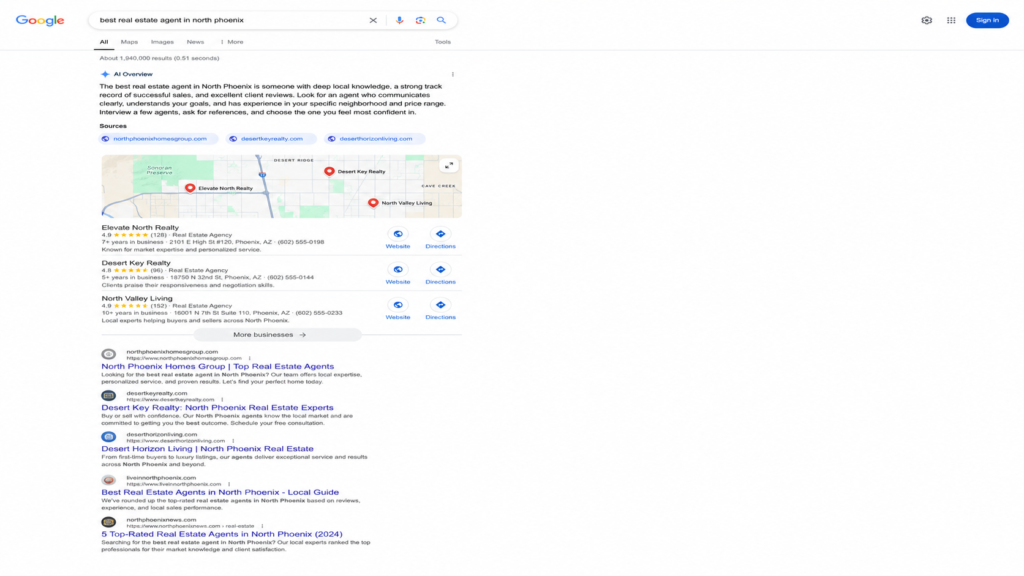
SEO & AEO: Getting Found on Google and AI Search
This is the channel most agents underbuild, and the one that compounds. An IDX-enabled, mobile-first website plus an SEO-driven blog and location pages builds traffic you own, not traffic you rent. Paid ads stop the day you stop paying. A page that ranks keeps working for years.
There is a new layer to it now. Buyers ask ChatGPT and read Google AI Overviews for agent recommendations and neighborhood questions before they ever fill out a form. Answer Engine Optimization (AEO) means structuring your content and your Google Business Profile so those AI answers cite you instead of a competitor. Clear questions, clear answers, and a complete, active profile are what make a page quotable.
This owned channel, ranking on Google and getting cited by AI search, is the one BASEO focuses on for real estate. The starting points are the same whether you do it yourself or hire it out: fix the SEO on your real estate website, publish local pages worth ranking, and set your profile up to rank in AI Overviews. For the agent-specific walkthrough, see our guide to SEO for realtors, and if you are still choosing a platform, start with an IDX-ready website builder.
Short-Form Video and Social Media
Short-form video is the highest-payoff social play for agents: Reels, TikTok, and YouTube Shorts. The agents winning here are not the most polished, they are the most consistent.
Three content ideas you can shoot this week:
- A 45-second listing walkthrough that opens with the best feature.
- A neighborhood tour: the coffee shop, the park, the school, the commute.
- A “3 things first-time buyers get wrong” education clip.
Match the platform to the persona. First-time buyers live on TikTok and Instagram, while move-up and downsizing sellers skew toward Facebook and YouTube. Shoot once, cut for each platform.
Email Marketing and Database Nurture
Your database is the highest-ROI asset you own, and email is how you keep it warm. Email returns roughly $36 for every $1 spent, per Litmus, because you are talking to people who already know you.
Segment the list so the message fits: past clients get referral and home-value touches, active buyers get new listings and market shifts, and your broader sphere gets a monthly newsletter. Keep the cadence simple: a monthly newsletter plus market updates when something in your area actually changes. The goal is to be the agent they think of first, not the one who only calls when they need a referral.
Paid Ads: Google, Meta, and Local Services Ads
Paid ads make sense when you have a specific job for them: promoting a new listing, generating buyer or seller leads on demand, or retargeting people who already visited your site. Google Ads for real estate and real estate Facebook ads each have their place, and Local Services Ads put you at the top of Google with a “Google Screened” badge.
Two rules keep paid from becoming a money pit. First, track cost per lead religiously, because a channel you cannot measure is a channel you cannot manage. Second, do not lean on paid before your organic foundations exist, or the ads just pay to expose a weak site and an empty Google Business Profile.
Traditional Marketing That Still Works
Digital does not replace local trust, it stacks on top of it. Yard signs, just-listed and just-sold postcards, door hangers, open houses, and sphere events still work because real estate is local and face-to-face.
Treat traditional as the complement, not the whole plan. A just-sold postcard hits harder when the neighbor has already seen your Reels and your name in the map pack.
How to Build a Listing Marketing Plan for Sellers
This is the plan you present to a seller to win the listing and then market the home. It is your single best differentiator in a listing appointment, because 91% of sellers hire an agent and marketing the home is one of their top reasons for choosing one.
Pre-Listing: CMA, Pricing, and Home Prep
Everything starts with the comparative market analysis (CMA). It is the pricing backbone, the data that tells the seller what the home is really worth and protects you both from an overpriced listing that sits.
Then find the story. Interview the seller about the home’s unique selling features: the renovated kitchen, the corner lot, the school district. They know things the MLS sheet never will. Finish with honest prep recommendations: the repairs, decluttering, and staging that move the needle, prioritized by return.
Listing Launch: Photography, Staging, and the MLS
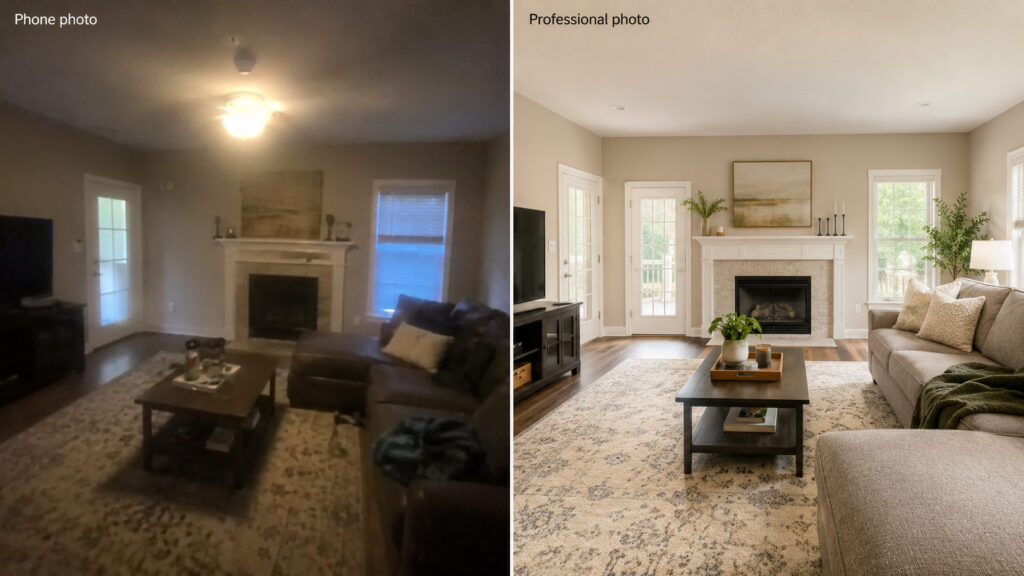
Professional photography is non-negotiable. Buyers judge your listing online before they ever step inside: 85% of buyers rank photos as the most important feature of an online listing, and homes with professional photos sell faster and for more than those shot on a phone.
Build the full launch package around those photos: a 3D or virtual tour, a walkthrough video, and listing copy that sells the lifestyle, not just the square footage. Then get the MLS entry right. Accurate fields, every feature filled in, and keyword-rich descriptions, because the MLS feeds every portal a buyer will search.
Amplification: Syndication, Social, and Open Houses
Listing on the MLS and hoping is the “post and pray” trap. The MLS is the start, not the finish. Your job is to push the listing everywhere the buyer is looking.
That means portal syndication to Zillow and Realtor.com, social promotion across your channels, and an email blast to your buyer database and your agent network. Then work the open house: a well-run event with real follow-up turns neighbors into leads and gives your seller proof you are working. Every channel you add is another shot at the right buyer seeing the home in its first week, when traffic is highest.
Seller Communication and Weekly Reporting
Here is the differentiator most agents skip: a weekly seller update, every week, even when it is quiet. Silence makes sellers nervous, and nervous sellers fire agents. A short, consistent report builds trust and manages price expectations when the market is slow.
A sample weekly report:
- Online views and saves across the portals
- Showings booked and completed
- Buyer and agent feedback, summarized
- Inquiry and offer counts
- Your recommendation for the week: hold, adjust price, or add marketing
Five lines. It takes ten minutes and it is the reason sellers refer you long after the sale.
The 7 Ps of Real Estate Marketing
The 7 Ps are a marketing framework that helps you position, price, and promote a home. They come from Booms and Bitner (1981), who extended the classic four Ps into a services marketing mix:
- Product: the home and how you present it (staging, photography, condition).
- Price: your pricing strategy, anchored by the CMA.
- Place: where the listing appears (MLS, portals, social, open houses).
- Promotion: the marketing that drives eyes to it (ads, email, video).
- People: you, your team, and the service the client experiences.
- Physical Evidence: your brand, signage, reviews, and proof you deliver.
- Process: how smoothly the transaction runs from offer to closing.
If your budget is tight, prioritize People and Process first. They cost time, not money, and they are what earn the reviews and referrals that make every other P cheaper.
5 Real Estate Marketing Plan Mistakes to Avoid
The top guides skip the failure modes. These are the five that quietly kill an agent’s plan, and the fix for each.
- No budget or tracking. Marketing “when you feel like it” with no cost-per-lead data means you never know what works. Fix: set a GCI-based budget and attribute every lead to its source.
- Too many channels done poorly. Being mediocre on six platforms beats no one. Fix: pick three or four, run them consistently, and add more only once those hum.
- “Post and pray” listings. Dropping a home on the MLS with phone photos and hoping is not a listing plan. Fix: run the full launch package, professional photos, syndication, social, and an email blast.
- Inconsistent branding. A different logo, color, and headshot everywhere means no one remembers you. Fix: one look, one voice, every channel.
- Treating the plan as one-and-done. A plan written in January and never reopened is a diary, not a strategy. Fix: review monthly, adjust quarterly, and cut what does not convert.
Turn Your Marketing Plan Into Rankings and Leads
A plan only pays off if buyers and sellers actually find you, and that is exactly where SEO and AI search come in. A converting, IDX-enabled website that ranks on Google and gets cited by AI is the compounding channel most agents leave on the table.
If you want to see where your website and Google presence stand today, get a free, written audit from BASEO. No call required, and it is yours to keep.
Real Estate Marketing Plan FAQs
Quick answers to the questions agents ask most when building a plan.
What should a real estate marketing plan include?
A real estate marketing plan should include SMART goals, a defined niche and target audience, a unique value proposition, chosen marketing channels, a budget, a content calendar, and KPIs to track results. Agents also add a listing marketing plan showing how they will market each property for sellers.
How much should real estate agents spend on marketing?
Most agents spend 5% to 10% of their gross commission income (GCI) on marketing. New agents and those in growth or competitive markets often invest 10% to 15%, and sometimes up to 20%. For example, an agent earning $300,000 in GCI at 10% would budget about $30,000 a year.
What are the 7 Ps of real estate marketing?
The 7 Ps of real estate marketing are Product, Price, Place, Promotion, People, Physical Evidence, and Process. They expand the classic four Ps into the services marketing mix, helping agents position, price, and promote listings to sell homes faster and for more money.
What is a listing marketing plan for sellers?
A listing marketing plan for sellers is the property-specific strategy an agent presents in a listing appointment. It covers pricing via a CMA, home prep and staging, professional photography, MLS and portal syndication, social promotion, open houses, and weekly seller reporting to market that home and win the listing.
How do I create a marketing plan as a new real estate agent?
New agents should start with free, time-based tactics: work your sphere of influence, host open houses, post consistent local content on social media, and build an email database. Set one or two SMART goals, pick three or four channels, and reinvest 10% to 15% of early commissions into marketing.
Leave a Reply