CMS

Author: Eddie Casas

  • Real Estate Facebook Ads: The Complete 2026 Lead-Generation Playbook

    Cash home buyer checking a new motivated seller lead from Facebook ads while standing outside a for-sale-by-owner house in a suburban neighborhood

    A cash buyer checks a fresh Facebook lead between property visits. The channel works, but only if you run it inside the rules.

    Most guides on real estate Facebook ads were written for agents chasing listings. They skip the one rule that gets cash buyers banned: your “we buy houses” ads are housing ads, and Facebook treats them differently from everything else. Get that wrong and the leads never come. Get it right and you have a real motivated-seller channel. Here’s the operator’s version, with real numbers and none of the fluff.

    Why Facebook Ads Still Work for Real Estate in 2026

    Facebook reaches a seller before they ever type a word into Google. You find the tired landlord or the guy behind on payments while he’s scrolling, not while he’s searching. That’s the whole value: interruption. Search catches sellers who already know they want out. Facebook catches them earlier.

    The tradeoff is honest and worth saying up front. That earlier seller is a lower-intent seller, and the moment you stop paying, the leads stop. Facebook is attention you rent, not an asset you own.

    It’s also getting pricier. Metro-market ad costs (CPMs, the price to show your ad 1,000 times) rose 20–35%, and real estate cost per lead climbed roughly 5–10% from 2025 to 2026 (Sotros). It still works. It just rewards operators who run it tight. If you’re weighing it against the free and referral channels, our breakdown of how to get motivated seller leads puts the paid option in context.

    The Special Ad Category That Changed Real Estate Facebook Ads

    Here’s the rule almost every agent guide buries. Because your ads are about housing, Facebook forces them into the Housing Special Ad Category, a restricted classification that strips out most of the targeting you’d normally use (Meta Business Help).

    This isn’t optional and it isn’t a glitch. It came out of a 2022 settlement between Meta and the U.S. Department of Housing and Urban Development over ad targeting that could discriminate in housing (Meta Newsroom). Fair-housing law now shapes how every “we buy houses” ad can be aimed.

    It hits a cash buyer harder than it hits an agent. Your whole pitch is geographic and situational. The Special Ad Category constrains both, so you have to win a different way.

    What You Can No Longer Target

    Inside the Housing category, the levers you’d reach for first are gone or capped (Meta Business Help):

    • No ZIP code targeting. You can target by city, county, or region, but not by postal code.
    • A 15-mile minimum radius. Drop a pin and Facebook automatically widens it to at least 15 miles in every direction (Meta Newsroom).
    • No location exclusions. You can’t carve out neighborhoods.
    • No age or gender targeting. Both are off the table.
    • Lookalike audiences and many interests are limited or unavailable. The precision tools most advertisers lean on are capped.

    What Still Works (and How to Win With It)

    You still pick the metro. You still let Facebook’s algorithm optimize toward the people most likely to act. And you still have the one lever the Special Ad Category can’t touch: your creative. When you can’t aim by demographics, you aim by message. More on that below, because it’s the whole game now.

    How Much Do Real Estate Facebook Ads Cost?

    In 2026, real estate Facebook ads cost about $35 per lead on average, though motivated-seller and home-valuation leads often run $15–$35, and smaller markets can fall to $8–$20. Expect a realistic starting budget of $500–$1,500 a month to gather enough data to know what a lead actually costs you (SuperAds).

    Now translate that into deal math, because cost per lead means nothing until it becomes cost per deal. Say your leads run $30 and you close 1 in 40 Facebook leads (paid social is lower-intent, so a low close rate is normal). That’s $1,200 in ad spend per deal, before you count the assignment fee or the flip. Tighter targeting-by-creative pushes that down. Sloppy ads push it up fast.

    Lead type / marketTypical cost per lead (2026)
    Home-valuation / seller leads$15–$35
    Buyer-form leads$35–$65
    Smaller (Tier-3) markets$8–$20
    Luxury$80–$200+
    Lead-form ad (avg)~$34
    Video ad (avg)~$46

    Real estate Facebook cost per lead, 2026. Motivated-seller and valuation offers sit at the cheap end; forms beat video on raw cost. Source: SuperAds.

    How to Set Up a Real Estate Facebook Ad Campaign (Step by Step)

    You don’t need an agency to launch. You need the steps in the right order and the discipline to declare the Special Ad Category before you do anything else. Here’s the sequence.

    1. Create your Facebook Business Page and ad account.
    2. Declare the Housing Special Ad Category.
    3. Choose your campaign objective.
    4. Build your audience within the rules.
    5. Pick the right ad format.

    Step 1: Create Your Facebook Business Page

    Everything runs through a business Page, not your personal profile. Set up the Page, open Meta Business Suite, and create an ad account under it. Add your payment method and confirm your business details so you’re not scrambling when an ad is ready to launch.

    Step 2: Declare the Housing Special Ad Category

    At the campaign level, Facebook asks whether your ad falls into a special category. For “we buy houses” ads, the answer is Housing, every time (Meta Business Help). Declaring it is mandatory. Skipping it to keep the better targeting is one of the fastest ways to get an ad rejected or an account flagged. Declare it and move on.

    Step 3: Choose Your Campaign Objective

    Your objective tells Facebook what to optimize for. Two fit motivated sellers: Leads (an instant form that opens inside Facebook) and Sales/Conversions (sending people to a landing page on your site). Lead forms are lower-friction and cheaper. Landing pages ask more of the seller and tend to bring higher intent. Pick based on how fast your team can follow up, which we’ll get to.

    Step 4: Build Your Audience Within the Rules

    Set your location to the metro you buy in, knowing the radius will snap to 15 miles minimum. Skip the demographic filters you can’t use anyway. If lookalikes are available in your account, keep them broad. Then let the algorithm do what it’s good at: finding the people in that area most likely to respond to your specific ad.

    Step 5: Pick the Right Ad Format

    Keep it simple. A single clear image or a short video outperforms busy carousels for this audience. Choose between a lead form and a link to your site based on your follow-up speed. On cost, lead-form ads average around $34 per lead versus roughly $46 for video, so forms win on price, but video often brings a warmer, more educated seller (SuperAds).

    The 3-Layer Facebook Ad Structure That Generates Leads

    A single ad blasted at a whole city wastes money. The structure that works is the same funnel you already run in acquisitions: reach a lot of people cold, warm up the ones who react, and close the ones who are ready.
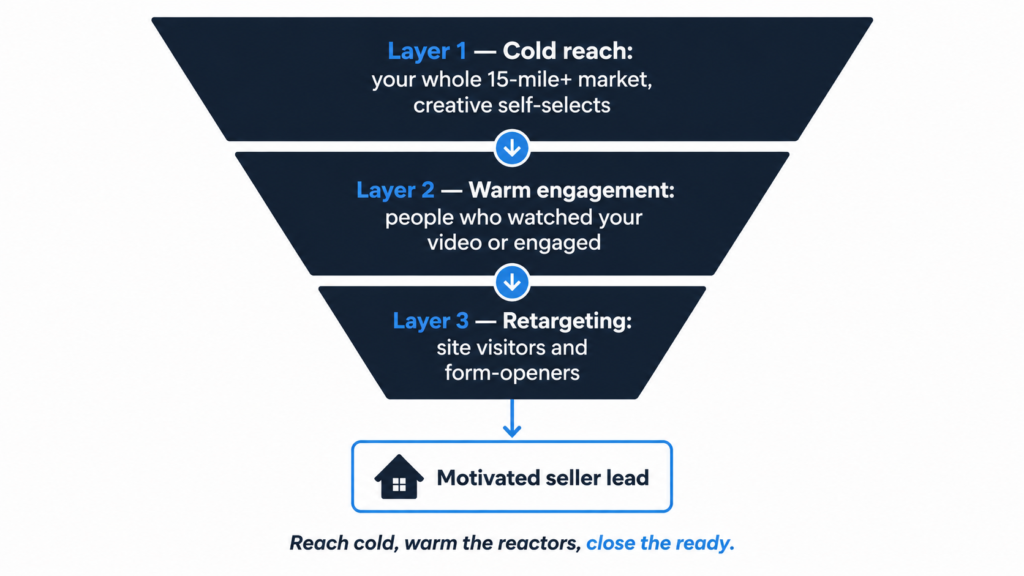
    Real estate Facebook ads funnel showing cold reach, warm audiences, retargeting, and motivated seller leads.

    The three layers: cold reach (often called TOF, top of funnel), warm engagement (MOF), and retargeting the ready seller (BOF). Each layer gets its own ad and its own budget.

    Layer 1 is cold prospecting: broad reach across your market, where the creative does the qualifying. Layer 2 re-engages the people who reacted, like video-viewers, with a stronger offer. Layer 3 is retargeting, the cheapest lead you’ll buy, covered in its own section below. Fund all three. Skipping the middle is why most single-ad accounts stall.

    Facebook Ad Creative: Where the Real Targeting Happens

    Since the Special Ad Category took your demographic targeting, your creative has to do that job instead. The headline and the image are your targeting now. Write for the situation, and only the sellers in that situation raise a hand.

    Speak to the moment, not the market. “Behind on payments and running out of time?” self-selects a pre-foreclosure seller. “Inherited a house you don’t want to keep?” pulls the probate seller. “Done being a landlord?” reaches the tired landlord with a problem tenant. Each ad filters the audience by relevance, which is exactly what you lost at the targeting layer.

    Keep it honest and plain. A phone photo of a real house beats a glossy studio render for this audience, because it reads as a real local buyer, not a national brand. If you want the fuller picture of how paid and organic social fit together, our guide to social media for cash buyers walks through the mix.

    7 Real Estate Facebook Ad Examples That Convert

    Every one of these is built to self-select a motivated seller, and every one is worded to stay inside Facebook’s rules (no “are YOU facing foreclosure” personal-attribute phrasing, which trips policy). Use them as starting angles.

    1. “Facing foreclosure? See your options before the auction date.” Pulls pre-foreclosure sellers who still think they have none.
    2. “Inherited a house you don’t want? We’ll buy it as-is.” Speaks to probate and out-of-state heirs.
    3. “Tired of being a landlord? Sell with the tenant still in place.” Reaches the burned-out buy-and-hold owner.
    4. “We buy houses as-is. No repairs, no agent fees, no showings.” For sellers who can’t or won’t fix up.
    5. “Need to sell fast before a move or divorce settlement?” Timeline-driven sellers who value speed over top dollar.
    6. Short video: “Here’s exactly how a cash offer works, in 60 seconds.” Educates the skeptical seller and warms Layer 2.
    7. “Get a fair cash offer in 24 hours.” The classic speed hook, still the highest-volume angle.

    Facebook Lead Ads vs. Landing Pages: Which Converts Better?

    Neither wins outright. They trade cost for quality, and the right pick depends on how fast your team calls a fresh lead.

    FactorFacebook lead adsLanding pages
    Cost per leadLower (~$34 avg)Higher
    Friction for the sellerLow (form pre-fills)Higher (they leave Facebook)
    Lead intentLowerHigher
    Follow-up urgencyExtreme (minutes)High
    Do you own the asset?NoYes
    Can it earn organic traffic?NoYes

    Lead ads are cheaper because they’re easy: the form pre-fills the seller’s info and they never leave the app. That ease is also the catch. Low friction means lower intent, and 78% of sellers work with the first buyer who responds (iHomefinder). If you can’t call within minutes, cheap leads go cold.

    Here’s the part the ad guides miss. A landing page is an asset you own, and a good one can also rank in Google for the exact searches sellers type when they’re ready. That’s the difference between renting attention and building something that pays you for years. It’s the channel we build for cash buyers, and it’s why a page worth advertising to is also a page worth ranking. If you want the mechanics, start with SEO for a real estate website and the keywords sellers search.

    Retargeting: How to Turn One Click Into a Client

    Most sellers won’t call the first time they see your ad. Retargeting is how you stay in front of the ones who showed interest, and it’s the cheapest lead you’ll ever buy because these people already know your name.

    The mechanics are simple. The Meta Pixel, a small tracking snippet on your website, remembers who visited. You then run ads only to those visitors and to people who watched most of your video. Warm audiences convert at a fraction of cold-audience cost.

    None of it matters without follow-up. About 80% of online leads need more than five follow-up attempts, yet the average operator follows up just 1.3 times (iHomefinder). Retargeting keeps you visible; a real cadence closes the deal. If your follow-up lives in your head instead of a system, a CRM to follow up is the fix.

    Common Mistakes That Get Real Estate Ad Accounts Banned

    A banned account costs you days and sometimes the whole ad account. Almost every ban traces to one of these:

    • Not declaring the Housing Special Ad Category. The single most common trigger. Declare it, always.
    • Personal-attribute language. Ads that imply you know something about the person (“Are you struggling with debt?”) violate Meta’s rules (Meta Transparency Center). Speak to the situation, not the person.
    • Fighting the 15-mile radius. Trying to sneak in ZIP-level targeting gets ads disapproved.
    • Landing-page mismatch. If the ad promises a cash offer and the page pitches something else, Facebook flags it.
    • Overreaching claims. “Guaranteed top dollar, today” reads as a policy violation and as a scam to sellers. Drop it.

    Ready to Scale Your Real Estate Lead Gen?

    Scaling lead gen is not the same as scaling ad spend. Every dollar you put into Facebook stops working the second you stop paying. Turn the ads off and the phone goes quiet the same week.

    The channel that compounds is the seller already looking for you: the one typing “sell my house fast” into Google, or asking ChatGPT who buys houses for cash in his city, at the exact moment he’s ready to deal. That intent is where the cheapest, highest-close leads live, and it’s the channel we build for cash home buyers. Original city pages for every market you buy in, tracking so every call and form is counted, and content formatted so AI search cites you. Not Facebook management, the organic engine underneath it.
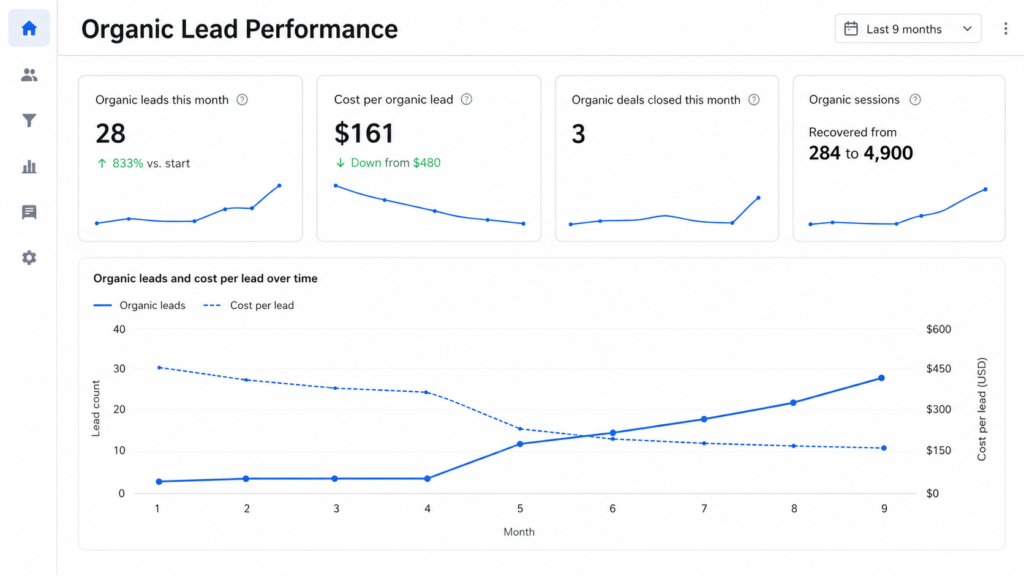
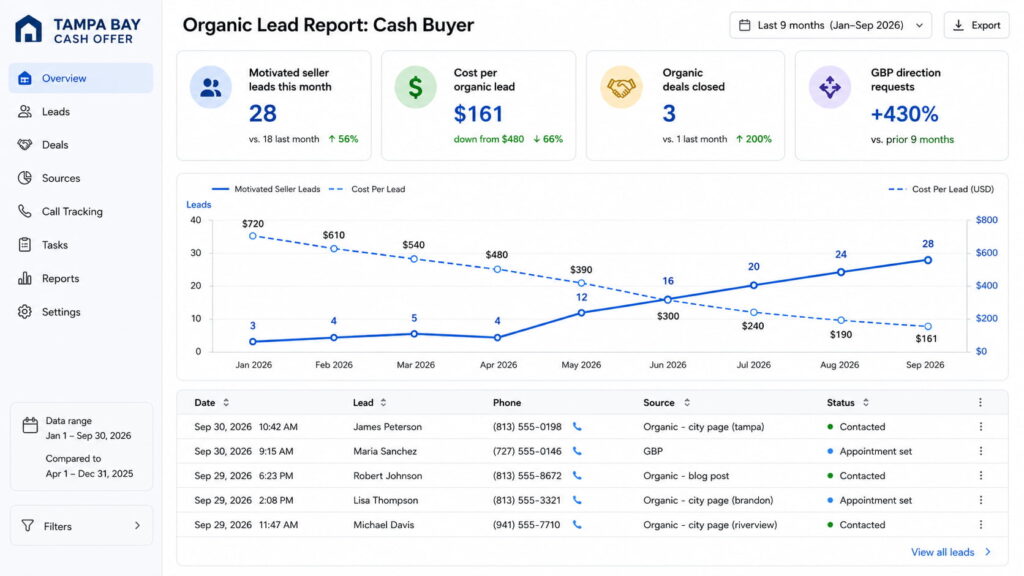
    real-estate-facebook-ads-organic-lead-growth-dashboard-2026

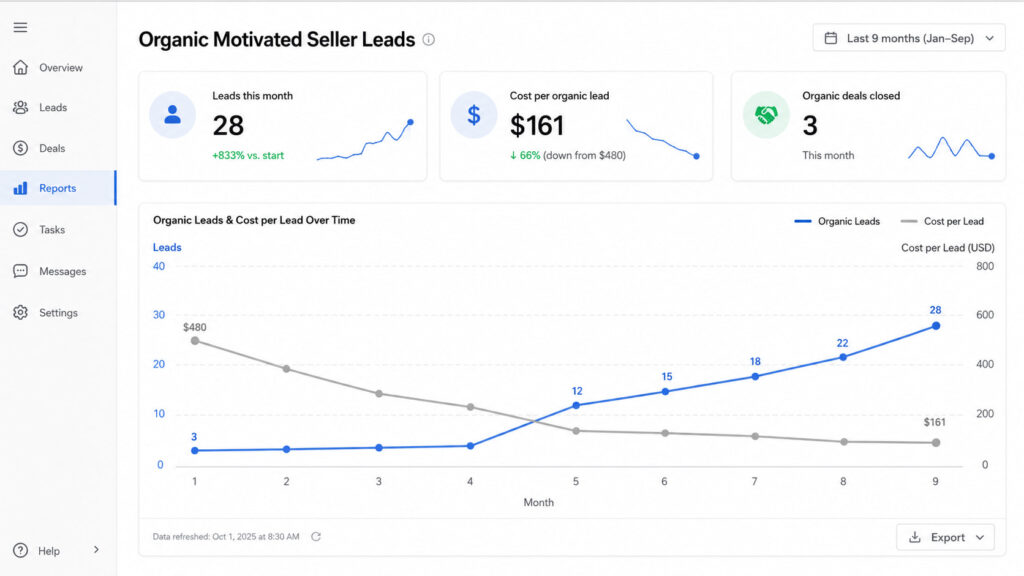
    One Florida cash buyer went from 3 organic leads a month to 28 in nine months, same market, no extra ad spend, with organic cost per lead around $161 and falling (BASEO client data).

    That’s the case for running both. Use Facebook to fill the pipeline now, and build the organic and AI Overviews presence that lowers your cost per deal over time. We work only with cash home buyers, so SEO built for cash home buyers already knows your keywords, your competitors, and your seller situations.

    Frequently Asked Questions

    How much do real estate Facebook ads cost?

    In 2026, expect about $35 per lead on average, with motivated-seller and home-valuation leads often at $15–$35 and smaller markets as low as $8–$20 (SuperAds). Plan on a $500–$1,500 monthly budget to gather enough data to know your true cost per lead, then judge it on cost per deal.

    Can I target by ZIP code for real estate ads?

    No. Because “we buy houses” ads fall under the Housing Special Ad Category, Facebook blocks postal-code targeting and enforces a minimum 15-mile radius around any location you pick (Meta Newsroom). You can target by city, county, or region, but not tighter than that.

    What is the Special Ad Category for housing?

    It’s Meta’s required classification for any housing-related ad, including cash-buyer ads. It removes age, gender, ZIP, and lookalike targeting to prevent housing discrimination, following Meta’s 2022 settlement with HUD (Meta Business Help). You must declare it, and it changes how you have to win: with creative, not demographics.

    Do Facebook lead ads work for real estate?

    Yes, for volume. Lead ads are cheaper and lower-friction, which also makes them lower-intent, so they live or die on follow-up speed. With 78% of sellers going to the first buyer who responds, lead ads only pay off if you can call within minutes.

    What budget should I start with?

    Start at $500–$1,500 a month. That’s enough to collect real data without betting the business on an unproven ad. Watch cost per lead first, then cost per deal, and scale only the ads that prove out.

    The bottom line

    Real estate Facebook ads are a real motivated-seller channel in 2026, but only if you respect the Housing Special Ad Category, aim with your creative instead of your targeting, and treat paid social as attention you rent. It fills the pipeline. It does not build equity.

    The leads that get cheaper every month come from the seller already searching for you, not the one you interrupt. Before you pour more into ad spend, it’s worth knowing what’s already working, and what’s broken, on the organic side of your lead gen. That’s what the audit is for. Free, in writing, no call required, yours to keep.

    Get your free site audit →

  • Marketing for Real Estate Agents: The Operator’s Playbook to Win More Deals

    Most marketing for real estate agents is a listicle of tactics nobody ranks in order. You have roughly 1.5 million licensed competitors, and the market got tighter: first-time buyers fell to a record-low 21% of buyers, the median buyer is now 40, and all-cash buyers hit an all-time high (NAR). Fewer, choosier sellers, more people fighting for each one. This playbook orders the work by what actually makes the phone ring, and it tells you the one hard truth most agent-marketing advice skips: social, ads, and portals rent you attention. Search and AI search build an asset you own.

    Real estate investor standing outside a suburban home with a For Sale sign, talking on the phone while evaluating the property and holding a clipboard on a residential street.


    Marketing is what turns a stranger into the seller who calls you first.

    Why real estate marketing matters more than ever

    The market tightened, and that raises the stakes on how you market. First-time buyers dropped to a record-low 21% of buyers, the median buyer age climbed to 40, and all-cash buyers hit an all-time high (NAR Profile of Home Buyers and Sellers). Fewer easy deals, more competition for each one.

    The bigger shift is where people look first. Sellers and buyers now research you online before they ever pick up the phone. For a growing share, the internet, not a referral, is where they first find the person they work with (NAR). If a motivated seller in your market can’t find you on Google, you’re not in the running, no matter how many deals you’ve closed.

    So marketing is not decoration on top of the job. It is the job of being findable and trusted the moment someone in your market decides to move. Chase listings one at a time and you compete on inventory. Build a marketing engine and you compete on trust, and trust is what gets the call.

    Step 1: Define your niche and personal brand

    Trying to be everyone’s agent makes you no one’s first call. The operators who get referred are the ones people can describe in a sentence: “she’s the first-time-buyer specialist on the east side,” “he’s the guy who buys houses fast in any condition.”

    Pick a lane you can own. A geographic farm (a specific set of neighborhoods or ZIPs you dominate), a client type (first-time buyers, downsizers, investors), or a situation you specialize in (probate, foreclosure, inherited, tired landlords). Choose where you already have traction, because you’ll be talking about it for years.

    Then build a brand that matches. A professional headshot, a simple logo, two or three consistent colors, a short tagline, and a one-line positioning statement (“I buy houses fast, as-is, anywhere in Tampa Bay”). Run the same look and message across your yard signs, your Instagram, and your email signature. Consistency is what makes a brand stick.

    Run this quick self-audit before you move on:

    • Who exactly do I serve, and can I name them in one sentence?
    • What do I want to be known for in my market?
    • Do my headshot, logo, and colors actually match that positioning?
    • If a stranger landed on my profile, could they tell in five seconds?

    Step 2: Build a lead-generating website and local SEO foundation

    Your website is the hub every other channel points to. Social posts, ads, and emails all send people somewhere, and you want that somewhere to be an asset you own, not a profile on a portal that also advertises three competitors next to your name.

    A lead-generating site needs a handful of things done well: IDX listings (a live feed of MLS homes embedded on your site), clear lead-capture forms, local pages for every market you work, real testimonials, and a fast mobile load. Most of your visitors are on a phone, and a slow page loses them before they see a thing.

    But here’s the order most people get wrong. Before content can pull leads, you need a foundation that makes leads countable. That means call tracking and form tracking installed, Google Analytics and Search Console set up (often for the first time), schema markup added (labels that tell Google exactly what your pages are), and your Google Business Profile rebuilt. This is the base layer BASEO installs first, because seller-situation pages without tracking is exactly how your last agency hid for eight months. The order matters: tracking first, then content, so every call and form gets counted from day one.

    Not sure which of these is missing on your site? A free written audit shows you the three biggest issues in about two business days, no call required, and you keep it either way. For the full technical walkthrough, here’s our guide to SEO for a real estate website.

    Local SEO and Google Business Profile

    Most buyers and sellers begin on search, and a lot of that search is local: “[city] homes for sale,” “sell my house fast [city],” “cash home buyers near me.” Local SEO is how you show up for those.

    Start with your Google Business Profile, the free business listing that appears in Google Maps and the local “map pack” of results. Rebuild it properly: correct category, service area, real photos, and a steady cadence of posts. Keep your NAP consistent, meaning your name, address, and phone number are identical everywhere online, because mismatches make Google trust you less. One client saw a 430% increase in Google Business Profile direction requests after the rebuild (BASEO client data), which is people literally pulling up directions to a business.

    Then work reviews relentlessly. Ask every closed client, make it one click, and respond to all of them. Reviews lift your local ranking and the odds a searcher picks you over the operator next to you.

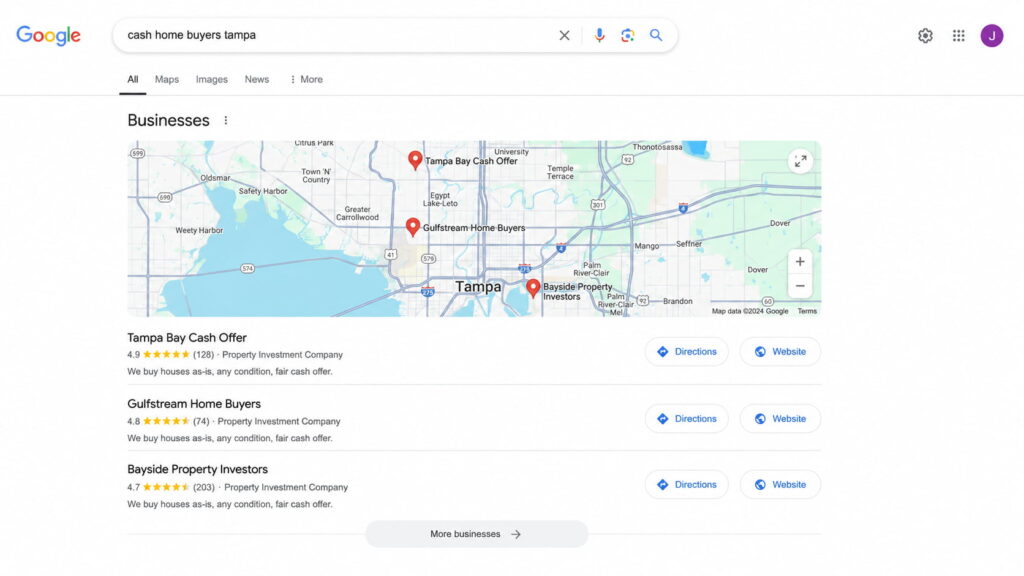
    Google search results page for “cash home buyers tampa” showing a local map pack with three property investment companies, including ratings, review counts, map locations, and options for directions and website access.


    The local map pack is where “near me” searches get decided, and Google Business Profile is how you get into it.

    Content and blogging for search visibility

    Search-optimized content is a slow asset that pays for years. The pages that actually pull leads on an operator’s site aren’t the homepage. They’re local pages for every market you work, and seller-situation pages that match the searches motivated sellers type under stress: probate, foreclosure, divorce, inherited property, problem tenants.

    Two rules make it work. Each page has to be original to its market, not a template with the city name swapped, because Google’s March 2024 update specifically went after duplicate, template content and buried the sites using it. And it has to compound: two to four genuinely useful pieces a month, organized into clusters, is what builds a moat. One client had watched organic traffic collapse from 10,000 sessions to 284 under a previous agency, then reversed that 97% drop within nine months of rebuilding it right (BASEO client data).

    The newer wrinkle is AI search. The AI-generated answers now sitting at the top of Google pull from well-structured, genuinely useful pages, so being cited in AI Overviews is becoming its own lead source. Nobody controls whether an AI cites you, and anyone promising page-one rankings on a timeline is guessing. But a year of consistent, local, honest content builds something a competitor can’t buy overnight.

    Step 3: Choose 2–3 social media platforms and go deep

    The fastest way to burn out on social is to try to be everywhere. Pick two, maybe three, platforms where your ideal clients actually spend time, and go deep instead of wide.

    Match the platform to your market. Local community and sphere reach still run through Facebook. Lifestyle and before-and-after deals play well on Instagram. Referral partners and relocation business live on LinkedIn. And keep the frame honest: social builds trust and reach, but it rents attention. The day you stop posting, the reach stops, which is exactly why it works best on top of the compounding search asset, not instead of it. For the deeper version, here’s our take on social media for real estate.

    Instagram and Facebook for listings and reach

    Instagram and Facebook are where most operators get their first traction, because the formats reward what you already have: properties and a local point of view.

    Lean on Reels (short vertical videos), before-and-after deal showcases, quick behind-the-scenes clips, and local spotlights on a business or park in your farm area. On Facebook, staying active in local community groups keeps you top of mind without paying for reach. The goal is to look like the operator who obviously knows this area, because that’s who gets the message when someone’s cousin needs to sell fast.

    A sustainable weekly mix might look like:

    • Monday: a quick market stat or “just closed” Reel.
    • Wednesday: a before-and-after or behind-the-scenes clip.
    • Friday: a local spotlight (a business, a neighborhood feature).
    • Sunday: a client win or a helpful seller tip.

    LinkedIn and video for authority

    LinkedIn is underrated for operators. It’s where referral partners, relocation business, and your professional sphere (agents, attorneys, property managers, lenders) actually pay attention. A steady presence turns your network into a referral pipeline.

    Video builds authority faster than any other format. YouTube is especially strong because neighborhood tours and “what it’s like to sell in [area]” videos are evergreen: they rank, they keep getting found, and they do the trust-building before you meet anyone. It’s worth putting video and 3D tours on your property pages too. Listings with video and interactive 3D walkthroughs tend to draw more views and more serious inquiries than photos alone, because someone who’s “walked” the home is already qualifying themselves before they call.

    Step 4: Nurture leads with email and CRM follow-up

    Most of your leads are not ready today, and that’s the whole point. The money is in staying useful for the months between “just looking into it” and “let’s do it.” Operators who win the long game have a system; the ones who don’t lose those leads to whoever followed up.

    That system starts with a CRM, a contact database that tracks every lead and automates follow-up so nothing slips. Everyone goes in: web inquiries, form fills, past sellers, your sphere. If you’re setting one up, our step-by-step on how to use a CRM for real estate walks through it. This is your tool to own, not something BASEO sells, but it’s non-negotiable for making the rest of this pay off.

    From there, nurture on a few simple tracks: a monthly market-update email, saved-search alerts for active buyers, and drip campaigns (automated email sequences that go out over time) for newer leads. Anniversary and check-in touches keep past sellers warm.

    One thing to fix today: speed to lead. When a new inquiry comes in, minutes matter. Responding in a few minutes instead of a few hours sharply improves your odds of connecting while the person is still paying attention. A CRM with instant notifications makes that automatic instead of luck.

    Step 5: Run paid ads to accelerate lead flow

    Ads buy speed. Organic builds an asset. That difference is the whole game: the day you stop paying, the ads stop, so use paid to accelerate lead flow, not as your entire plan.

    Two engines cover most operators. Google Ads captures intent: someone typing “sell my house fast [city]” is already looking, and you pay to sit at the top of that moment. Meta ads (Facebook and Instagram) work the other way, on audience targeting: you reach people by location, demographics, and behavior before they’ve searched. Retargeting sits on top of both, showing ads to people who already visited your site and left.

    Here’s the math that matters. Track cost per lead and cost per deal, never clicks or impressions. Paid leads for seller keywords run expensive and get pricier every year, and the moment you stop, they vanish. Organic goes the other way. One client reached $161 per organic lead by month nine, and it kept declining (BASEO client data), while their paid cost per lead stayed flat. The honest play isn’t killing PPC on day one, it’s running it well while organic compounds, then shrinking paid spend as the free channel takes over. BASEO runs both under the same cost-per-deal lens, and most clients cut paid spend meaningfully once organic is doing the heavy lifting.

    Google AdsMeta Ads (Facebook/Instagram)
    Best forCapturing active searchersBuilding awareness, seller leads
    TargetingSearch intent (keywords)Audience (location, demographics, interests)
    Typical use“sell my house fast [city]” campaignsHome-value offers, brand awareness
    Watch out forRising cost per click on seller termsNeeds strong creative; lower buying intent

    Step 6: Sharpen your listing presentation (photo, video, 3D)

    Here’s the part sellers actually judge you on: your last deals. Before a homeowner works with you, they look at how you marketed the properties you already handled. Your listings and case studies are your portfolio, and mediocre photos tell a prospective seller exactly how their home would be treated.

    So invest where it shows. Professional photography is the baseline. Video walkthroughs and interactive 3D tours go further, turning browsers into inquiries by letting someone experience the property before they visit. Deals presented this way attract more, and more serious, interest.

    Treat every property as an audition for the next one. When a seller down the street sees a well-marketed home with your sign in the yard, you’ve already made your pitch.

    Professional real estate marketing image featuring a bright, modern living room with large windows, natural light, neutral furnishings, and a staged interior. A virtual-tour interface appears alongside the room, displaying a dollhouse-style 3D floor plan and navigation controls, illustrating an interactive home walkthrough experience for property listings.


    Sellers judge your marketing by your last deals. Photo, video, and 3D are the audition.

    Step 7: Systematize referrals and past-client marketing

    Referrals and repeat business are the highest-return marketing you have, and the channel most operators leave entirely to chance. Past clients and their referrals make up a large share of experienced operators’ business (NAR), yet most go quiet the moment a deal closes.

    Systematize it instead of hoping. Build a repeatable cadence of value and asks, so staying in touch isn’t something you “get around to.” A simple past-client engine:

    • At close: ask for the review while the good feeling is fresh, and make it one click.
    • Quarterly: a genuinely useful email (market update, home-maintenance tip), not a “just checking in.”
    • Anniversary: a personal note on the date the deal closed.
    • Annually: a client event or a “state of your neighborhood” value piece.
    • Always: ask directly. “Who’s the next person you know thinking about a move?”

    Those review requests do double duty, feeding the local authority you built in Step 2. Real editorial links and citations from local chambers, REIAs, and local news outlets are the kind of authority that moves rankings, and it’s the sort of thing BASEO builds for the markets you work, with no link farms or paid schemes. The referral you earn today is the deal you close next quarter.

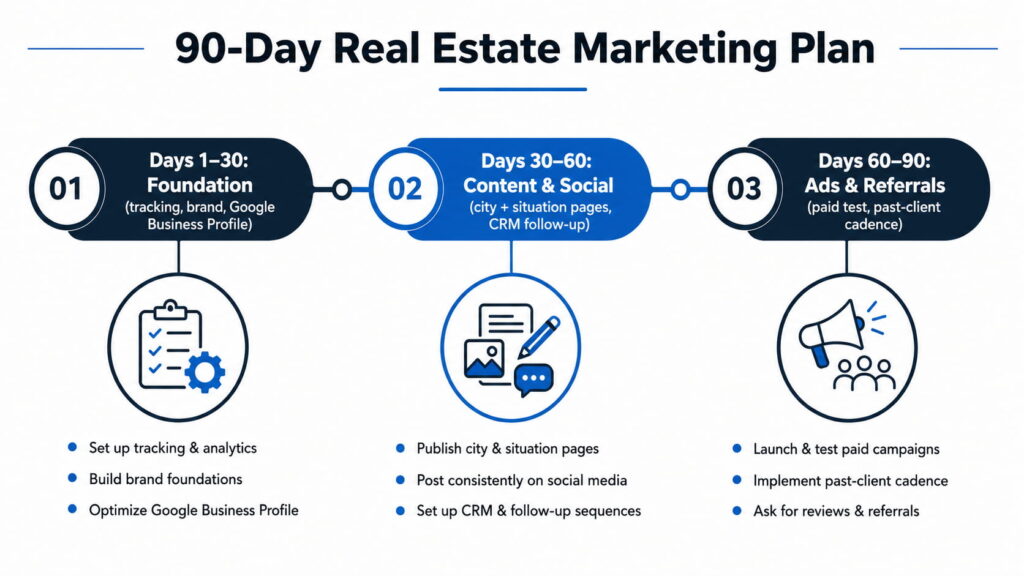
    How to build a 90-day real estate marketing plan

    Seven steps is a lot to do at once, so don’t. Sequence them. Build the foundation first, then the content and social engine, then paid and referrals on top. Here’s a 90-day rollout you can copy:

    1. Days 1–15: Install the foundation first: call and form tracking, Analytics and Search Console, and a rebuilt Google Business Profile.
    2. Days 1–15: Lock your niche and brand basics (headshot, logo, colors, positioning statement).
    3. Days 15–45: Choose two social platforms and start a weekly cadence you can sustain.
    4. Days 15–60: Publish your first local page and seller-situation pages (probate, foreclosure, inherited), original to your market.
    5. Days 30–60: Put every lead into a CRM with instant notifications and an automated follow-up sequence.
    6. Days 60–90: Launch one small paid campaign on Google or Meta and track cost per lead.
    7. Days 60–90: Set up your referral and past-client touch cadence and start asking for reviews.
    8. Days 90+: Review by cost per lead and cost per deal, then double down on the channel that’s working.
    Professional vector infographic titled “90-Day Real Estate Marketing Plan” displaying a horizontal three-phase timeline. The first phase, Days 1–30: Foundation, highlights tracking and analytics setup, brand development, and Google Business Profile optimization. The second phase, Days 30–60: Content & Social, focuses on publishing city and situation pages, consistent social media posting, and CRM follow-up sequences. The third phase, Days 60–90: Ads & Referrals, covers paid advertising tests, past-client outreach, and referral generation. Each phase is represented by a rounded timeline segment with a corresponding icon, connected in sequence using a clean navy and blue design on a white background.


    Build in order: foundation first, then the engine, then the accelerators.

    Real estate marketing tools and budget benchmarks

    You don’t need every tool, and you definitely don’t need the most expensive one. You need one solid pick per category and the discipline to use it. A common rule of thumb is to reinvest roughly 10% of your income into marketing, with newer operators spending more upfront to get visible and established ones spending less as referrals carry more of the load.

    Here’s a vendor-neutral starting map:

    CategoryExample toolsRough monthly costNote
    CRMFollow Up Boss, HubSpot, REsimpli$0–$150Start lean; upgrade as lead volume grows
    Social schedulerLater, Buffer, Metricool$0–$40Batch a week of posts in one sitting
    DesignCanva$0–$15Templates for deals, stories, flyers
    Website / IDXCarrot, AgentFire, WordPress + IDX$30–$150Own the hub; IDX pulls in live listings
    Email marketingMailchimp, MailerLite$0–$50Newsletters and drip campaigns

    Budget bands, monthly: a newer operator can run a credible program on roughly $150–$500 in tools plus sweat equity on content and social. Done-for-you SEO is its own line: across the industry, investor SEO retainers typically run $2,000–$6,000 a month, which is why the cost-per-deal math matters so much. Judge every dollar by cost per lead and cost per deal, not by how busy it makes you feel. One deal usually covers many months of the investment.

    Ready to get found by more sellers?

    That’s the whole playbook, and every piece of it is work, every month. Some operators run it themselves and do fine. Most would rather spend that time closing deals.

    If you want to know which pieces your site is missing before you decide either way, that’s what the audit is for. BASEO works only with cash home buyers, so it already knows your competitors, your keywords, and your seller situations. You send the domain, you get the three biggest issues, your competitor’s keyword gap, and the deal math for your market, in writing, in about two business days. No call required, and you keep it whether we ever speak or not.

    Get your free site audit →

    Frequently asked questions

    A few of the questions operators ask most about marketing themselves.

    How much should a real estate agent spend on marketing?

    Most agents invest roughly 10% of their income into marketing, though newer ones often spend more upfront to build visibility. Start with a lean budget focused on a tracked website, one paid channel, and a CRM, then reinvest as leads convert into closed deals. Done-for-you SEO across the industry tends to run $2,000–$6,000 a month, so judge it by cost per deal, not sticker price.

    What is the best marketing strategy for a new real estate agent?

    For newer operators, the fastest path is combining a defined niche, a rebuilt Google Business Profile, and consistent posting on two social platforms, all sitting on a tracked website. Pair that with disciplined follow-up in a CRM. Local SEO and referrals compound over time and cost little beyond effort, which is why they beat paid over the long run.

    Do real estate agents need a website?

    Yes. Sellers and buyers now research you online before they reach out, so a website is the hub that captures leads and builds credibility. It hosts your local pages, testimonials, and seller-situation content, and gives paid ads and social posts a destination you own that converts visitors into inquiries, instead of sending them to a portal.

    How do real estate agents get leads online?

    Operators generate online leads through local SEO, a tracked lead-capture website, social media, paid ads, and email nurture. Search and referrals produce the highest-intent leads, while paid ads accelerate volume. The key is consistent follow-up, since most leads convert weeks or months after first contact.

  • Google Ads for Real Estate: The 2026 Guide to High-Intent Leads

    Google Ads put you in front of people who are searching to buy or sell a house right now. Not next year. Today. That is the whole appeal, and it is why real estate keeps spending on paid search even as clicks get pricier.

    The good news: real estate has some of the cheapest clicks of any industry. The average cost per click sits around $3.22 in 2026 (WordStream), and more than 90% of buyers use the internet somewhere in their search (NAR data via Axios). The bad news: cheap clicks are not the same as cheap leads.

    This guide covers what Google Ads actually cost in 2026, the four campaign types, the keywords that convert, and the one policy that quietly shuts down new investor accounts: the Housing Special Ad Category. No promises of easy money. Just the math.

     An operator checking a fresh lead. The click is cheap. The lead only pays off if someone calls it back fast.

    Do Google Ads actually work for real estate?

    Yes, but only if you have three things first: a landing page built to capture leads, a CRM to follow up, and the discipline to call every lead within five minutes. Google Ads reach buyers and sellers with high, bottom-of-funnel intent. Without those three, the clicks convert to nothing.

    Start with the landing page. Your homepage is not it. A homepage asks the visitor to browse. A landing page asks for one thing: the phone number or the address. Send paid clicks anywhere else and you pay for traffic that wanders off.

    Then the follow-up. A lead you do not call is money you set on fire. Responding within five minutes makes you roughly 900% more likely to reach the lead than waiting even a little longer (speed-to-lead research). A CRM is how you make that happen every time instead of when you remember.

    When all three are in place, the numbers get good. Well-run real estate campaigns report a return near 8:1 (Avenue). That is eight dollars back for every dollar in. But read the word “well-run” twice. The 8:1 is the ceiling for operators who did the boring prep, not a starting point.

    What Google Ads cost for real estate in 2026

    There is no single price. What you pay depends on three levers: the keyword you bid on, the campaign type you run, and how competitive your market is. A buyer click in a quiet market and a “sell my house fast” click in a major metro are not in the same universe. Here is how each one breaks down.

    Cost per click by keyword type

    Real estate clicks are cheap on average. The 2026 average cost per click is about $3.22, one of the lowest of any industry (WordStream). But the average hides a wide spread, because a buyer browsing listings and a seller in distress are worth very different amounts.

    Keyword typeExampleTypical CPCWhy
    Buyer intent“homes for sale in phoenix”$0.50–$5High volume, lower urgency, plenty of free organic competition
    Seller intent“sell my house fast dallas”$5–$65Each lead can be a deal worth thousands, so investors bid hard
    Premium niche“luxury waterfront homes”$100+ per leadSmall audience, high value, few advertisers willing to pay

    Seller keywords cost the most for a simple reason: a motivated seller can turn into an assignment fee or a flip. The commercial value per click is high, so more investors crowd the auction and the price climbs. That is the trade. You pay more per click for the searches most likely to become a deal.

    Cost per lead: seller vs. buyer campaigns

    Cost per click is not cost per lead. The gap between them is your landing page and your follow-up. In a well-optimized campaign, seller leads run about $15–$20 each in the US and Canada. That is the low end, and it takes tight message match and fast follow-up to hit it.

    Buyer campaigns work differently. At a $20–$25 cost per click and a 10–15% conversion rate, your cost per lead lands closer to $200–$250. Higher, because buyer intent is softer and the sales cycle is longer.

    Generic industry averages sit in between, around $100 to $116 per lead (WordStream). The spread is enormous because cost per lead real estate Google Ads numbers depend on everything downstream of the click: keyword intent, page quality, market, and how fast you call. Two investors bidding on the same keyword can see a 10x difference in cost per lead based on nothing but their landing page and phone habits.

    How much should you budget per month?

    You need enough budget to give Google’s algorithm data to learn from. Too little and it never optimizes.

    A working floor is $500 to $1,000 per month just to start collecting real numbers. A solo operator who wants consistent lead flow usually needs $900 to $2,000 per month. In large, competitive markets, expect $2,000 to $3,000 or more to stay visible against investors who have been bidding for years.

    The trap is going in under the floor. On a tiny budget, you get a handful of clicks, almost no leads, and no signal for the algorithm to improve on. You are not testing Google Ads at that point. You are just donating to Google.

    The 4 Google Ads campaign types for real estate

    Google gives you four ways to run real estate ads: Search, Local Service Ads, Performance Max, and Display or Remarketing. They are not equal for lead generation. If you are starting out, put your money into Search and Local Service Ads first. That is where the intent, and the ROI, live.

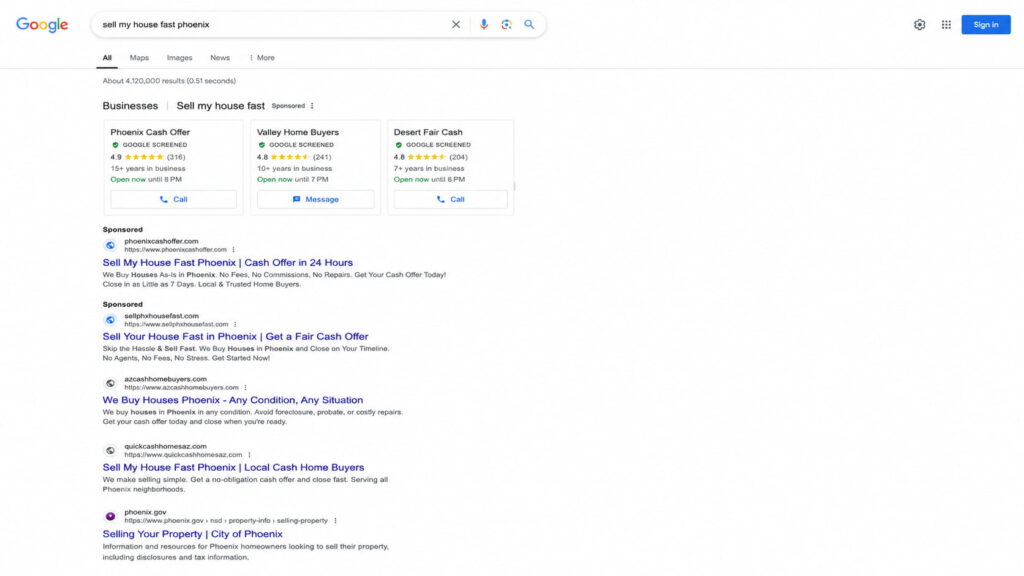
     Local Service Ads sit above everything, then Search Ads, then organic. The order on the page is the order of intent.

    Search Ads

    Search Ads are the text ads that show when someone types a query. They carry the highest intent of any ad type, because the person is actively searching for exactly what you offer. Typical cost per lead runs $50 to $70. Use them as your foundation. A seller-intent Search Ad for “sell my house fast Dallas” might read: “Sell Your Dallas House Fast, Fair Cash Offer in 24 Hours, No Repairs, No Fees.” Keyword in the headline, promise in the description, one clear action.

    Local Service Ads (LSAs)

    Local Service Ads run on a different model. You pay per lead, not per click, so you only pay when someone actually calls or messages you (Google). They sit above the regular Search Ads at the very top of the page, and they carry a “Google Screened” badge once you pass Google’s verification. For a local operator, that badge plus the top spot is close to gold. The catch is the verification step, which takes time and documentation, so start it early.

    Performance Max

    Performance Max is Google’s fully automated, multichannel campaign. It spreads your budget across Search, Display, YouTube, and more, and lets the algorithm decide. It only works once you already have solid conversion data loaded, because the automation needs something to optimize toward. This is not a beginner tool and it is not for small budgets. Run it after your Search campaigns are producing steady leads, not before.

    Display & Remarketing

    Display and Remarketing ads are the banners that follow people around the web. They are best for awareness and for re-touching visitors who came to your site and did not convert. Clicks are cheap, but intent is low, so treat these as a support layer, not a lead source. The right job for Display is reminding a seller who already visited your page, not finding a new one cold.

    Best keywords for real estate Google Ads

    Your keyword list is really three lists: seller-intent keywords, buyer-intent keywords, and the negative keywords that stop you from paying for junk. Seller keywords convert hardest and cost most. Buyers are cheaper but slower. And negatives protect the whole budget.

    Seller-intent keywords

    These are the searches a motivated seller types when they want out. They convert best and cost most, so bid on them deliberately:

    • “sell my house fast [city]”
    • “what is my home worth [zip]”
    • “home value estimate”
    • “cash offer for my house”

    Every one of these signals a person ready to act, which is why the click is expensive and worth it. If you want the full channel picture around these searches, our guide on how to get motivated seller leads covers where paid fits next to free and referral sources.

    Buyer-intent keywords

    Buyer keywords pull more volume at a lower cost per click, but the sales cycle is longer, so plan for more follow-up before a deal:

    • “homes for sale in [city/neighborhood]”
    • “best real estate agent near me”
    • “[city] condos for sale”

    These are cheaper to click but softer in intent. A buyer searching listings may be months from a transaction, so nurture beats hard-sell here.

    Negative keywords you must add

    Negative keywords tell Google which searches to ignore. Skip them and you pay for clicks that will never become a deal. Add these on day one, at minimum:

    • “jobs”
    • “salary”
    • “careers”
    • “free”
    • “zillow”
    • “realtor.com”
    • “for rent”
    • “rental”
    • “how to become a realtor”
    • “real estate license”
    • “real estate school”
    • “diy”

    Each of these catches a searcher who wants a job, a rental, or a course, not your service. Blocking them is the fastest way to stop your budget from bleeding on the wrong clicks.

    The Housing Special Ad Category: what breaks most accounts

    This is the part most new real estate advertisers miss, and it is the one that costs them their account. Google classifies real estate as a Special Ad Category for housing in the US and Canada (Google Ads policy). That classification changes the rules on you.

    Two things happen. First, Google restricts how you can target. Second, and this is the one that surprises people, Google reviews both your ad and your landing page for compliance (Google Ads policy). Your ad can be spotless and still get flagged for what is on the page it points to.

    Ignore this and the consequences escalate fast: ad disapprovals, limited delivery, or a full account restriction that is painful to reverse. Carrot has warned investors about exactly this in its Housing policy coverage. Treat the Special Ad Category as the first thing you handle, not a surprise you discover after your account gets limited.

    What targeting you lose

    Under the Housing category, you cannot target or exclude people by age, gender, parental status, marital status, or ZIP code, and housing-related interest targeting is restricted (Google Ads policy). The fine-grained audience controls other advertisers rely on are off the table.

    That sounds like a handicap. It is really a forcing function. Since you cannot win with narrow targeting, you win with message and keyword instead. The right keyword already filters for intent, and a sharp ad does the qualifying that demographics used to. Build around the search, not the person.

    Fair Housing language on your landing page

    Because Google reads your landing page too, the words on it matter as much as the words in your ad. Certain phrases trigger a Fair Housing flag on sight. Never use language like:

    • “exclusive community”
    • “no children”
    • “English-speaking only”
    • “Christian neighborhood”

    The rule reaches further than most people expect. Even a testimonial that mentions a demographic characteristic can violate the policy. Audit every line of your landing page copy with a Fair Housing lens, cut anything that describes who a neighborhood is “for,” and use inclusive imagery. When in doubt, describe the house and the offer, never the buyer.

    How to set up your first campaign (step by step)

    Setting up a compliant, lead-focused campaign is a sequence. Follow it in order, and do not skip step two.

    1. Create your Google Ads account. Use a business email and set your billing before you build anything.
    2. Declare the Housing Special Ad Category at campaign creation. This is non-negotiable. Real estate campaigns must be flagged as housing when you create them. Skip it and you are out of compliance from the first click.
    3. Choose your objective. For lead generation, pick Leads or Website traffic, not brand awareness.
    4. Set your geography and daily budget. Draw the target area around the markets you actually buy or sell in, and set a daily budget that adds up to your monthly floor.
    5. Build ad groups by intent. Keep seller keywords and buyer keywords in separate ad groups so each gets its own tailored ad and its own budget.
    6. Write responsive search ads with the keyword in the headline. Match the ad to the search. “Sell My House Fast [City]” in the headline tells both Google and the seller they are in the right place.
    7. Connect conversion tracking before you spend a dollar. Track calls and form fills. Without conversion tracking, you are flying blind and the algorithm has nothing to optimize toward.

    Step two is the one that saves accounts. Declare the Housing category up front and the rest of the build is ordinary Google Ads work.

    Landing pages that convert real estate ad clicks

    A great ad pointed at a weak page is wasted money. The page is where the click becomes a lead, and a few rules decide whether it does.

    Start with message match. The headline on your landing page should echo the ad and the keyword almost word for word. If the ad said “Sell Your Dallas House Fast,” the page should open with the same promise. When the message matches, Google rewards you with a higher Quality Score, and a higher Quality Score lowers your cost per click. Message match is not just conversion hygiene. It is a discount on every click.

    Then, one audience per page. A buyer running an IDX property search and a seller wanting a home valuation need different pages. Do not make one page try to serve both. Keep the form short, load fast on mobile, and make the single next action obvious.

    Keep the social proof compliant. Reviews and results are fine, but per the Housing rules above, drop any testimonial that references demographics. Describe the outcome, never who the customer was.

    How to know if your campaigns are working

    Give it time before you judge it. Most operators see their first leads within 7 to 14 days. The first 30 to 60 days are the learning phase, when Google collects conversion data and figures out who to show your ads to. Full efficiency usually arrives around 60 to 90 days. The biggest early mistake is tinkering with the campaign every day during the learning phase, which resets the algorithm’s progress.

    Watch the numbers that actually predict deals, not vanity metrics. Here is where a healthy real estate campaign lands:

    Metric2026 real estate benchmarkWhat good looks like
    Click-through rate (CTR)~7.6–8% (WordStream)At or above benchmark means your ad and keyword match
    Conversion rate~3.3% (WordStream)Above 3.3% means your landing page is doing its job
    Cost per lead~$100+ average; $15–$20 for tight seller campaignsFalling over time as the algorithm learns
    Cost per acquisitionYour CPL divided by close rateThe number that tells you if a deal actually pays

    CTR and conversion rate tell you if the front end works. Cost per lead and cost per acquisition tell you if the business works. If clicks are cheap but leads are not converting, the problem is almost always the landing page, not the bid.

    Should you run Google Ads yourself or hire help?

    You can absolutely run this yourself. If you have the time to learn the platform and a budget you can afford to spend while you figure it out, DIY is a real option, especially for a single market. Plenty of operators run their own Search campaigns and do fine.

    Hiring help makes sense when the cost of mistakes outweighs the fee. The Housing Special Ad Category, wasted spend on the wrong keywords, and a slow landing page can quietly cost more than a manager would. This is the lens BASEO uses on paid: motivated-seller campaigns run under the same measure as everything else, leads and cost per deal, never clicks or impressions as a scorecard. If your current PPC manager does not know a real estate account from a plumber’s, that is usually where the money leaks. Whatever you decide, the honest math should drive it, not a sales pitch.

    Get more leads without paying per click

    Here is the limit of Google Ads, and it is a real one. The day you pause your spend, the leads stop. Paid search rents attention. You are only visible while the meter runs.

    Organic search works the other way. SEO and AI search optimization (AEO) build traffic that compounds, so the pages you rank keep pulling leads at a falling cost per lead long after they are published. One Florida cash buyer we work with went from 3 to 28 motivated seller leads a month in nine months, same market, no extra ad spend (BASEO client data). That is the difference between renting attention and owning the asset.

    The strongest setup uses both: ads for immediate flow while your organic engine builds. If you want to see what your market’s organic lead math looks like next to your ad spend, that is what our free audit is for. It covers SEO for a real estate website and how to rank in AI Overviews in your specific market. Written, delivered in about 2 business days, no call required, yours to keep.
    Get your free site audit →

    Paid leads stop the moment you stop paying. Organic keeps compounding after the work is done.

    Frequently asked questions

    Quick answers to the questions real estate advertisers ask most about Google Ads.

    Are Google Ads worth it for realtors?

    Yes, if you have three things first: a lead-capture landing page, a CRM, and the discipline to call every lead within five minutes. Well-run real estate campaigns report ROI near 8:1 because Google Ads reach buyers and sellers with high, bottom-of-funnel intent. Without those prerequisites, results disappoint.

    How much do real estate leads cost on Google Ads?

    Seller leads typically cost $15 to $20 each in well-optimized US and Canadian campaigns, while buyer leads run higher, often $200 to $250, because of longer sales cycles. Generic industry averages land around $50 to $110 per lead. Premium niches like luxury or waterfront homes can exceed $100 per lead.

    How long until Google Ads generate leads?

    Most agents see their first leads within 7 to 14 days of launching a Search campaign. The first 30 to 60 days are the algorithm’s learning phase, when Google collects conversion data. Expect 60 to 90 days before a campaign reaches full efficiency, so avoid major edits early on.

    What is the Housing Special Ad Category?

    It is Google’s rule that treats real estate ads like credit and employment ads. You lose targeting by age, gender, ZIP code, and housing-related interests, and Google reviews both your ad and landing page for Fair Housing compliance. Ignoring it risks disapprovals or account restrictions.

    Google Ads or SEO for real estate?

    Google Ads deliver leads fast but stop the moment you pause spending. SEO and AEO build compounding organic traffic that keeps generating leads without per-click costs. The strongest approach uses ads for immediate flow while SEO builds a durable, lower-cost lead engine over time.

  • How to Do SEO for a Real Estate Website: The Step by Step Playbook

    Ninety three percent of home buyers use real estate websites as an information source, and roughly 44% start the whole search online (NAR). The sellers and buyers you want are already searching. The only question is whether your site is the one they find.

    This is the playbook: eight steps to rank a real estate website, ordered by impact, written for the operator who wants the phone to ring, not a marketing lecture. No fluff, no guarantees. Just the work, in the order that matters.

    An investor checks a new lead the morning after his city page went live. That is what all eight steps are building toward.

    What Real Estate SEO Actually Means (and Why It Beats Paid Leads)

    Real estate SEO is the work of optimizing your website so buyers and sellers find you when they search Google for property, a cash offer, or an investor in a specific area. Done right, it puts your site in front of people at the exact moment they are looking, and it keeps doing it after the work is done.

    That last part is the whole difference from paid. The moment you stop funding Google Ads, the leads stop with them. SEO keeps working. One page you rank today can still pull leads two years from now with zero additional spend.

    The other advantage is intent. Someone who types “sell my house fast” into Google already wants what you offer. You are not interrupting them with an ad. You are showing up as the answer. That is why organic leads close differently, and why mature organic can run down to figures like $161 per lead and keep falling (BASEO client data) while paid cost per lead climbs every year.

    Step 1: Start Your Real Estate SEO With a Baseline Audit

    You cannot fix what you have not measured. Before you write a single page, get an honest read on where your site stands.

    Start with the free tools. Connect Google Search Console and GA4 so you can see what Google already knows about your site and where your traffic comes from. Run your key pages through PageSpeed Insights. Only then reach for paid tools like Ahrefs or Semrush, which are worth it for competitor keywords and gap analysis once the basics are in place.

    Here is the baseline checklist:

    • Confirm your important pages are actually indexed in Search Console.
    • Check page speed, especially on mobile.
    • Find orphan pages (pages with no internal links pointing to them).
    • Flag duplicate or near-identical content, the classic Carrot-template problem.
    • Verify call tracking and form tracking exist, so leads are countable from day one.
    • Note which local keywords your top competitor ranks for that you do not.

    This is also the first thing BASEO does for a new cash buyer. Before any monthly fee, you get a free written audit: the three biggest issues holding the site back, the competitor gap, and the deal math for your market. It is yours to keep whether we ever speak or not.

    Step 2: Real Estate SEO Keyword Research That Matches How People Search

    People search the way they talk, not the way marketers write. Nobody types “distressed property acquisition services.” They type “who buys houses for cash near me.”

    Your keyword research is really just writing down the real sentences your market uses. A few examples:

    • “we buy houses [city]”
    • “how much is my house worth in [city]”
    • “sell my house fast [city]”
    • “best realtor for first time buyers [city]”

    Notice how specific those get. That is long-tail, and long-tail is where you win first. “Real estate” has millions of searches and zero chance for your site. “Sell inherited house fast in [your city]” has less volume, far less competition, and a searcher who is ready to talk. Less traffic, more leads. That trade is almost always worth it.

    The 4 Search Intents in Real Estate

    Every real estate keyword falls into one of four intents, and each one needs a different page.

    1. Research: the searcher wants information about areas or prices (“cost of living in [neighborhood]”).
    2. Comparison: they are weighing options or agents (“cash buyer vs realtor”).
    3. Transactional: they are ready to act now (“sell my house fast [city]”).
    4. Valuation: they want a number (“what’s my home worth in [city]”), which is the moment to capture a seller before they call anyone else.

    Map One Keyword Group to One Page

    One rule prevents most self-inflicted ranking problems: each group of keywords maps to one dedicated page. When two pages target the same terms, Google cannot decide which to rank, so it often ranks neither well. That is keyword cannibalization.

    So do not mix “sell my house fast Dallas” and “Dallas homes for sale” on the same page. Different intent, different searcher, different page. One page, one job.

    Step 3: Build Location Pages (the Core Asset of Real Estate SEO)

    If you take one thing from this playbook, take this: location pages are the core asset of real estate SEO. Every market you buy in deserves its own page, and no two of those pages should read the same.

    The reason is simple. Real estate is local-first, and Google prioritizes local results. Someone searching in Tampa gets Tampa results. Without a real Tampa page, you are invisible to that search no matter how good your homepage is.

    Every one of those spots is a page someone built.

    Building original pages for every market you serve is the core of what BASEO does for cash buyers, and it is the foundation of SEO built for cash home buyers.

    What Every Location Page Needs

    A location page that ranks is not a homepage with the city name swapped in. It carries real, local substance:

    • The local keyword in the title tag and H1.
    • Local market data (median price, inventory, days on market).
    • Unique local content: neighborhoods, schools, transit, what living there is actually like.
    • An embedded map of the service area.
    • Internal links back to your main service or pillar page.
    • A visible, obvious call to action.

    How to Scale Location Pages Without Duplicate Content

    Here is where most investors get burned. They build one good city page, then clone it fifty times and change only the city name. Google’s March 2024 update was built to crush exactly that. Its new Scaled Content Abuse policy targets mass-produced, unoriginal pages, and the rollout cut low-quality content in results by about 45% (Google Search).

    So the goal is scale with substance. Every page needs its own local data, not a template with the city changed. Thin or duplicated pages do not just fail to rank, they can drag down the pages that would have. The upside: the big portals do not publish this depth of local content, so a focused local site can out-rank them on their own turf. BASEO builds those pages original to each market, which is the difference between programmatic done right and a template that gets penalized.

    Step 4: Optimize Your Google Business Profile for the Map Pack

    If you want the fastest visibility win available, it is your Google Business Profile. It is the most direct lever you have on whether you show up in the local map pack, the three-business box that sits above the regular results.

    Google decides local rankings on three things (Google Business Profile Help):

    • Relevance: how well your profile matches the search. This is content: categories, services, description.
    • Proximity: how close you are to the searcher. Geography.
    • Prominence: how well-known you are. This is reviews, citations, and links.

    You cannot move your office, but you control relevance and prominence completely. The checklist:

    • Set the correct primary and secondary categories (Property Investment Company, not just “Real Estate”).
    • Keep your name, address, and phone identical everywhere online.
    • Add real photos and post regularly.
    • Ask for a review the moment a deal closes, when goodwill is highest.
    • Respond to every review, good or bad.

    This works. Rebuilding a client’s Google Business Profile from scratch drove a 430% increase in direction requests (BASEO client data), which is sellers literally asking their phone how to get to the business. That is the map pack doing its job.

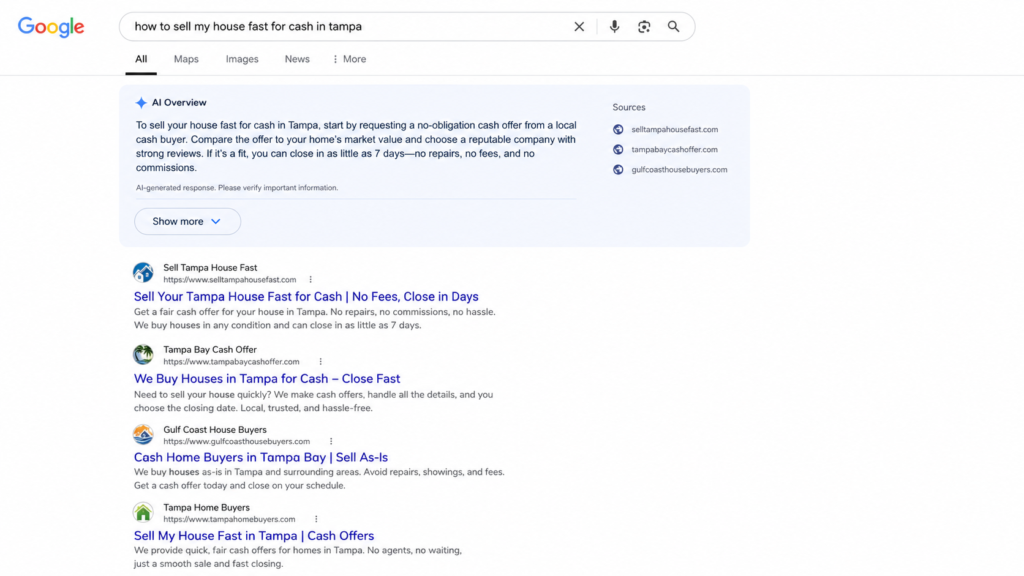
    The AI Overview answers the seller before they scroll

    Step 5: Real Estate SEO Technical Basics: Speed, Mobile, Schema

    Most property searches happen on a phone, so mobile-first is not optional. If your site is slow or awkward on mobile, you lose the seller before they read a word.

    The technical basics come down to a few things Google measures, called Core Web Vitals:

    • LCP (Largest Contentful Paint): how fast the main content loads. Aim under 2.5 seconds.
    • CLS (Cumulative Layout Shift): whether the page jumps around while loading. It should not.
    • INP (Interaction to Next Paint): how quickly the page responds when tapped.

    Real estate sites carry a specific weight problem: photos. Listing and neighborhood images are heavy, and uncompressed they crush your load time. Compress every image, and give each one descriptive alt text that names what it shows in natural language. Getting the tracking, schema, and technical foundation right before scaling content is the exact order BASEO works in, because content on a broken foundation just hides the problem longer.

    Real Estate Schema Markup That Moves the Needle

    Schema markup is code that tells Google exactly what your page is, in a language it reads perfectly. For real estate, four types earn their keep: RealEstateAgent, LocalBusiness, FAQPage (which can trigger rich snippets in the results), and Review. You do not need to see it as a visitor. Google does, and it uses it to understand and feature your pages.

    Step 6: Publish Content That Answers Real Questions

    Write for people first. That is not a platitude, it is the highest-return content strategy there is. Useful, genuinely local content is the strongest signal you can send: it builds topical authority, earns backlinks on its own, and gives AI systems the material they need to cite you.

    Publishing deep local content consistently is the single highest-impact content action a real estate site can take. It is also where seller-situation pages live, the pages built around the specific, urgent reasons people sell.

    The 4 Content Types That Generate Real Estate Leads

    Four content types do the heavy lifting for a real estate site:

    1. Neighborhood guides (“Living in [area]: The Complete Guide”). They rank for research intent and never expire.
    2. Valuation posts (“How Much Is My House Worth in [city]?”). They catch sellers at the exact moment of intent.
    3. Process explainers (“How to Sell Your House Step by Step”). They answer the questions every seller has and build trust.
    4. Market updates (monthly or quarterly, with your own local data). Nobody can copy numbers you gathered yourself, and they earn links.

    The longevity is the point. A well-researched neighborhood guide published today can still generate leads two years from now with no additional spend. That is the compounding a paid ad never gives you. The urgent seller-situation pages (probate, foreclosure, divorce, inherited property, problem tenants) are exactly the pillar content BASEO builds for cash buyers, because those searches carry the highest intent on the whole site.

    Step 7: Earn Backlinks That Google Actually Trusts

    A backlink is another site vouching for yours. Google treats them as votes of confidence, and they remain one of the strongest ranking signals. But this is quality over quantity, and it is not close. One link from a trusted local news outlet is worth more than dozens from spammy directories.

    Where good links come from:

    • Guest posts on real estate and home-improvement blogs.
    • Local digital PR: get quoted in local news, sponsor a community event.
    • Natural niche partners: local lenders, contractors, title companies, REIA groups.

    Do not buy links. Link schemes are the fastest way to earn a penalty that undoes months of work. The links that hold up are editorial and local: chambers of commerce, REIAs, local news. Not link farms, not PBNs. That is the kind of authority BASEO builds for the markets you operate in.

    Step 8: Optimize for AI Search (AI Overviews, ChatGPT, Perplexity)

    Here is the gap almost no competitor has closed yet. A seller no longer always starts at Google or a portal. They open ChatGPT and ask “how do I sell my house fast for cash in Tampa,” and the tool answers with a short list of companies. Buyers are increasingly starting their whole search inside AI tools before they ever touch a traditional search bar (Florida Realtors).

    Whoever shows up in both classic search and AI answers captures most of the high-intent leads, because AI traffic is qualified before it arrives. In one study, visitors from ChatGPT converted at 15.9%, against 1.76% for Google organic (Seer Interactive). The AI did the qualifying before the click.

    Getting cited comes down to a few things you can actually do:

    • Structure content in clear question-and-answer format, the way the FAQ at the bottom of this article is written.
    • Add FAQ sections to your key pages.
    • Use schema that signals expertise and answers specific questions.

    This is BASEO’s core work. We format pages for citation, add citation-friendly schema, and track weekly whether you (or a competitor) get cited across ChatGPT, Perplexity, Claude, and Google AI Overviews. On the flagship account, the client’s pages started getting cited by AI Overviews and Perplexity by month 7 (BASEO client data). The window to be early on this is still open, and it will not stay open forever.

    How Long Does Real Estate SEO Take? A Realistic Timeline

    Anyone promising leads in 30 days is describing paid ads or lying. Here is the honest version.

    Most sites see measurable ranking improvement within 3 to 6 months of consistent work (SEO.com). ROI typically breaks even around month 10. Page-one rankings in competitive markets can take 6 to 12 months. It is slower than paid at the start and cheaper than paid forever after.

    PhaseTimeframeWhat happens
    FoundationMonths 1–3Tracking live, technical fixes, indexation, first pages published
    Local tractionMonths 3–6City pages and GBP start ranking, first organic leads
    CompoundingMonths 6–12Consistent page-one rankings, steady lead flow, AI citations

    The reason to start is the compounding. Content accumulates. One Florida cash buyer went from 3 organic leads a month to 28 in nine months, same market, no extra ad spend (BASEO client data). The pages you build this quarter keep paying next year.

    7 Real Estate SEO Mistakes That Kill Rankings

    Most rankings are lost to avoidable mistakes, not tough competition. The seven that do the most damage:

    1. Keyword stuffing. Cramming keywords reads as spam to Google and to humans. Write naturally.
    2. Copied location pages. Duplicate city pages get penalized. Make each one original.
    3. Ignoring your Google Business Profile. It is the fastest local win, and it is free.
    4. Relying only on IDX listings. Listings expire and lose their SEO value. Build permanent pages around them.
    5. Thin pages. A 150-word city page ranks for nothing. Give it real depth.
    6. Generic keywords with no location. “Real estate” will never rank for you. Localize everything.
    7. Traffic with no way to convert. Visitors without contact forms are just numbers. Traffic that never becomes a lead does not pay for itself.

    Want This Done for You?

    Running all eight steps consistently is a job that takes months. BASEO does programmatic SEO and AI search optimization for real estate businesses that want organic leads without chasing them. If you want to see where your own site stands first, that is what the free audit is for. We work only with cash home buyers, so it already knows your market.

    See exactly what’s broken on your site and what your top competitor built instead. Get your free site audit →

    Real Estate SEO FAQs

    Quick answers to the questions investors ask most about ranking a real estate website.

    How long does SEO take for a real estate website?

    Most real estate websites see measurable ranking improvements within 3 to 6 months of consistent SEO work. Page-one rankings in competitive markets typically take 6 to 12 months. SEO compounds over time: every optimized page keeps generating traffic and leads long after it is published.

    Can I do real estate SEO myself?

    Yes, especially in less competitive markets. Start with your Google Business Profile, one dedicated page per service area, and content that answers real buyer and seller questions. The tradeoff is time: consistent execution over 6 to 12 months is what separates agents who rank from agents who quit.

    Is SEO worth it for real estate compared to paid ads?

    For most real estate businesses, yes. Paid ads stop producing leads the moment you stop paying. SEO keeps generating exclusive, high-intent leads from people already searching for your services. The break-even point typically arrives around month 10, and returns compound after that.

    What is the most important first step in real estate SEO?

    Optimize your Google Business Profile and build dedicated pages for each area you serve. These two actions target the local search intent that drives most buyer and seller traffic, and the map pack is the fastest visibility win available to a real estate website.

    Is blogging still worth it for real estate?

    Yes. Blog content targeting specific local searches compounds in value: a well-researched neighborhood guide published today can generate leads two years from now with zero additional spend. It also feeds AI search engines the material they need to cite your site in generated answers.

    Do IDX listings help or hurt SEO?

    Both. Raw IDX feeds create thin, duplicate pages that can hurt rankings, and listings expire and lose their SEO value. IDX helps when you add unique local copy, contextual content, and careful indexation around it. Never rely on listings alone as your SEO strategy.

  • How to Get Motivated Seller Leads: The 2026 Playbook

    You got your license, or you closed your first deal, and you figured the hard part was over. Then the phone went quiet.

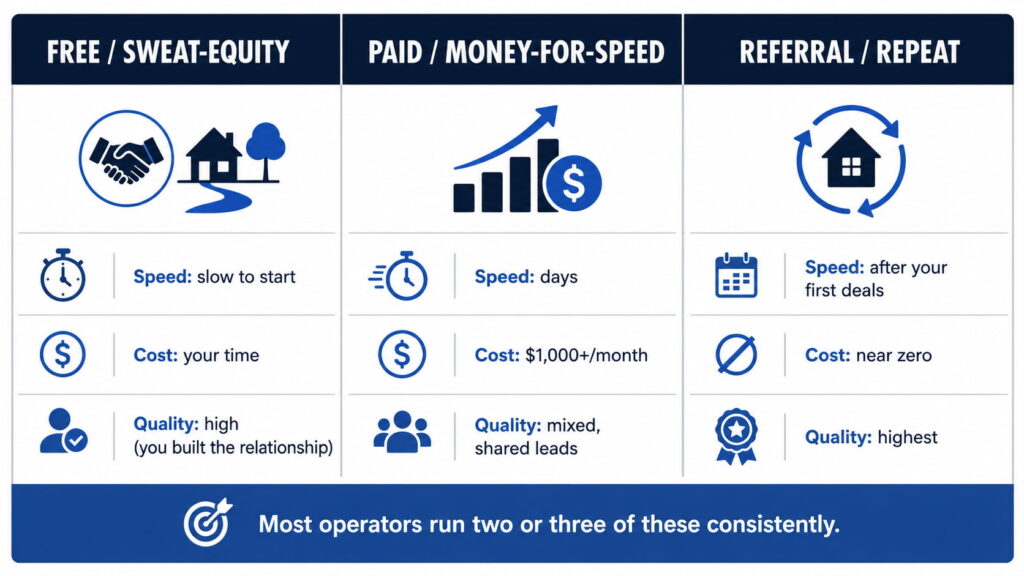
    Here’s what most gurus won’t tell you about how to get motivated seller leads: there’s no single magic tactic. Deals come from three things working together. Relationships. Consistent prospecting. And being findable the moment a stressed seller starts looking for a way out.

    This is the prioritized playbook. Free before paid, this week before this year. Start where the deals are warmest and cheapest, then layer on speed. No fluff, no filler. Just what works, in the order it works.

    Real estate investor standing beside a pickup truck on a quiet suburban street, talking on a cell phone and holding a notepad. A modest single-story house with an overgrown lawn and a "For Sale By Owner" sign is visible in the background. Warm morning sunlight and ample copy space on the left create a professional real estate marketing image.

    An operator in his truck, working a FSBO lead. This is where most first deals actually come from, not a lead list.

    In this playbook:

    Why Motivated Seller Leads Are the Hardest Part

    Anyone can run comps and write an offer. Finding the seller willing to take it is the actual job. Once the phone rings, the rest of the business gets easier fast.

    Real estate runs on relationships more than any pitch admits. In the 2024 NAR Profile of Home Buyers and Sellers, 40% of buyers found their agent through a referral from friends or family, and 66% of sellers used an agent they already knew or one who was referred to them (NAR). Different transaction, same lesson: people transact with the operator they already trust or the one a trusted person pointed them to.

    Your first deals will come the same way, from people who already know you. So treat lead generation as a daily habit, not a campaign you run once and check off. The operators pulling in deals every month aren’t smarter than you. They just show up and prospect when it’s boring, week after week.

    Your Sphere of Influence: The Warmest Seller Leads

    Your sphere of influence is everyone you already know who could refer or become a motivated seller. That’s a longer list than you think: past sellers, contractors, wholesalers, agents, probate attorneys, property managers, tired landlords, and the people you know from your neighborhood, gym, or church.

    This is the highest-return, lowest-cost source of deals you have. Those people already trust you, so a warm referral skips the entire step where a cold seller decides whether you’re legit. Relationships with probate attorneys, agents, property managers, and contractors can turn into a steady stream of leads (PropertyLeads). Start here before you spend a dollar anywhere else.

    How to Build Your Sphere of Influence List

    Dump every contact you have into a spreadsheet or CRM. Phone, email, Instagram, old text threads. Don’t filter yet. Aim for 100 to 300+ names, then tag each one by how well they know you and how likely they are to send you a seller.

    Think broadly. The contractor who did your last rehab hears about distressed houses all day. The closing attorney sees probate and divorce files. The property manager knows which landlords are done. A simple tag list keeps it usable:

    • Name
    • Relationship (close friend, past client, vendor, acquaintance)
    • Source (phone, email, IG)
    • Referral likelihood (High / Medium / Low)
    • Last touch date

    That last column is the one most operators skip, and it’s the one that turns a contact list into a pipeline.

    Scripts to Reactivate Your Network Without Being Pushy

    You’re not selling anything here. You’re telling people what you do and asking to stay top of mind. Value first, no hard close. Here are three you can copy and adjust:

    Text (warm contact): “Hey [name], quick update. I’ve been buying houses for cash around [area], as-is, no repairs or agent fees for the seller. If you ever hear of someone who needs to sell fast, would you keep me in mind? Appreciate you.”

    Email (past client or vendor): “Hi [name], hope you’re well. Wanted you to know I’m actively buying homes in [market], especially the ones that need work or where the owner just wants it done quickly. No pressure at all, but if anyone in your circle is ever in that spot, I’d love an intro. Happy to make it easy for them.”

    Nurture (monthly check-in): “Morning [name]. Random useful stat: cash buyers in [city] are still closing in about [X] days right now, way faster than a traditional sale. Anyway, hope the family’s good, we should grab coffee soon.”

    The nurture message is the one that compounds. Send something useful a few times a year and you stay the name people think of when a seller finally raises their hand.

    How Do Real Estate Investors Generate Leads? The 3 Lead Buckets

    Real estate investors generate motivated seller leads through three channels: free sweat-equity methods (sphere of influence, driving for dollars, FSBOs, social media, and local SEO), paid sources (lead lists, portals, and ads), and referrals from past sellers. Most successful operators run two or three of these consistently instead of betting everything on one.

    That’s the whole map. Every tactic in this guide falls into one of three buckets, and the reason to think in buckets is simple: you pick by budget and timeline, not by whatever a podcast hyped last week.

    • Free / sweat-equity trades your time for leads. Slow to start, cheap forever, and the online pieces compound.
    • Paid / money-for-speed buys volume fast, but quality varies and it stops the day you stop paying.
    • Referral / repeat is the compounding engine. Highest conversion, lowest cost, but you have to earn it first.

    The math is what makes any of these worth the grind. The average wholesale assignment fee runs about $13,000 nationally (Real Estate Bees), and a typical flip netted $65,981 in gross profit in 2025 (ATTOM). One deal covers months of effort in any bucket. The free bucket’s online piece, a site sellers actually find, is the one asset here that keeps producing after you build it, and it’s the part BASEO builds for cash buyers who’d rather close deals than learn SEO.

    Vector comparison chart showing three ways real estate investors generate motivated seller leads: Free/Sweat-Equity (slow to start, costs time, high-quality relationships), Paid/Money-for-Speed (fast results, higher cost, mixed lead quality), and Referral/Repeat (develops after completed deals, low cost, highest-quality leads), with a note that most investors use multiple lead sources consistently.

    The three buckets, mapped by speed, cost, and lead quality. Pick two to run daily before you add a third.

    BucketSpeed to first leadCostLead qualityBest for
    Free / sweat-equityWeeks (online: months)Time, not moneyHigh, and compounding onlineOperators with a small budget
    Paid / money-for-speedDays$1,000+/monthMixed, often sharedOperators who need volume now and already follow up
    Referral / repeatAfter your first dealsNear zeroHighestEvery operator, once you’ve closed a few

    Free Ways to Get Motivated Seller Leads

    Free leads aren’t actually free. You pay in time and effort instead of dollars, which makes this bucket the right place to start when the budget is thin. The upside: you keep control, and the online pieces you build here compound into a pipeline that outlasts any ad campaign.

    Driving for Dollars and Local Networking

    This is the fastest free on-ramp for a new operator. Drive your target neighborhoods and log every house that looks neglected: peeling paint, an overgrown yard, code-violation notices, a full mailbox. Those are the owners most likely to sell fast and as-is. Build the list, skip-trace the owners later, and reach out.

    Pair it with showing up where sellers and referral sources gather. REIA meetings, foreclosure auctions, contractor and property-manager networks. You’re not there to pitch. You’re there to be the local cash buyer people remember. Capture every address and contact, and follow up within 24 hours while you’re still fresh in their mind.

    Door Knocking and Circle Prospecting

    Knocking on doors or calling around a distressed, absentee, or pre-foreclosure home is old-school for a reason. Conversion is low, but you control the volume completely, and you’re talking to owners no one else is bothering. A value-first opener beats a script every time:

    “Hi, I’m a local buyer. I pay cash, buy as-is, and close on your timeline. Is this a house you’d ever consider selling?”

    Set a consistency target you’ll actually hit, like 25 doors or one hour a day, and protect it. One caution: respect the Do-Not-Call Registry when you’re phoning, and check local solicitation and permit rules before you knock. A single complaint isn’t worth a marginal lead.

    FSBOs and Expired Listings

    For-Sale-By-Owner and expired listings are a motivated-seller goldmine, and they cost almost nothing to work. A FSBO is already trying to sell without paying a commission, so a clean cash offer with no fees means more in their pocket. An expired listing is an owner who wanted to sell, couldn’t, and is now frustrated with the traditional route.

    Find them on Craigslist and FSBO sites, in expired MLS data through an agent, and in county records. The mindset that wins here: these sellers don’t need more noise, they need a better option. Lead with the fast, as-is, no-commission close and treat them like people, not a list.

    Social Media Content That Builds Trust

    Stop posting your deals. Start being useful. Sellers research a buyer quietly long before they ever call, so your feed’s job is to make you look like the credible local operator, not a flipper bragging about spreads.

    Post local market updates, a plain-English breakdown of how a cash sale actually works, the before-and-after of a rehab, answers to the questions every nervous seller has. Pick one primary platform and post a few times a week. You’re not chasing viral. You’re making sure that when a seller finally searches your name or your city, they find someone who clearly knows the local market and looks like a safe pair of hands.

    Local SEO and a Content-Driven Website

    Here’s the channel most of your competitors gloss over, which is exactly why it’s the opening. A seller in trouble types “sell my house fast [city]” or “we buy houses [city]” into Google, and increasingly into ChatGPT. If your site isn’t there, you’re invisible at the precise moment of highest intent.

    When a motivated seller searches, the buyers on page one get the call. Everyone else gets nothing.

    What actually ranks isn’t a homepage. It’s an original page for every market you buy in, plus seller-situation pages for the searches people type under stress: probate, foreclosure, divorce, inherited property, problem tenants. Template pages that just swap the city name don’t cut it anymore, and a claimed, active Google Business Profile with real reviews is what puts you in the map pack. That’s the core of what BASEO builds for cash buyers: a unique page per market, seller-situation pillars, the Google Business Profile rebuilt, and call and form tracking installed first so every lead is actually counted.

    Be honest with yourself about the timeline. SEO compounds, but it takes roughly 6 to 12 months to hit stride. The trade is that it builds equity while paid ads only rent attention. The numbers back the patience: one Florida cash buyer went from 3 to 28 motivated seller leads a month in nine months, same market, no extra ad spend, at $161 per organic lead by month 9 (BASEO client data). That same client saw a 430% increase in Google Business Profile direction requests (BASEO client data). And the AI channel is real, not hype: visitors coming from ChatGPT convert at 15.9%, against 1.76% for Google organic (Seer Interactive), because the AI already narrowed the seller’s options before they clicked.

    Organic lead report dashboard for a real estate cash buyer showing 28 motivated seller leads, $161 cost per organic lead, 3 closed deals, and a nine-month trend of increasing organic leads and decreasing lead costs, with a table of recent seller inquiries from organic search and Google Business Profile sources.

    The compounding curve: leads climbing from 3 to 28 while cost per lead falls. This is what “SEO builds equity” looks like on a report.

    If you’d rather see where your own site stands before building anything, that’s the whole point of the free audit. Send your domain and you get back the 3 biggest issues holding your site back, the keywords your top local competitor ranks for that you don’t, and the deal-math projection for your market. It’s written, delivered in about two business days, no call required, and yours to keep. You can also read how the organic channel works for cash home buyers before you decide.

    Email Marketing and Market Updates

    Every lead that doesn’t close today is worth keeping warm. Build an email list from your sphere, your web leads, and your driving-for-dollars contacts, segment it by location, and send one short market update a month: what cash buyers are paying, notable recent sales, a quick note on timelines.

    It’s the cheapest way to stay top of mind for years. Sellers move on their schedule, not yours, and the operator who’s been quietly showing up in the inbox is the one they call when life finally forces the decision.

    Paid Ways to Get Motivated Seller Leads

    Paid channels buy speed and volume. They do not buy quality, and they stop the moment you stop paying. The rule before you turn any of them on: have a follow-up system first, or you’ll spend real money generating leads you never call back. Mid-career operators routinely spend $1,000+ a month on leads, which sounds like a lot until you remember one assignment averages around $13,000 (Real Estate Bees). The math works if you close. It’s a disaster if you don’t follow up.

    Motivated-Seller Lead Lists and Portals

    Lead lists are skip-traced distressed or absentee data you buy in bulk. Lead portals sell you inbound seller inquiries, usually on a per-lead or subscription model. Both can fill a pipeline fast.

    The catch is real. Portal leads are often shared with several investors at once, intent runs low, and they demand relentless follow-up to convert. Who this is actually for: an operator with a dialer, a CRM, and the discipline to work a lead ten times, not a beginner hoping a purchased list closes itself. If that’s not you yet, spend the money on the free bucket instead.

    Wholesale and JV Referral Partnerships

    If cash is tight, partner with people who already have deals. Other wholesalers, agents, and birddogs will bring you sellers in exchange for a fee or a split paid only when the deal closes. No upfront cost, no wasted marketing spend, just a slice of the spread when money changes hands.

    Structure it cleanly so nobody feels burned later. Get it in writing, define the split before the deal, and be clear on roles: they bring the seller, you bring the close and the capital. Done right, it’s the lowest-risk way to keep deals moving while you build your own channels.

    Paid Social and Google Ads

    Facebook and Instagram lead ads, plus Google search ads on “sell my house fast [city],” can put leads in your inbox within days. That speed is the entire point of paid. But it demands tight targeting, a real landing page, and follow-up measured in minutes, not hours.

    Know the price of admission. Paid clicks on “sell house fast” run roughly $12 to $63 each, and seller cost per lead lands anywhere from about $100 to $350 depending on the market (Realty Crux). Quality tends to sit below content and referral leads, so treat ads as a speed layer, not a foundation. This is also where a specialist matters: BASEO runs motivated-seller PPC under the same cost-per-deal lens as organic, and shrinks it as the organic channel takes over the heavy lifting. The point of paid isn’t to feed it forever. It’s to keep the phone ringing while the free bucket compounds.

    Turn One Deal Into Ten: Referrals and Repeat Business

    Referrals are the highest-converting, lowest-cost leads you will ever get. No cost per click, no cold open, just a seller who arrives already trusting you because someone they trust sent them. This is the bucket that turns a good year into a business.

    The trick is asking at the right moment. The best times are when goodwill peaks: at the signed contract and again at the closing table. Make it effortless for them: “If you know anyone who needs to sell fast, send them my way. I’ll take good care of them.” A happy seller, their neighbors, their family, and the attorney who referred them are all one conversation from your next deal.

    Then systematize it so it doesn’t rely on memory. Check in with past sellers around four times a year, send something genuinely useful, and drop off a small closing gift three or four months after the deal. It takes multiple touches before most people act, often six or more (PropertyLeads), so the operators who stay in the rotation are the ones who get the call. Stay in the rotation.

    Pick a Niche and Own a Market (Geographic Farming)

    Spreading yourself across ten strategies and three counties is how operators stay busy and broke. The fix is focus. Niche down and farm.

    Niching means picking a lane and becoming the obvious buyer for it: probate, foreclosure, tired landlords, or a specific set of zip codes. Geographic farming means choosing one area and showing up in it relentlessly, month after month, through mail, door knocking, local sponsorships, and an online presence built for that exact market. Depth beats breadth. The seller who’s seen your name five times calls you, not the buyer they’ve never heard of.

    Set the expectation up front: farming takes 6 to 18 months to produce real traction, and most operators quit around month 4, right before it works. Consistency is the entire strategy.

    The online version of farming a market is a real page for that market. Google’s March 2024 update introduced a Scaled Content Abuse policy that specifically crushed template pages that just swap the city name (Google Search Central), so each market page has to be genuinely original to rank. That per-market page buildout is exactly what BASEO handles for the markets a cash buyer operates in.

    Build a Daily Lead Generation System

    Tactics don’t fail because they’re bad. They fail because they’re done once, then abandoned. Scattered effort is why most operators plateau. A repeatable daily block is why the rest scale. The goal of this section is to turn everything above into a habit you run without deciding.

    The 3-Hour-a-Day Rule

    The common coaching benchmark is about three hours of lead generation a day to support a six-figure acquisitions business. It sounds like a lot until you block it like an appointment and stop negotiating with it. A sample block:

    1. 60 minutes of seller calls and follow-ups (the highest-value hour, do it first).
    2. 60 minutes of driving for dollars or list work.
    3. 30 minutes of content, one post or one email.
    4. 30 minutes of sphere-of-influence touches, five people you haven’t talked to in a while.

    Protect those three hours and the pipeline takes care of itself. Skip them for a “busy” week and you’ll feel the gap 60 days later, because that’s the lag on your lead gen.

    Use a CRM to Track and Follow Up

    Most operators don’t have a lead problem. They have a follow-up problem. Deals come in, get scribbled somewhere, and die. A CRM fixes that: log every contact, set the next action, and automate the sequence so nobody slips through.

    Speed is the other half. Respond to an inbound seller within five minutes and you’re up to 21 times more likely to qualify the lead than if you wait (Verse.ai). Slow-play it and the seller has already called the next buyer on the list. Pair fast first contact with patient follow-up, because it takes six or more touches before many sellers convert (PropertyLeads). Any of the well-known real estate investor CRMs will do the job. The tool matters far less than actually working it every day.

    How Long Does It Take to Get Motivated Seller Leads?

    It depends on the channel. Driving for dollars, sphere-of-influence outreach, and cold calling can produce leads in days to weeks. Paid ads can produce them in days. Content marketing takes 3 to 12 months, local SEO 6 to 12 months, and geographic farming 12 to 18 months. Consistency matters more than the channel, and most operators who quit do so too early.

    Here’s the honest breakdown:

    ChannelTime to first leadsCostCompounds?
    Paid adsDaysHigh, ongoingNo, stops when you stop paying
    Sphere of influenceDays to weeksFreeSomewhat
    Driving for dollars / door knockingWeeksTimeNo
    FSBO / expired outreachWeeksLowNo
    Social media content1–3 monthsTimeYes
    Local SEO / content site6–12 monthsModerateYes, strongly
    Geographic farming12–18 monthsModerateYes

    For the SEO channel specifically, expect the first organic leads around month 3 to 5 and real volume by month 6 to 9. The Florida client hit 12 organic leads by month 5 and 28 by month 9 (BASEO client data). Anyone promising motivated-seller leads in 30 days is selling you paid ads or lying. The channels that compound are slow to start and impossible to stop once they’re rolling. That’s the trade.

    Common Lead Generation Mistakes New Investors Make

    Most of these cost deals quietly, month after month:

    • Chasing every shiny tactic. Getting mediocre at ten channels instead of good at two or three.
    • No follow-up system. Leads arrive and die in a notebook because there’s no next action logged.
    • Quitting a channel too early. Killing SEO or farming at month 3, right before the payoff at month 8.
    • Buying leads before you can work them. Paying for volume with no CRM and no time to follow up ten times.
    • Talking only about yourself. “I buy houses!” instead of the seller’s problem you solve.
    • Inconsistent prospecting. Going hard for a week, then going dark, so the pipeline whipsaws.
    • Ignoring online presence entirely. Sellers searching right now can’t find you. One operator’s site had collapsed from 10,000 to 284 monthly organic sessions under a previous agency before it was rebuilt (BASEO client data). Invisible is a choice, and it’s an expensive one.

    Your Next 30 Days: An Action Plan

    You don’t need all of this at once. You need momentum. Here’s a 30-day start:

    1. Week 1. Build your sphere-of-influence list, 100 to 300 names, and send the announcement scripts. Pick the market or niche you’re going to own.
    2. Week 2. Start driving for dollars and launch a social cadence, three posts a week. Log every lead somewhere you’ll actually look.
    3. Week 3. Stand up or fix your website and local SEO, claim and rebuild your Google Business Profile, and set up a CRM so no lead is ever lost.
    4. Week 4. Add one paid channel, ads or a lead list, now that follow-up exists to catch what it brings in.

    The piece most operators skip is week 3, the online presence that compounds while they sleep. Some run it themselves and do fine. Most would rather spend that time closing deals. If you want to know exactly what’s missing on your site and what your top local competitor built to outrank you, the free BASEO audit spells it out, market-specific, no call required.

    Frequently Asked Questions

    How do real estate investors get their first deal?

    Most land it through their sphere of influence, the people who already trust them. Announce that you buy houses for cash, ask to be kept in mind, and pair that with driving for dollars and fast follow-up. Warm referrals from your existing network are the fastest path to a first deal.

    How do real estate investors generate leads?

    Through three buckets: free sweat-equity methods (sphere of influence, driving for dollars, FSBOs, social media, local SEO), paid sources (lead lists, portals, and ads), and referrals from past sellers. Most successful operators combine two or three consistently rather than relying on a single tactic.

    How long does it take to get motivated seller leads?

    It varies by channel. Sphere outreach, driving for dollars, and paid ads can produce leads in days to weeks. Content marketing takes 3 to 12 months, local SEO 6 to 12 months, and geographic farming 12 to 18 months. Consistency matters more than the channel, and most who quit do so too early.

    What are the best free motivated-seller lead sources?

    The highest-return free sources are your sphere of influence, driving for dollars, FSBO and expired listings, social media content, and a locally optimized website. Your own network converts best, because those people already know and trust you before you ever make an offer.

    How much do investors spend on leads?

    It ranges widely. Many mid-career operators spend $1,000+ a month on lists and ads, while experienced buyers spend less because referrals carry the business. New operators can start at $0 by focusing on sphere of influence, driving for dollars, and content before paying for volume.

    Can a new investor get deals with no track record?

    Yes. Prove your value upfront: make fair as-is cash offers, close on the seller’s timeline, and answer every question honestly. Sellers care far more about certainty and speed than your résumé. Lean on your network and show up consistently online.

    Is cold calling and door knocking still effective?

    Both still work, but conversion is low and requires volume and consistency. They shine for targeting specific neighborhoods, FSBOs, and expired listings. Lead with value, respect the Do-Not-Call Registry and local solicitation rules, and treat them as one channel within a larger system, not the whole plan.

    Final thoughts

    There’s no magic channel for how to get motivated seller leads. Deals come from relationships, from prospecting when it’s boring, and from being findable the moment a seller decides they’re done. The operators winning your market aren’t smarter than you. They’ve just been consistent longer.

    So pick two channels and run them daily, then add the online asset that keeps producing after you build it. That’s the one most operators skip, and it’s the one that compounds. If you want to know exactly what’s broken on your site and what your top local competitor built to rank, that’s what the free audit is for: the 3 biggest issues, the keywords they rank for that you don’t, and the deal-math for your market. Written, no call required, yours to keep.
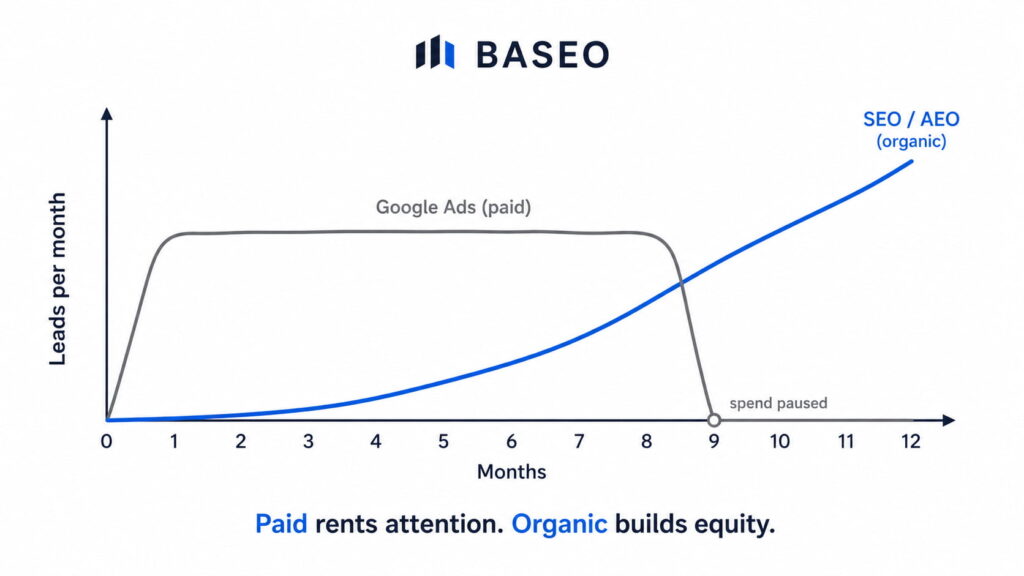
    Get your free site audit →

  • Do You Have to Buy a Foreclosure With Cash?

    No. In most cases you can finance a foreclosure with a regular mortgage. The main exception is buying at a public auction, where cash is usually required.

    Most investors treat “foreclosure” as one thing that always demands a briefcase of cash. It isn’t. It’s three different stages, and only one of them locks you out of financing. Get the stage right and you decide how the deal gets paid for: keep your cash, use a loan, or bring certified funds because the auction gives you no other choice.

    Here’s how it breaks down, and where your capital actually has to show up.


    Where your cash has to show up depends entirely on which stage of foreclosure you buy in.

    In this guide:

    The Short Answer: No, Not Always

    No, you don’t have to pay all cash for a foreclosure. Pre-foreclosures, short sales, and bank-owned (REO) homes can be bought with a regular mortgage, the same as any other house. All-cash is typically required only at the public foreclosure auction, where you have to settle in a day or two.

    Financing a foreclosure isn’t the workaround. It’s the norm. Wells Fargo says approximately 60% of its foreclosed homes are purchased with financing (Policygenius). So the real question isn’t “cash or not.” It’s which stage you’re buying in, because that’s what sets the rule.

    Why the Answer Depends on the Foreclosure Stage

    “Foreclosure” covers three separate moments in the process, and each one has its own payment rule. Think of them as three different acquisition channels, each asking a different amount of capital up front.

    One is the owner selling before the bank takes over. One is the bank selling after it took over. And one is the courthouse auction in between. You can finance the first two. The third is where cash lives.

     Same word, three very different payment rules. Only the auction forces cash.

    Pre-Foreclosure and Short Sales

    In pre-foreclosure, the owner still holds the title. They’re behind on payments and trying to sell before the bank takes the house. Sometimes they owe more than the home is worth, so the sale needs the lender to accept less than the full balance. That’s a short sale (Policygenius).

    You can finance either one with a conventional or government-backed loan. There’s no cash requirement here. The catch is time, not money. A short sale can crawl, because the lender has to sign off on taking a loss, and that approval can drag on for months. So your constraint on these deals is patience and a rate lock that doesn’t expire, not a pile of certified funds.

    Bank-Owned (REO) Properties

    When a house doesn’t sell at auction, it reverts to the lender and becomes real-estate-owned, or REO. This is the most normal foreclosure to finance. If the home is livable, you buy it with a conventional, FHA, or VA loan like any other listing.

    The wrinkle is condition. REOs sell as-is, and the appraisal can gate your loan. Banks won’t lend on a house with a hole in the roof or a missing furnace (Policygenius). Get preapproved before you make an offer. On an REO, a serious, financed buyer with paperwork ready beats a maybe every time.

    Foreclosure Auctions

    The auction is the cash exception. At a sheriff’s or trustee sale, you’re expected to bring cash or certified funds, close in roughly 24 to 72 hours, and you don’t get to inspect the property first (Auction.com).

    That’s a different game with a different bankroll. It’s also why most operators shouldn’t start at the auction. The next two sections cover why the cash rule exists and exactly how much you need to show up with.

    Why Auctions Usually Require Cash

    This is the part most guides wave off. The auction isn’t cash-only because someone wants to keep you out. It’s cash-only because a mortgage physically can’t close that fast.

    A lender won’t fund a loan without three things: an appraisal, an inspection, and a clear title. At auction, you get none of them. The property sells as-is, with no title report and no inspection period, so the buyer accepts whatever liens or problems come with it (Auction.com). No underwriter signs off on that.

    Then there’s the clock. A normal mortgage takes about 30 to 45 days to underwrite (Rocket Mortgage). The auction gives you 24 to 72 hours to settle. Those two timelines don’t overlap, so the sale gets paid in certified funds.

    A mortgage takes 30 to 45 days to underwrite. An auction gives you 24 to 72 hours to pay. That gap is the whole reason auctions are cash.

    How to Finance a Foreclosure Without Cash

    For the financeable stages, pre-foreclosure, short sales, and REO, you have four main routes. The point of financing isn’t just affording the house. It’s keeping your capital spread across more deals instead of sunk into one.

    One heads-up before the list: two of these four are owner-occupant programs. FHA and the 203(k) are built for people who will live in the house, which makes them tools for a house-hack or a live-in flip, not a straight rental or a quick flip you never move into.

    Conventional Loans

    A conventional mortgage is the standard route for a livable REO or short sale. Step one is preapproval, which tells sellers and listing agents you can actually close. The home has to be in insurable, lendable condition, so anything structurally broken can stall the loan until it’s fixed.

    If the foreclosure needs work but not a gut job, a renovation mortgage like Fannie Mae’s HomeStyle wraps the purchase price and the repairs into one loan. It generally wants a credit score around 620 and can go as low as 5% down (Policygenius).

    FHA Loans (3.5% Down)

    FHA is the low-cash path. You can put down as little as 3.5% with a credit score of 580 or higher, or 10% with a score between 500 and 579 (Rocket Mortgage).

    Two conditions matter for a foreclosure. First, the home has to meet FHA minimum property standards: safe, structurally sound, and sanitary. As-is foreclosures often flunk that until repairs are made, which can hold up the loan. Second, FHA is for owner-occupants. It’s not meant for investors or house-flippers (Policygenius). If you plan to live in the property, it’s one of the cheapest ways in. If you don’t, skip to conventional or hard money.

    FHA 203(k) Renovation Loans

    The 203(k) is the standout for a beat-up foreclosure, because it finances the purchase and the repairs in a single loan. There are two versions. The Limited 203(k) lets you borrow up to $75,000 for non-structural work. The Standard 203(k) handles structural jobs, requires a minimum of $5,000 in repairs, and brings in a HUD consultant to oversee the project (Rocket Mortgage).

    The rules are strict. A licensed contractor has to do the work, and it must start within 30 days of closing. Like standard FHA, the 203(k) is a primary-residence program, not an investment-property loan (Rocket Mortgage). For an operator willing to live in the deal while it’s rehabbed, it’s a way to buy and fix with very little cash. For a pure flip, it’s the wrong tool.

    Hard Money and HELOCs

    These are the investor’s real financing tools for foreclosures. Hard money is fast, short-term, and asset-based: private lenders care about the property’s value more than your credit, they can fund in a couple of days, and they’ll often want up to 30% down at higher rates and fees (Policygenius).

    That speed is the move that gets you into an auction. Experienced investors close like cash with hard money, renovate, then refinance into a cheaper conventional loan once the property can pass a bank inspection. A HELOC does something different: it pulls equity out of a property you already own to fund the next one. Both work. Both cost more than a standard mortgage, so price the interest into the deal before you sign.

    How Much Cash Do You Actually Need at Auction?

    There’s no national number. Auction rules are set county by county, and they vary. But the shape is consistent: a deposit the day of the sale in certified funds, then the balance fast. Here’s what that looks like in three real jurisdictions.

    In Philadelphia, you post a $5,000 deposit plus a $35 non-refundable fee just to bid. That deposit applies to a 10% down payment due by the next business day, with the remaining 90% due by the fifteenth day after the sale (Philadelphia Sheriff).

    In Florida, the winning bidder owes 5% of the bid in certified funds immediately at the end of the sale, it’s nonrefundable, and the balance is due the same or next business day (Brevard County Clerk). In Lorain County, Ohio, win a $100,000 bid and you hand over a $5,000 cashier’s check on the spot, then bring the remaining $95,000 within 30 days. Miss that deadline and interest starts stacking at 10% a year (Policygenius).

    The through-line: if you miss the balance deadline, you forfeit the deposit. Verify your own county’s rules before you raise your hand, because the number that matters is the one your courthouse prints, not the one in this article.

    Cash vs. Financing: Which Is Right for You?

    Cash and financing solve different problems. Cash buys speed, a stronger negotiating position, and access to auctions, but it sinks your capital into one property. Financing preserves your liquidity and lets you spread the same money across several deals as down payments, but it’s slower and the house has to qualify.

    Run the math on your own capital. One all-cash purchase ties up, say, $150,000 in a single deal. The same $150,000 as 25% down covers three or four financed deals. Cash wins on speed and it’s the only way into most auctions. Financing wins on deal count.

    FactorCashFinancing
    Speed to closeDays~30–45 days (longer for 203k)
    Capital tied upFull purchase price in one dealDown payment only; rest spread across deals
    Auction accessYesNo
    Negotiating powerStrongest (certain, fast close)Weaker (contingent on approval and appraisal)
    Condition limitsBuy anything, any conditionHome must meet lender/insurer standards
    Best fitAuction hunters, flippers who need speedBuy-and-hold, portfolio builders

    Pick by your model. If you chase auctions and flips where speed wins the deal, cash (or hard money that acts like it) is your lane. If you’re building a rental portfolio, finance the financeable stages and keep your cash working. Either way, the real bottleneck usually isn’t capital. It’s deal flow. You still have to be the buyer a distressed seller finds first, which is exactly what organic motivated-seller leads are for.

    Common Mistakes to Avoid

    The difference between a foreclosure deal and a foreclosure trap is usually one of these:

    • Assuming every foreclosure needs cash. You just talked yourself out of the roughly 90% you could have financed.
    • Bidding at auction with no certified funds or inspection lined up. You’re buying blind, and if you win you can’t pay.
    • Underestimating repairs. The “deal” evaporates the moment the real rehab number lands. Run it before you bid, not after.
    • Skipping preapproval before you offer on an REO. Cash-flush investors take the property while you’re still filling out forms (Policygenius).
    • Ignoring liens and back taxes. At auction there’s no title report, so unpaid liens can survive the sale (Auction.com). Win the bid, inherit the debt. This is the one that quietly wrecks new auction buyers.

    The Bottom Line

    So, do you have to buy a foreclosure with cash? Only at the auction. Pre-foreclosures, short sales, and bank-owned homes finance like any other purchase, and most foreclosures are actually bought with a loan. Match the stage you buy in to the money you have: finance what you can, reserve cash (or hard money that closes like it) for the auctions that demand it, and the “cash-only foreclosure” myth stops costing you deals.

    Before You Chase Your Next Foreclosure Deal

    Financing answers how you’ll pay for the next foreclosure. It says nothing about how a seller in trouble will find you first, and that’s the half most operators leave to luck. Building the organic lead channel that puts you in front of motivated sellers is what we do at BASEO, exclusively for cash home buyers.

    If you want to see where your own site stands before your next deal, send your domain for a free, written audit: your three biggest issues, the local keywords your top competitor ranks for that you don’t, and the deal-math projection for your market. No call required, and it’s yours to keep.

    Get your free site audit →

    Frequently Asked Questions

    Do you have to pay all cash for a foreclosure?

    No. Most foreclosures, including pre-foreclosures, short sales, and bank-owned (REO) homes, can be purchased with a regular mortgage. All-cash is typically required only at public foreclosure auctions, where buyers must close within a day or two using certified funds.

    Can you get a mortgage on a foreclosed home?

    Yes. Bank-owned (REO) and pre-foreclosure homes that are livable can be financed with conventional, FHA, or VA loans, just like any other property. The main catch is that the home must be in insurable condition to qualify for financing.

    Why are foreclosure auctions cash only?

    Auctions require winners to close in 24 to 72 hours, with no inspection or appraisal allowed beforehand. Mortgage lenders can’t underwrite a loan that fast or without a clear title, so sales are settled with cash or a cashier’s check instead.

    Can you buy a foreclosure with an FHA loan?

    Yes, if the home meets FHA minimum property standards and will be your primary residence. You can put down as little as 3.5% with a 580+ credit score. An FHA 203(k) loan can even bundle the purchase and renovation costs together.

    How much cash do you need for a foreclosure auction?

    It varies by county. Most require a deposit of about 5% to 10% of your bid (sometimes the full amount) the day of the sale via cashier’s check, with the balance due within 24 to 72 hours. Miss the deadline and you forfeit your deposit.

  • What Does Pre-Foreclosure Mean for a Buyer?

    A house two streets over just got a Notice of Default. The owner still has the keys, still lives there, and still controls what happens next. For a few months, you can knock on that door and make a deal before the bank ever takes it to auction.

    That window is pre-foreclosure. Here’s what it means when you’re the one buying, how the timeline works, how to actually close one, and the risks worth verifying first.

    Pre-foreclosure timeline showing the buyer's opportunity to negotiate before auction.

    An investor sizing up a pre-foreclosure before it ever reaches the courthouse steps.

    Pre-Foreclosure, Explained in One Minute

    Pre-foreclosure is the window after a homeowner falls behind on mortgage payments and gets a Notice of Default, but before the bank sells the home at auction. For a buyer, it means you can negotiate directly with a motivated owner who still holds title, often below retail.

    It doesn’t start on the first late payment. Under federal law, a lender generally can’t begin foreclosure until the borrower is more than 120 days delinquent (Nolo). A formal Notice of Default usually lands after roughly three missed payments, once the grace period and lender outreach have passed (Upsolve).

    From there, the owner is in mortgage arrears but still owns the home. Pre-foreclosure ends one of three ways: the owner reinstates the loan and keeps the house, sells it (to you, if you move), or it goes to auction. You’re dealing with a person, not a bank.

    What Pre-Foreclosure Means for You as a Buyer

    For a buyer, pre-foreclosure is two things at once. It’s a real opportunity to buy below retail from a seller with a reason to move fast. It’s also a deal with more moving parts than a normal purchase, and a seller who can still change their mind. Both sides are worth understanding before you knock.

    The Opportunity: Below-Market Price and Less Competition

    The owner is motivated in a specific way: a completed foreclosure wrecks their credit for years, so many would rather sell and walk than let the bank take it. That motivation is where your room to negotiate comes from.

    The homes are often in better shape than what you’d find at auction, because the owner still lives there. And many never hit the MLS. A pre-foreclosure isn’t automatically for sale (Zillow), which means less competition than the open market, where every listing draws a crowd. You’re working off public records, not a bidding war.

    There’s usually a discount, but be honest about it. There’s no fixed number. What you save depends on the owner’s equity, the condition of the house, local demand, and how motivated the seller really is. Pre-foreclosures tend to sell for less of a discount than bank-owned or auction homes, precisely because the owner still controls the sale.

    The channel isn’t small, either. ATTOM reported 118,727 U.S. properties with a foreclosure filing in the first quarter of 2026, up 26% year over year (ATTOM). More filings means more owners in that pre-auction window.

    The Catch: A Motivated but Still-in-Control Seller

    Here’s the friction. Until you have a signed contract, the owner is still in control. They can reinstate the loan, refinance, borrow from family, or work out a plan with the servicer, and your deal evaporates.

    If the owner owes more than the house is worth, they’re underwater, and the sale can’t happen without the lender agreeing to take less than the balance. That’s a short sale, and it changes the math. A short sale needs the lender’s approval, and every lienholder has to sign off, not just the first mortgage. Junior lienholders, a second mortgage or an HOA, can refuse a deal that leaves them with nothing (Nolo).

    That makes these deals run longer than a normal sale, and it puts you across the table from someone under real stress. Approach the conversation with tact. The investors who close pre-foreclosures consistently are the ones the seller trusts, not the ones who show up treating a hard moment like a fire sale.

    Pre-Foreclosure vs. Foreclosure vs. Short Sale

    Buyers mix these three up constantly, and the difference decides how you buy and how much diligence you get.

    Pre-foreclosure means you buy directly from the owner, before the auction, while they still hold title. Foreclosure, once it’s complete, means the bank has taken the home; you buy it at the courthouse auction or later as an REO (real-estate-owned) listing from the bank, usually as-is and often with little time to inspect (Rocket Mortgage). A short sale is a way of selling, not a separate stage: the owner sells for less than they owe with the lender’s sign-off, and it typically happens during pre-foreclosure (Nolo).

    Pre-ForeclosureForeclosure / REOShort Sale
    Who owns itThe homeownerThe bank / lenderThe homeowner (still)
    Where you buyDirectly from the ownerAuction or from the bankFrom the owner, with lender sign-off
    Buyer due-diligence timeMore: you can inspect and pull titleLittle: often as-is, sometimes sight-unseenMore, but slowed by the lender
    Typical price vs retailSome discount, variesOften a larger discountBelow what’s owed, lender-approved

    Where you buy, and how much room you get to inspect, changes at every stage.

    The Pre-Foreclosure Timeline (and Where Buyers Fit In)

    The sequence is consistent even when the clock isn’t: missed payments, then a Notice of Default, then the pre-foreclosure period, then a Notice of Sale, then the auction. Your window is any point before that auction sale date.

    The length of that window is where it gets local. Judicial-foreclosure states run the process through the courts, which is slower. Non-judicial states follow notice steps defined by statute and can move in about 120 days, sometimes longer (Nolo). California, for example, gives the owner 90 days from the recorded Notice of Default to cure before the process can advance (California Courts). Depending on the state, the whole run from default to auction often lands somewhere between three and ten months.

    That variation matters for you. In some states an owner has as little as 30 days to actually close a pre-foreclosure sale before the bank takes over (Zillow). Before you invest time in a property, confirm the scheduled sale date and learn how your state handles the process, including any redemption period after a sale. That one check tells you how much runway you have.

    Pre-foreclosure timeline from Notice of Default to foreclosure auction.

    Where a buyer fits: any point before the auction sale date, on a clock that varies by state.

    How to Buy a Pre-Foreclosure Home, Step by Step

    This is the part you came for. Here’s the sequence from finding a property to closing on it, in the order an operator actually works it.

    1. Find Pre-Foreclosure Properties

    Most pre-foreclosures aren’t sitting on the MLS waiting for an offer. You find them at the source:

    • Zillow’s pre-foreclosure filter and similar portal filters
    • County public records and Notice of Default filings, the raw feed
    • RealtyTrac and Foreclosure.com, aggregated listings
    • HomePath (Fannie Mae) and HomeSteps (Freddie Mac) for later-stage inventory
    • Local legal-notice newspapers, where sale notices are published
    • Driving for dollars and direct mail, working a target neighborhood

    Those are all outbound: you chase the list, and so does every other investor with the same subscription. The source that compounds is inbound, being the site a distressed owner finds when they open their phone and search their exact situation. That’s the seller-situation search channel a specialist team like BASEO builds for cash home buyers, so the leads come to you instead of you buying the same NOD list as everyone else. If you want to see how that channel is built, start with SEO built for cash home buyers.

    2. Research the Property, Loan Balance, and Liens

    Before you talk price, pull the numbers. Find the outstanding loan balance, the payoff, because on a non-short-sale deal that’s your floor: the sale has to cover the debt.

    Then check what else is attached to the title. A title search is the only reliable way to surface every lien on a property, second mortgages, HELOCs, IRS or property-tax liens, mechanic’s liens, unpaid HOA dues, and some of those survive a foreclosure and land on the next owner (New Funding Resources). Pull public records or open a file with a title company early. And confirm with the trustee that the property is genuinely still in default and not already reinstated or scheduled for sale sooner than you think.

    3. Contact and Negotiate With the Homeowner

    Reach the owner by mail or a respectful door-knock. Remember who’s on the other side: someone having a hard year, not a motivated seller in a marketing funnel. Lead with that.

    The pitch is a real win-win. A completed foreclosure follows them for years; selling to you lets them walk away cleaner, and often with a little cash instead of none. On price, anchor to your numbers: ARV minus repairs minus the payoff and your margin. That’s the cash offer that has to work for you.

    One hard constraint sits under every conversation. Unless the lender approves a short sale, the price has to at least satisfy the mortgage payoff. If the owner has equity, you have room. If they’re underwater, you’re not really negotiating with them anymore, you’re negotiating with the lender.

    4. Make an Offer With the Right Contingencies

    Put it in writing with a purchase agreement, drawn up by an agent or, better on a distressed deal, a real estate attorney. This isn’t the step to freelance.

    Three contingencies protect you specifically here: a clear, marketable title (so you don’t inherit those liens), a professional inspection (so a hidden repair bill doesn’t erase your margin), and financing if you’re not paying all cash (SmartAsset). Distressed properties carry more title surprises and more deferred condition than a normal sale, so these contingencies are your exit if the diligence turns up something ugly.

    5. Handle the Lender (Short Sale Approval)

    If the home is worth less than the owner owes, the lender has to approve the short sale, and this is where deals stall. The lender isn’t obligated to say yes, and when there’s a second mortgage or other junior lien, every one of those lienholders has to sign off too. Any one of them can refuse (Nolo).

    Plan for it to take weeks, sometimes months. What moves it along is clean paperwork, a complete package, and steady, professional communication with the loss-mitigation department. Patience is part of the acquisition cost on an underwater deal. If you can’t carry that uncertainty, target owners with equity instead.

    6. Inspect, Title Search, and Close

    Before money moves, do the two things auction buyers usually can’t. Inspect the property so you’re pricing real repairs, not guesses. And run a full title search so no surprise lien shows up after you own it.

    Then close through a title or escrow company that handles the payoff and records the transfer cleanly. This is the quiet advantage of pre-foreclosure over the courthouse steps: you get real due-diligence time. At auction you often buy sight-unseen and inherit whatever’s on the title. Here, you get to look first.

    Risks of Buying a Pre-Foreclosure

    None of these should scare you off the channel. Each one has a mitigation, and the operators who work pre-foreclosures well just build the checks into their process:

    • The seller reinstates and backs out. Get to a signed agreement before you sink real money in, and don’t count a deal until it’s under contract.
    • Hidden liens and back taxes. Run a title search before closing; some liens survive foreclosure (New Funding Resources).
    • Deferred maintenance. Inspect, then budget repairs honestly into your ARV math instead of hoping.
    • Timeline uncertainty. Sale dates move; build slack into your plan and don’t overcommit on close dates.
    • Lender delays on short sales. Expect weeks to months, and don’t spend the profit before the lender says yes (Nolo).
    • Emotional sellers. Tact and honesty aren’t just decent, they’re what get the deal to the table and keep it there.

    The pattern is the same across all six: verify, budget, and don’t treat a maybe like a yes.

    Is Buying a Pre-Foreclosure Right for You?

    Pre-foreclosure rewards a specific kind of buyer. If you have cash or flexible financing, the patience to wait out a lender, and the discipline to run title and inspections properly, this is one of the better ways to buy below retail with less competition.

    It’s a poor fit if you’re on a tight clock and need a turnkey home to move into next month. The timelines slip, short sales crawl, and some deals die at the reinstatement stage after you’ve done the work. That’s the honest tradeoff. If waiting out a short-sale lender would break your plans or your patience, this channel will frustrate you, and there’s no shame in buying on the open market instead.

    Build a Channel That Brings Pre-Foreclosure Sellers to You

    The investors who win this channel don’t just buy the same NOD list as everyone else and hope. They build a way for distressed sellers to find them first, so the deals come inbound. That’s the seller-situation search channel BASEO builds for cash home buyers: original pages that answer the exact questions a foreclosure, probate, or divorce seller types under stress, so your site is the one they call. One Florida cash buyer went from 3 to 28 motivated seller leads a month in nine months, same market, no extra ad spend (BASEO client data).

    Frequently Asked Questions

    Can you buy a house in pre-foreclosure?

    Yes. You buy directly from the owner, who still holds title, before the home goes to auction. You negotiate a price that satisfies the mortgage payoff, or, if the owner owes more than the house is worth, through a lender-approved short sale.

    Is pre-foreclosure a good time to buy?

    It can be. You often get some discount and far less competition than the open market. But the deals run longer and carry more risk, hidden liens, lender delays, a seller who backs out. It suits patient buyers who can do their diligence properly.

    How much cheaper are pre-foreclosure homes?

    It varies, and there’s no fixed discount. Price depends on the owner’s equity, the home’s condition, local demand, and how motivated the seller is. Pre-foreclosures usually sell for less of a discount than auction or bank-owned homes, because the owner still controls the sale (Zillow).

    What’s the difference between pre-foreclosure and foreclosure?

    In pre-foreclosure the homeowner still owns the property, and you negotiate with them before the auction. In foreclosure the lender has taken the home or sold it at auction, so you buy from the bank or at the courthouse, usually with less time to inspect. The comparison table above breaks it down.

    Can a seller back out of a pre-foreclosure sale?

    Before a binding contract, yes. An owner can reinstate the loan or find other financing and keep the home. Once a purchase agreement is signed, normal contract law applies to both sides. Confirm your specific protections with a real estate attorney.

    Final thoughts

    Pre-foreclosure means buying from a motivated owner who still holds the keys. That’s where the room to negotiate lives, and it’s also why the diligence has to be tightest: the liens, the lender, and the timeline are all yours to verify before you commit.

    The buyers who close these consistently aren’t just working harder lists. They’ve built a way for distressed sellers to find them first, so acquisition doesn’t depend on out-hustling everyone for the same public records. If you want to see which seller-situation searches your market already gets, and which ones a competitor is catching, that’s what the free audit is for. Written, no call required, yours to keep.
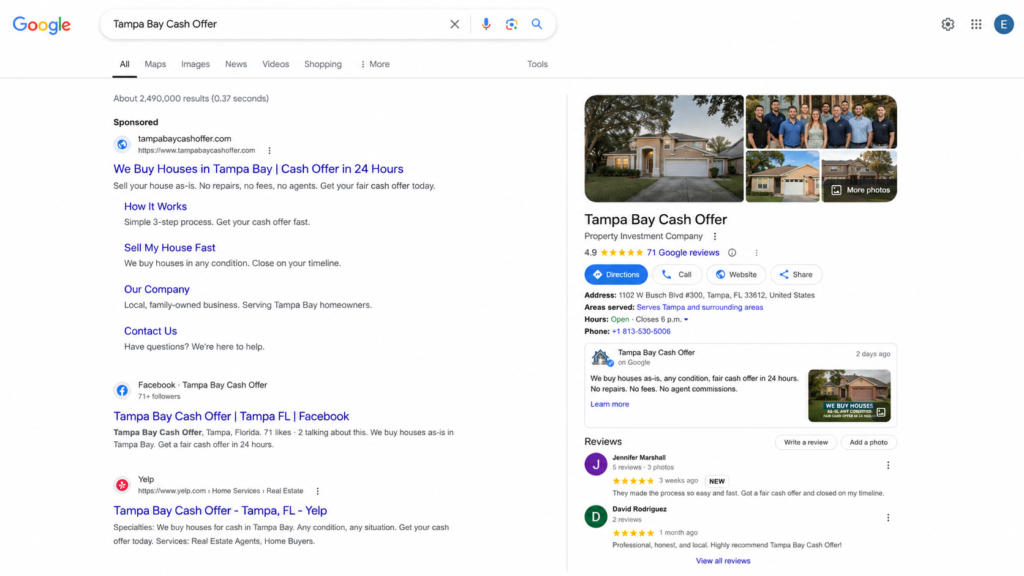
    Get your free site audit →

  • Social Media Marketing for Real Estate Investors: How Cash Buyers Turn Followers Into Motivated Seller Leads

    Most social media advice for real estate isn’t written for you. It’s written for Realtors, who sell listings. You buy houses. A Realtor posts a listing to attract buyers. You need a motivated seller to call you before a competitor does. Same platforms, opposite job. This is the version built for cash buyers: what to post, how to turn a follower into a lead, and where social quietly runs out of road.

    An investor making content himself. For cash buyers, the goal isn't a pretty feed. It's a seller who calls.

    Why Social Media Marketing Works Differently for Cash Buyers

    The Realtor playbook doesn’t transfer. Agents build a personal brand to win listings. You don’t have listings, and “brand” for its own sake doesn’t buy houses.

    For a cash buyer, social media does three jobs: it builds local trust, it puts you in front of seller networks, and it grows a disposition buyers list. That’s it. Everything you post should serve one of those.

    And here’s the honest part most posts skip. Social is weakest exactly where you need it most. The seller in probate, foreclosure, or a messy divorce isn’t scrolling for a home buyer. He’s typing “sell my house fast” into Google at 11pm. Social builds the trust that makes him pick you later. It rarely catches him at the moment of intent.

    What Investors Actually Want From Social Media: Sellers, Deals, and a Buyers List

    Followers are a vanity number. Deals are the number. Keep three outcomes in front of you, all measured in leads and closings:

    • Motivated seller leads. The person who fills out your form or sends a DM saying “what would you pay for my house?”
    • A cash buyers list. For wholesalers, a warm list of buyers who take your assignments fast is leverage on every deal.
    • Local credibility. The trust that shortens the gap between “saw your video” and “signed your contract.”

    If a piece of content doesn’t move one of those three, it’s a hobby, not marketing.

    Choosing the Right Social Media Platforms as a Cash Buyer

    You don’t need to be everywhere. You need to be consistent somewhere. Pick based on two things: where your sellers and buyers actually are, and which format you’ll still be making in six months. Consistency beats reach, and consistency comes from doing something you don’t hate.

    Here’s how the main platforms map to a cash buyer’s job.

    Facebook: Local Groups, Marketplace, and Motivated Sellers

    Still the workhorse for most investors. It has the widest local reach, active community and neighborhood groups, and Marketplace. It skews older, which lines up with a lot of inherited-property and tired-landlord sellers. Join local groups and give real value, answer questions, share market notes. Don’t spam “we buy houses” links. The person who remembers you helped is the one who calls.

    Instagram: Rehab Before-and-Afters and Trust

    Instagram is your proof channel. Before-and-after rehab reels, quick walkthroughs, and stories that show the work. It’s where a nervous seller decides you’re a real operator and not a scam. Carousels that teach (“3 things that happen when a house goes to probate”) do quiet, compounding work.

    TikTok: Reaching Younger and First-Time Sellers

    TikTok gets fast reach with younger and first-time sellers through short, personal video. It rewards volume and honesty, not production budget. A winning format is simple: “here’s what we paid for this house and why.” Only invest the time if your market’s sellers are actually here. For some rural markets, they’re not.

    YouTube: Searchable Content That Feeds Google and AI

    YouTube is the one social platform that’s also a search engine. A video titled “Selling an inherited house in [city]” can rank for years and pull sellers long after you post it. It also feeds AI answers, which matters more every month. If you only add one long-form channel, this is the one with the longest tail.

    LinkedIn: Cash Buyers, Agents, and Referral Deals

    LinkedIn isn’t for sellers. It’s for the deal network: agents sitting on pocket listings, other investors for dispositions, attorneys who handle probate. Low cadence, high value. A few sharp market posts a month keep you top of mind with the people who send deals.

    The Content That Attracts Motivated Sellers (Not Just Other Investors)

    The most common mistake in investor content: the whole feed talks to other investors. Guru quotes, “closed another one” flex posts, deal-math jargon. Sellers don’t speak that language, and they scroll right past it.

    Rotate five pillars instead. Keep the flexing small and the seller-useful content large.

    The mix that pulls sellers. When listings-style flexing is your whole feed, you're talking to competitors, not clients.

    1. Educational Content for Distressed Situations

    Answer the questions a stressed seller actually Googles. Three that work: “What happens to the mortgage when you inherit a house?” “Can you sell a house in foreclosure?” “Do I have to make repairs to sell as-is?” You become the person who explained it before you ever pitched.

    2. Before-and-After Deals and Proof

    Show a house you bought as-is and what you did with it. The transformation proves two things at once: you close, and the seller who took your offer came out fine. Real photos beat any stock image.

    3. Local Market Point-of-View

    Have an actual take on your market. What you’re paying, what’s sitting, what’s moving. Not recycled national headlines, a real local read. This is what makes a seller trust that you know their neighborhood, not just their zip code.

    4. Behind-the-Scenes and Personal Brand

    Let people see the operator. A day driving for dollars, a closing, the team. Humanize yourself so a nervous seller feels safe dialing your number. The line to hold: personal, not oversharing.

    5. Seller Testimonials and Social Proof

    “We closed in nine days, no repairs, no agent fees.” A short video from a past seller plus the problem you solved is the highest-trust content you can post. Always get permission before you use a name, a face, or an address.

    How Often Should Investors Post on Social Media?

    Aim for three to five posts a week on your main platform, and treat consistency as the real target. One post a week sustained for six months beats five a week for three weeks and burnout. Batch a month of content in one sitting and schedule it, so a busy week of closings doesn’t take you off the map.

    Here’s a realistic cadence by platform once you’ve picked your two or three.

    PlatformRealistic cadenceBest format
    Facebook4–7 posts/weekGroup value, market notes, before/after
    Instagram3–5 posts/weekReels, before/after, carousels
    TikTokDaily (only if used)Short personal video
    YouTube1–2 videos/week“Selling a house in [situation/city]”
    LinkedIn1–2 posts/weekMarket takes, deal-network posts

    Turning Social Media Followers Into Motivated Seller Leads

    A follower isn’t a lead. The gap between the two is where most investor social falls apart. Here’s the funnel that closes it.

    A lead sitting in your DMs is a lead you don't really have.

    Reach comes from the video and value you post. Engagement is the comment or DM. Then comes the step most investors skip: capture off the platform. Move that conversation to something you own, a simple “what would you pay for my house?” form, a free cash-offer request, an email. A lead sitting in Instagram DMs isn’t yours. The algorithm owns it, and it can bury you tomorrow.

    Then follow up fast. Responding to a web lead within five minutes has been shown to lift the contact rate by up to 900% versus waiting (Verse.ai roundup of the InsideSales study). A motivated seller who messaged three investors is talking to whoever answers first. Speed isn’t a nice-to-have on a distressed lead. It’s the whole game.

    Building a Cash Buyers List on Social Media (For Wholesalers)

    This one is pure investor, and no Realtor guide covers it. If you wholesale, social is a fast way to build a cash buyers list so you can move a contract the day you get it.

    Run a simple play: post “deal of the week” style content, spin up a local buyers Facebook group, and add a one-line opt-in (“want first look at our next deal? drop your email”). A warm list of buyers who trust your numbers means you assign faster and negotiate harder on acquisition, because you already know the deal will move. The buyers list is leverage on every future contract.

    Paid vs. Organic Social, and the Fair Housing Trap for “We Buy Houses” Ads

    Organic builds trust slowly and for free. Paid buys reach now. The smart use of paid isn’t to invent an audience from scratch, it’s to put money behind a post that already worked organically, or to promote a lead magnet like a free cash offer.

    But there’s a rule that trips up almost every investor, and getting it wrong is a legal problem, not just a marketing one.

    A “we buy houses” ad is a housing ad. On Meta, housing ads must run under a Special Ad Category, and that category strips most of your targeting. You can’t target by age, gender, or zip code, and there’s roughly a 15-mile minimum radius in the US. This came out of a Fair Housing Act settlement between the Department of Justice and Meta over discriminatory ad delivery (Meta, DOJ).


    Housing ads run under Meta’s Special Ad Category. Age, gender, and ZIP targeting are off the table.

    The practical takeaway: your ads have to lean on creative and offer, not tight demographic targeting. And because this is Fair Housing law, confirm your setup with someone who handles compliance before you scale spend. This is one place where “move fast and figure it out” can cost you.

    Social Media vs. Search: Why Social Alone Won’t Fill Your Pipeline

    Here’s the reframe that changes how you budget your time. Social media is rented attention. You’re posting on someone else’s algorithm, and the day you stop, the reach stops with you. Search is different. A seller in crisis types “sell my house fast [city]” with intent to act this week, and whoever shows up owns that moment. Social rarely catches it.

    Social mediaOrganic search + AI
    Attention typeRented (algorithm-owned)Owned (your pages, your rankings)
    Seller intentLow to medium (browsing)High (searching to sell now)
    What happens when you stopReach dies fastRankings keep pulling leads
    Cost trendRising ad costs, constant effortCompounds; cost per lead falls over time

    The compounding is the part that matters. One Florida cash buyer went from 3 to 28 motivated seller leads a month in nine months, in the same market, with no extra ad spend, at $161 per organic lead and falling (BASEO client data). Compare that to seller keywords on Google Ads, where “sell my house fast” clicks run $5 to $65 each (Carrot). And traffic from AI tools like ChatGPT has been shown to convert at 15.9% against 1.76% for regular Google organic in one study, because the seller is already qualified by the time they click (Seer Interactive).

    That owned, compounding channel is exactly what SEO for real estate investors is built to capture. Use social for trust and reach. Use search to catch the seller at the moment he’s ready to sign.

    Organic leads climbing 3 to 28 in nine months while cost per lead falls. Social builds trust; this is what compounds.

    How Social Media Feeds AI Answers Like ChatGPT

    More sellers are skipping the search box entirely and asking ChatGPT or Google’s AI “who buys houses fast in [city]?” The answer they get is assembled from content the AI can read and trust: YouTube videos with the city named out loud, consistent reviews, a coherent brand that says the same thing across every channel. Your social presence is an input to those answers, not a separate silo.

    This isn’t theory. One Carrot user reported getting 26 of 45 leads in a single week from ChatGPT (Carrot). The investors showing up in AI answers now are claiming a window before their local competitors even know it exists.

    The practical move: name your city and situations explicitly in captions and video, keep your reviews and profile consistent, and make sure the content lives somewhere searchable, not just on a feed. Tracking and optimizing which AI tools cite you in your markets is part of what BASEO’s organic lead channel work covers for cash buyers. Social feeds the machine. Search and AI are where it pays out.

    Common Social Media Mistakes Investors Make (and the Fix)

    Most of these are fixable this week. None of them require a bigger budget.

    • Posting to other investors. Fix: write every caption for a stressed seller, not the REI group.
    • Only flexing closings. Fix: make “look what I closed” the smallest slice, not the whole feed.
    • No call to action or capture. Fix: end posts with one clear next step to an off-platform form.
    • Leaving leads in the DMs. Fix: move every serious conversation to a channel you own, then follow up in minutes.
    • Inconsistency. Fix: batch a month of content and schedule it so closings don’t knock you offline.
    • Ignoring Fair Housing on ads. Fix: run housing ads under the Special Ad Category and confirm compliance.
    • Buying followers and chasing vanity metrics. Fix: measure leads and deals, not likes.

    The Tools to Plan, Create, and Schedule

    Don’t overbuild your stack. Group tools by function and start small.

    For scheduling, a tool like Buffer, Hootsuite, or the free Meta Business Suite lets you batch and queue posts. For design and video, Canva handles graphics and carousels while CapCut handles quick vertical video edits. For capture and follow-up, you need a form and a CRM so leads land somewhere you control and get worked fast.

    Start with one scheduler and one design tool. Add a capture form the day you post your first seller-facing call to action. That’s enough to run the whole system above without drowning in software.

    Final thoughts

    Social media is a trust-and-reach layer for a cash buyer, not the pipeline itself. It warms sellers up, builds your local name, and grows a buyers list. But the seller who’s actually ready to sign is searching, and that demand compounds only where you own the asset instead of renting attention on a feed.

    So before you spend another month posting into the void, get clear on which channel actually feeds your deals. If you want to know exactly where your motivated seller leads will come from, and what’s missing between your current presence and a pipeline that runs without you posting daily, that’s what the free audit is for. Written, no call required, yours to keep. Get your free site audit →
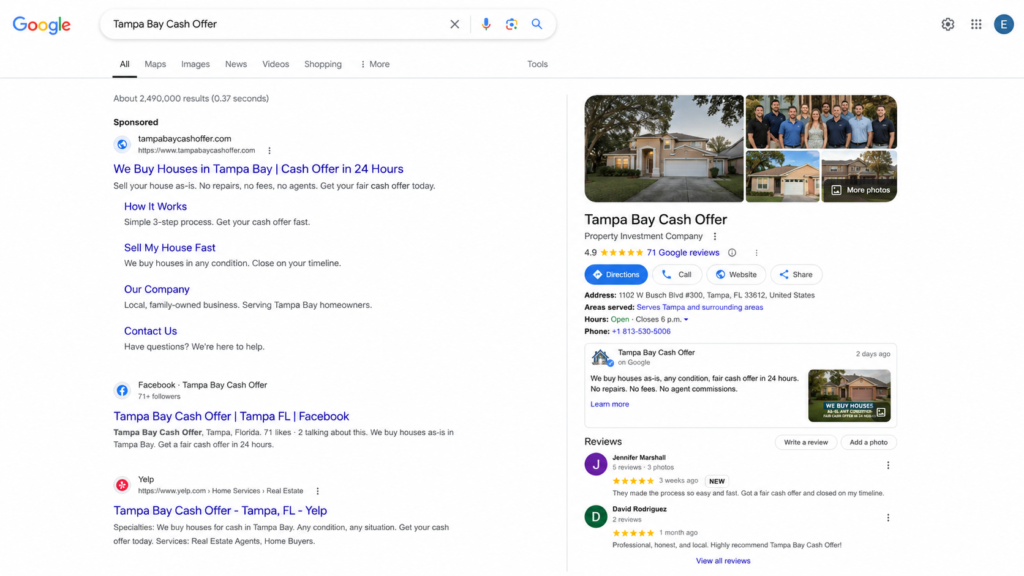
    Frequently Asked Questions

    Quick answers to what cash buyers ask most about social media.

    What is the best social media platform for real estate investors?

    Facebook is the best all-around platform for most cash home buyers because of its wide local reach, active community groups, Marketplace, and older seller base. Instagram is the strongest second channel for before-and-after proof, and YouTube wins for searchable content that keeps pulling seller leads for years.

    How often should a real estate investor post on social media?

    Aim for three to five posts a week on your main platform, and prioritize consistency over volume. Posting steadily for six months beats a burst that burns you out in three weeks. Batch a month of content in one session and schedule it so a busy week of closings doesn’t take you offline.

    Does social media marketing actually generate motivated seller leads?

    Yes, but mostly indirectly. Social builds the trust and local reach that make a seller choose you, and it can surface leads through groups, DMs, and video. The catch: you have to capture those conversations off-platform and follow up fast, because most high-intent sellers still find buyers through search.

    Can real estate investors run “we buy houses” ads on Facebook?

    Yes, but they count as housing ads and must run under Meta’s Special Ad Category. That removes targeting by age, gender, and ZIP code and applies a minimum radius, because of Fair Housing law. Lean on strong creative and offers instead of tight targeting, and confirm your setup with someone who handles compliance.

    What should real estate investors post on social media?

    Rotate five pillars: educational content for distressed sellers, before-and-after deals, a real local market take, behind-the-scenes to humanize you, and seller testimonials. Keep “look what I closed” flexing the smallest slice. Write every post for a stressed homeowner, not for other investors in your REI group.

    Should investors do social media themselves or focus on SEO?

    Do social yourself if you can post consistently and answer leads fast, since it builds trust cheaply. But it won’t capture the seller searching “sell my house fast” at the moment of intent. That high-intent, compounding demand comes from search and AI, so most investors treat social as a layer and make search the pipeline.