Most landscaping companies are built on two things: referrals and the season. Both work until they don’t.
When the referral well runs dry in a slow March, there’s no lever to pull. You can’t schedule when a past customer decides to redo the backyard. What you can do is be the crew Google shows when someone three towns over decides it’s time.
Landscaping SEO is the process of getting your business to show up on Google when homeowners in your service area search for lawn care, landscape design, hardscaping or maintenance.
This guide covers SEO for landscapers in the order the work actually has to happen, how long each piece takes, what landscaping search engine optimization costs at every level, and the five numbers that tell you whether it’s working.
The work that fills April happens in a truck in January.
What’s in this guide
- What landscaping SEO actually is (and what it isn’t)
- Why landscaping SEO is worth doing before anything else
- How Google decides which landscapers show up
- Step 1: Landscaping SEO starts with your Google Business Profile
- Step 2: Build a keyword list that matches how homeowners search
- Step 3: The landscaping SEO site structure that ranks
- Step 4: Make those pages convert, not just rank
- Step 5: Technical SEO basics landscapers can’t skip
- Step 6: Earn local links, citations and mentions
- Step 7: Time your SEO to the landscaping calendar
- How to measure landscaping SEO: the only five numbers that matter
- How long landscaping SEO takes and what it costs
- Seven mistakes that keep landscapers off page one
- Doing it yourself vs. hiring a landscaping SEO company
- Your first week of landscaping SEO
- What to do next
- Landscaping SEO FAQs
What landscaping SEO actually is (and what it isn’t)
Landscaping SEO is the work of earning your spot in Google’s free results when someone in your service area searches for the work you do. It covers two surfaces: your Google Business Profile, which decides whether you appear in the map at the top of the page, and your own website pages, which compete in the blue links underneath it.
Those two surfaces plus a third one, paid, are what fills a local results page. Most owners treat all three as one thing called “being on Google,” and that confusion is why the money usually goes to the wrong place first.
| Layer | What it is | How long it takes | Pay per click? |
|---|---|---|---|
| Google Business Profile (the map) | Your free listing and the three businesses Google shows above everything else | Days to weeks for visible movement | No |
| Organic results | Your own service pages and city pages in the blue links | Months | No |
| Paid: Google Ads and Local Services Ads | Bought placement at the top of the page | Days | Yes |
SEO covers the first two. Paid is a separate channel with its own budget and its own math, and it is worth running. It is just not what anyone means by landscaping SEO.
Two things it also isn’t.
It isn’t putting keywords on your website. That was true in 2011. Today the words on the page are maybe a fifth of what decides a local ranking, and the profile you’ve never finished filling out is worth more.
And it isn’t a one-time payment. Nobody “does SEO” to a landscape contractor’s site and walks away. Your competitors keep publishing, Google keeps changing, and your service area keeps growing. Landscaping business SEO is a line item, not a project.
Why landscaping SEO is worth doing before anything else
Here is the thing that makes search different from every other channel you’ve paid for.
A homeowner who types “landscapers near me” has already decided to hire someone. The decision to spend money is made. The only question still open is who gets the job.
Compare that to a door hanger, a yard sign, or a boosted post. Those find people who weren’t thinking about their yard at all, and your job is to talk them into it. Search finds people at the exact moment they’ve stopped needing convincing.
You’ll see guides claiming SEO returns 800% or some other number with a lot of zeros. Ignore them. Nobody measuring your business produced that figure, and you can’t take it to the bank. The honest case for landscaping SEO is simpler: it is the only channel where the buyer showed up already sold on the purchase.
What one landscaping customer is actually worth
Before you spend a dollar on any of this, work out what a new customer is worth to you over three years. Everything downstream, including how much you should pay for search, resolves against that one number.
The math is average ticket, times jobs per year, times years they stay.
A maintenance customer. Say $150 a month across an eight-month season. That’s $1,200 a year. Keep them four years and that one customer is worth about $4,800 to the business.
A hardscape customer. A $12,000 paver patio and outdoor living project. One transaction, no recurrence, done. Worth $12,000 and then gone.
Same customer count. Completely different businesses.
The maintenance side needs steady local volume, because the model is a route that fills up and renews. The design and install side needs far fewer leads, but they have to be qualified, because you’re not closing a $12,000 job off a price-shopper who found three other bids. One of BASEO’s landscaping clients closed a $14,800 patio and an $18,600 retaining wall off pages the crew owned outright (BASEO client data). Two jobs. That’s the ceiling on what a single well-placed page can be worth in this trade.
Now the break-even. Take what you’d spend on search in a month, divide it by what one customer is worth over three years, and you have the number of new customers a month you need just to be even.
If a customer is worth $4,800 and you’re spending $1,200 a month, you break even at one new customer every four months. Run that against your own numbers before you read the cost section. It’s the only way that section will mean anything.
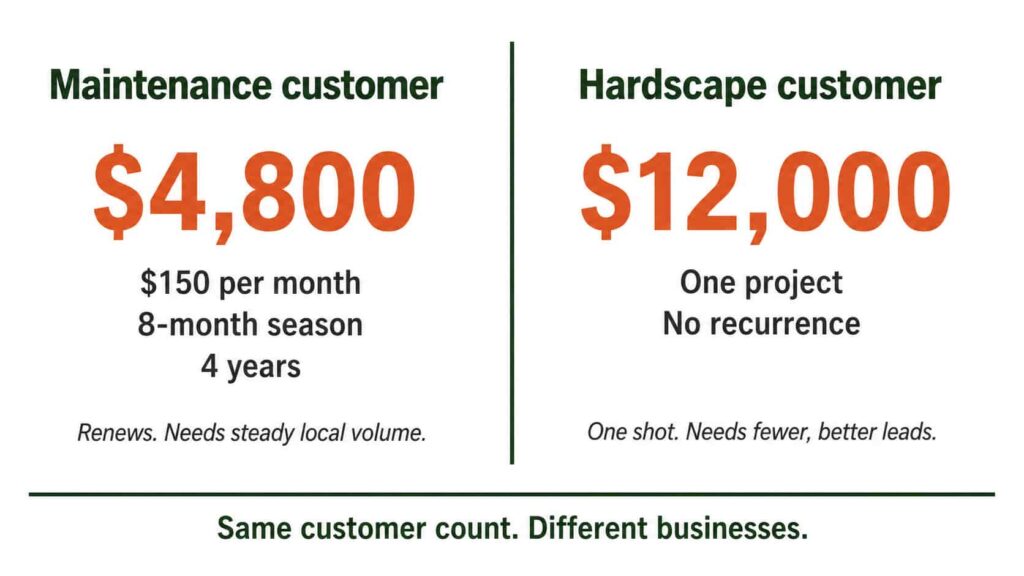
Run this math on your own numbers before you price any marketing.
SEO vs. shared lead marketplaces
The problem with Angi, Thumbtack and the rest isn’t the price. It’s the structure.
The same lead gets sold to three to five contractors. By the time you call, the homeowner has already talked to two other crews, so the conversation opens on price instead of on the work. You pay whether you close it or not. And the contact never becomes yours, so next month you buy the same kind of lead again.
An organic lead arrives differently. It comes to you directly, having already looked at your photos and read your reviews, which means the price conversation happens after they’ve decided they want you specifically. The page that produced it keeps working next month at no additional cost, and it’s yours.
The gap is real and it’s measurable. One BASEO landscaping client was paying $78 per shared lead and ended up at about $11 per organic lead from pages he owns (BASEO client data).
Here’s the honest part, though. Don’t cancel the marketplace on Monday. It’s feeding your crew this week and search isn’t going to produce anything for a few months. The goal isn’t to quit it in a huff. The goal is to build the channel you own until the marketplace becomes optional, and then decide with a calculator instead of a grudge.
SEO vs. Google Ads and Local Services Ads
This one isn’t a fight, it’s a scheduling decision.
Ads put you at the top of the page the week you turn them on. That’s the entire point of them, and it’s the only thing that matters when next month’s schedule is half empty. What ads don’t do is get cheaper, and the flow stops the day the spend stops.
SEO is the opposite trade. It takes months to build and it doesn’t charge you per click, so every job it produces after that costs less than the last one.
The seasonal math makes the choice concrete. In landscaping and lawn care paid search, cost per lead drops to roughly $40 to $50 in late April and early May, when demand is highest and the auction rewards you for showing up. Then it climbs into the mid-$80s and $90s through summer as competition peaks, against a category average around $87.80 (Green Industry Pros / Evergrow Marketing).
So the recommendation is straightforward. If you’re starting from zero in the middle of your season, run ads to cover the gap while the pages mature. Ads book jobs now, organic makes every job after that cheaper, and running both is how most crews should be doing it anyway.
Local Services Ads are worth naming separately. They’re the pay-per-lead units that sit above the map with the Google Guaranteed badge, and unlike a regular ad they deliver a phone call instead of a form. For a homeowner choosing between three crews he’s never heard of, the badge does real work. If you want the detail on how the paid side is structured, that’s what Google Ads for landscapers covers.
How Google decides which landscapers show up
Open a search for “landscaping company” plus your city and you’re looking at three separate contests on one screen.
At the top, paid. In the middle, the map with three businesses in it. Below that, the blue links. Each one is won a different way, and most of the phone calls come from the middle one.
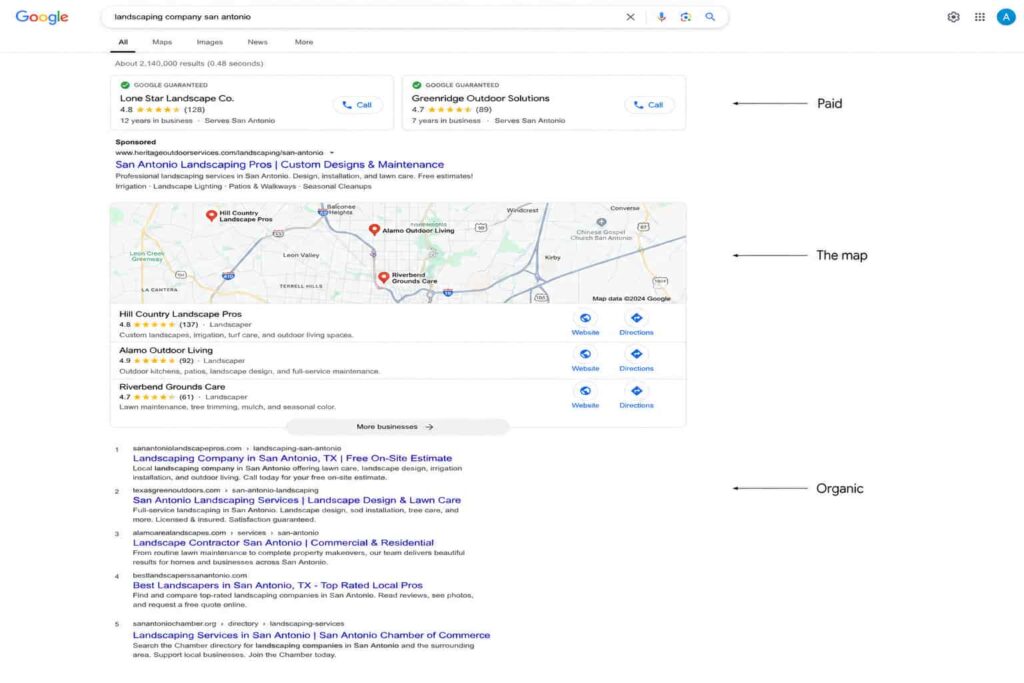
Three contests, one screen. The middle one is where the calls come from.
The map pack (where most calls come from)
Google says local results are based on three things (Google Business Profile Help). Translated into plain terms:
Relevance is whether your profile actually matches what the person typed. A profile that says “Landscaper” and lists paver patios is relevant to a paver patio search. One that says “Lawn Care Service” isn’t, no matter how many patios you’ve built.
Distance is how close you are to whoever is holding the phone.
Prominence is how well known your business is, online and off. Reviews, links, mentions, the local paper, the years you’ve been doing this.
How much does each piece weigh? Whitespark surveys the people who do this work for a living, and its 2026 Local Search Ranking Factors report, drawn from 47 expert local SEOs, puts Google Business Profile signals at about 32% of what decides the map, reviews at about 20%, on-page content at about 19%, and links at about 15% (Whitespark). In the same survey, the strongest individual factors are your primary business category and your proximity to the searcher, essentially tied.
Now the conclusion nobody else in these guides states out loud.
Proximity is the biggest thing on that list and it’s the one thing you cannot change. You’re not moving the shop. So every hour and every dollar goes into the factors you do control, and that is exactly why this guide runs profile first, then content, then links, in that order.
It also sets a realistic expectation about your radius. If you’re not showing up in the map for a city 25 miles away, that isn’t a failure and it isn’t something to fix on your profile. That’s distance doing what distance does. Ranking in that city happens in the blue links instead, which is the entire reason service-area pages exist.
The organic results below the map
Underneath the map, the rules change.
What wins down there is pages built for one specific thing: a service plus a city, with actual depth behind it. And the signals Google groups under experience and trust, which in practice means your own job photos instead of stock, your license and insurance, the number of years you’ve been running crews, and the owner’s name and face somewhere on the site.
Here’s the difference that matters most, and it’s the answer to the question every owner asks first: in organic you can rank in cities where you have no address. On the map you generally can’t. No office in that town, no map placement in that town.
That single distinction is what the whole service-area page strategy is built on, and it’s covered further down. If you want the version of this we build for clients, it’s on the SEO for landscapers page.
AI Overviews and AI Mode: what changed for local
Before the panic, one number: AI Overviews show on about 15% of simple local searches. The split runs right along the line you care about.
Whitespark studied how often AI Overviews appear on local business queries. Across all of them, about 68%. But broken out by intent, AI Overviews showed on only about 15% of simple local-intent searches and about 92% of informational ones (Whitespark).
Read that against your own keyword list. “Landscaping company Tampa” is the first kind, and the map still decides it. “Why does my yard flood when it rains” is the second kind, and an AI answer is almost certainly sitting on top of it.
Where they do appear, the cost is real. Seer Interactive tracked 3,119 queries and 25.1 million organic impressions and measured organic click-through rate on AI Overview queries falling 61%, from 1.76% down to 0.61% (Seer Interactive). In your world that reads like this. The blog post you wrote about why a yard floods after heavy rain will keep collecting impressions and stop collecting clicks, because the AI answered the drainage question without sending anybody to you. The paver patio page in Frisco is largely untouched, because nobody asks an assistant to pick their hardscaper and then declines to call one.
Worth saying in the same breath: Seer’s 2026 update shows a partial recovery, from 1.3% in December 2025 back up to 2.4% in February 2026 (Seer Interactive). These percentages move, and they move differently by industry.
The other side of it is the part worth acting on. Brands that get cited inside the AI Overview earn about 35% more organic clicks than brands that don’t. Being in the answer is worth more than it used to be, which is the whole game now.
Four things put you in the running to be cited:
- Answer questions directly, in 40 to 55 words, at the top of the section that asks them. Not after three paragraphs of setup.
- Keep your name, address and phone number identical everywhere they appear.
- Publish real prices or real ranges, and your actual process. Vagueness gets skipped.
- Collect reviews whose text describes the specific service and the town.
Nobody controls whether an assistant names your business. What you control is whether you’re the easiest business in your market to quote. That’s the work BASEO does under AI search optimization: structuring content so it can be cited, tracking which towns you’re named in, and recovering the AI-referred visits that GA4 quietly files under “Direct.”
Step 1: Landscaping SEO starts with your Google Business Profile
Your profile is roughly a third of what decides the map, it costs nothing, and it’s the fastest visible movement available to you. Which is why it comes first, ahead of anything on your website.
Start by finding out how many profiles you actually have. A lot of landscapers have two or three: one they claimed, one Google generated from a directory listing years ago, and one a former employee set up and never handed over. Duplicates split your reviews and your signals across listings that all rank worse than one complete profile would.
Audit and consolidate before you optimize. Then rebuild it properly: categories, the full service list, service area, photos, hours, attributes, and a posting cadence. That’s the piece BASEO does first on every landscaping account, alongside putting call and form tracking on every number, because a profile that starts producing calls you can’t count is only half useful.
Primary category, service areas and business name
Primary category. In Whitespark’s survey this scores as the single strongest individual factor you can actually set, and most landscapers set it wrong. Not wrong in the sense of inaccurate. Wrong in the sense of unprofitable.
Pick the category that matches the service that pays best, not the one you do most often. If half your revenue is design-build and hardscape but your profile says “Lawn Care Service,” you’ve told Google to send you the mowing searches. “Landscaper,” “Lawn Care Service” and “Landscape Designer” pull noticeably different traffic, and the choice between them is a margin decision, not a paperwork decision.
Add secondary categories for the other services you genuinely sell. Don’t inflate the list with things you’d technically do if someone asked.
Service areas. If you don’t have a storefront customers visit, hide the address and set service areas instead. List the towns your trucks actually drive to. Listing towns three counties away does not generate rankings there, and it dilutes the relevance of the areas where you do have a shot.
Business name. This one has a trap in it. Keywords in the business name correlate strongly with map rankings, which is why you’ll see “Austin Landscaping and Paver Patios LLC” sitting above you. It is also a violation. Google’s guidelines are explicit that including unnecessary information in your business name isn’t permitted and could result in suspension of your profile (Google Business Profile Help).
Your profile name should be the name on your trucks, your signage and your license. Nothing else. The competitor who stuffed his is running a risk he probably doesn’t know about, and a suspension in April is not a survivable event.
Photos, services and posts
Photos first, because this is where landscaping has an advantage almost no other trade has and almost nobody uses.
You finish visibly impressive work every single week. Post it. Before and after shots, the crew mid-job, the lettered truck on site. New photos every month, not a batch of twelve uploaded once in 2023. Stock photography reads as stock photography to a homeowner comparing three profiles, and it costs you the exact credibility your actual work would have earned for free.
Then fill in the Services section using the words people search with, not the words on your invoices. “Paver patio installation,” not “hardscape solutions.” “Yard cleanup,” not “seasonal property remediation.”
Use Posts for whatever is seasonal right now: spring cleanup, mulch delivery, aeration bookings, irrigation blowouts. It’s a small signal, but it’s also the only part of the profile that shows a homeowner you’re currently operating.
And answer your own Q&A. You can post questions to your own profile and answer them. Use the ones you already get on the phone twenty times a season: do you do free estimates, are you licensed and insured, what’s your minimum, how far out are you booking.
None of this is exotic. The business reason is simple: a complete profile is what makes someone call you instead of scrolling to the next listing that answered their question already.
Reviews: how many you actually need
There’s no magic number, but there is a gap that matters, and it’s the one between roughly ten reviews and roughly fifty.
Local Falcon analyzed 50 million search results and found businesses ranking in the top three local positions average 47 Google reviews, against 38 for businesses sitting in positions seven through ten (Local Falcon). BrightLocal’s 2026 local research points the same direction more sharply: businesses with 50 or more reviews are considerably likelier to appear in the map than businesses under 10.
Total count isn’t the whole story, though. Three other things do real work.
Velocity. A steady trickle every month beats forty reviews that all landed in the same week, which looks exactly like what it usually is.
Owner responses. Answer every one, including the bad ones, especially the bad ones. The reply is read by the next customer, not by the one who complained.
Review text. A review that says “great job” is worth less than one that says “they rebuilt our retaining wall in Bulverde and finished a day early.” The service and the town in the text are signals.
The system that actually works is boring: ask the day the job finishes, while the customer is standing in a yard that looks better than it did this morning. A short link texted from the foreman’s phone before he pulls out of the driveway will beat any process that requires you to remember something at the end of the week.
One line that isn’t optional. Never buy reviews and never offer a discount in exchange for one. It violates Google’s policies and the FTC’s rules on endorsements, and the downside is a stripped review profile at the worst possible moment. BASEO runs review generation for clients as part of the local authority work, and the first rule of it is that every review is real.
Step 2: Build a keyword list that matches how homeowners search
This step is not about finding “the keyword.” There isn’t one. It’s about writing down the words your customers actually use, which are almost never the words you use.
You say “seasonal turf remediation.” They type “yard cleanup.” You say “hardscape installation.” They type “how much does a paver patio cost.” Every one of those gaps is a page you’re not ranking for, because the page is written in contractor.
The four keyword types that matter for landscapers
There are four groups, and they don’t do the same job.
1. Service plus city. This is the money. “Landscaping company Tampa.” “Landscape design Frisco TX.” “Paver patio San Antonio.” “Sod installation Charlotte.” “Retaining wall contractor Austin.” Whoever is typing this has a project and a budget and is building a shortlist right now.
2. Near me. “Landscapers near me.” “Sod installation near me.” “Landscaping companies near me.” “Lawn care near me.” Same intent as the first group, but Google resolves the location itself, and the map does most of the deciding.
3. Problem and symptom. “Brown patches in lawn.” “Yard floods when it rains.” “How much does a paver patio cost.” “Best time to install sod.” These people have a problem and haven’t gotten to hiring yet. They’re worth having, but not today.
4. High intent with a modifier. “Emergency tree removal.” “Same day lawn mowing.” “Licensed landscaper Austin.” “Free estimate landscaping [city].” The modifier tells you what they’re worried about, and a page that answers the worry closes it.
| Keyword type | Example searches | What the searcher already decided | Which page wins it |
|---|---|---|---|
| Service + city | “landscaping company Tampa”, “paver patio San Antonio” | To hire someone for this specific job | A service page for that service |
| Near me | “landscapers near me”, “sod installation near me” | To hire someone nearby, today | Your Business Profile, backed by a service page |
| Problem / symptom | “yard floods when it rains”, “brown patches in lawn” | Nothing yet. They’re diagnosing | A blog post |
| High intent + modifier | “emergency tree removal”, “licensed landscaper Austin” | To hire, and they have one specific worry | A service page that answers the worry |
The classic mistake is writing blog posts for group one. “Landscaping company Tampa” does not want an article. It wants a page that says you’re a landscaping company in Tampa, shows what you’ve built there, and has a phone number on it.
How to find keywords without paying for a tool
You don’t need software to start. You need about an hour.
- Google autocomplete. Type “landscaping” plus your city and watch what Google finishes for you. Those are real searches.
- People Also Ask. The expanding questions in the middle of any results page. Every one of them is a heading on a future page.
- Related searches. Bottom of the results page. Same idea, broader.
- Google Search Console. If it’s connected, this is the best list you’ll ever get, because it’s the searches you’re already appearing for. Most owners have never opened it.
- Your own Business Profile. The performance section shows the terms people used to find your listing.
- The three competitors already ranking above you. Read their service menus. Whatever they list and you don’t is either a page you’re missing or a service you should be selling.
Paid tools like Ahrefs, Semrush and Google’s Keyword Planner add volume estimates and competitive data, and they’re worth it once you’re past the basics. They’re not where you start.
Step 3: The landscaping SEO site structure that ranks
One intent, one page. That rule decides almost everything about how a landscaping site should be built.
Your homepage cannot rank for eight services across five cities. Google has to pick one page as the best answer to “paver patio Frisco,” and a homepage that mentions patios in a paragraph alongside mowing, irrigation and cleanups will lose every time to a page that is entirely about paver patios in Frisco.
Here’s the structure that works:
Home
├── Services
│   ├── Landscape design & install
│   ├── Hardscaping & paver patios
│   ├── Lawn maintenance
│   ├── Irrigation
│   └── Seasonal cleanup
├── Service areas
│   ├── [City 1]
│   ├── [City 2]
│   └── [City 3]
└── Blog
Service pages ordered by margin, city pages for the towns you actually drive to, blog underneath for the problem searches.
The ordering is the part almost everyone gets backwards. Most landscaping sites lead with mowing because mowing is what they do most, and end up ranking for their worst-margin service. BASEO builds the service pages in margin order for exactly that reason, hardscape and design-build first, because the patio search and the mow search cost about the same to win.
Service pages
A service page that ranks and converts has the same anatomy every time.
An H1 with the service and your base city. A first hundred words that answer what this is and who it’s for, before any storytelling. What the service includes. Your process, step by step, so a homeowner who has never hired a landscaper knows what happens after they call. A price range, or at minimum the factors that move the price. Three to five before-and-after photos of your own work. Two or three reviews from customers who bought that specific service. A short FAQ. A clear call to action.
The price piece is the differentiator, and it’s the one almost nobody does. Publishing a range feels like giving something away. What it actually does is filter out the people who were never going to pay you and send a signal to the ones who will. A homeowner searching “how much does a paver patio cost” is going to land somewhere that answers it. That should be you.
Then order the pages by margin, not by volume.
The search for a paver patio costs about the same to win as the search for a mow. One of them is a $14,800 job and the other is $65 a visit. One patio is worth forty mowings, and both searches cost about the same to win. Ranking for the mow and not the patio is the most expensive ordering mistake in this industry, and it’s the default outcome if nobody makes a deliberate decision.
For a full-service landscaping crew, the pages that almost always earn their own URL, roughly in priority order: hardscape and design-build, irrigation, lawn maintenance, tree and shrub care, sod, mulch, seasonal cleanup, and snow removal if your winters call for it.
Your order might be different, because it depends on your actual margins and what your crews can absorb. But it should be an order somebody chose. Budget 600 to 1,000 words per page.
Service-area (city) pages
The first question every owner asks: can I rank in a city where I don’t have an office?
Yes, organically. No, on the map. You can build a page for Bulverde and compete in the blue links for “landscaping Bulverde” without an address there. You generally will not appear in Bulverde’s map results without one. Those are two different contests and only one of them is open to you.
A city page that actually works is built from things only you have:
- Three to five real projects you completed in that city, with photos of those projects.
- Reviews from customers who live there.
- Neighborhoods and subdivisions named specifically, because that’s how locals describe where they live.
- The local conditions you already know about that town. The clay in one area, the watering restrictions in another, the drainage problems in the subdivision built on a slope.
- Your realistic response time out there, and which crew covers it.
Then the golden rule, and it’s the only quality check you need: if you can swap the city name for another city and the page is still true, the page is worthless. Not just to Google. To the homeowner reading it, who can tell in four seconds whether you’ve ever worked in his neighborhood.
Start with three to five cities. Do them properly. Only add a sixth when the first five have real projects and real reviews in them. A crew covering four towns and a crew covering twenty need completely different builds, and the page count follows your trucks, not a keyword list.
How to avoid the duplicate-page trap
Here’s how this goes wrong. Somebody sells you forty city pages. They’re one template with the town name swapped by find-and-replace.
That is not a shortcut, it’s a named violation. Google’s spam policies call this doorway abuse, and they describe it almost exactly: pages targeted at specific regions or cities that funnel users to one page. The same policies cover scaled content abuse, which is generating many pages primarily to manipulate rankings rather than to help anyone (Google Search Central).
The consequence isn’t usually dramatic. The pages simply never index, or they index and rank nowhere, and in worse cases the whole site gets treated as less trustworthy. Your pages look like everyone else’s, so Google ranks none of you.
The decision rule is easy: five real city pages beat forty empty ones, every time. And if you haven’t done a job in that city yet, don’t publish the page. Go do a job there first. That’s the version of this mistake that shows up in the seven mistakes further down, because it’s the most common one that gets sold to landscapers as a service.
Step 4: Make those pages convert, not just rank
Ranking first with a page that doesn’t convert is paying for traffic that leaves. Most guides give this two sentences. It deserves more, because this is where the money either shows up on your schedule or doesn’t.
A homeowner landing on your service page from a phone, standing in his yard, needs a very short list of things.
- A clickable phone number in the header, and a sticky one on mobile. He is holding a phone. Make the phone do the thing phones do.
- A form with four fields maximum: name, phone, zip, service. Every field past that costs you quote requests. Nobody needs his email address and his preferred contact time before you’ve spoken.
- Price context, even a “starting at.” It filters the people who were never going to hire you and reassures the ones who will.
- A before-and-after gallery of your own work. Not stock. This is the single highest-value asset you already own and rarely use.
- License, insurance, and years-in-business badges. He’s about to let strangers into his backyard with machinery.
- A promised response time you actually keep. “We call back within the hour, every weekday” is worth more than any headline on the page, if it’s true.
That last one is worth more attention than almost anything else on this list. How fast you answer the lead moves the outcome more than most on-page changes ever will.
The median first response across home services sits somewhere around 42 minutes. Think about what that means on your own numbers. If you paid $78 for that lead and three other crews bought it too, 42 minutes is the difference between a job and a receipt. The crew that calls back inside five minutes is talking to a homeowner who hasn’t spoken to anybody else yet. The one who calls at lunch is the third quote.
None of this requires new software. It requires somebody whose job it is to answer, and a page that gave them something to answer. What a landscaping site needs to turn a click into a booked job is the whole argument behind how landscaping websites that convert get built.
And build for the phone first. Most local search traffic is mobile, and your customer is not sitting at a desk. He’s standing in the yard he wants fixed.
Step 5: Technical SEO basics landscapers can’t skip
None of this is glamorous and all of it is cheap. In business terms, not code:
Speed. Google’s own research found that 53% of mobile visits are abandoned when a page takes longer than three seconds to load (Marketing Dive). Half the people who clicked your result never saw it, and the culprit is usually uncompressed project photos.
Real mobile design. Open your own site on your own phone and try to request a quote. If it annoys you, it’s costing you.
HTTPS. The padlock. Browsers warn people away from sites without it.
Clean, flat URLs. /services/paver-patios/ tells Google and the customer what the page is. /index.php?id=4471 tells neither.
Consistent name, address and phone. Identical in every page footer and every directory. Not “St.” here and “Street” there. Google matches these to confirm you’re one real business.
Schema markup, code that labels your page so Google knows what it’s looking at. You want the version that marks you as a local business and lists the areas you serve, plus one for your FAQ answers.
An XML sitemap, a list of your pages submitted to Google Search Console so nothing waits to be discovered.
Descriptive alt text on project photos. “Paver patio installation in Boerne TX” instead of “IMG_4471.jpg.”
Search Console and PageSpeed Insights are free and take about ten minutes to set up. Start there before you pay anyone to audit anything.
Step 6: Earn local links, citations and mentions
These two words get used interchangeably and they’re not the same thing.
Citations are listings: your business name, address and phone number appearing consistently across the web. Backlinks are other websites linking to yours because they had a reason to. Citations confirm you exist. Links suggest you matter.
For citations, consistency beats volume. Get your details identical on Google, Apple Business Connect, Bing Places, Yelp, the BBB, Angi, Nextdoor, and your local chamber of commerce. And yes, Angi is on that list. A consistent listing on a directory is a completely different thing from buying leads from one, and you want the first even if you’ve decided against the second.
For links, forget guest post outreach. Here’s what a landscaping company can actually get:
- Sponsor a youth sports team. Most leagues list sponsors on their site with a link.
- Donate work to a school, a park, or a community garden, and ask for the mention. You were going to do the job anyway.
- Trade referrals with contractors who share your customer but not your service: pool builders, roofers, deck builders, home builders. Referral relationships turn into links naturally.
- Get the local paper out for a notable project. A large public install or a storm cleanup is a story to a local reporter.
- Join NALP and your state landscape contractors association. Membership directories are real links from relevant sites.
- Get listed as a certified installer by the nurseries and equipment suppliers you already buy from.
What you should not do is buy links, and you should not pay anyone promising to submit you to hundreds of directories. Those are link farms, they’re the thing Google spent fifteen years learning to detect, and the cleanup costs more than the links ever did. The authority work BASEO does is exactly the list above: real local citations and editorial links from chambers, associations, local news and relevant directories. No farms, no private networks, no shortcuts that age badly.
Step 7: Time your SEO to the landscaping calendar
Landscaping is the seasonal business. Everybody in it knows the cliff: slammed from March through October, staring at a half-empty February.
And yet every SEO guide written for landscapers gives advice with no date on it. Do this, then this, then this. As if a March start and a November start produce the same result.
They don’t, because of one mechanical fact: search takes months to mature. Work published in January is competing by April. Work published in April is competing in August, which is when you needed it least.
So the question stops being “when will this start working” and becomes “when do I need it working, and how far back do I have to start.” That reframe is the most useful thing in this article for anyone whose revenue has a shape.
Why your peak month depends on your state
Nationally, lawn care search interest peaks in April and bottoms out in December. That’s the average, and the average describes almost nobody.
The spread is enormous. Minnesota, Vermont, New Hampshire, Montana and Wyoming run mowing seasons of roughly six months. Florida and Texas run close to year round (LawnStarter). A snow belt operator and a Sun Belt operator building the same content on the same calendar will get completely different results, and one of them will conclude SEO doesn’t work.
Don’t take the national number. Go get yours.
Open Google Trends, search your main service term, filter to your state, and set the range to five years. You’ll see your own curve, with your own peak month on it. Then subtract four to six months. That’s when the content needs to be live, not when you should start thinking about it.
If your curve peaks in May, the pages go up between November and January. If you’re in Texas and it peaks in February, you’re building in September.
What to publish each season
Four blocks. Copy this straight into whatever you use to plan the year.
| Season | Months | What to build or publish | What it’s for |
|---|---|---|---|
| Winter | Nov–Feb | Technical audit, new service pages, city pages, planning and budget content | Building. Nothing published now is meant to convert now |
| Spring | Mar–May | Profile posts, spring cleanup and mulch offers, fast review responses | Selling. Everything should already be live |
| Summer | Jun–Aug | Irrigation, pests, drainage and brown spots, hardscape projects | Catching problem searches while demand holds |
| Fall | Sep–Oct | Aeration, overseeding, leaf removal, snow contracts where the climate calls for it | Bridging into the off-season and locking next year’s contracts |
Two things that table can’t tell you. Winter is when the building happens because winter is when you finally have time, and that is not a coincidence to waste. And spring is not for building. Spring is for selling what December built.
The rule underneath all of it: publishing in your peak month is late. The page you write in April is for next April.
How to measure landscaping SEO: the only five numbers that matter
Most reporting on this measures traffic. Traffic is not a business number. You can double your traffic and book fewer jobs, and if the only number on the report went up, nobody will notice for eight months.
Here are the five that actually settle the argument.
- Calls and form fills attributed to search. Not sessions. Actual people who contacted you, with the channel attached. This is the number the whole program exists to move.
- Map position for your five money keywords, measured from several points across your service area. This one has a trap: the position you see standing in your own kitchen is not the position your customer sees standing in his. You’re next to your own business. He isn’t. Check it from a few points across the area you actually serve, or you’re grading yourself on the easiest possible test.
- Impressions and clicks per page in Search Console. Diagnostic only. This is the number you use to find out why number one moved, never the number you report as a result.
- Cost per organic lead. What you spent this month, divided by the leads it produced. Watch the direction of this line more than the value of it. It should fall over time, and if it doesn’t after six months, something in the program is wrong.
- Jobs closed and revenue attributed. The only one that ends the conversation. Everything above it is a leading indicator of this.
The minimum setup is free and takes an afternoon: Google Search Console, GA4, and call tracking, or at absolute minimum one dedicated phone number that only appears in your search results. Then add one mandatory question when you book a job: how did you find us. Half your attribution problem is solved by somebody writing down the answer.
Number one is what movement actually looks like. One BASEO landscaping client went from 28 organic quote requests a month to 77 over six months (BASEO client data). What that curve looked like month to month is the useful part: nearly flat through months one and two, moving in month four, and steep by month six. If you only checked at week six you’d have concluded it failed.
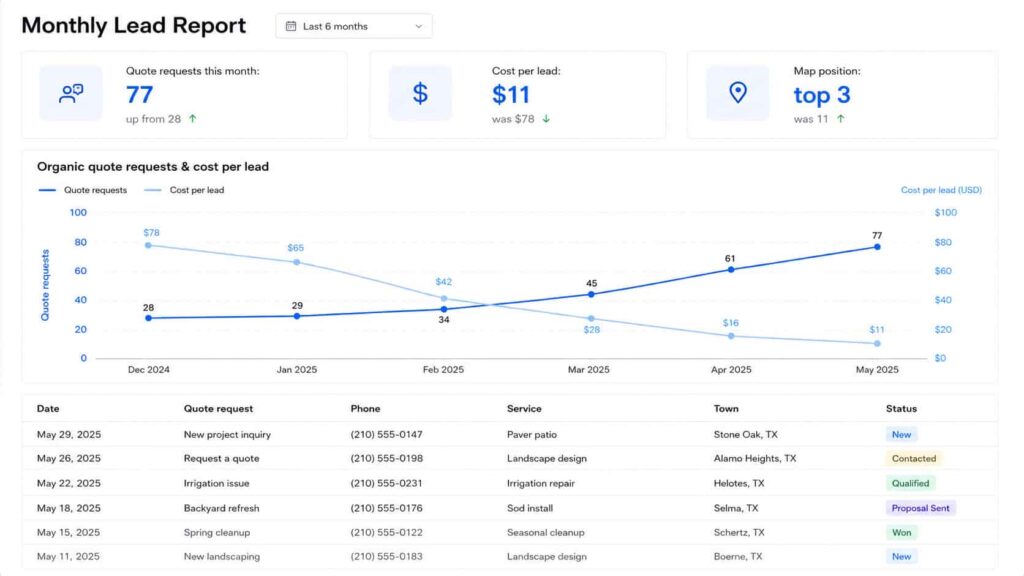
A real six-month curve is flat before it’s steep. Checking at week six tells you nothing.
This is what a monthly report should look like: quote requests and calls with phone numbers attached, the cost per lead trend, map position for the keywords that matter, what got published, and next month’s plan in plain English. One page, no dashboard to learn. That’s how BASEO reports, because a report that doesn’t contain the words “quote requests” and an actual phone number isn’t a report.
If you want to know which of those five numbers you currently can’t see on your own business, that’s exactly what the free audit tells you. Send me the map pack audit →
How long landscaping SEO takes and what it costs
Anybody promising you page one in 30 days from organic search is selling smoke. That is not a hedge, it’s arithmetic: pages take time to index, gain trust and accumulate signals.
Worth keeping the channels straight, though. Ads genuinely can book jobs in the first two or three weeks, because you’re buying placement rather than earning it. Fast results from paid are real. Fast results from organic are a story.
Both questions below get answered in ranges. Anyone giving you a single number is guessing or selling.
A realistic timeline
Months 1 and 2. Profile optimized and consolidated, technical audit done, keyword research finished, site architecture decided. Movement here shows up on the map first, and only close to your address. This is the least satisfying phase and the one that determines everything after it.
Months 3 and 4. The first service pages and city pages are indexed and starting to place. Rankings move measurably. First quote requests attributable to organic typically start landing somewhere in here.
Months 5 and 6. Lead flow becomes steady enough to notice without looking for it. This is usually the point where the owner stops asking whether it’s working.
Months 7 through 12. Compounding. Published pages accumulate authority, newer pages rank faster than the early ones did, and cost per lead falls because the same monthly investment produces more.
That maps closely to what the industry reports. Most sources put initial results at three to six months, with meaningful compounding gains between six and twelve (WebFX). The extremes are wide: a brand new domain can take twelve months or more, while an established site with existing authority can move in thirty to ninety days.
Three variables move that clock. How old and trusted your domain already is. How competitive your market is, because Dallas and a town of 9,000 are not the same problem. And how consistently the work gets done, which is the variable most people lose on.
What DIY, a freelancer and an agency actually cost
Three bands, and what each one honestly covers.
DIY. Zero cash, five to ten real hours a month of your time. That’s enough to claim and complete the profile, run the review system, keep photos current, and answer leads fast. Those four things are genuinely most of the early gain, and plenty of owners do them well. Where DIY runs out is content architecture, local link building, technical work and measurement, which need either skill you don’t have or time you don’t have in season.
A freelancer or contractor. Low end of the market, usually partial coverage. Often good at one piece, rarely running the whole program. Works best when you know exactly what you need done.
An agency. A full local program: content architecture, service and city pages, citations and links, technical work, and reporting.
For the market rates, published industry pricing surveys put local SEO commonly between $500 and $3,000 a month, with many small businesses landing around $1,000. Broken out by market, small and low-competition areas run roughly $300 to $1,200, suburban and moderately competitive markets $600 to $2,500, and large metros $1,000 to $10,000 or more. One-time project work generally runs $500 to $5,000 (WebFX, SEO.com).
Those are market ranges and they vary enormously by city, scope and competition. Treat them as a map, not a quote.
And then do the thing that actually decides it. The right number for you doesn’t come off anyone’s pricing page. It comes from the math in what one landscaping customer is actually worth. If a customer is worth $4,800 over three years, an $800 month needs one new customer every six months to be worth doing, and that’s a very different decision than it looks like before you run it. BASEO prices per market rather than off a list, and that number arrives inside the free audit, before there’s an invoice.
Seven mistakes that keep landscapers off page one
1. One page trying to cover every service and every city.
Google has to pick a single best page for each search, and a page about everything is the best answer to nothing. You end up ranking for your company name and nothing else. Fix: one page per service, one page per city.
2. City pages cloned with find-and-replace.
Forty pages, one template, the town name swapped. Google’s spam policies name this pattern directly, and the pages either never index or drag the site’s credibility down with them. Fix: five real pages with real projects in them.
3. A profile unclaimed, duplicated, or on the wrong category.
Two listings split your reviews. An unclaimed one can’t be edited. And a hardscape business categorized as “Lawn Care Service” is telling Google to send it the lowest-margin searches it has. Fix: audit for duplicates, claim everything, set the category to the service that pays best.
4. Name, address and phone that disagree.
“Suite 200” on the website, nothing on Yelp, an old number on the profile. Google uses these to confirm you’re one real business, and inconsistency reads as uncertainty. Fix: pick one exact format and make everything match it.
5. Stock photos instead of your own work.
This one is worse in landscaping than in any other trade, because your work is visual and you finish something photogenic every week. A homeowner comparing three profiles can spot a stock crew in matching polos instantly, and it costs you the credibility your actual portfolio would have earned for free. Fix: your phone, this week’s job, before and after.
6. Ignoring reviews, or answering only the good ones.
An unanswered one-star sitting on top of your profile is doing more damage than the review itself. The response isn’t for the person who complained. It’s for the next customer reading it. Fix: answer every review, especially that one.
7. Dropping the work in peak season.
This is the one that costs the most and gets noticed the least. You’re slammed in May so the pages stop, which means the following April is built on nothing. The busiest months are exactly when next year’s pipeline gets built. Fix: put the content work on the calendar like a job, in the months you’re least busy, and don’t cancel it when you get busy.
Doing it yourself vs. hiring a landscaping SEO company
There’s a real answer here and it isn’t “hire someone.”
Plenty of what moves the needle early is genuinely DIY. Claiming and completing your Business Profile. Running a review system off completed jobs. Uploading your own photos every month. Answering leads within minutes. Those four things are cheap, fast, and worth more in month one than anything else on this list, and no landscaping SEO company can do the fourth one for you anyway.
Where hiring starts to pay is the work that needs either specialized skill or sustained attention through your busiest months: content architecture, writing service and city pages that don’t read like templates, building genuine local links, technical work, and measurement you can actually trust. That’s the bulk of what landscaping SEO services cover, and it’s the part that quietly stops happening every May when you do it yourself.
If you do go looking, these are the questions that separate a real provider from an expensive one. Ask them before you sign anything:
- Will you give me direct access to my own Google Search Console and Analytics, or do I only see reports from your tool?
- Do you work with my direct competitor in this market?
- Who writes the content, and have they ever written for a landscaping company before?
- If we part ways, who owns the website, the content, and the Google Business Profile?
- What do you measure: rankings, or leads and booked jobs?
- Is there a lock-in contract, and what does it take to leave?
- What exactly gets done in month one, in writing?
And the red flags, which are easier to spot than most people think:
- Guaranteed #1 rankings, or a guaranteed number of leads. Nobody can guarantee a position, including Google, which says so publicly. A guarantee is a sales tactic, not a capability.
- “Submission to hundreds of directories.” That’s a link farm with a friendly name.
- Monthly reports with no lead numbers in them. If the report doesn’t say how many people called, it isn’t reporting on your business.
- Anyone who won’t tell you what happens in month one. Vagueness at the sales stage becomes vagueness at the invoice stage.
The honest summary: local SEO services for landscaping companies are worth paying for when the work is beyond your time or skill, and a waste when you’re paying someone to do the four things you could do yourself in an hour a week. Know which one you’re buying. If you want the wider view of how the channels fit together, that’s what a full marketing program for landscapers covers.
Your first week of landscaping SEO
The order is what makes this work, and the calendar is what makes the order urgent. Profile, then pages, then links, timed backward from your peak month rather than started whenever the phone gets quiet enough to think.
Five things you can finish inside seven days:
- Claim your Google Business Profile, check for duplicates, and set the primary category to the service with your best margin.
- Text the last ten happy customers and ask for a review.
- Upload twenty real photos of your own work from this season.
- Check that your name, address and phone match exactly across your website, your profile and Yelp.
- Pick your highest-margin service and write its page.
None of that costs anything except an evening.
What to do next
All of it ranks in the season after this one, not this one, which is the whole reason the best month to start is the slowest month on your calendar.
If you’d rather see exactly which of these your site is missing and what the crew above you on the map built instead, that’s what the audit is for. Some owners read it, do the work themselves in the off-season, and do fine. Most would rather spend that time bidding jobs. The team on your account works only with landscapers, so it already knows your competitors, your keywords and your season. Free, in writing, about two business days. No call required, and it’s yours to keep either way.
Landscaping SEO FAQs
What is landscaping SEO?
Landscaping SEO is the process of optimizing your website and Google Business Profile so your company appears when homeowners in your service area search for lawn care, landscape design, hardscaping or maintenance. It combines local optimization, service and city pages, technical fixes and reviews to turn searches into booked jobs.
How much does SEO cost for a landscaping company?
Published industry pricing surveys put local SEO commonly between $500 and $3,000 per month, with many small businesses landing near $1,000. Small markets run roughly $300 to $1,200, suburban markets $600 to $2,500, and large metros $1,000 to $10,000 or more. One-time project work typically runs $500 to $5,000.
How long does SEO take for landscapers?
Expect three to six months before landscaping SEO produces meaningful lead flow. Google Business Profile changes can move map rankings within weeks, but service pages, city pages and local links compound over months. Domain age, market competition and how consistently you execute all shift the timeline.
Is SEO worth it for a small landscaping business?
Yes, if one customer is worth more than a month of the work. Search captures homeowners who have already decided to hire someone, so the leads close better than interruption channels. Divide your monthly cost by what one customer is worth over three years to see how many new jobs you need to break even.
Can I do landscaping SEO myself?
Yes, partially. Claiming and completing your Google Business Profile, collecting reviews, uploading real project photos and answering leads fast are all DIY-friendly and drive most early gains. Content architecture, local link building and technical work take more time and skill than most owners have in season.
How do I rank in the Google map pack for landscaping?
Pick the right primary category, set accurate service areas, keep your name, address and phone identical everywhere, upload real photos regularly and build a steady flow of reviews you respond to. Proximity to the searcher is the biggest factor and you can’t control it, so maximize everything else.
How many Google reviews does a landscaping company need?
Aim for 50. Local Falcon’s analysis of 50 million search results found businesses in the top three local positions average 47 Google reviews against 38 for positions seven to ten, and BrightLocal’s 2026 research points the same way. Steady velocity matters as much as total count.
How do I rank in cities where I don’t have an office?
You can rank organically in nearby cities with dedicated service-area pages, but you generally won’t appear in that city’s map results without a physical address there. Make each page genuinely local: real projects, real customer reviews, named neighborhoods and the local conditions you already know.
Do I still need a website if I have a Google Business Profile?
Yes. Your profile wins map placements, but the organic results below the map, service pages, city pages and pricing information all live on your site. Google also uses your website to confirm what you do and where you work, which strengthens the profile itself.
What’s the difference between local SEO and regular SEO for landscapers?
Local SEO targets searchers in your service area and focuses on your Google Business Profile, reviews, citations and city pages. Regular SEO focuses on ranking pages nationally through content and links. Landscapers sell locally, so local SEO drives the revenue while broader content supports authority.
Leave a Reply