
Most operators lose money on the wrong types of real estate leads before they ever figure out which ones pay. They buy portal leads that never answer, chase cold lists that go nowhere, and ignore the sources that actually close. This guide maps every lead type across two simple axes, adds a temperature layer, then ranks the sources by what they really cost and convert in 2026, so you spend on the ones worth chasing.

The lead types you chase decide your cost per deal long before your follow-up does.
- What Is a Real Estate Lead?
- The Two Ways to Classify Real Estate Leads
- Lead Types by Prospect: Buyer vs. Seller
- Lead Types by Source: Inbound vs. Outbound
- Lead Types by Temperature: Cold, Warm & Hot
- High-Intent Seller Lead Types Worth Knowing
- Referral & Sphere-of-Influence Leads
- Types of Real Estate Leads Ranked by Cost & Conversion
- How to Choose the Right Lead Types for Your Business
- Get More High-Intent Leads Without Buying Contact Lists
- Frequently Asked Questions
What Is a Real Estate Lead?
A real estate lead is a person or business who has shown some potential interest in buying or selling property, or who fits the profile you’re trying to reach. That’s it. The word covers a huge range of readiness.
It helps to separate three things people use interchangeably. A contact is just a name and number on a list. A lead is a contact who has given you some signal of interest, a form fill, a call, a reply. A prospect is a lead you’ve qualified and confirmed has real intent and a real timeline.
The important part: leads sit on a spectrum of intent. On one end is someone who merely fits a demographic. On the other is a motivated seller who wants a cash offer this week. Same label, wildly different value. That spectrum is the whole reason some leads cost 100 times more to turn into a deal than others, and it’s why a complete investor lead generation guide starts with intent, not volume.
The Two Ways to Classify Real Estate Leads
Every real estate lead can be sorted two ways, and understanding both is what stops you from overpaying.
- By who they are: buyer leads (looking to purchase) or seller leads (looking to sell).
- By how they reach you: inbound (they find you) or outbound (you find them first).
- Plus a temperature layer: cold, warm, or hot, based on how ready they are right now.
These overlap. An inbound warm seller is one lead described three ways at once. Classifying a lead this way isn’t academic. It tells you what the lead should cost, how hard you’ll have to work it, and how fast you need to call back.
Lead Types by Prospect: Buyer vs. Seller
The first split is the most basic and the most important for your margins. For cash buyers, the seller side is the whole game, but it’s worth knowing both.
Buyer Leads
Buyer leads are people actively searching to purchase a property. They usually enter through listing portals, paid ads, referrals, or a direct inquiry off your site. They’re the easiest lead type to generate at volume, which is why newer agents lean on them.
The upside is scale. Buyer demand is broad, the channels are well-established, and you can turn the tap on quickly with ads or a portal subscription.
The downside is readiness. A buyer lead may be six months from a purchase, still getting pre-approved, or just browsing on a Saturday. Many aren’t ready to commit, so they need education and a long follow-up. High volume, lower average intent. For a cash-buying operation, buyer leads matter mostly on the disposition side, moving a property once you own it.
Seller Leads
Seller leads are homeowners thinking about listing or selling. They’re the more valuable half of the market, and everyone knows it.
A seller lead usually means one transaction you can control from start to finish, with a clearer timeline and faster deal cycle than a buyer who might tour 30 homes and buy none. That’s why seller leads are the most sought-after and the most competitive to source. When you land a listing appointment or a motivated homeowner who wants an offer, you’re much closer to a closing than with an equivalent buyer.
The catch is supply. Seller leads are harder to find and cost more to win, because every investor and agent in your market wants the same homeowner. For cash buyers, the entire pipeline runs on seller leads for investors, which is why the rest of this guide leans toward the seller side.
Buyer Leads vs. Seller Leads: Which Are More Valuable?
Seller leads are generally more valuable, with higher earning potential and faster closings. Buyer leads win on volume and scalability. That’s the short answer.
The reason is control. A seller lead is one property, one decision, one transaction you can drive to the closing table. A buyer lead is a maybe that can shop you for months. There’s also a source effect: inbound leads convert at roughly 10 to 15%, against about 1 to 3% for cold outbound (biscred), and some analyses put inbound’s return at several times outbound’s. Since more seller intent tends to arrive inbound (people searching “sell my house fast” when they’re ready), the value gap compounds.
| Factor | Buyer leads | Seller leads |
|---|---|---|
| Value per lead | Lower | Higher |
| Speed to close | Slower, can browse | Faster, clearer timeline |
| Competition | Moderate | High |
| Effort / education needed | High | Moderate |
Lead Types by Source: Inbound vs. Outbound
The second axis, how the lead reaches you, is the one that most changes what a lead costs.
Inbound Leads
Inbound leads come to you. They find your website through search, read your content, click an ad, see your Google Business Profile, or get referred by someone who knows you. By the time they reach out, they’ve usually done some homework and are further along, which makes them cheaper to convert.
Inbound leads carry a self-initiated interest that outbound never has (iSpeedToLead). Nobody cold-pitched them. They raised their hand.
Common inbound channels include organic search (ranking for “we buy houses” and “sell my house fast” terms), content and SEO for a real estate website, Google Business Profile and map results, paid search and social ads, and referrals. The organic ones get cheaper over time because the asset keeps working after you stop paying.
Outbound Leads
Outbound leads are the ones you reach first. You go get them through cold calling, direct mail, door knocking, cold email, SMS, and networking. The homeowner wasn’t looking for you, so you’re starting the conversation.
The trade-off is persuasion and time. Outbound needs more education, more touches, and a longer cycle, because you’re creating interest instead of catching it. What you get in return is control: you pick exactly who to target, which street, which absentee owner, which distress signal.
Outbound works, but it’s labor and spend that stop the day you stop. If you want fewer of those calls, there are proven ways to get leads without cold calling that lean on inbound and referrals instead.
Lead Types by Temperature: Cold, Warm & Hot
Temperature is how ready a lead is to transact right now. It cuts across every source.
Cold leads fit your target profile but haven’t interacted at all. Most of a bought list is cold: the right demographic, zero relationship. Cold leads are cheap and plentiful and take the most work to warm up.
Warm leads have engaged. They opened your mail, replied to a text, visited your site twice, or asked a question. They’re interested but not ready to sign. This is where most follow-up discipline pays off.
Hot leads are ready now. The motivated seller who wants a call today is a hot lead, and the clock is running the moment they raise a hand.
Temperature drives urgency. How fast you respond tends to predict conversion more than which source the lead came from, because a hot lead who reaches three of your competitors first is usually gone. A tight follow-up system is what turns warm into hot and hot into closed, which is the whole point of learning how to convert leads in real estate before you buy more of them.
High-Intent Seller Lead Types Worth Knowing
These are the specialized seller lead types investors and top agents prioritize, because the intent is already high. They’re the sources that print deals, and most of them start from a specific situation you can find in foreclosure and distress records.
Motivated Seller Leads
A motivated seller lead is a homeowner with real urgency: financial distress, a job relocation, a divorce, an inherited property they don’t want, or a tired landlord done with tenants. They need to sell, and they need to sell fast. This is the core lead type for cash buyers and investors.
They convert because they have a problem to solve, not a price to shop. A homeowner facing a foreclosure date cares more about certainty and speed than squeezing the last few thousand dollars, which is exactly what a cash offer delivers.
Motivated sellers show up through search (they type their problem into Google), direct mail, referrals, and distress data lists. The best operators build more than one path to them, but the cheapest path over time is the one where they find you. Here’s how to get motivated seller leads across free and paid channels.
Expired Listings
Expired listings are homes that were listed with an agent, failed to sell, and came off the market. The seller already proved they want to sell. They just didn’t get it done the first time.
That proven intent is why they convert so well. In 2026, expired listings carry roughly a 44% list rate and a 20.7% sold rate nationally, with about a 30-day cycle from lead to signed listing, making them the highest-converting seller source in the data (REDX). The competition shows up fast, though, so speed and a real reason-to-believe pitch matter.
FSBO (For Sale By Owner) Leads
FSBO leads are homeowners trying to sell without an agent. They’ve decided to sell, which is half the battle, but they’ve chosen to go it alone.
FSBOs convert at about a 27.8% list rate and a 13.1% sold rate (REDX). The angle that works: many FSBOs eventually get tired of the hassle and either list or take a straightforward cash offer. Patient, respectful follow-up wins these, because you’re often the person they call when the DIY route stalls.
Probate Leads
Probate leads come from inherited property moving through the court after an owner passes. They’re one of the most underrated and fastest-growing lead types in real estate, driven by an aging population (REWW).
They tend to combine three things investors love: a motivated seller who often doesn’t want the house, a property frequently owned free and clear, and a below-market entry price, which is why probate ranks near the top on per-deal margin and can close in 30 to 90 days (ProbateData). They also demand sensitivity. Someone is grieving. Lead with help, not a pitch.
Absentee & Predictive Seller Leads
Absentee owners are landlords who live out of the area, often tired of managing a property from a distance. That fatigue makes them quietly motivated, and they rarely get marketed to well.
Predictive seller leads are the modern layer. These are AI-scored lists that model who is likely to sell soon by combining signals like upsizers, downsizers, and absentee owners into a probability (The Share Group). Instead of blasting a whole ZIP code, you focus outreach on the homeowners most likely to transact this year. Used well, absentee and predictive data is a pipeline builder that keeps your outbound from being pure guesswork.
Referral & Sphere-of-Influence Leads
Referral and sphere-of-influence leads are the most profitable leads in real estate, full stop. The hard acquisition cost is close to zero, and they convert at 15 to 25% (Jamil Academy). Somebody already vouched for you, so the trust is pre-built and the decision is half made before the first call.
The numbers back it up: about 41% of a typical operator’s business comes from repeat and referral relationships (FoneSwift). That’s a huge share of revenue from a channel most people never systematize.
Three ways to generate more of them:
- Stay in front of past sellers and buyers with a simple, consistent cadence (a quarterly check-in beats a yearly holiday card).
- Ask at the closing table, when goodwill is highest, for one introduction.
- Build referral partners: agents who don’t buy, attorneys handling probate and divorce, contractors who see distressed homes first.
Types of Real Estate Leads Ranked by Cost & Conversion
Here’s every major lead source side by side, on what it typically costs and how it typically converts in 2026. Use it to decide where your next dollar goes.
| Source | Typical cost per lead | Typical conversion to deal | Best for |
|---|---|---|---|
| Referrals / sphere of influence | ~$0 hard cost | 15–25% | Highest ROI, every operator |
| Expired listings | Low (data + your time) | ~20.7% sold rate | Fast listings, proven intent |
| FSBO | Low (data + your time) | ~13.1% sold rate | Persistent, respectful follow-up |
| Probate / inherited | Low to moderate (data) | High per-deal margin | Cash buyers, patient outreach |
| Inbound organic (SEO / AI search) | Falls toward near-zero over time | High, leads arrive pre-qualified | A compounding, owned pipeline |
| Google seller-keyword ads | ~$150–$400 | Moderate | Speed, in markets with budget |
| Portal leads (Zillow / Realtor.com) | ~$100–$300 | 0.4–1.2% | Buyer volume, not margin |
| Paid social (Facebook / Instagram) | ~$5–$30 | Low, top of funnel | Cheap volume plus nurture |
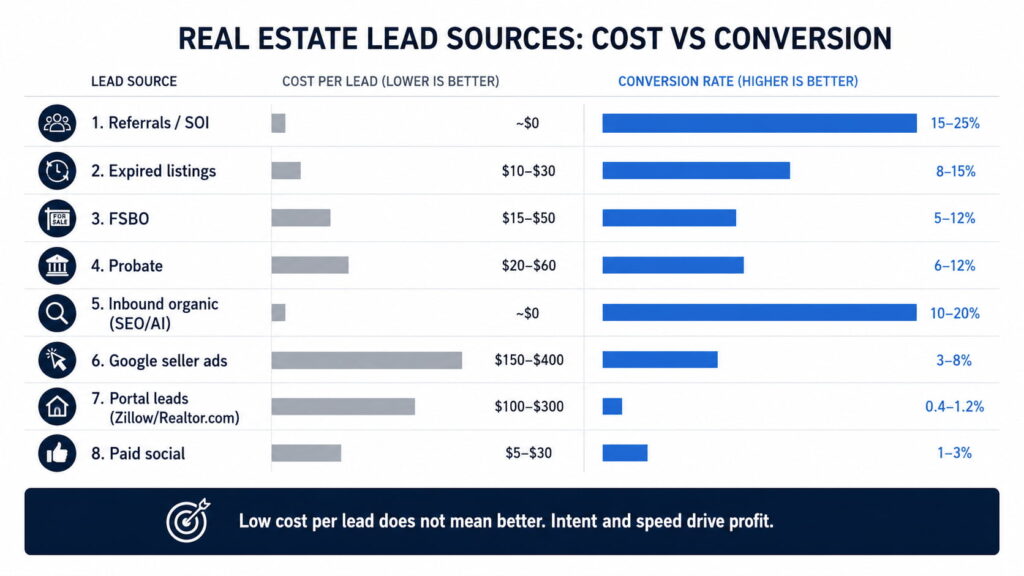
Cost per lead is a trap metric. Portal leads look mid-priced but convert at 0.4–1.2%, while referrals and inbound organic cost almost nothing and convert many times higher.
Read the table one more time, because the takeaway is where most operators go wrong. Low cost per lead does not mean a better lead. The blended industry cost per lead hit about $503 in 2026, at roughly a 1 to 4% conversion rate for raw volume (Deal Machine OS). Portal leads sit in a mid-cost, low-conversion box that quietly eats margin. Run the napkin math: a $200 portal lead that converts at 1% means 100 leads and $20,000 in lead spend for a single deal. A referral that closes at 15 to 25% gets you there in a handful of contacts at almost no hard cost. Referrals and inbound organic sit in the low-cost, high-conversion box. What actually drives profit is intent and speed to lead, not a cheap number on a subscription. The right lens is Google Ads cost for real estate measured as cost per deal, and the same goes for real estate Facebook ads.
How to Choose the Right Lead Types for Your Business
There’s no universal best lead type. There’s the right mix for your goal, your budget, your skill, and your market.
Start with the goal. If you need raw volume and have thin margins to protect, portals and paid social fill a pipeline fast. If you need margin, motivated sellers, probate, expired listings, and referrals are where the real dollars are. Then be honest about skill and stomach: cold outbound rewards people who can handle rejection and follow up relentlessly, while inbound rewards patience and consistency.
For most operators, the strongest setup is a simple mix:
- One inbound compounding channel you own (organic search and AI search), so leads get cheaper over time instead of more expensive.
- One high-intent outbound channel (motivated seller mail, probate, or expired) for deals you need this quarter.
- A referral engine running in the background, because it’s the cheapest, highest-converting source you have.
One more thing matters more than adding a fourth source: your follow-up. A fast, disciplined response system beats chasing more leads every time. Speed and consistency turn the leads you already have into deals, and the inbound compounding channel in that mix, organic and AI search, is exactly what BASEO builds for cash home buyers so the pipeline keeps working after the spend stops.
Get More High-Intent Leads Without Buying Contact Lists
The highest-quality leads aren’t for sale on a list. They’re inbound leads you own: motivated sellers and buyers who find you through search and AI answers at the exact moment they’re ready to act.
That pipeline gets built, not bought. Original city pages for every market you work, seller-situation content for the searches motivated sellers actually type (probate, foreclosure, divorce, inherited property), and AI-search optimization so you’re the name ChatGPT and Google’s AI answers hand back. That’s the work BASEO does for cash home buyers, and it’s why an owned channel beats renting overpriced portal leads: it compounds instead of resetting to zero every month. If you want to see it working, here’s how to get cited in AI Overviews and what SEO for cash buyers looks like in practice.
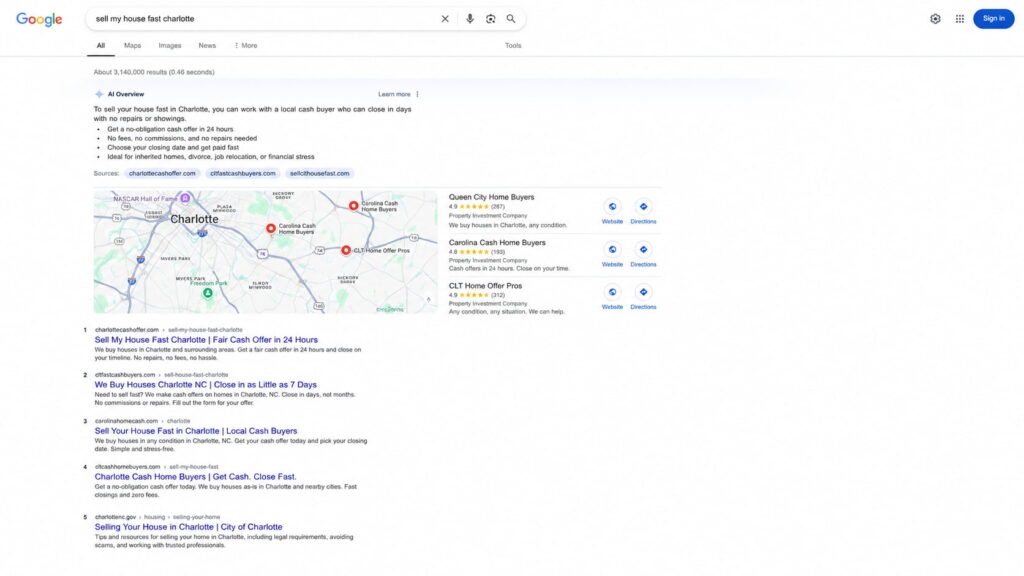
The inbound seller lead you own: a motivated homeowner finds you in the AI answer and the map, at the moment they’re ready to sell.
If you’d rather see where your own site stands before building anything, that’s what the free audit covers below.
Frequently Asked Questions
A few quick answers to the questions operators ask most about real estate lead types.
What are the two main types of real estate leads?
The two main types are buyer leads and seller leads. Buyer leads are people looking to purchase property; seller leads are homeowners considering listing. Leads are also classified by source, inbound (they contact you) versus outbound (you reach them first), and by intent level.
What is the difference between a buyer lead and a seller lead?
A buyer lead is someone actively searching to purchase a home, usually entering through listing sites or ads. A seller lead is a homeowner thinking about selling. Seller leads are typically more valuable, with higher earning potential and faster deal cycles, but they’re harder to source.
Which type of real estate lead converts best?
Expired listings convert best among paid sources, roughly a 44% list rate and 20.7% sold rate in 2026. Referral and sphere-of-influence leads convert at 15 to 25% with almost no cost. Inbound leads generally convert several times better than outbound.
What is a motivated seller lead?
A motivated seller lead is a homeowner who needs to sell quickly due to circumstances like financial distress, relocation, divorce, or an inherited property. They’re the highest-intent seller type and the primary target for real estate investors and cash home buyers because they close fast.
How much does a real estate lead cost?
It varies widely by source. Paid social runs $5 to $30 per lead, Google buyer ads $20 to $60, portals like Zillow and Realtor.com $100 to $300, and Google seller-keyword ads $150 to $400. Referral and sphere-of-influence leads carry almost no hard cost.
Final thoughts
There’s no single best type of real estate lead. There’s the mix your market, budget, and follow-up can actually convert, and cost per lead is the wrong scoreboard for choosing it. The lead that looks cheap on a portal invoice often costs the most per deal, while the one who finds you on their own costs the least.
So build one channel you own, add a high-intent outbound source, keep a referral engine running, and measure everything in cost per deal, not cost per lead. If you want to see which lead sources your specific market actually rewards, that’s what the free audit is for. Written, delivered in about 2 business days, no call required, yours to keep.
Leave a Reply