Every offer you write starts with the same number. So does every assignment fee and every rehab budget.
Get that number 10% wrong and the profit you penciled in is gone before you reach the closing table. So what is ARV in real estate, and how do you calculate one you can actually defend? Here’s the math, start to finish, on one worked example you can copy for your next deal.
The ARV work happens before the offer: comps, a notepad, and a number you can defend.
ARV (after repair value) is the estimated market value of a property after planned renovations are complete. It’s based on recent sold prices of comparable, already-renovated homes nearby, not the property’s current as-is condition. Investors, wholesalers, and hard-money lenders use ARV to set offers, assignment prices, and loan amounts.
Almost everyone in the deal runs on this number. Flippers use it to set the resale target. Wholesalers price their assignment against it. BRRRR investors need it for the refinance appraisal. And hard-money lenders lend against a percentage of it, which means their appraiser will check your math.
One thing to keep straight: ARV is a forecast, not a fact. The house isn’t worth that number yet. It’s worth that number if the renovation gets done and if your comps were honest. Which is why the calculation matters more than the definition.
The ARV Formula: How to Calculate After Repair Value
The textbook formula is simple: ARV = the property’s current value + the value added by renovations. Nobody credible calculates it that way.
In practice, operators skip the theory and work backwards from comps: what did renovated houses like this one actually sell for? That’s the whole method, done in three steps.
Take the example we’ll carry through this article: a distressed 3-bed, 2-bath that needs a full cosmetic rehab, in a neighborhood where renovated houses sell around $300K.
Step 1: Pull the Right Comps
Pull 3–5 sold comps, not active listings, from the last 3–6 months, within about a mile, in the same bed/bath and size band.
Then the filter that separates a real ARV from a hopeful one: the comps must be in renovated condition. The #1 rookie error is comping a future-renovated house against as-is sales. You’re estimating what the house will be worth after the work, so the comps have to reflect houses after the work.
Where operators pull them: MLS access through an investor-friendly agent, county public records, and the listing portals. Any of the three works; the discipline is what matters.
Step 2: Adjust for the Differences
No comp matches your subject exactly. Adjust for square footage, lot size, garage, and condition delta between each comp and your post-renovation subject.
Then run the sanity check: price per square foot times your subject’s footage. If renovated comps trade around $200/sqft and your subject is 1,500 sqft, you should land near $300K. If your adjusted comps say $340K, one of your comps is lying to you.
Step 3: Settle on a Defensible Number
Average your adjusted comps and lean conservative. The test isn’t whether the number works in your spreadsheet. It’s whether it survives someone else’s.
A hard-money lender’s appraiser runs this exact exercise on an ARV appraisal before funding a rehab loan. If your $300K only holds up with the one outlier comp from the nicer street, the appraisal comes back at $280K and your deal math breaks in escrow, not on paper.
With a defensible ARV in hand, the next question is what to pay for the house.
The 70% Rule: Turning ARV Into a Maximum Offer
This is the part you came for: turning the ARV into a buying decision.
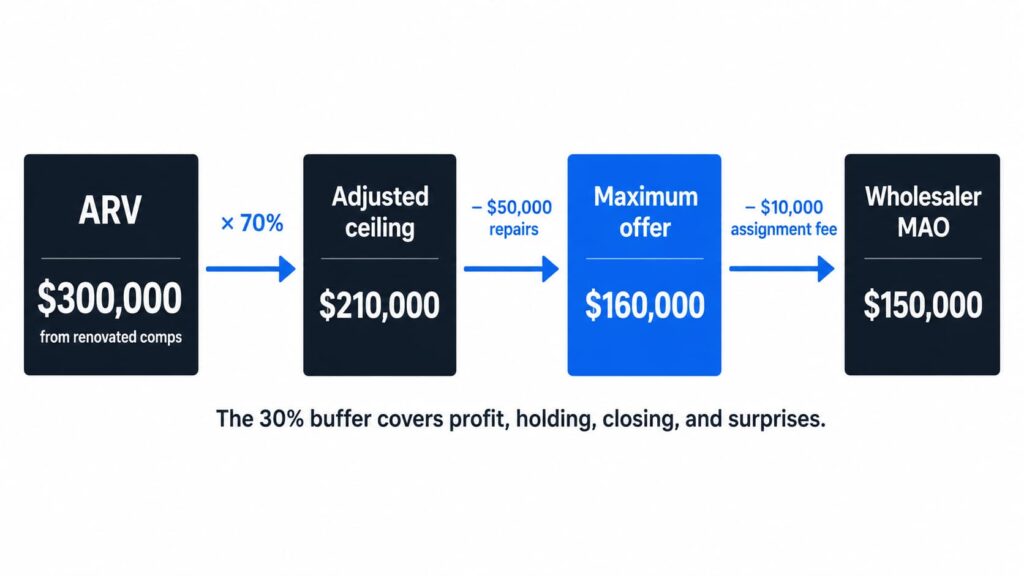
Maximum purchase price = (ARV × 0.70) − repair costs
The 30% you’re holding back isn’t greed. It has to cover your profit, holding costs, closing costs on both ends, commissions on the resale, and the surprises behind the drywall. Margins are thin enough that the buffer is doing real work: the median flip returned $65,981 in gross profit in 2025, the lowest return on investment since 2008 (ATTOM). Gross, before holding and closing costs. The buffer is where your actual profit lives.
A Worked Example, Start to Finish
Run our 3/2 through it:
Step
Number
ARV (from renovated comps)
$300,000
× 70%
$210,000
− Repair estimate
$50,000
Maximum offer
$160,000
Now the reason this article opened with a 10% warning. Say you buy at $160K, spend the $50K, and the true ARV was $270K, not $300K. Your gross spread just fell from $90K to $60K. One estimating error cost $30K, and every dollar of it comes out of the profit line, not the budget line.
One estimating error at the ARV block flows through every number to its right.
When the 70% Rule Breaks
The rule is a screen, not a law of physics, and there are three places it bends:
Hot or expensive markets. In metros where renovated inventory moves fast, operators buy at 75–85% of ARV because 70% offers never win. Thinner spread, faster velocity.
Sub-$100K houses. Thirty percent of a small number isn’t enough dollars. On a $90K ARV, the buffer is $27K before repairs, and fixed costs (closing, utilities, insurance) don’t shrink because the house was cheap.
Buy-and-hold. If you’re keeping the property, cash flow and refinance math matter more than the flip spread. The 70% rule screens flips; it doesn’t underwrite rentals.
Adjust the percentage to your market. Keep the discipline.
ARV for Wholesalers: The MAO Formula
If you’re wholesaling, your version of the math adds one line:
MAO = (ARV × 70%) − repairs − your assignment fee
Extend the example: $210K minus $50K in repairs minus a $10K fee puts your maximum allowable offer at $150K. Lock it up higher than that and you’re negotiating your own fee down at disposition. The fee itself is worth protecting: the national average assignment fee is about $13,000 per a survey of 1,000+ wholesalers, with the working average nearer $10,000 once newer operators are included (Real Estate Bees).
Here’s what generic ARV explainers miss: your end buyer runs the same 70% math you just did. Your ARV doesn’t have to convince you. It has to convince the cash buyer you’re assigning to, and his lender’s appraiser after that. An inflated ARV doesn’t die at the contract stage; it dies at disposition, after you’ve spent the marketing money to find the deal. If you’re building toward that business, here’s how to start wholesaling real estate the right way.
ARV vs. Market Value vs. Appraised Value
Same house, three different numbers. Here’s the fast version:
Term
What it measures
Who produces it
As-is market value
What the house sells for today, in its current condition
The market, via as-is comps
Appraised value
A licensed appraiser’s opinion of value; can be as-is, or “subject to completion” (an ARV appraisal) for rehab loans
Licensed appraiser
ARV
Future value after planned repairs, based on renovated comps
The investor, verified by an appraiser on rehab loans
Offers built on the wrong one of these three lose money. You buy against as-is value, you borrow against appraised value, and you profit against ARV.
Common ARV Mistakes That Kill Deals
Every one of these has killed real deals. Most operators have made at least one:
Comping against unrenovated sales. As-is comps produce an as-is number, not an ARV. You just valued the house you’re buying, not the house you’re selling.
Using active listings instead of solds. Asking prices are opinions. Sold prices are facts.
Stale comps in a shifting market. A comp from six months ago in a cooling market bakes in a value that’s already gone.
Over-improving for the street. A $350K renovation standard on a $280K street still sells for $280K. The neighborhood sets the ceiling, not your finish schedule.
Taking the seller’s or a guru’s ARV at face value. Whoever hands you an ARV has an incentive attached to it. Run your own comps, every time.
Ignoring holding-time risk. Every extra month of holding eats the spread the 30% buffer was protecting. A right ARV with a wrong timeline still loses.
What ARV Has to Do With Your Marketing Budget
Everything above is spread discipline: what the deal is worth, minus what it costs, equals what you keep. The same math runs your marketing, one level up.
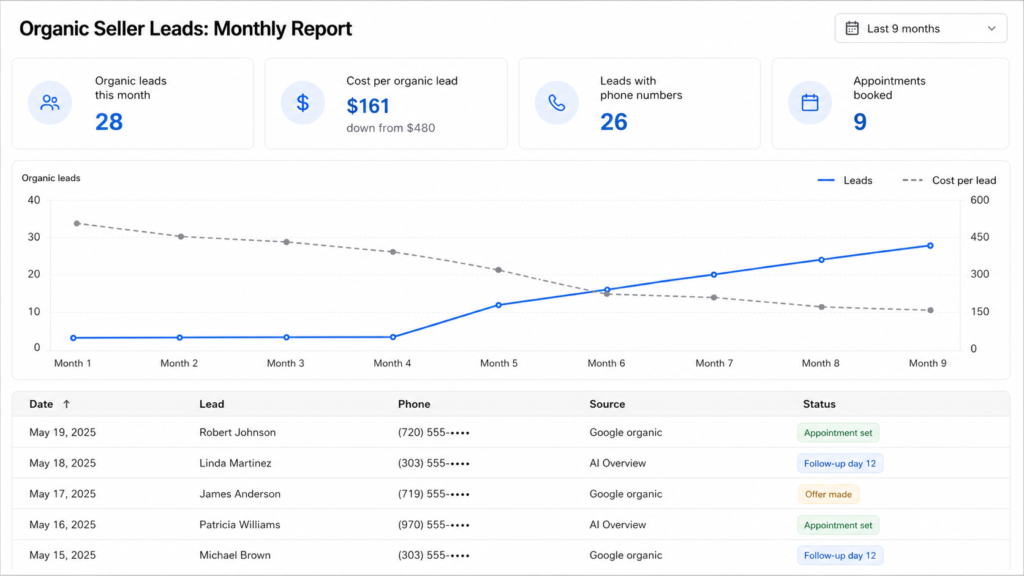
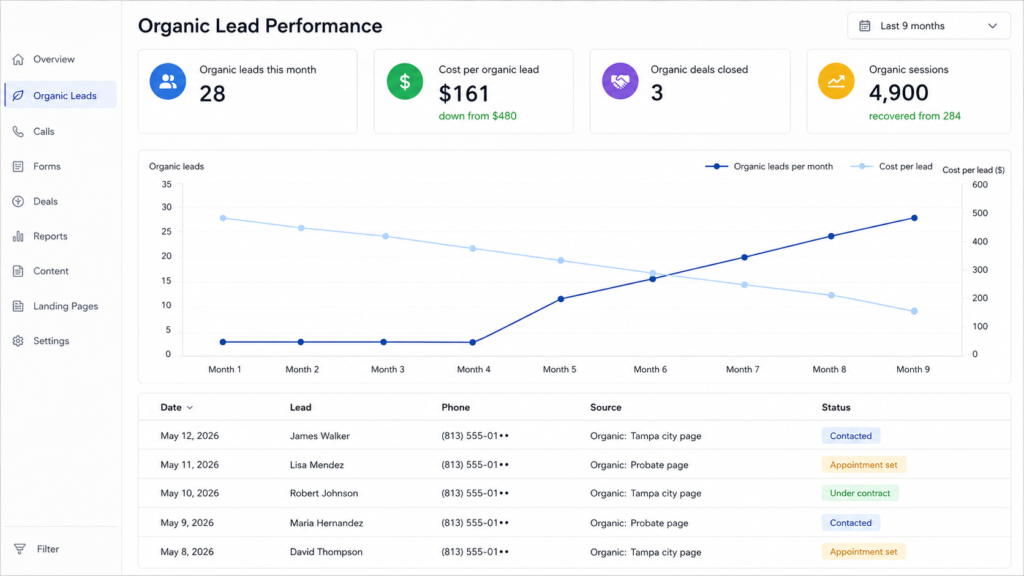
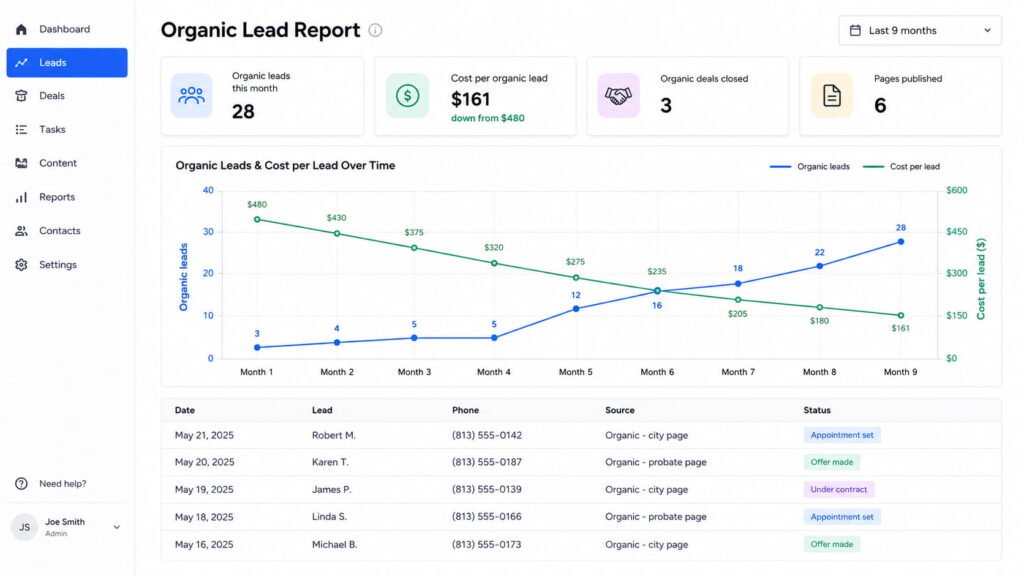
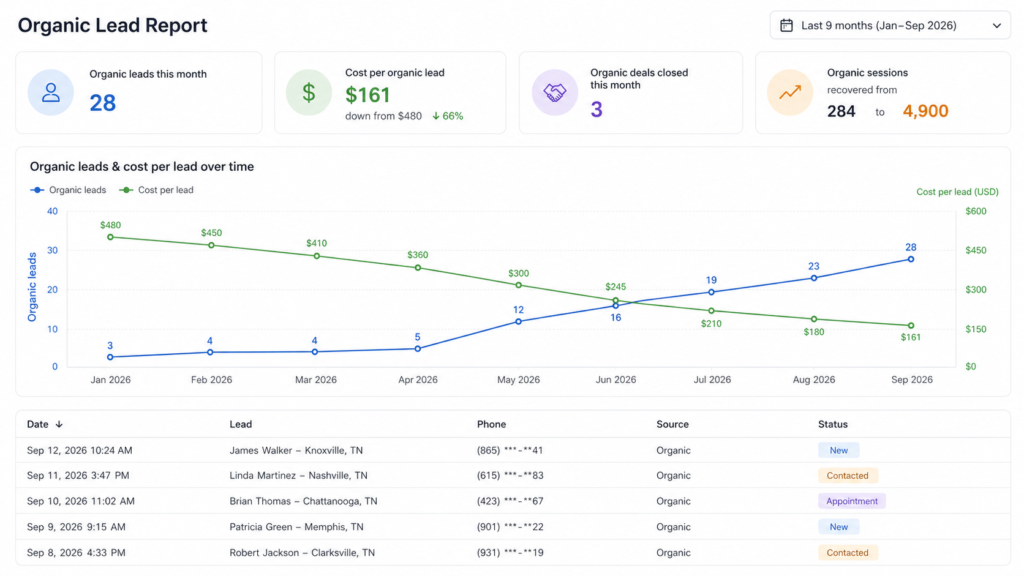
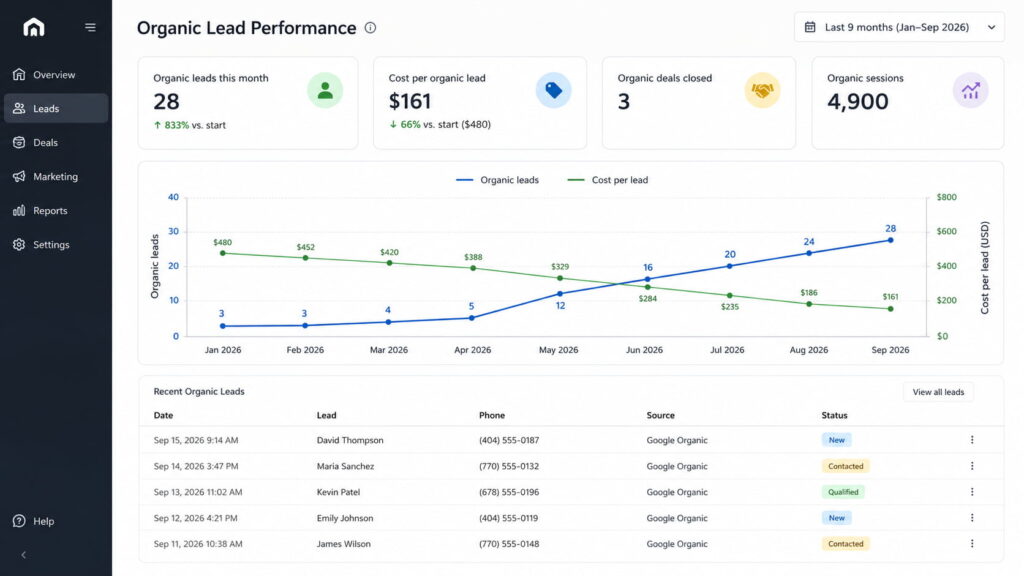
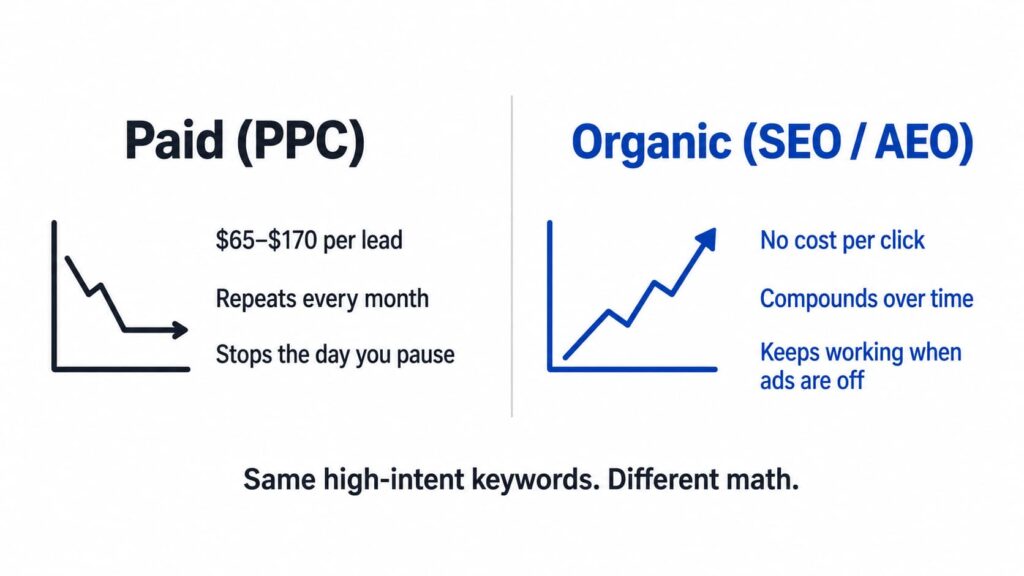
The ARV spread defines what a deal nets. What a deal nets defines what a seller lead is worth. And what a lead is worth defines what you can afford to pay per lead, by channel. If your average close nets $25–$30K off the spread, those aren’t equal choices: pay-per-click for motivated sellers runs $20–$100 per click before a click ever becomes a lead (Real Estate Bees), while one Florida cash buyer’s organic leads from Google cost $161 each and declining monthly (BASEO client data). A lead that takes several $20–$100 clicks and a $161-and-falling lead are two different businesses at the closing table.
That’s why operators who run Google Ads for real estate still build the organic channel underneath it, and why comparing how to get motivated seller leads channel by channel is worth an afternoon. If you want the numbers for your own market, a free written audit from BASEO’s SEO team for cash home buyers includes exactly that deal-math projection. Comp your lead sources the way you comp houses.
FAQs About ARV
What does ARV mean in real estate?
ARV stands for after repair value: what a property should sell for once its planned renovation is finished. It’s calculated from recent sales of similar, already-renovated homes nearby. Flippers, wholesalers, and rehab lenders all price their side of a deal against it.
How do you calculate ARV?
Pull 3–5 sold comps from the last 3–6 months within about a mile, in renovated condition and the same bed/bath and size band. Adjust each for square footage, lot, and condition differences, then average them. Cross-check with price per square foot times your subject’s footage.
What is the 70% rule in real estate?
The 70% rule says pay no more than 70% of ARV minus repair costs for a flip. The 30% held back covers profit, holding costs, closing costs, and surprises. It’s a screening tool, not a guarantee, and operators adjust the percentage in hot or very cheap markets.
Is ARV the same as appraised value?
No. ARV is the investor’s own comp-based forecast of post-renovation value. Appraised value is a licensed appraiser’s opinion, produced either as-is or “subject to completion” for rehab loans. Lenders order that ARV appraisal precisely to check the investor’s number before funding.
What percentage of ARV do cash buyers pay for a house?
Commonly 50–70% of ARV, depending on repairs and the market. The math explains the range: 70% of ARV minus repair costs is the standard ceiling, so a house needing light work prices near the top and a heavy rehab pushes the offer toward the low end.
Do lenders use ARV?
Yes. Hard-money and rehab lenders lend against a percentage of ARV rather than the purchase price, which is what makes fix-and-flip financing work. They verify the number with a subject-to-completion appraisal, so an inflated ARV usually surfaces before funding, not after.
Final thoughts
ARV isn’t the number you hope the house is worth. It’s the number you can defend with renovated comps, and every other figure in the deal (your max offer, your MAO, your rehab budget, your marketing spend) inherits its accuracy.
Before your next offer, run the three steps on the actual lead in front of you. Then run the same discipline on what you paid to get that lead in the first place, because the spread doesn’t care whether you lose it at the purchase or at the marketing line.
If you want to see what your own site could produce, the audit is free, written, delivered in about 2 business days, and yours to keep. No call required. Get your free site audit →
The right real estate website builder is not the one with the prettiest template. Most agents pick wrong because they shop the way they’d shop for a listing photo: they compare how the demos look. The three decisions that actually move business are quieter. Does it pull live MLS listings through IDX? Does it capture and route a lead the second someone lands? And can you control the SEO so the site gets found at all? We evaluated seven platforms against exactly those criteria, plus real pricing (IDX and add-ons included, not just the headline plan), design flexibility, and lead generation. Some are built for solo agents, some for luxury teams, one for the tightest budgets. Below is the honest breakdown, starting with the quick verdict so you can skip to your case.
Quick verdict: the best real estate website builder by use case
Short on time? Here are the seven real estate website builders, ranked by who each one fits. Prices are current as of July 2026; confirm the number on the official site before you buy, because plans change often.
Placester: best all-in-one for solo agents ($59/mo, plus $25/mo per MLS for IDX).
AgentFire: best brand-first design for competitive markets (from $129/mo, optional setup).
Real Geeks: best for lead generation with a built-in CRM (from $299/mo).
Agent Image: best custom build for luxury teams and brokerages ($2,000+ setup, ~$99/mo hosting).
Luxury Presence: best high-end plug-and-play design plus agency services (from ~$300/mo, plus setup).
Wix: best budget and AI-assisted website builder for real estate (from $17/mo, annual billing).
Squarespace: best design polish without real estate lock-in (from $16/mo, annual billing).
Two quick notes before the detail. Among these website builders for real estate, only the vertical platforms (Placester, Real Geeks, AgentFire) include IDX and a CRM out of the box. The generic ones (Wix, Squarespace) win on price and design freedom but need a third-party app for live listings.
What a real estate website builder actually does (and what it doesn’t)
A real estate website builder is a no-code platform that creates, publishes, and manages a property website: listings, lead capture, and hosting in one subscription, with no developer required. That is the whole job description. You pick a template or answer a few prompts, connect a listings feed, and the platform keeps the site online.
Here is what it does not do. It does not generate demand. It does not rank you on Google. And it does not replace a content strategy. A builder gives you a technically fine starting line and a place to send traffic. Getting the traffic is a separate job, run on top of the builder, not inside it. Hold that distinction, because it is the whole argument of this article: the box and the leads are two different purchases.
Generic builders vs. real estate specific platforms
Two families compete for the same agent. The generic builders (Wix, Squarespace, Jimdo, GoDaddy) ship real estate templates and drag-and-drop design, but no native IDX. According to Website Planet, free and generic builders rarely support MLS feeds directly, so live listings get added through third-party apps or embed codes. You trade listings functionality for a lower price and total design freedom.
The vertical platforms (Placester, Real Geeks, AgentFire, Constellation1) are built for the job. IDX, a CRM, and agent or broker workflows come standard, so the listings, the lead, and the follow-up live in one system. The trade is the mirror image: you pay more and design inside their rails. That is the real fork for any agent, or any estate agent website builder shopper in the UK reading the same reviews. Do you want cheap and flexible, or do you want property search that works on day one? Neither answer is wrong. Picking without knowing the trade is.
IDX and MLS integration: the dividing line
IDX (Internet Data Exchange) is the connection that pulls live listings from the MLS onto your site, so what a buyer sees on your pages matches what is actually for sale. MLS is the shared listings database agents feed. Sync them and your inventory updates itself. Skip the sync and you are copy-pasting listings that go stale in a week.
Three things trip agents up here. First, the feed usually costs extra: Placester’s IDX runs on top of the base plan, for example, so the “starting price” is never the real price. Second, the feed needs your local MLS to approve it, which takes days, not minutes. Third, IDX listing pages carry an SEO cost most agents never hear about. They are near-identical to thousands of other IDX pages (thin content), they churn as homes sell and unpublish, and without correct canonical tags they can compete with your own pages for the same search. For NAR members, get.realtor Premium Plus syncs automatically with the MLS so listings stay current, which removes the maintenance headache but not the SEO one. This is buying criterion number one. Without IDX, your site is a brochure that sends every serious buyer to Zillow.
How we evaluated these real estate website builders
We scored every platform on five criteria, in this order:
Pricing: the true monthly total, including IDX and add-ons, not the headline plan.
Design quality and flexibility: how good it looks and how far you can move off the template.
Ease of use: how genuinely no-code the build is for a non-technical agent.
Lead gen and CRM: forms, home valuation, chat, and where the lead lands.
SEO and AEO control: access to schema, URL control, site speed, and indexability.
One bias, stated plainly: criterion five carries more weight here than in most roundups, because control over search is the difference between a site that sits there and a site that brings deals. These conclusions come from operating real estate websites and watching what ranks, not from reading vendor landing pages.
The 7 best real estate website builders
Each platform below follows the same format so you can compare like for like: who it’s best for, real pricing, three pros, two cons, and a short SEO verdict of our own. Start with the one that matches your situation from the quick verdict above.
Placester: best all-in-one for solo agents and small teams
Best for: newer solo agents and small teams who want a working IDX site fast without piecing tools together.
Pricing (July 2026): the Essential plan is $59/month, and adding IDX runs $25/month per MLS, so an IDX-enabled site starts at $84/month, per Placester. Plus is $79/month and Premier $129/month ($154 with IDX); team plans start at $199/month. An optional concierge service that manages setup and updates adds about $50/month. Plans are no-contract with a 14-day trial.
Pros:
Generates a ready-to-edit real estate site in minutes using AI, so a solo agent is live the same day.
IDX and a basic CRM are bundled, so listings and leads sit in one place at an entry price.
Placester positions its sites on technical foundations meant to surface in both Google results and AI-generated answers, a claim worth testing but rare at this tier.
Cons:
The value proposition thins out for teams, where Real Geeks or Agent Image do more.
The base price is not the real price once the IDX feed and any concierge are added.
SEO verdict: a strong technical starting point for a solo agent, and the AI-answer positioning is a real plus. The ceiling is capped by template structure, so what ranks is the local content you add, not the platform.
AgentFire: best for brand-first agents in competitive markets
Best for: agents, teams, and boutique brokerages who need a branded, design-led site that still captures leads.
Pricing (July 2026): a Spark site is $129/month with no required setup fee, per AgentFire; an optional Express Setup is $199, and semi-custom or custom design packages run from roughly $700 to $3,500 one-time. MLS pass-through fees are separate, so confirm your market’s charge before signing. HousingWire calls AgentFire a fit for agents, teams, and boutique brokerages on tight budgets who still need to compete for online leads in tough markets.
Pros:
Design-first system that produces a genuinely distinctive brand presence, not a template everyone recognizes.
Local-area content tools (“Area Guides” style pages) that fit how buyers actually search by neighborhood.
Lead capture and IDX layered onto the design, so the brand work does not cost you conversions.
Cons:
A design-led build only pays off if you actually publish content into it.
The $129/month base can climb fast once you add a design package, plugins, and MLS fees.
SEO verdict: good bones and a sensible local-content structure. Performance still tracks the local content the agent publishes, not the template, so the framework helps only if you feed it. If you find a live AgentFire site in your market, study how many neighborhood pages it actually has.
Real Geeks: best for lead generation and built-in CRM
Best for: agents and teams whose whole reason for a site is lead volume plus a system to work those leads.
Pricing (July 2026): the Establish plan starts at $299/month for up to two users (plus a one-time onboarding fee around $250), scaling through Grow at $599, Expand at $999, and Conquer at $1,599/month, per Real Geeks. The Geek AI add-on is bundled into Grow and above. HousingWire notes Real Geeks is trusted by more than 7,000 agents and teams.
Pros:
IDX site and a full CRM in one platform, with AI features to organize contacts and automate follow-up.
Automated home valuation (Estate IQ) that turns a homeowner’s address into a seller lead, plus a built-in Facebook ad tool for traffic.
An AI-assisted SEO blogging tool and a two-way integration with CRMs like Follow Up Boss if you already run one.
Cons:
Even with the Follow Up Boss integration, the model nudges you to replace your current CRM with theirs.
Deep feature set means a steeper setup than a solo-agent builder.
SEO verdict: the lead machinery is the strongest here, but be careful with the AI blogging tool. Publishing AI-generated pages without editing is how sites end up with thin, near-duplicate content that competes with itself for the same search. Use it to draft, then make each page genuinely local.
Agent Image: best for luxury teams and brokerages
Best for: luxury teams and brokerages who need a custom site that stands out in a fiercely competitive market.
Pricing (July 2026): a project cost, not a flat subscription. Setup runs from about $2,000 for a template build to $7,500 and well into six figures for a full custom site, with an ongoing hosting-and-support fee around $99 to $199/month, per Agent Image. IDX integration is typically $50 to $150/month on top. HousingWire frames these custom designs as costly for a solo agent but necessary for teams and brokerages fighting in brutal luxury markets.
Pros:
Top-shelf custom design and deep customization that genuinely differentiates a high-end brand.
Because the build is custom, you get more technical access than any templated platform offers.
Fits the buyer expectations of a luxury market, where a template can quietly cost you listings.
Cons:
Overkill and over budget for a solo agent or a new team.
Custom control only helps if someone on your side knows how to use it.
SEO verdict: the highest SEO ceiling on this list. A custom build means real control over schema, URL structure, and speed, which is exactly what programmatic and AI-search work needs. That ceiling is only reached if you hire someone to use it.
Luxury Presence: best for high-end plug-and-play design
Best for: Realtors who want an elegant, ready-to-run luxury site plus done-for-you marketing services.
Pricing (July 2026): custom quotes, not published rates. Independent reviews put monthly plans from about $300 (entry Launch tier) to $1,500 (top All In tier), with setup fees of roughly $3,500 to $5,000, per AgentAdvice. Agents at partner brokerages may see reduced fees. HousingWire describes Luxury Presence as pairing customizable plug-and-play sites for Realtors with full agency marketing services.
Pros:
Clean, modern, high-end design without a custom-build timeline.
Agency marketing services bundled, so design and promotion come from one team.
Strong luxury branding out of the box for agents who need to look established fast.
Cons:
Plug-and-play means it is harder to differentiate when local competitors run the same base.
The bundled services push the real monthly cost well up.
SEO verdict: the agency package can be worth it, but ask exactly what the SEO service includes before you sign. “Marketing services” covers everything from a monthly blog post to real local-search work, and the gap between those is your entire result.
Wix: best budget and AI-assisted option
Best for: budget-conscious agents who want to build fast and are comfortable adding an IDX app.
Pricing (July 2026): the Light plan is $17/month on annual billing ($24 month-to-month), rising through Core at $29, Business at $39, and Business Elite at $159/month, per Wix. It is the lowest entry point on this list, before you add a third-party IDX app.
Pros:
An AI assistant asks about your business and brand, then generates a full site you can keep refining by chat, with a drag-and-drop editor for manual control.
The widest template library here: Wix offers 2,500+ templates overall and, per Website Planet, around 40 built for real estate, the most of any free-tier builder, plus automatic mobile optimization.
Built-in SEO and GEO tools, so on-page basics and AI-search formatting are handled inside the platform.
Cons:
Not built specifically for real estate, so agent workflows are thinner than a vertical platform’s.
No native IDX. Live MLS listings require a third-party app (IDX Broker, iHomeFinder) or an embed, per HousingWire and Website Planet.
SEO verdict: for the price, the SEO and GEO tooling is genuinely useful and the platform is fast enough. The catch is the same as every generic builder: the tools are there, but nothing about a template does the local-content work that actually ranks a real estate site.
Squarespace: best for design control without real estate lock-in
Best for: agents who prioritize personal brand and content over on-site property search.
Pricing (July 2026): the Basic plan is $16/month on annual billing, rising through Core at $23, Plus at $39, and Advanced at $99/month, per Squarespace. It carries a well-earned reputation for premium template polish.
Pros:
The most polished out-of-the-box design of any builder here, with strong content and blogging tools.
No real estate lock-in, so the site works as a brand hub, not just a listings portal.
Cons:
No native IDX, so live MLS search needs a third-party integration.
Limited control over advanced schema and programmatic page architecture.
SEO verdict: a solid technical base and clean markup, but the schema and site-architecture control top out below a custom build. If your strategy is brand and content rather than on-site search, Squarespace is a fair pick. If it is programmatic ranking, it will fence you in. Against Wix, Squarespace wins on design and loses on real estate features and IDX options.
Real estate website builder comparison table
The seven platforms side by side, with prices verified July 2026. Rates change often, so reconfirm on the official site the day you buy.
Platform
Best for
Starting price
IDX included
Built-in CRM
SEO control
Placester
Solo agents, small teams
$59/mo + $25/mo IDX
Add-on
Basic
Medium
AgentFire
Brand-first agents, boutique brokerages
From $129/mo (+ optional setup)
Yes
Add-on
Medium
Real Geeks
Lead-focused agents and teams
From $299/mo
Yes
Yes (full)
Medium
Agent Image
Luxury teams and brokerages
$2,000+ setup, ~$99/mo
Yes (custom)
Via integration
High
Luxury Presence
High-end plug-and-play + agency
From ~$300/mo (+ setup)
Yes
Yes
Medium
Wix
Budget, AI-assisted build
From $17/mo (annual)
No (third-party)
Basic
Medium-High
Squarespace
Design-led personal brand
From $16/mo (annual)
No (third-party)
No
Medium
The thing no builder solves for you: ranking
Notice what every comparison above, including the top five platforms, argues about: templates, price, and features. Not one of them answers the only question that decides whether the site pays for itself. Why doesn’t it show up on Google?
The builder is the container. The traffic comes from something else entirely: site architecture, local content, and authority. Two agents can buy the identical platform and one gets found while the other never does, because ranking was never a feature of the box. It is work done on top of the box. This is the same gap we spend our days closing at TheBaseo, and it is why we lead with SEO for realtors rather than web design. The platform choice is the easy 10% of the decision. The next two sections are the 90% no vendor demo shows you.
Why templated builder sites plateau on SEO
A default builder site is five or six pages: home, about, listings, contact, maybe a blog. Those pages look almost exactly like the sites of 400 other agents on the same platform. There is no market-specific content, so there is nothing for Google to rank you for beyond your own name.
Then the IDX listings work against you. Homes sell, listings unpublish, and the pages behind them turn into 404s or thin, near-empty shells. Search engines notice a site that keeps shedding pages. Worst of all, a template has no architecture: no silos organized by city, by neighborhood, by property type. Everything is a flat handful of pages fighting for the same generic terms.
Picture two agents on the same template in the same market. One leaves the default six pages up. The other builds 40 pages, one for each neighborhood they work, each with real local detail on schools, price trends, and what it’s like to buy there. Same platform, same budget. The second agent owns local search and the first is invisible. That gap is not design. It is site architecture, internal linking, and local content, none of which a template builds for you.
Programmatic pages and AEO: where the traffic is going
Programmatic SEO is how the agent with 40 neighborhood pages got there without writing 40 pages by hand. You generate pages at scale from data: one page per neighborhood, one per price band, one per property type, each populated from a structured source and made genuinely useful. Done right, it is how a single agent covers an entire metro in search.
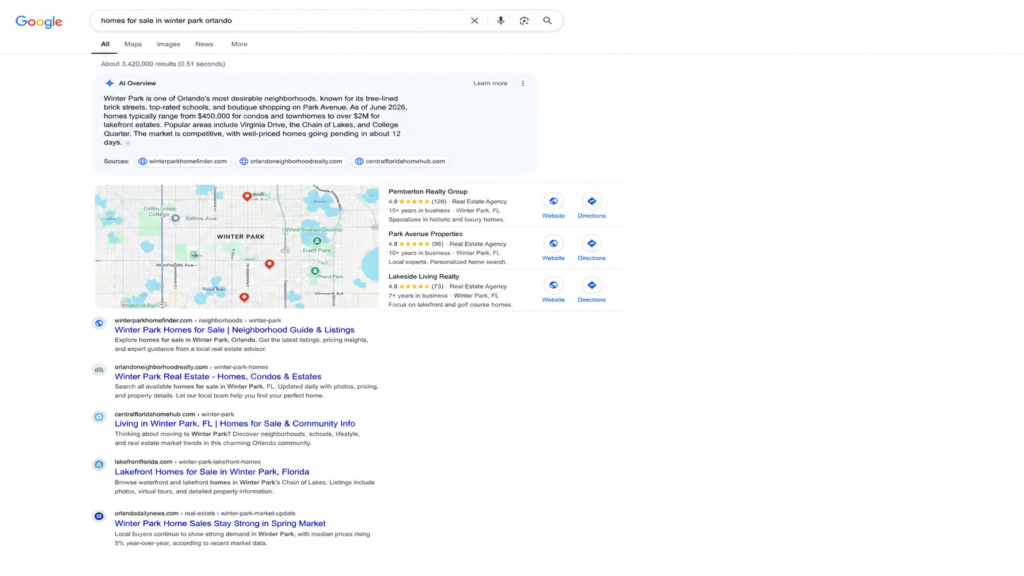
AEO (answer engine optimization), sometimes called GEO, is the next layer. AI answers in Google’s AI Overviews, ChatGPT, and Perplexity cite sources that have clear entities, structured data, and direct answers to real questions. Pages built to be quoted get quoted. The tell that this matters: the builders themselves now sell it. Placester advertises technical foundations for both Google and AI answers, and Wix ships GEO tools. When the platforms market the thing, the thing is no longer optional.
A quick example of the structure. Instead of one “listings” page, you build a URL pattern like /homes/winter-park/under-500k/ and /homes/winter-park/condos/, each a real page answering a real search. That is the layer that outranks the top five builders’ default sites, and it is exactly the work we do: programmatic pages and AI-search optimization that get real estate businesses cited and found. If you want the mechanics, our guide to ranking in AI Overviews breaks it down.
How to create a real estate website in 7 steps
Once you know a builder is just the container, the build itself is straightforward. Here is the sequence, with the two steps most guides skip pulled to the front where they belong.
Choose your platform by IDX, not by template. Decide first whether you need live MLS search on the site. If yes, start with a vertical platform (Placester, Real Geeks) or budget for a third-party IDX app on Wix or Squarespace. The template is the last thing to worry about.
Lock your domain and hosting. Register a clean, brandable domain (most builders bundle hosting). Use your name or your market, not a string of keywords.
Pick a template or generate with AI. Choose a real estate template or let an AI assistant (Wix, Placester) draft the site from a few questions, then customize the structure to match how you actually work.
Connect the IDX/MLS feed. Apply for your local MLS feed, connect it, and confirm listings display and update correctly. Expect a few days for approval, and confirm canonical tags so listing pages don’t compete with your own content.
Set up lead capture. Add contact forms, a home-valuation tool, and a chat widget, and route every submission to a CRM so no lead sits unanswered. This is where a site becomes a business asset instead of a business card.
Configure technical SEO and your Google Business Profile. Set titles, meta descriptions, schema, and clean URLs, then claim and complete your Google Business Profile so you show up in the local pack. This is the step that starts the ranking work.
Publish and measure. Launch, connect analytics, and watch leads, not just visits. Then keep adding local pages, because the site that ranks is the one that keeps growing.
How much does a real estate website cost?
Three tiers, with July 2026 numbers. A DIY generic builder (Wix from $17/mo, Squarespace from $16/mo) runs roughly $16 to $39 per month, before you add an IDX app. A vertical platform with IDX lands from about $84 per month all-in on Placester once you count the feed, up to $299 per month and beyond on a lead-focused system like Real Geeks. A custom or agency build (Agent Image, Luxury Presence) means a four-figure setup fee ($2,000 to $7,500 or more) plus an ongoing retainer of roughly $99 to $300+ per month. HousingWire’s own picks span exactly that range, from AI builders around $17 per month to high-end platforms built for teams and brokerages.
Here is the line no pricing page prints: the real cost of a real estate website is not the platform, it’s the content. A $17 site with 40 sharp neighborhood pages beats a $500 site with six. The subscription is rounding error next to the work that makes the site rank, which is why the smart budget question is not “which builder is cheapest” but “what will it cost to actually get found.” For the wider picture, see our marketing for real estate agents breakdown.
Which real estate website builder should you choose?
Skip the fiches and match your situation:
Solo agent on a budget → Placester or Wix, because you get a working site fast at the lowest all-in cost, Placester with IDX built in and Wix with an app.
Brand-first agent in a competitive market → AgentFire, because distinctive design that still captures leads is its whole reason to exist.
Team focused on lead volume → Real Geeks, because the built-in CRM, home valuation, and ad tools are the strongest lead machinery here.
Luxury team or brokerage → Agent Image or Luxury Presence, because custom or high-end plug-and-play design is what a brutal luxury market demands, and Agent Image gives you the SEO ceiling to match.
Get a real estate site that actually ranks
You picked the builder. That was the easy part. The part that decides whether the phone rings is the layer no template performs for you: architecture, local content, and authority. TheBaseo does SEO, AEO, and programmatic pages for real estate businesses, built around the Deal Flow Bridge, which is PPC for speed now while SEO compounds into the channel that pays for itself. No rankings promised, no timelines invented. Want to see what’s actually keeping your site off page one? We’ll send a free, written diagnostic of your site, your market, and your competitors. Get your free site audit →
Frequently asked questions
What is the best website builder for real estate agents?
Placester is the best overall real estate agent website builder for solo agents and small teams, with an IDX site and CRM from around $59 per month plus an IDX fee. Choose AgentFire for brand-led design, Real Geeks for lead generation, and Agent Image for luxury brokerages.
Can I build a real estate website for free?
Yes. Wix, SITE123, Webador and Jimdo all offer free plans with real estate templates. The catch is IDX: free builders rarely support MLS feeds directly, so listings must be added through third-party apps or embed codes. NAR members can also get free sites via get.realtor.
Do I need IDX on my real estate website?
If you want visitors to search live listings on your site, yes. IDX syncs your site with the MLS so properties stay current automatically. Without it, your site works as a brand and lead-capture page but sends buyers to Zillow or your brokerage to browse inventory.
How long does it take to build a real estate website?
Anywhere from a few hours to a few days. AI builders like Wix and Placester can generate a ready-to-edit real estate site in minutes. Adding your own photos, listing descriptions, IDX feed and SEO settings is what stretches the timeline into days.
Is Wix or Squarespace better for real estate?
Wix wins for real estate specifically: it has around 40 real estate templates, an AI site generator, and built-in SEO and GEO tools. Squarespace offers stronger out-of-the-box design polish. Neither includes native IDX, so both need a third-party integration for MLS listings.
Is a website builder good for SEO?
A builder gives you a technically sound starting point, not rankings. Modern platforms handle speed, mobile and basic on-page setup. What decides visibility is site architecture, local neighborhood content and structured data, none of which any template provides for you.
Leads don’t die because sellers change their minds. They die in spreadsheets: the follow-up that never happened, the callback scheduled for Tuesday that nobody made, the motivated seller who signed with the operator who called first.
If you’re comparing every CRM for real estate investors on the market, this guide does the work for you: the 10 best tools with real pricing, a verdict for each type of investor (wholesaler, flipper, buy-and-hold), and a clear answer on where AI fits and where it can’t replace your system of record. No paid placements. Just the tools and the math.
What Makes a Real Estate Investor CRM Different From an Agent CRM
Search “real estate CRM” and almost everything you’ll find is written for agents. Forbes, HubSpot, the big listicles: agent tools, agent workflows, agent problems.
You don’t have agent problems. A real estate investor CRM is built around acquiring properties from motivated sellers, and that changes every feature that matters:
Skip tracing to find owner contact info behind a distressed property.
List stacking to spot the owner who shows up on the probate list AND the tax-delinquent list.
Multichannel drips: SMS, direct mail, and voicemail drops, not just email nurture.
An acquisition pipeline that runs from raw seller lead to signed contract.
KPIs in your units: cost per lead and cost per contract, not open rates.
An agent CRM optimizes MLS integration, showings, and buyer nurture. Different job entirely.
That’s why Follow Up Boss and kvCORE, both excellent agent platforms, don’t appear on this list. If you’re new to the category, start with how to use a CRM for real estate and come back to pick your tool.
The 10 Best CRMs for Real Estate Investors
Every tool below was selected on three criteria: investor-specific features (not agent features), verifiable current pricing, and zero paid placement. Nobody on this list bought their spot.
Here’s the summary before the detail:
CRM
Best for
Price from
REsimpli
All-in-one for wholesalers and cash buyers
$149/mo
InvestorFuse (Carrot CRM)
Follow-up discipline
$69/mo (free 1-user tier available)
FreedomSoft
Established data workflows
$197/mo (~$147 billed annually)
REI BlackBook
Built-in phone system
~$149/mo
DealMachine
Driving for dollars
~$99/mo billed annually
Left Main REI
Scaling teams on Salesforce
~$300+/mo
Podio + REI add-ons
Low-cost custom build
~$25/mo
GoHighLevel
Tech-savvy operators
$97/mo
Forefront CRM
Visual pipeline
Varies
HubSpot / Pipedrive
Free and generic starting points
Free / $14 per user/mo
REsimpli: Best All-in-One Real Estate Investing CRM
REsimpli’s pitch is consolidation: list building, skip tracing included, a native dialer, direct mail inside your drip sequences, driving-for-dollars tracking, basic accounting, and a KPI dashboard, all in one login. It also ships a suite of AI agents that answer inbound seller calls and book appointments to your calendar.
Pricing runs $149 to $599 a month across three tiers, with a 30-day free trial (REsimpli pricing).
Pro: it genuinely replaces 5 or 6 separate tools, which is where the price stops looking expensive.
Con: the accounting and portfolio side is thin for heavy buy-and-hold operations.
Verdict: the default pick for wholesalers and cash buyers who want the best real estate investing CRM without duct-taping a stack together.
InvestorFuse (Carrot CRM): Best for Follow-Up Discipline
InvestorFuse is built on one thesis: deals die from bad follow-up, not from a shortage of leads. The workflows are structured so nobody on your team can skip a step, and every lead has a named owner who’s accountable for the next action.
It now lives under Carrot CRM: a free single-user tier to start, then plans at $69, $179, and $349 a month as the team grows, with no setup fees (Carrot CRM pricing).
Con: no native skip tracing or dialer, so you’ll pair it with a sourcing tool.
Verdict: for acquisition teams sitting on hundreds of unconverted leads. Pair it with a 90-day follow-up cadence and watch what your “dead” list produces.
FreedomSoft: Best for Established Data Workflows
FreedomSoft is CRM-first: a phone system, workflow automation, and e-signature built around a pipeline that’s been serving investors for over a decade. Entry runs $197 a month, or about $147 with annual billing, with team tiers up to $497 (FreedomSoft pricing).
Con: no native list builder or skip tracing, and the interface hasn’t evolved much in years.
Verdict: strong pipeline management if your data sourcing is already solved with PropStream or BatchLeads. If it isn’t, look at REsimpli first.
REI BlackBook: Best Built-In Phone System
REI BlackBook’s edge is Profit Dial: calls, call tracking, and mass texting native to the platform, plus campaign automation and an included website. Solo runs $149 a month, Team $299, and the $799 Executive tier bundles the AI and ads add-ons (REI BlackBook pricing).
Con: lower tiers meter calls and texts pay-as-you-go, and the AI, ads, and advanced list tools cost $199 to $299 a month each unless you’re on Executive.
Verdict: for operators who live on the phone and want every call tracked, recorded, and followed up automatically.
DealMachine: Best for Driving for Dollars
DealMachine is mobile-first by design: you drive your farm area, pin distressed properties from the app, skip trace the owner instantly, and trigger automated mail before you’re back home. Plans run about $99 to $232 a month billed annually, or $119 to $279 billed monthly (DealMachine pricing).
Con: as a complete CRM it comes up short. The winning stack is DealMachine for field capture feeding REsimpli or FreedomSoft for pipeline management.
Verdict: essential if driving for dollars is your primary channel. Insufficient on its own.
Left Main REI (Salesforce): Best for Scaling Teams
Left Main REI is an investor overlay built on Salesforce, which means deep customization, enterprise-grade reporting, and effectively unlimited scale. Expect $300 to $1,000 or more per month once licenses, implementation, and consulting are counted, and plan on someone owning the admin work.
Verdict: built for teams of 10+ doing institutional volume. If that’s not you yet, the cheaper tools above will get you there first.
Podio: Best Low-Cost Custom Build
Podio is the REI community’s classic hack: a no-code platform that starts as a blank canvas. With add-on packages like REI Automation Squad, it becomes a full investor CRM for roughly $25 to $50 a month.
Con: everything gets built from scratch, there’s no native skip tracing or mail, and it needs constant maintenance. Many teams that built on Podio years ago are now migrating to AI-first platforms.
Verdict: only if you have a technical profile, time to build, and a budget that rules everything else out.
GoHighLevel: Best for Tech-Savvy Operators
GoHighLevel gives you maximum platform flexibility: funnels, SMS, email, pipelines, booking, and websites under one flat rate of $97 to $297 a month with unlimited users (HighLevel pricing guide).
Con: budget weeks of configuration, plus external tools for skip tracing and list building that can add $300 to $500 a month.
Verdict: for technical operators and agencies who want to build their own machine. Not for the investor who needs to start calling sellers tomorrow.
Forefront CRM: Best Visual Pipeline
Forefront’s whole design philosophy is visibility: a drag-and-drop pipeline where every deal’s stage is obvious at a glance, follow-up automation underneath it, and a learning curve short enough that your acquisitions rep is productive in an afternoon.
Verdict: solos and small teams who want to see the whole business on one screen without an operations manual.
HubSpot / Pipedrive: Best Generic (Free) Starting Points
Can you start with a free CRM? Yes. HubSpot’s free tier handles contacts and basic pipeline, Pipedrive starts at $14 per user per month billed annually (Pipedrive pricing), and Zoho is free for up to 3 users.
What none of them have: skip tracing, list stacking, or direct mail automation. You’ll track your first leads fine, then hit the wall the moment you run real marketing volume and start migrating data.
Verdict: better than Excel. Worse than any investor-specific CRM once deals are flowing.
Real Estate Investor CRM Pricing: What You’ll Actually Pay
Investor CRM pricing lands in four tiers:
Tier
Monthly range
Examples
Low-cost
$25–$69
Podio + REI add-ons, Carrot CRM Essential
Mid-range sweet spot
$99–$179
DealMachine, REsimpli Basic, Carrot CRM Scale
All-in-one
$197–$349
FreedomSoft, REsimpli Pro, Carrot CRM Team
Enterprise
$300–$1,000+
Left Main REI on Salesforce
The number that matters isn’t the sticker price. It’s the cost of consolidation. If you’re paying separately today for a CRM, a dialer, skip tracing credits, and accounting software, a $200 all-in-one is cheaper than your current stack, and that’s before you count the hours lost to copying data between tools.
Two things to check before you commit. Some platforms charge setup fees that run $500 to $2,500, so ask directly. And demand a full free trial with every feature enabled, not a “limited features” teaser. A CRM you can’t fully test is a CRM you can’t fully trust.
How to Choose the Best Real Estate Investing CRM for Your Operation
The right answer depends on your business model, not on anyone’s ranking. A wholesaler pushing volume, a flipper managing renovations, and a landlord building a portfolio need three different tools. Here’s the honest breakdown of which real estate investing CRM fits each operation.
If You’re Wholesaling at Volume
Your CRM needs to handle:
List stacking across probate, tax-delinquent, and absentee lists
A native dialer so reps aren’t switching apps mid-call
Mass SMS for outreach at scale
Speed-to-lead automation, because the first caller usually wins the contract
REsimpli or FreedomSoft are the picks. The pro stack: a data tool like BatchLeads or PropStream feeding an all-in-one CRM, with your questions to ask motivated sellers scripted into the lead form.
If You’re Flipping Houses
Your deal count is lower and each deal is heavier, so the CRM’s job shifts: deal analysis, renovation progress tracking, and managing the seller relationship through a longer close. REsimpli or InvestorFuse cover the pipeline, paired with a dedicated analysis tool for rehab numbers. REI BlackBook is worth a look if you want project tracking and the phone system in one place.
If You’re Buying and Holding Rentals
Here’s where this list gets honest: a heavy investor CRM is probably overkill for you. If you’re acquiring a few rentals a year, Pipedrive covers the acquisition pipeline, and property management software like Stessa or DoorLoop handles what happens after closing. Save the $200 a month for the next down payment. Not every operation needs the full machine, and anyone who says otherwise is selling you one.
ChatGPT for Real Estate Investors: Where AI Fits (and Where It Doesn’t)
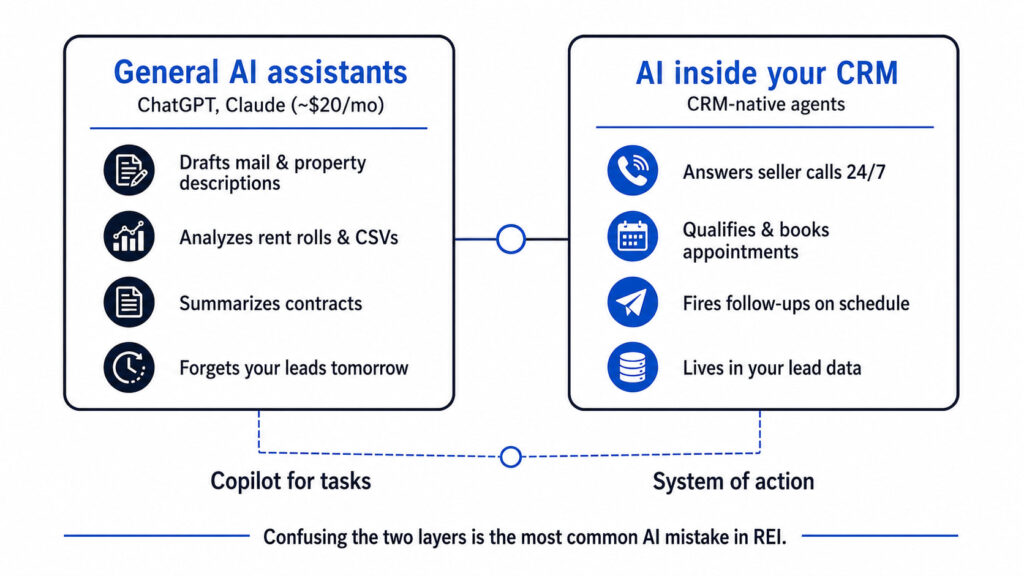
Every conversation about ChatGPT for real estate investors mixes up two different layers of AI, and the confusion costs money.
Layer one: general assistants like ChatGPT and Claude. Task tools. You bring the context, they do the work, they forget you tomorrow.
Layer two: AI embedded in your CRM. It lives inside your lead data, acts on triggers, and works while you sleep.
Buying layer one and expecting layer two is the most common AI mistake investors make right now. Here’s what each layer is actually for.
What ChatGPT and Claude Do Well for Investors
For about $20 a month, a general AI assistant earns its keep on tasks like these:
Marketing copy: property descriptions and direct mail letters, drafted in seconds
Data analysis: upload a rent roll or a CSV of comps and ask questions in plain English
Contract summaries: plain-language breakdowns of purchase agreements, with every deadline listed
Deal math: ROI scenarios and mortgage payment comparisons
Follow-up drafts: first versions of seller emails and texts
Three prompts worth stealing:
“Rewrite this direct mail letter for a pre-foreclosure list in Memphis. Sixth-grade reading level, respectful tone, under 150 words.”
“Here’s my rent roll CSV. Flag every unit renting below market and estimate gross yield at a $340,000 purchase price.”
“Summarize this purchase agreement in plain English and list every date I can miss and lose the deal.”
One warning: verify every market number it gives you. ChatGPT has no MLS access and no live comps, and it will state a wrong ARV with total confidence.
Why ChatGPT Can’t Replace Your CRM
It can’t, and the reason is structural. ChatGPT has no persistent memory of your leads. It won’t fire a follow-up text at 6pm on a Friday because a seller’s file says day 30 of the drip. It doesn’t track your pipeline, and it keeps no time-stamped record of disclosures, which matters if you operate in a regulated state.
Your CRM is the system of record and the system of action: every lead, every conversation, every scheduled next touch, executed whether you remembered or not.
ChatGPT is a copilot for tasks. The CRM is the machine that runs your acquisitions. Use both, but don’t confuse the seat each one sits in.
AI Agents Inside Your CRM: The Real Shift
The real 2026 shift isn’t investors chatting with ChatGPT. It’s CRMs shipping native AI agents that answer seller calls 24/7, qualify motivation, mark DNC requests, and book appointments straight to your acquisitions calendar. REsimpli’s AI engine is the clearest example in the investor space, and technical teams are wiring custom voice agents to their pipelines for the same effect.
The pattern to notice: the AI that makes money lives where your leads live. An assistant that forgets your pipeline every session can’t compound; an agent inside the CRM gets better with every call it logs.
The same logic is arriving on the search side, where AI decides which investors get recommended. That battle is covered in how to rank in AI Overviews.
A CRM Won’t Fix an Empty Pipeline
The most common mistake in this entire category: buying a $300-a-month CRM to manage 12 leads a month.
A CRM multiplies what enters it. If nothing enters, it multiplies zero.
The investors who dominate their markets don’t just have clean pipelines. They combine lead generation they own (local SEO, PPC, direct mail) with systematic follow-up inside the CRM. The CRM converts more of what marketing brings; it can’t invent what marketing didn’t bring.
That means the real cost of your stack is CRM plus marketing, and the marketing line is the one that moves your deal count. For scale: one cash buyer’s organic channel reached $161 per organic lead from Google, declining monthly (BASEO client data). Numbers like that are what make the follow-up machine worth feeding, and they come from the channel mix, not the software.
Pick any tool on this list and it will manage your leads well. None of them will create leads.
That’s the part TheBaseo builds for cash home buyers and investors: SEO built for cash home buyers that compounds month over month, bridged with PPC that produces calls now while the organic asset grows. Sellers search, your pages answer, your CRM fills. If you’re already running paid, start with the numbers in Google Ads for real estate.
The first step is free: a written audit of your site, your competitors, and your market, delivered in about 2 business days. No call required, and it’s yours to keep either way.
Quick answers to the questions investors ask most before picking a CRM. (Publisher note: implement with FAQPage schema; Astro renders schema at build.)
What is the best CRM for real estate investors?
REsimpli is the strongest all-in-one CRM for most real estate investors, combining skip tracing, list stacking, a dialer, direct mail, and AI agents from $149/month. InvestorFuse is better for follow-up discipline, and DealMachine leads for driving for dollars. The right pick depends on your acquisition strategy.
Do real estate investors actually need a CRM?
Yes. Without a CRM, leads sit in spreadsheets, follow-ups get skipped, and deals fall through the cracks. A CRM automates multi-touch follow-up, tracks every seller conversation, and gives you a time-stamped record of communications, which also protects you in regulated states. Most investors recover the cost with one saved deal.
What’s the difference between an investor CRM and a realtor CRM?
Realtor CRMs focus on MLS integration, showings, and buyer nurturing. Investor CRMs are built around motivated seller acquisition: skip tracing, list stacking, direct mail drips, cold outreach, and deal pipelines from lead to contract. Tools like Follow Up Boss serve agents; REsimpli, InvestorFuse, and FreedomSoft serve investors.
How much does a real estate investor CRM cost?
Expect $99 to $150 per month for mid-range platforms like REsimpli or DealMachine, $150 to $250 for all-in-one systems like FreedomSoft, and $300 or more for Salesforce-based enterprise builds. Podio with investor add-ons can run as low as $25 to $50 monthly but requires manual setup.
Can I use a free CRM like HubSpot for real estate investing?
You can start with HubSpot’s free tier or Zoho’s free plan, but they lack investor-specific features like skip tracing, list stacking, and direct mail automation. They work for tracking your first leads; once you run real marketing volume, an investor-specific CRM pays for itself quickly.
Can ChatGPT replace a CRM for real estate investors?
No. ChatGPT excels at drafting marketing copy, analyzing deal numbers, and summarizing documents, but it has no persistent lead database, no automated follow-up sequences, and no pipeline tracking. Use ChatGPT as a copilot for tasks and a CRM as your system of record. Many CRMs now embed their own AI agents.
Final thoughts
The best CRM for real estate investors isn’t a single tool. It’s the tool that matches your operation: REsimpli for consolidation, InvestorFuse for follow-up discipline, DealMachine for the field, Pipedrive plus property management software if you’re holding rentals. Pick by business model, demand a full trial, and do the consolidation math before the sticker-price math.
Then remember what no CRM can do: fill itself. Your deal count follows your lead flow, and lead flow is a marketing problem, not a software problem.
If you want to know what your market’s organic lead flow could look like before you spend another dollar on tools, that’s what the audit is for. Free, in writing, delivered in about 2 business days. No call required, yours to keep.
Your problem probably isn’t lead generation. It’s that the leads you already paid for are sitting in a CRM with no next action on them.
This is how to convert leads in real estate as an investor: a cash buyer, a wholesaler, a flipper. Not an agent with listings. You get benchmarks by lead source, a six-question seller script, and a 90-day follow-up cadence you can copy on Monday.
What “lead conversion” actually means for a real estate investor
An agent converts a lead into a client. You don’t have clients. You have a signed contract or you have nothing.
That changes what you’re counting. Your funnel has six stages:
Lead: a name and a number came in.
Contact: you actually spoke to a human.
Appointment: you saw the property or ran a real offer conversation.
Offer presented: a number left your mouth.
Contract signed: this is the conversion.
Closing: the money moves.
Most investors quietly count stage 3 as a win. A booked appointment feels like progress, so it goes in the win column and the week feels productive. It isn’t a conversion. It’s a lead that hasn’t died yet.
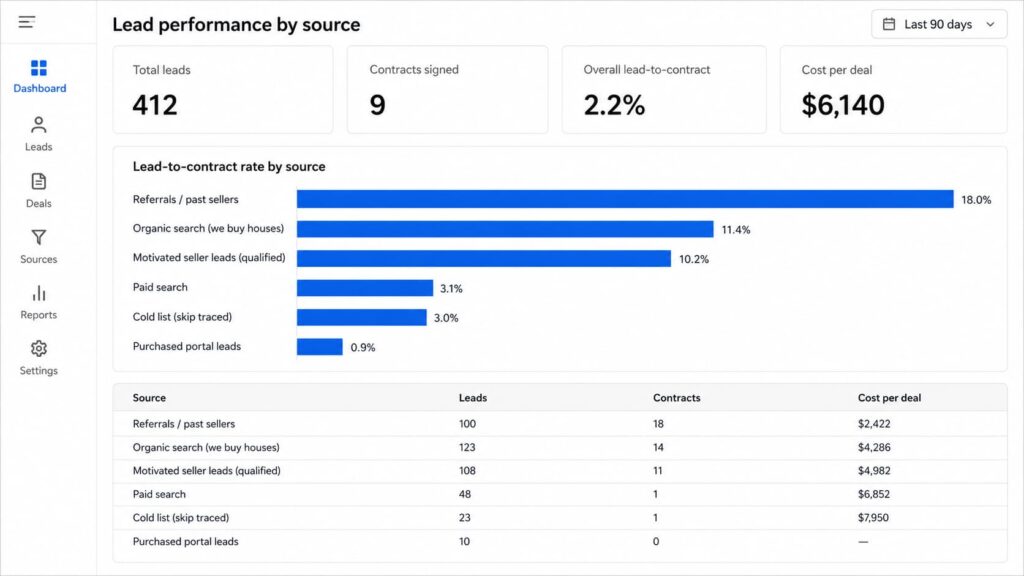
The number that matters is lead to contract, and it depends almost entirely on what kind of lead you started with. Goliath Data puts well-qualified motivated seller leads at 10% to 15%, which works out to roughly 15 to 30 leads per deal. Cold lists run 3% to 5%, so you need 25 to 35 of those for the same deal.
There is no single good real estate lead conversion rate. It depends entirely on the source. Purchased online leads convert at 0.4% to 1.2%. Across all sources, the average lands at 2% to 5%. Well-filtered motivated seller leads convert at 10% to 15%, and referrals reach 14% to 30%.
Those ranges come from Real Geeks, Ylopo and Goliath Data. Read them again and notice the spread: the best source converts about 30 times better than the worst one.
So when your rate looks bad, the first question isn’t “what’s wrong with my calls.” It’s “what am I calling.” A low rate is usually a source problem wearing a skill problem’s clothes.
Conversion benchmarks by lead source
Lead source
Typical conversion to contract
First contact to contract
Relative cost per deal
Purchased portal / online leads
0.4%–1.2%
Long, and you’re rarely first
High. You pay per lead and share it with four other buyers.
Cold lists (skip-traced, public records)
3%–5%
45–60 days
Medium per lead, high per deal once you count the volume
Direct mail / cold call
Low per touch, compounds with repetition
Long. Response usually takes several touches.
Medium to high, and it never stops being a bill
Paid search (inbound, high intent)
Varies by market
Short. The seller reached out to you.
Rising. The day you stop paying, it stops.
Organic search (“we buy houses”, “sell my house fast”)
Sources: Real Geeks, Ylopo, Goliath Data. Where a public number doesn’t exist, the cell says what’s true directionally instead of inventing a percentage.
The distance between the top row and the bottom row is 20x or more. No script closes a gap that size.
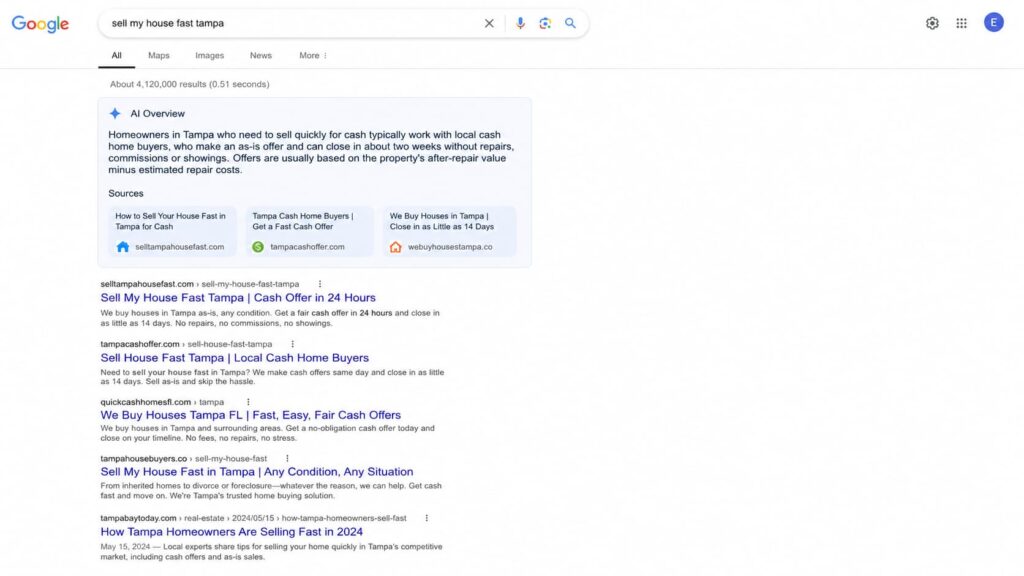
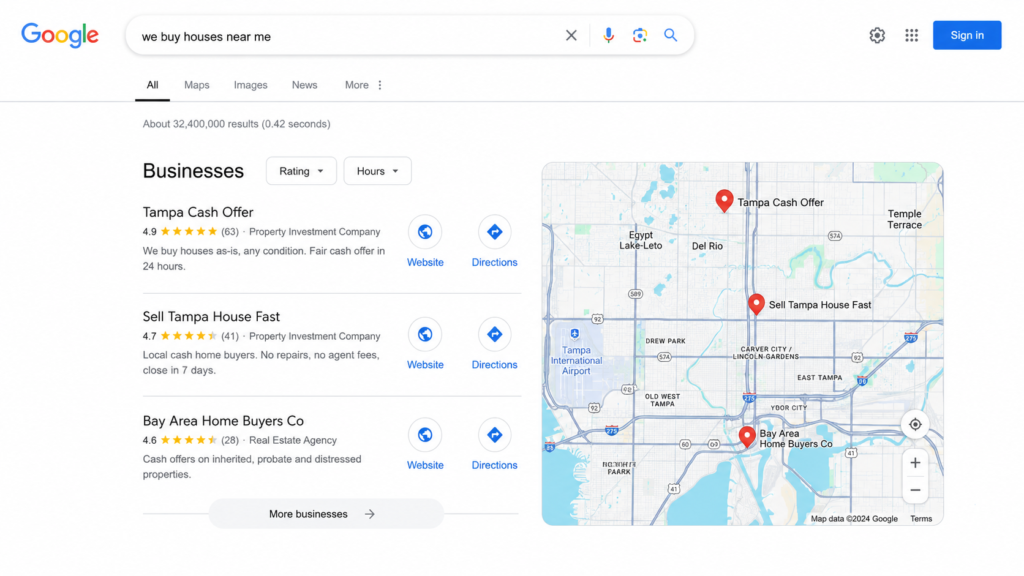
An inbound organic seller converts far above a cold list for one boring reason: he qualified himself before he ever reached you. He typed his problem into Google, read your page, and dialed. Nobody had to convince him he wanted to sell. Portal leads sit at the bottom of the table because you’re one of five investors who bought the same name on the same afternoon, and four of them are already dialing. If you want the full picture on what seller leads actually cost, that math deserves its own look, as does the real cost of Google Ads for real estate.
How to calculate your own lead-to-deal ratio
The rate itself is simple:
(deals closed ÷ leads received) × 100
Run it per source. Never in aggregate. An aggregate number tells you the business is mediocre. A per-source number tells you which channel to shut off on Friday.
Then run the one that actually moves money:
cost per deal = marketing spend ÷ deals closed
Compare that against your average spread. A survey of more than 1,000 wholesalers put the average assignment fee at $13,000, ranging from about $5,000 in Arizona to about $22,000 in North Carolina and Georgia. So here’s a quarter, in round numbers.
You bought 400 leads from one paid source. You got 4 contracts and closed 2. Lead to contract: 1%. You spent $12,000 on that channel, so your cost per deal is $6,000. Against a $13,000 assignment fee, that channel nets you about $7,000 a deal before anything else comes out.
Now run the same math on referrals: 20 leads, 3 closed, $0 spent.
The second channel is a fifth the size and several times better, and only the per-source math will ever tell you that. If you’re new to the mechanics of wholesaling a contract, start there, then come back and do this math on your own numbers.
Why most real estate leads never convert
Five root causes. Most investors have three of them running at once.
You answered too late. The seller takes the first reasonable offer, not the best one. Fixed in Step 1.
You stopped following up at touch two. Sellers almost never say yes on the first or second contact, and most investors never make a third. Fixed in Step 4.
You pitched a price before you understood the motivation. A number given to a seller who hasn’t told you why he’s selling is a number he can only compare to Zillow. Fixed in Step 2.
Your leads were sold to five investors before you called. No script wins a race you entered last. That’s a source problem, and it’s the last section of this article.
There’s no system. The lead is in a text thread, a voicemail, a note on the dashboard of your truck. If it has no next action with a date, it isn’t a lead. Fixed in Step 5.
None of these are character flaws. They’re what happens when the person generating the leads, working the leads and closing the deals is the same person, and that person also had to go look at a roof today.
Step 1: Win the first 5 minutes (speed to lead)
Speed to lead is the cheapest lever in the business, and it’s free.
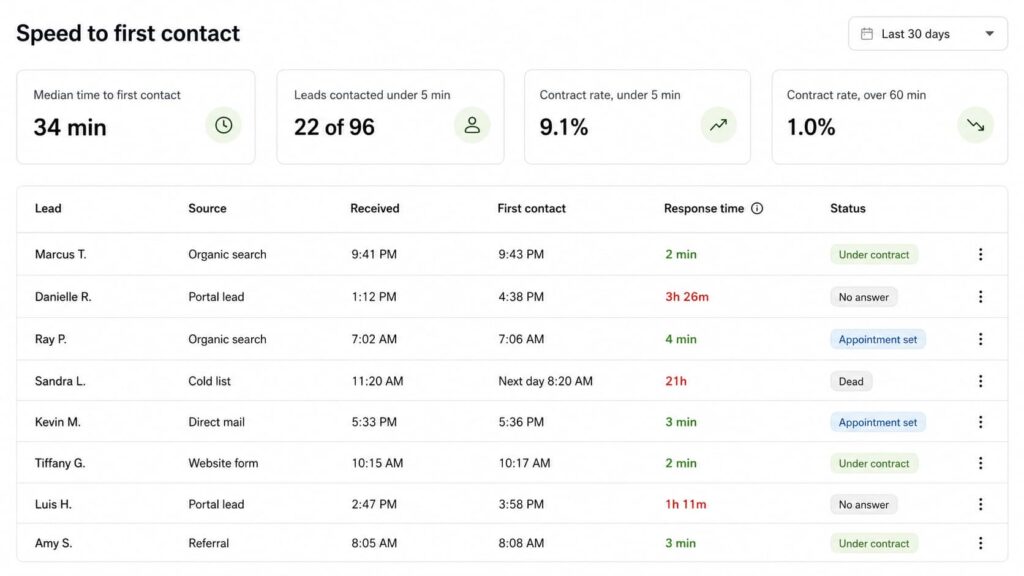
The number everyone quotes comes from a study by Dr. James Oldroyd at MIT with InsideSales, built on more than 15,000 leads and 100,000 dials: contacting a lead within 5 minutes instead of 30 makes you 21 times more likely to qualify that lead, and 100 times more likely to reach them at all. That study is from 2007 and nothing has knocked it off since. It gets miscredited to Harvard constantly. It’s MIT.
Note what it measures: the odds of reaching and qualifying a lead. Not a promise about your close rate. Answering fast doesn’t close the deal. It gets you into the conversation the other four investors are about to miss.
For motivated sellers it hits even harder than it does for agents. A distressed seller isn’t comparing five offers over three weeks. He’s trying to make a problem stop, and he tends to stop looking the moment somebody credible picks up the phone. Speed beats price more often than most investors are comfortable admitting.
What that means on a Tuesday:
Call first. Not email. An email is a message. A call is a conversation, and he only wanted one of those.
Double touch. Call, and if there’s no answer, text within the minute: “Hi [name], [your name] here, you just asked about an offer on [address]. Calling you right back.”
Push notifications, on the phone in your pocket. Not an email digest you read at 7pm.
Decide today who answers after 6pm, and write it down. Seller form fills do not land at 10am on a Tuesday. They land at 9:40 on a Sunday night, after a fight about the house.
The 2am lead: an automatic text on submission so he knows a human is coming, then a live call first thing. The auto-text buys you the night. It does not replace the call.
None of that requires a budget. It requires deciding that the phone is the job.
Step 2: Qualify motivation before you qualify the property
Most investors spend the first call on the house. Beds, baths, square footage, roof age, a rough ARV in their head.
None of it predicts whether this closes.
The house tells you what the deal is worth. The seller tells you whether there’s a deal at all, and only one of those two things can kill your week. Ask about motivation first. The property will still be there in ten minutes.
Score it 1 to 10. A 9 is a man with an auction date. A 3 is a man who wants to know what his house is worth and enjoys talking about it. The wholesalers who close consistently work 7s through 10s and put everybody else on a slow drip. That isn’t arrogance. It’s arithmetic: a 3 will eat six hours of your month and pay you nothing.
The 6 questions that separate a deal from a tire-kicker
Ask these, in this order, on the first call.
“Why are you selling now, and why now instead of six months ago?”
What you’re listening for: the event. A foreclosure notice, a death in the family, a divorce filing, a tenant who destroyed the place. No event usually means no deal, at least not yet.
“If this doesn’t sell in the next 60 days, what happens?”
What you’re listening for: a consequence. A seller with no consequence has no deadline. A seller with no deadline is a nurture lead wearing a deal’s clothes.
“What’s still owed on it?”
What you’re listening for: whether the math can work at all. If the payoff is above what the house supports, you found that out in 30 seconds instead of 30 days.
“If you were staying, what would you fix first?”
What you’re listening for: the real condition, in his words, with his guard down. Ask a seller what’s wrong with the house and he defends it. Ask what he’d fix and he tells you about the roof.
“Have you had other investors out to look at it?”
What you’re listening for: whether you’re first, fifth or last. It also tells you what he’s already been offered and what he turned down, which is worth more than a comp.
“If I could close in two weeks and you didn’t spend a dollar on repairs, what number would get you to sign this week?”
What you’re listening for: his real number, out of his own mouth, before you say yours. Whoever names a number first sets the frame, and it should not be you.
That’s the short version. The full set of questions to ask motivated sellers goes deeper on the follow-ups, but these six will tell you inside five minutes whether to get in the truck.
Scoring leads: hot, warm, cold
Score on criteria, not on how the call felt. Every investor has talked himself into a dead lead because the seller was friendly.
Tier
Objective criteria
Contact frequency
Hot
Motivation 8–10, timeline under 30 days, real distress (foreclosure, divorce, probate, forced relocation)
Daily until it’s a yes or a no
Warm
Wants to sell, exploring options, no hard deadline
Weekly
Cold
Timeline beyond six months, or just curious what it’s worth
Monthly, automated
Tag the tier the same day as the first contact, while you still remember the call. A lead you never tagged behaves exactly like a cold lead, because nobody ever calls it again.
Step 3: Run the offer conversation, not a sales pitch
Your seller is not comparing your offer to another offer. He’s comparing it to the number Zillow showed him, and that number has no commission in it, no repairs, no carrying costs and no buyer whose loan falls through in week seven.
So stop defending your price. Change what it gets compared to.
Cash, a close in about two weeks, as-is condition, no commission, no showings, no repairs, against a retail listing with all of it. That comparison is winnable. A price-versus-price comparison is not.
Build it as net to seller, not price. The headline price is what a seller brags about. The net is what lands in his account.
List with an agent
Your cash offer
Headline price
$200,000
$130,000
Agent commission (about 6%)
−$12,000
$0
Repairs to make it listable
−$20,000
$0
Carrying costs, 60–90 days on market
−$4,000
$0
Closing costs and concessions
−$6,000
Typically covered
Net to seller
about $158,000, in 3+ months, if it appraises
$130,000, in about 2 weeks, with no financing to fall through
Example only. Run the real numbers for the property in front of you.
Say the gap out loud. You are not pretending $130,000 equals $158,000. You’re showing him what that extra $28,000 actually costs: three months, a contractor he has to manage, and a buyer who can still walk. Some sellers want the retail number and are right to go list. The ones who want the problem gone this month are yours, and now they can see why.
How to anchor price without killing trust
Give the range before you give the number.
“Based on what you’ve described, I’m probably somewhere in the $125,000 to $135,000 range. Let me walk it and I’ll firm that up.” A range starts a conversation. A single number invites a yes or a no, and it’s usually a no.
Then explain the formula out loud. ARV times 70%, minus repairs, is the standard starting point in this business and there’s nothing in it worth hiding. On a $200,000 ARV house: 70% is $140,000, minus $20,000 in repairs puts you at $120,000. Say that arithmetic to the seller’s face. A seller who understands why the number is the number argues with it far less than a seller who thinks you pulled it out of the air.
Treat 70% as a starting formula, not a law. Markets and margins differ.
And never raise your price for free. If you come up, something comes back: a faster close, the furniture stays, the inspection contingency comes off. Free concessions teach the seller your first number was theater.
The real killer is dropping the price after the inspection with no warning. That kills more deals than a low opening offer, because it turns a negotiation into a bait and switch. If a re-trade is even possible, say so on day one and say what would trigger it.
Handling the three objections that kill cash deals
“Your offer is too low.” What it actually means: he’s comparing your price to a retail headline, not to his net.
Say: “It’s lower than the Zillow number, and it should be. Let me show you what that number actually pays out after commission, repairs and three months of holding it. If the retail net is better for you, I’ll tell you to go list it.”
“I need to think about it. I want to talk to my family.” What it actually means: either there’s no urgency, or the person who decides isn’t in the room.
Say: “That’s fair. Who else is part of this decision? Let’s get them on a call with me, because I’d rather answer their questions directly than have you try to relay them.” Never push past this objection. Go find the missing decision-maker instead.
“I got a higher offer from another investor.” What it actually means: maybe he did. Whether it closes is a completely different question.
Say: “Take it, if it closes. Ask them two things first: is there an inspection contingency, and does the price change after they walk the property? A lot of high offers come down after the inspection. Mine won’t, and I’ll put that in writing.”
An offer that gets signed and an offer that gets honored are not the same product. Most sellers have never been told that, and the investor who explains it calmly, without trashing the competitor, is the one who gets the call back in three weeks.
Step 4: Build a follow-up cadence that closes deals 60 days later
Sellers almost never say yes on the first or second contact. Direct mail operators put the average at around six touches before a prospect responds at all, and Goliath Data says the same thing about motivated sellers in different words: they convert after repeated follow-up, not after the first call.
Most investors stop at two.
Here’s the frame that should bother you: that lead is already paid for. You spent the money the day it came in. Following up costs a calendar reminder. It’s the only channel in your business with zero marginal cost, and it’s the one that gets abandoned first.
The 60-day deal isn’t a slow deal. It’s a deal that did not exist in week one, because the seller wasn’t ready in week one. Then the auction date moved. The tenant left. The sibling finally agreed. You want to be the name on his phone when that happens, and you get there by still being there.
A 90-day cadence you can copy
Day
Touch
What it carries
0
Call within 5 minutes, text if no answer
You’re real, you’re fast, you’re first
0–2
Call, then email the offer in writing
The number, plus the net-to-seller breakdown
5
Call
An answer to the objection he raised last time, with a specific
10
Text
A real comp from his street. Not “just checking in.”
21
Call
A different structure: seller finance, a longer close, a rent-back
30
Email
A similar seller’s outcome. What his situation was, what it took
45
Text
A market change. Rates, days on market, a listing near him that expired
60
Call
“Is it still on the table? My number hasn’t moved.”
90
Breakup, then a monthly drip
Close the loop cleanly and let the automation carry it
One rule governs all nine touches: every touch has to carry new information. A comp, a market shift, a different way to structure the deal. “Just following up” is not information. It’s a request for attention with nothing in exchange, and it teaches the seller to stop picking up. If you have nothing new to say, you aren’t ready to make the touch. Go find a comp.
Cadence by seller type (pre-foreclosure, probate, tired landlord)
One cadence does not fit four situations. The clock is different in each one, and so is the tone.
Pre-foreclosure. The auction date is a real, public deadline, and it’s doing your urgency work for you. Tighten as it approaches: every five days at 90 days out, more often inside the last month. Tone matters more here than anywhere. He is being called by everyone, and most of those calls sound like a scam. Be the calm, specific one. It helps to actually understand how the pre-foreclosure timeline works before you dial.
Probate and inherited property. The clock belongs to the court, and to grief. Thirty-day cadence, educational, patient. The heir frequently does not yet know what he’s allowed to do, and he’s making decisions with a sibling in another state. The investor who explained the process without pushing is the one who gets called when the estate clears.
Tired landlord. No deadline at all, which is exactly why most investors drop him. His trigger is external and it’s coming: the next bad tenant, the next $8,000 repair, the next eviction. Long nurture, low frequency, and be the first call he thinks of when the water heater goes.
Divorce. Two decision-makers who don’t agree, and your only job is absolute neutrality. Never take a side. Never carry a message between them. Communicate with both at once, in writing when you can. A deal that looks dead all spring can close the week the settlement lands.
Step 5: Fix the leaks in your CRM and tracking
Four fields. Every lead, no exceptions:
Source, tagged. The field everyone skips and the one that decides where next quarter’s budget goes.
Motivation tier, hot, warm or cold.
Next action, with a date on it.
An owner. A person, not “the team.”
Then the rule that makes the whole thing work: if a lead has no next action with a date, it is not a lead. It’s a lost lead that hasn’t been written off yet.
Three automations are worth building. Only three. An instant text on form fill, so the seller knows a human is coming. A touch reminder that actually interrupts you, not a list you’ll read on Sunday. A monthly drip for the cold tier, so nobody has to remember them. Everything else is a project you’ll abandon in March.
The source tag deserves its own sentence. Without it, cost per deal by source is unknowable, and you are choosing where to spend next quarter based on which channel felt good. That’s how a bad channel survives for two years.
Investors run REsimpli, Podio, Follow Up Boss, GoHighLevel, Salesforce. None of them is the answer, and the brand matters far less than the discipline: the best CRM is the one you will actually update at 4pm on a Friday. If you’re setting one up from scratch, here’s how to use a CRM for real estate without turning it into a second job.
Step 6: Convert leads you never talked to (retargeting and re-engagement)
Most motivated sellers don’t decide on the first interaction. They keep looking, for weeks, while the problem gets worse and the mail keeps coming. Retargeting on Google, Facebook and Instagram is how your name stays in front of the seller who isn’t ready yet but will be.
The cheaper play is the one almost nobody runs: reactivate your dead list.
Every investor has a folder of sellers who said no thanks six or twelve months ago. A meaningful slice of them listed with an agent, sat on the market, watched it expire, and are still holding the same house with less patience and a worse roof.
That list costs you nothing. It’s already yours. One text:
“Hi [name], [your name] here. We talked last spring about [address]. Did it end up selling? If not, I’m still buying in the area and my number would look different today.”
One line. No pitch. Easy to answer with a single word. Send it to the whole dead list on a Tuesday morning and work whatever comes back.
Compare the cost of that campaign to the cost of one fresh lead in the same market, and the math answers itself.
The conversion multiplier nobody talks about: where the lead came from
Now the honest part.
You can run every step above perfectly and still lose the deal, because the lead was sold to five investors before your phone rang. Speed doesn’t fix that. Scripts don’t fix that. You entered a race late and no amount of technique un-late’s you.
Look back at the benchmark table. A portal lead converts at 0.4% to 1.2% and arrives with four competitors already dialing. A referral converts at 14% to 30%, because the seller showed up pre-sold. And an inbound organic seller, the one who typed “sell my house fast [city]” into Google at 11pm and called the first result, behaves like a referral. He diagnosed his own problem. He chose you. Nobody else is on the line.
The economics diverge too. A paid lead costs the same next year, or more. An organic lead gets cheaper every month the page keeps ranking, because the page is already paid for. One Florida cash buyer we work with went from 3 to 28 motivated seller leads a month in nine months, in the same market, with no extra ad spend, at $161 per organic lead and falling (BASEO client data).
There’s a newer layer on top of this, and it’s moving fast. Sellers now open ChatGPT and ask who buys houses for cash in their city, then act on the answer. Traffic that arrives from ChatGPT converts at 15.9%, against 1.76% for Google organic, according to Seer Interactive’s GA4 analysis. The reason is simple: the seller finished deciding inside the conversation, then clicked once. These systems answer by citing a short list of sources per question. If your site isn’t on that list, you’re not in the conversation, and the worst part is you’ll never see the leads you didn’t get. Getting cited in AI Overviews is a different job than ranking, and it’s becoming the more valuable one.
What earns those leads is unglamorous. An original page for every market you actually buy in, because template pages that swap the city name got flattened by Google’s Scaled Content Abuse policy. Pages for the seller situations that drive the highest-intent searches: probate, foreclosure, divorce, inherited property, problem tenants. And content formatted so an AI system can quote it. That’s what BASEO builds for cash home buyers, and it’s why the keywords motivated sellers actually type are worth more study than most investors give them.
Lead conversion metrics to track every week
Seven numbers. Pull them every Monday.
Speed to first contact (median, in minutes). If your median is measured in hours, nothing else on this list matters yet.
Contact rate. Of the leads that came in, how many did you actually speak to? Under half and your problem is Step 1, not your leads.
Appointment rate. Contacts that turned into a walk-through or a real offer conversation.
Offer rate. Appointments where a number actually got presented. High appointments and low offers means you’re qualifying the house instead of the seller.
Contract rate, by source. The only rate that pays. Benchmark it against the table above: 0.4% to 1.2% on portal leads, 10% to 15% on well-qualified motivated sellers.
Cost per deal, by source. Spend on that channel divided by deals it actually closed. Not cost per lead. Cost per lead is how bad channels stay alive for years.
Average touches to contract. If your average is 2, you aren’t measuring follow-up. You’re measuring where you quit.
If you can only track two of them, track speed to first contact and cost per deal by source. Every other number on the list is a diagnosis of one of those two.
Turn more of your traffic into deals
Steps 1 through 6 change what happens after the lead arrives, and they’re worth running. Answer in five minutes, qualify motivation before the property, reframe the offer as a net, follow up for 90 days, keep a clean CRM, work the dead list. That work is real and it pays.
But the ceiling on all of it gets set before the phone rings, by where the lead came from. The investors sitting at the top of that benchmark table aren’t better on the phone than you. They’re talking to sellers who found them first, in Google and increasingly in AI answers, and who called with nobody else on the line.
If you want to know where your site actually stands for the searches motivated sellers run in your market, that’s what the audit is for. It’s free, it’s written, it lands in about two business days, and there’s no call required. It’s yours to keep either way, and it’s built by people who only work with cash home buyers, so it already knows your competitors and your keywords.
What is a good lead conversion rate in real estate?
A good real estate lead conversion rate depends on the source. Purchased online leads convert at roughly 0.4% to 1.2%, all sources average 2% to 5%, well-filtered motivated seller leads convert at 10% to 15%, and referrals reach 14% to 30%. Investors should track lead to contract by source, not in aggregate.
How fast should you respond to a real estate lead?
Within five minutes. The MIT and InsideSales lead response study found that contacting a lead within five minutes instead of 30 makes you up to 21 times more likely to qualify it, and 100 times more likely to reach the person at all. For motivated sellers, minutes instead of hours decide who gets the conversation.
How many times should you follow up with a seller lead?
Far more times than most investors do. Sellers rarely respond on the first or second contact, and most investors quit at two. Use a fixed cadence across 30 to 90 days, and make every touch carry new information: a comp, a market change, or a different way to structure the deal.
Why are my real estate leads not converting?
The four usual causes: you respond too slowly, you stop following up after two touches, you talk price before uncovering motivation, or your leads are resold to several investors at once. Fix response time first. It is the cheapest and fastest lever, and it costs nothing.
Are paid real estate leads worth it?
Sometimes, but only if you measure cost per deal, not cost per lead. Purchased leads convert at 0.4% to 1.2% and are often sold to multiple investors at the same time. Organic inbound leads from search convert far higher, because the seller found you and contacted you first.
What is the best CRM for converting real estate leads?
The best CRM is the one you actually update. Investors commonly use REsimpli, Podio, Follow Up Boss, or GoHighLevel. The brand is not what matters: every lead needs a tagged source, a motivation tier, and a scheduled next action, plus an instant text on form fill.
The investor’s actual scoreboard: a lead notification, with a phone number attached.
Every agency ranking for “real estate SEO services” is selling you traffic.
Traffic isn’t what you’re short of. Deals are.
So there are two questions worth asking about any real estate SEO service: what does a lead cost, and what does it close for? Most agency pages answer neither. This one does, including the parts that don’t flatter us.
The failure mode is always the same. An agency signs you, then runs the playbook it runs for a dentist. Blog posts on a content calendar. A monthly report full of impressions. Nothing that touches the pages a motivated seller lands on.
Three things make this niche a different product.
The searcher is in distress, not browsing. A man handling his mother’s estate isn’t comparison shopping, he’s solving a problem tonight. The intent is geo-bound: a seller in Tampa doesn’t want a national brand.
And the competitive set is largely identical. More than 30% of the top Google rankings for motivated-seller terms are Carrot template sites (Carrot): dozens of your competitors running near-identical copy with the city name swapped.
That stopped being cosmetic in 2024. Google’s scaled content abuse policy targets “large amounts of unoriginal content” generated “for the primary purpose of manipulating Search rankings,” and it applies “no matter how it’s created” (Google Search Central).
In operator language: your site looks like everyone else’s, so Google ranks none of you.
The damage isn’t theoretical. One client came to us after his previous agency ran his organic traffic from roughly 10,000 sessions down to 284, a 97% drop, while invoicing him every month (BASEO client data).
That’s why BASEO works only with cash home buyers. One niche, one page architecture. For the execution-level version, we published how to do SEO for a real estate website.
What Our Real Estate SEO Services Include
Read this as a vetting checklist, not a pitch. It’s what you should be getting for the money, from us or from anyone else.
Keyword and market research built on two axes: city and seller motivation
Local SEO and a Google Business Profile rebuilt from scratch
Content that ranks and converts: original city pages and seller-situation pages
Technical foundation: tracking first, then schema, then programmatic pages
Local authority: real editorial links, no farms
AEO/GEO: being the company AI search names when a seller asks
The order isn’t decorative. Tracking goes in before content, or you end up back where you started: a report full of impressions and no way to prove a lead came from any of it.
Keyword and Market Research by City and Motivation
Two axes. City, and motivation.
Most agencies hand a cash buyer a keyword list built for a Realtor: “homes for sale in Tampa,” “best neighborhoods in Tampa.” Nobody typing that is selling you a house.
The motivation axis is where your deals live: probate, foreclosure and pre-foreclosure, divorce, inherited property, problem tenants. That’s how the search gets typed at 11pm.
The paid market tells you which terms are contested. “Sell house fast” runs roughly $12 to $63 per click (Webrageous); broader investor terms like “we buy houses cash” run closer to $2.50 to $5.00 (Promodo). Read those as a valuation, not a cost: what a keyword costs on the paid side is the clearest signal of what it’s worth organically.
When a seller searches “we buy houses near me,” the answer resolves in the Map Pack. Three results. That’s the entire competition for that search.
Your Google Business Profile is the cheapest asset you own and the one almost nobody has rebuilt: categories right, services listed, real photos, posts on a cadence instead of never.
Three results. That’s the entire competition for “we buy houses near me” in your city.
It moves real numbers: one client’s profile went from ignored to a 430% increase in direction requests (BASEO client data).
One honest limit. A rebuilt profile wins the near-me search. It does not win “sell my house fast [your city].” That one needs a page.
Content That Ranks and Converts Sellers and Buyers
Your homepage is not your most important page. On investor sites that actually pull leads, 60% or more of organic traffic lands on city pages. The homepage is where a seller checks that you’re real, after a city page already caught him.
City landing pages: one for every market you actually buy in, original to that market. Local copy, local proof, market-specific detail. Not a template with the city name swapped, which is the exact behavior Google’s policy was written to catch.
Seller-situation pages: probate, foreclosure and pre-foreclosure, divorce, inherited property, problem tenants. These convert above average for a reason that has nothing to do with SEO. The situation is urgent, so the searcher isn’t shopping, he’s solving. They also feed internal links back to your city pages.
Most cash buyers don’t have a technical problem in the abstract. They have a tracking problem.
So the foundation goes in first: call tracking and form tracking installed, so a lead becomes something you can count. GA4 and Search Console configured, often for the first time. Schema markup on the service pages (labels that tell Google exactly what a page is). The inherited template copy replaced.
The order matters more than any item on that list. Situation pages without tracking is how your last agency hid for eight months.
Then programmatic pages, done the way that survives: original per market, or you’re inside the definition of scaled content abuse and the pages are a liability.
Link Building That Moves Local Rankings
What moves a local ranking is local authority. Chambers of commerce. REIAs. Local news outlets. Sites that exist in your market and have a reason to mention a company that buys houses in it.
No link farms. No PBNs. No paid schemes. If an agency won’t tell you where a link came from, you already have your answer.
A link from the county REIA does more for “we buy houses [city]” than a generic high-authority placement with no connection to the market. That’s the authority BASEO builds, in the markets you operate in.
AEO / GEO: Getting Recommended by ChatGPT, Perplexity and AI Overviews
A seller opens ChatGPT and types the question he used to type into Google. “How do I sell my house fast for cash in Phoenix.”
He gets an answer. The answer names two or three companies.
That list is the new Map Pack, and it’s shorter.
AI Overviews now appear on nearly half of all searches, and Google rolled out AI Mode to every US searcher in May 2025 (Carrot). The number that travels in REI circles came from Carrot’s own customer base: one investor received 26 of his 45 leads in a seven-day stretch from ChatGPT.
Those leads behave differently, because the seller arrives having already had the conversation. In one published case study, ChatGPT traffic converted at 15.9% against 1.76% for Google organic (Seer Interactive). That study tracked a single B2B software client, so treat it as direction, not a benchmark for your market. The mechanism is what carries over: the AI qualified the seller before he clicked.
The AI Overview names two companies. In that search, those are the only two that exist.
There’s a measurement trap here. Most AI-referred visits land in Google Analytics as “Direct,” so the channel looks like it doesn’t exist. It isn’t absent, the attribution is broken. And the window is open right now, because the cited list in most markets is still short.
What BASEO does about it: Q&A structure and citation-friendly schema these systems lift from, weekly citation tracking across ChatGPT, Perplexity, Claude and AI Overviews for every market you operate in, and AI referral attribution that pulls those “Direct” sessions back into the report.
What BASEO does not do is promise a citation. Nobody controls whether an AI cites a page. We optimize the inputs, track the outputs, and show you when a competitor gets named instead of you. The mechanics are in how to get cited in AI Overviews.
Who We Work With: Investors and Cash Buyers
BASEO works with cash home buyers. Wholesalers, flippers, buy-and-hold operators, HomeVestors franchisees. That’s the list.
The narrow list isn’t exclusivity for its own sake. It means we walk into your market already knowing your competitors, your keywords, and your seller situations.
If you’re an agent or a listing team, retail SEO is a different product with different pages and a different buyer at the end of it. We won’t pretend otherwise to win the engagement. Start with our marketing playbook for agents instead.
Structurally, here’s the engagement:
Month-to-month. Thirty days’ written notice. We have placed 0 clients on a 12-month contract, ever (BASEO client data).
A written scope of work every month. If we miss a deliverable on it, that month is refunded.
Market exclusivity. One client per core metro, so we’re never optimizing two sites against each other.
You own everything. The content, the links, the data, the reports. If you leave, it leaves with you.
The Deal Flow Bridge: PPC for Speed, SEO for Compounding Growth
Don’t kill your ads.
BASEO manages PPC for cash buyers, which is exactly why that advice isn’t self-serving. Paid rents attention. It’s the fastest way to a lead, and the only channel that stops the day your card stops.
Google Ads (paid)
Mature organic
First lead
Days
Typically months 3 to 5
Cost per lead
$28 to $65 on investor campaigns
Falls over time, toward $7 to $30
When you stop paying
Leads stop that day
Leads keep coming
Over time
Cost per click rises with competition
Cost per lead falls as the asset compounds
What you own at the end
Nothing
The pages, the rankings, the traffic
Sources: investor PPC cost per lead of $28–$65 (Promodo); mature content cost per lead of $7–$30 (Visionary Marketing).
Now the number that decides the argument. In real estate, organic leads cost 83% less than paid leads, the largest gap of any industry in the comparison, and Carrot’s Investor Performance Study found organic leads close 2x more profitably (Visionary Marketing). Our Florida client landed at $161 per organic lead by month 9 (BASEO client data).
$161 per organic lead. And falling every month.
So the bridge is a sequence, not a war. Paid keeps the phone ringing through months 1 to 5 while the organic asset gets built. Then the spend comes down because it can: most clients cut PPC 30% to 50% by months 6 to 9.
Straight answer first. Across the industry, the most common agency retainer sits between $1,500 and $5,000 a month, where roughly half of all agencies operate. The Ahrefs survey of 439 SEO professionals put the average at $3,209 a month (GoodFirms).
Here’s what those tiers buy.
Monthly range
What it typically buys
Who it fits
The risk at this tier
Under $1,000
A few blog posts. Maybe a directory listing. No tracking, no page production.
Nobody serious about deal flow.
You pay for activity and never find out whether it produced a lead.
$1,000 to $2,000
Basic local SEO and profile upkeep. Little original page production.
A single-market operator testing the water.
Not enough production to outrank an established competitor.
$2,000 to $5,000
The common tier: technical foundation, original city and situation pages, local authority, real reporting.
Most cash buyers in one to three markets.
The tier is usually right. The agency is where it goes wrong. Ask what gets built and what gets counted.
$5,000+
Multi-market builds, aggressive content and authority programs.
Operators buying across many metros.
Paying enterprise rates to an agency that doesn’t know the niche.
The monthly number is the wrong question anyway. The right one is cost per deal. A $2,000 retainer that produces nothing is infinitely expensive. A $4,000 retainer that produces one extra assignment a month is the cheapest thing in your business.
So the number to fear isn’t a high one. It’s a wasted one. That Florida client spent 14 months at $4,500 a month with his previous agency, and not one report contained a lead count (BASEO client data). He didn’t have a pricing problem. He had an accountability problem.
BASEO’s number is custom to your market, and it’s in the audit, in writing, before anyone asks you to decide anything. Get your free site audit →
How Long Until Real Estate SEO Pays for Itself?
Anyone telling you leads in 30 days is describing PPC, or lying.
The honest arc: first organic leads typically show up in months 3 to 5, and real lead volume tends to land between months 6 and 9. That’s an expectation based on what we’ve seen, not a promise. Nobody can guarantee a ranking, and Google says so itself.
Phase
When
What happens
What you should see
Audit
Week 1, free
Written audit: the 3 biggest issues, the competitor keyword gap, the deal math for your market.
A document you keep, whether or not you hire anyone.
Foundation
Months 1 to 2
Call and form tracking installed. GA4 and Search Console configured. Schema added. Template copy replaced. Google Business Profile rebuilt.
Leads become countable. Usually for the first time.
Content engine
Months 2 to 6
Original city pages and seller-situation pages published.
First organic leads, typically months 3 to 5.
AI layer
Months 3 to 9
Q&A structure, citation-friendly schema, local editorial links.
AI citations typically become visible months 6 to 9.
Compounding
Month 9+
The asset keeps working without new spend behind it.
Lead volume that changes how the business feels.
The curve bends late, and that’s the trade. Paid is a flat line: you pay, you get leads, you stop, they stop. Organic is slow, then it isn’t, because content compounds while the cost per lead moves the other way, from around $80 to $100 down to $7 to $30 once the pages have authority (Visionary Marketing). For the Florida client, month 5 was the turn: 12 organic leads, and the first 3 organic deals closed (BASEO client data).
Which leaves the only payback question that matters: what is one extra deal a month worth to you?
Results: What One Extra Deal per Month Is Worth
Start with the before, because it’s the part most people recognize. A Florida cash buyer, 14 months into an agency relationship. Organic traffic down from roughly 10,000 sessions to 284. Three motivated seller leads a month.
What happened over the next nine months, same market, same invoice, no extra ad spend (all figures BASEO client data):
3 to 28 motivated seller leads a month, in 9 months.
The 97% traffic collapse reversed within those same 9 months.
$161 per organic lead, declining every month.
Month 9: 3 organic deals closed, $54K in combined profit, against a $4,500 monthly invoice.
Across other accounts, organic sessions rose 102%, 438%, and 121% (BASEO client data).
What the report is supposed to show: leads with phone numbers, and a cost per lead that goes down.
That’s what the monthly report is built around: leads with phone numbers, the cost-per-lead trend, pages published, AI citations, and next month’s plan in plain English. If your current report leads with impressions, you already know what it’s hiding. The month-by-month version is in the full case study.
Now run your own number, because your market isn’t Florida. The national average wholesale assignment fee is about $13,000, ranging from roughly $3,000 to $25,000 by market (Real Estate Bees). On the flip side, ATTOM’s Q3 2025 data shows the median flipped home bought at $260,000 and sold at $320,000: $60,000 in gross profit, at a 23.1% return, the lowest since 2008 (ATTOM).
So one extra assignment a month is $13,000 against a marketing invoice that’s a fraction of it. One extra flip is roughly five times that. And that margin compression is precisely why the cost of a lead matters more this year than last. When the spread on the deal narrows, the cost of finding the deal is what’s left to fix.
Get a Real Estate SEO Plan for Your Market
Send us your domain. That’s the whole ask.
In about two business days you get a written audit back: the three biggest issues holding your site back, the keywords your top local competitor ranks for that you don’t, the deal math for your market, and what the work would cost in your situation.
No card. No contract. No call required. If you never speak to us again, the document is still yours, and you can hand it to whichever agency you do hire.
And if your market doesn’t support the math, the audit will say so. We’ve turned down operators whose markets weren’t worth the spend. You’d rather hear that in a free document than discover it in month seven.
One practical note: one client per core metro. If yours is spoken for, better to know now.
Most agencies charge between $1,500 and $5,000 a month, where roughly half the market sits, and the industry survey average is about $3,200 (GoodFirms). For real estate, the monthly figure matters far less than the cost per deal it produces. BASEO prices per market, and your number comes back in the free audit.
Is SEO worth it for real estate businesses?
It depends on your market and your math, and any agency answering with an unqualified yes is selling. In real estate, organic leads cost 83% less than paid leads and close 2x more profitably, per Carrot’s Investor Performance Study (Visionary Marketing). In thin markets, the numbers don’t get there. We’ve told operators not to buy.
How long does real estate SEO take to work?
First organic leads typically appear in months 3 to 5. Meaningful volume usually lands between months 6 and 9, once the city pages and seller-situation pages have authority behind them. Anyone promising leads in 30 days is describing pay-per-click advertising, or lying. That timeline is an expectation, not a guarantee.
What is included in a real estate SEO package?
A real package covers six things: keyword and market research by city and seller motivation, local SEO and a rebuilt Google Business Profile, original city and seller-situation pages, a technical foundation with lead tracking installed first, local editorial links, and AI search optimization. “Package” means whatever an agency wants it to mean, so get the deliverables in a written scope with a date on each one.
Do I need SEO if I already run Google Ads or buy leads?
Ads stop producing the day you stop paying, and purchased leads are usually sold to your competitors too. Organic keeps working after the invoice ends, and in real estate organic leads run about 83% cheaper than paid (Visionary Marketing).
This isn’t an argument to quit ads. Investor campaigns produce leads at $28 to $65 (Promodo), which is real. Run both, then shrink the paid side as organic takes over. Here are the keywords worth bidding on.
What is GEO and does it matter for real estate?
GEO (generative engine optimization), also called AEO, is the work of getting your pages cited by ChatGPT, Perplexity, Claude and Google’s AI Overviews when a seller asks how to sell a house fast for cash in your city. It’s a citation game, not a ranking game: the AI names two or three companies, and you’re either on that list or invisible.
It matters now because the list is short. One Carrot customer got 26 of his 45 leads in a single week from ChatGPT (Carrot).
Final thoughts
The investors winning organic search in your city aren’t smarter than you. They started earlier and built the pages you haven’t built yet.
That’s the whole playbook above, and every piece of it is work, every month. Some operators run it themselves and do fine. Most would rather spend those hours at a kitchen table with a seller, which is where the money gets made.
If you want to know which pieces your site is missing before you decide either way, that’s what the audit is for. We work only with cash home buyers, so it already knows your competitors, your keywords, and your seller situations. Free, in writing, about two business days. No call required, and yours to keep.
The goal of every strategy below: this call, coming in, not going out.
Nobody got into real estate to make 300 dials a day and eat 295 rejections. Yet that’s how most investors are told to fill a pipeline: buy a list, skip-trace it, grind the phone.
There’s a better answer. You get real estate leads without cold calling by building inbound channels: SEO, referrals, direct mail, and paid ads that make motivated sellers contact you first. That’s how to get real estate leads without cold calling in one sentence, and the rest of this guide is the how.
This isn’t another flat list. The 9 strategies below are ranked by how hard they compound, and you’ll get two things the usual roundups skip: which channel to start with for your budget, and the real cost per deal of each one.
Why Cold Calling Is the Slowest Way to Fill Your Pipeline
Cold calling produces deals. That’s not the argument. The argument is the ratio.
Across real estate, dial-to-appointment rates average 1.7–2.7% (Gitnux). The floor is worse: a Baylor University study tracked 6,264 genuinely cold calls and found only 28% were answered, and just 0.3% became appointments. About one appointment for every 330 dials (CallingAgency).
One appointment for every 330 dials. That’s the measured worst case of buying a list and grinding the phone.
Even the grinders hit a ceiling: agents making 100+ calls a day average around 18 cold-call closings a year (Gitnux). That’s a full-time job’s worth of dialing for a deal and a half a month.
Meanwhile, the seller you’re trying to reach is already online. NAR’s 2025 Profile found 46% of buyers start their search online, and essentially everyone uses the internet during it (NAR). Off-market sellers behave the same way: they google “sell my house fast” before they talk to anyone.
So it’s not that cold calling “doesn’t work.” It’s that it has the worst time-per-deal ratio of any channel, and it doesn’t compound. The day you stop dialing, the pipeline dies.
9 Ways to Get Real Estate Leads Without Cold Calling
The 9 strategies below run from most compounding to least. The first ones build an asset that keeps producing after you stop feeding it; the last ones buy activity you have to keep buying. If you want the broader picture of every seller channel, the motivated seller leads playbook covers it.
1. Rank Your Website for Motivated Seller Searches (SEO)
When a seller decides to sell fast, they type “sell my house fast [city]”, “we buy houses [city]”, or “cash home buyers near me”. Most of those clicks go to the top 3 organic results, not the ads.
That’s why this is the hero strategy. The seller who finds you already chose you: motivated seller websites convert 7–20% of visitors, and the 20% end of that range only happens with organic search or direct traffic (Carrot). Inbound leads from targeted sources close around 1 in 10 to 1 in 15 (Goliath Data).
Getting there takes three pillars, minimum:
City and service pages: one original page for every market you buy in. Template pages that just swap the city name got crushed by Google’s March 2024 update, so original local content is the entry price.
Seller-situation content: pages answering what stressed sellers actually search: probate, foreclosure, inherited house, problem tenants. This is where how to do SEO for a real estate website goes deepest.
Local reviews and citations: Google Business Profile, real reviews, consistent listings. Google won’t rank a site it doesn’t trust.
That architecture is what BASEO builds for cash home buyers, with lead tracking installed first so every call and form gets counted from day one. One Florida client went from 3 to 28 motivated seller leads a month in nine months, same market, no extra ad spend (BASEO client data). Start with the keywords for real estate investors that fit your footprint.
Be honest about the timeline: 4–8 months for real traction in most markets. That same Florida client saw his first 12 organic leads and 3 closed deals in month 5 (BASEO client data). Which is exactly why you start today, not when the skip-tracing list runs dry. If you want to know which pillar your site is missing, a free written audit will tell you.
The page a Tampa seller sees. The top 3 organic spots and the Map Pack take almost every click.
2. Show Up When Sellers Ask ChatGPT and Google AI (AEO)
Sellers don’t only google anymore. They ask ChatGPT, Perplexity, and Google’s AI Overviews things like “should I sell my house to a cash buyer” and “best we buy houses company in Tampa”. The engines answer by citing a short list of sites, and the list comes from structured content, clear FAQs, and consistent brand mentions across the web.
The traffic is small but it closes hard. ChatGPT visitors convert at 15.9% versus 1.76% for Google organic (Seer Interactive). One Carrot user got 26 of his 45 weekly leads from ChatGPT (Carrot). AI referrals grew 527% year over year, even though they’re still around 1% of total traffic (AirOps).
What to do: add FAQs with schema markup (labels that tell Google exactly what your page is), answer full questions in 40–60 words, keep your name, address, and phone identical everywhere, and earn mentions in local directories and press that the AI engines use as sources. The full playbook is in rank in AI Overviews.
BASEO formats client pages for citation and tracks AI citations weekly across the major engines. Nobody controls whether an AI cites a page, but this is the 2010 version of SEO: the window is open and most of your competitors aren’t in it.
3. Run PPC While Your SEO Compounds
Google Ads on high-intent keywords brings leads this week. That speed has a meter running: seller campaigns cost $5–$65 per click depending on your market (ROA Marketing), and motivated seller leads typically run $50–$200 each (Promodo). Those leads still close around 1 in 10 to 1 in 15 (Carrot).
Treat PPC as the bridge while your organic matures, not the permanent plan. And know the failure mode: without a landing page that converts (social proof, a clear offer, a short form), PPC just burns budget. Pick terms from the top real estate keywords with buying intent, not research intent.
Facebook and Instagram ads are cheaper but lower intent: use them for retargeting and awareness, not bottom-funnel seller capture.
BASEO manages motivated-seller PPC under the same lens as organic (leads and cost per deal, never clicks), and the plan is always to shrink it: most clients cut paid spend 30–50% by months 6–9 as organic takes over.
4. Direct Mail That Sends Sellers to Your Website
Direct mail still works for off-market sellers. What changed is its job: mail no longer competes with your website, it feeds it.
The mechanics: pull segmented lists (absentee owners, high equity, pre-foreclosure, probate, vacant), pick a farm of 200–500 properties, and mail them on a 6–8 week cadence instead of blasting one-and-done postcards.
The modern twist is a QR code or short URL pointing at your site, so the seller can research you on their own terms instead of having to make an awkward phone call. That matters because they were going to google you anyway. Mail with no credible website behind it converts worse: the seller checks you out, finds nothing, and tosses the postcard. Your letter starts the conversation; your site and reviews close it.
5. Referrals and Your Sphere of Influence
After 2–3 transactions, you already have a network: past sellers, the contractors on your flips, title companies, even the neighbors who watched a rehab happen.
Most investors never work it. The play is a quarterly touch with something of value, a market update, a completed project, an introduction. Not “got any deals?”
Where your state allows it, offer a clear, legal referral fee and say the number out loud. People refer more when they know exactly what happens when they do. Referrals stay one of the most reliable sources of repeat business in this industry, and the cost is coffee and follow-through.
6. Strategic Partnerships: Attorneys, Agents, and Other Investors
The agent version of this advice is stale. Here’s the investor version.
Four partners worth building: probate and divorce attorneys, whose clients have legal urgency and a property to solve; agents holding expired listings or houses too rough for the MLS; local wholesalers, whose overflow you can buy when their buyer list passes; and property managers with tired landlords ready to sell the headache.
Open every one of these by giving value first: close fast, close clean, make the attorney or agent look good to their client. Then formalize it. A partner who knows exactly what you buy and how you close sends the next one without being asked.
7. Social Media Content That Pre-Sells You
Social media’s real job for an investor isn’t volume. It’s proof. Among real estate professionals, 52% say social media leads beat MLS leads on quality (Resimpli).
Skip the listings. Document the work: before-and-after flips, deal-number breakdowns, a seller saying the process was painless. That’s the content another human trusts.
Pick one or two platforms and post consistently rather than everywhere occasionally. More on the investor angle in social media marketing for investors.
Here’s the quiet payoff: when your letter lands or your site comes up, the seller googles you. If they find a feed full of real projects and real people, you’re safe to call. Social is the trust layer under every other channel on this list.
8. Email and SMS Nurture for Leads That Aren’t Ready Yet
Most seller leads don’t close on first contact. 80% of deals need five or more follow-ups (Goliath Data), and the investor who follows up usually beats the one with the better offer.
Build one automated sequence for leads who filled your form but didn’t book: a market update, a success story, a simple “still thinking about selling?” Segment warm from cold so a motivated probate seller doesn’t get the same drip as a tire-kicker. A basic setup like the one in using a CRM for real estate covers it.
One compliance line, plain language: text only people who opted in (that’s the TCPA rule). This is nurture for leads who already contacted you. It is not cold texting, and it shouldn’t smell like it.
9. Driving for Dollars + Mail Follow-Up
The zero-budget classic, minus the cold call. Drive your farm neighborhoods and log the distress signals in person:
Log each property in an app while you drive. Then, instead of skip-tracing the owner and dialing, send a letter or postcard that points to your website (strategy 4 does the converting).
This is the cheapest channel in cash and the most expensive in time, which makes it exactly right for an investor starting with no budget. The list you build is also an asset: those addresses feed your mail cadence for months.
Which Strategy Should You Start With?
A list of nine is useless without a starting point. Your budget picks for you.
Your situation
Start with
Why
No budget, have time
Driving for dollars + referrals + social, and start a basic blog/SEO now
Costs hours, not dollars, and the site you start today is the asset that compounds
Moderate budget ($1–3K/month total marketing)
SEO/AEO as the base + segmented direct mail
One channel compounds while the mail produces conversations this quarter
Need deals now, have budget
PPC as the bridge + SEO in parallel
Paid keeps the phone ringing while organic grows to replace it in 6–12 months
The rule underneath all three rows: run one channel that compounds (SEO) plus one channel of immediate activity (mail or PPC). The first builds your future cost per deal down; the second pays this quarter’s bills. Investors who run only activity channels are still renting their pipeline in year five. The full source-by-source comparison lives in seller leads for investors.
Cold Calling vs. Inbound: The Real Cost Per Deal
Run the math on all three and the argument settles itself.
Cold calling pays in hours. 100 calls a day, five days a week, at a ~2% dial-to-appointment rate is about 10 appointments from 25+ hours of dialing. Every week. Forever. The cost per deal is your calendar.
Organic pays up front, then gets cheap. Inbound leads close around 1 in 10 to 1 in 15 (Goliath Data), and once you rank, the marginal cost of the next lead approaches zero. BASEO’s flagship client pays $161 per organic lead from Google, declining monthly (BASEO client data). In month 9 he closed 3 organic deals for $54K combined profit against a $4,500 monthly invoice (BASEO client data).
PPC pays per lead: at $50–$200 per lead and 10–15 leads per deal, you’re at roughly $500–$3,000 in ad spend per deal, climbing with your market’s competition.
Channel
Cost per lead
Leads per deal
Cost per deal
Compounds?
Cold calling
Your hours
~1 appointment per 330 dials (worst case)
25+ hrs/week of dialing
No
PPC
$50–$200
10–15
~$500–$3,000 +
No
Organic (mature)
$161 and falling (client example)
10–15
Lowest of the three, still dropping
Yes
On a deal netting $25K, those differences are the margin. The honest conclusion: inbound costs more in the first months and wins by a mile at 12+.
The compounding curve: leads up 3 → 28 over nine months while cost per lead falls. This is what “the asset kicks in” looks like on a report.
Want Motivated Sellers Calling You Instead?
The best time to start building inbound was a year ago. The second best is today, because every month of dialing is a month your future rankings aren’t aging.
BASEO works only with cash home buyers: we build the city pages, seller-situation content, and AI-search presence that put you in front of motivated sellers before your competitors, and we report in leads, not impressions. No dials, no burned lists. If you want to see exactly where your site stands, start with the free site audit: free, in writing, delivered in about 2 business days, no call required, yours to keep.
Frequently Asked Questions
Quick answers to the questions investors ask most about getting leads without cold calling.
How do real estate investors get leads without cold calling?
Real estate investors get leads without cold calling by ranking their website for motivated seller searches, sending targeted direct mail, running PPC ads, building referral partnerships with attorneys and agents, and posting proof-of-work content on social media. Inbound channels make sellers initiate contact, which produces warmer, higher-converting leads.
How can I get real estate leads for free?
The main free lead sources are referrals from past sellers and contractors, driving for dollars, posting consistently on social media, and answering questions in local Facebook groups. They cost time instead of money. Pair one free channel with basic SEO on your website so leads compound over time.
Is cold calling still worth it in real estate?
Cold calling still produces deals, but it’s the least efficient channel: only about one in four prospects answers, roughly 1–2% of dials become appointments, and results stop the moment you stop calling. Most investors get a better return by shifting that time into SEO, referrals, and direct mail.
What is the best source of motivated seller leads?
Organic search is the highest-quality source of motivated seller leads. Sellers searching “sell my house fast” have already decided to sell and are choosing who to call, so inbound leads typically convert to a deal for every 10–15 leads, far better than cold outreach.
How long does SEO take to generate seller leads?
Expect 4–8 months to see consistent seller leads from SEO in most markets, faster in smaller cities with weak competition. Rankings compound: after the initial ramp, leads keep arriving at near-zero marginal cost, which is why investors pair SEO with direct mail or PPC while it matures.
Final thoughts
The investors winning inbound in your market aren’t smarter than you. They started building the asset 12 months ago while everyone else kept dialing.
The move this week is simple: pick one compounding channel and one activity channel, and put the hours you were going to spend on the phone into both. In deal terms, that’s trading 25 hours a week of dialing for a pipeline that gets cheaper every quarter.
Every piece of the SEO side is work, every month, and some operators run it themselves just fine. Most would rather spend that time closing. If you want to know exactly which pieces your site is missing before you decide either way, that’s what the audit is for. We work only with cash home buyers, so it already knows your competitors, your keywords, and your seller situations. Free, in writing, no call required.
Short sale leads are back on the table, and there are more of them than there have been in years. Foreclosure filings hit 118,727 properties in the first quarter of 2026, up 26% year over year and the highest quarterly level in six years (ATTOM). That is a wave of underwater homeowners who need an agent who knows how to work a distressed sale. The problem: most agents chase them the same way, buying the same list everyone else bought. This guide covers 8 real sources for short sale leads, what each one costs, and how to convert them into signed listings.
What Is a Short Sale Lead (and Why It Matters in 2026)
A short sale lead is a distressed homeowner who owes more on their mortgage than the home is worth and is likely to sell for less than the loan balance, with the lender’s approval. These owners are usually 30, 60, or 90 days behind on payments, or already have a Notice of Default on record. That financial pressure is what makes them motivated.
Why the niche is worth farming: fewer agents fight for these listings, the sellers are already motivated, and you can earn on both sides if you also represent the buyer. The 26% year-over-year jump in foreclosure filings (ATTOM) means more of these owners enter the pipeline every month.
It also pays to signal you know the process. NAR’s Short Sales and Foreclosure Resource (SFR®) certification teaches you to qualify sellers, build a short sale package, and negotiate with lenders. It reads as competence to a homeowner who is scared and behind. If you want the mechanics of the stage before default, here is how pre-foreclosure works.
Short Sale vs. Pre-Foreclosure Leads: Are They the Same?
They overlap, but they are not identical. Pre-foreclosure means the legal foreclosure process has already started, usually marked by a filed Notice of Default. A short sale is a resolution, where the lender agrees to accept less than the full mortgage balance so the home can sell.
The common thread is negative equity: nearly every short sale starts with an underwater owner. But not every pre-foreclosure ends in a short sale. Some owners reinstate the loan, refinance, or get sold at auction first.
Attribute
Pre-Foreclosure Lead
Short Sale Lead
Trigger
Notice of Default filed; legal process started
Owner owes more than the home is worth; lender approval needed
Timing
Early, right after the NOD
Once the owner decides to sell below the balance
What the homeowner wants
Any way to avoid losing the house
A clean exit that protects their credit
8 Best Sources for Short Sale Leads
The 8 sources below run from free but labor-heavy to paid but fast, and finish with the one that pays back for months: inbound. Don’t treat this as a menu where you pick one. The agents who dominate the niche stack two or three: a foundation data source, an outreach method, and a long-term asset only they own. For the wider view of paid and free options, see these motivated seller lead channels.
1. Public Records & County Filings (Notice of Default)
This is the free, at-the-source option. Your county recorder’s office logs Notices of Default, Lis Pendens, and trustee sale dates, all public. Title insurance companies also track these filings and sometimes share lists with agents they already work with.
The upside is obvious: it costs nothing and the data is as fresh as it gets. The downside is the labor. Records rarely include a working phone number, so you will need skip tracing to reach anyone. A practical tip: focus on filings 14 to 60 days old. Fresh enough that the owner is motivated, not so fresh they are still in denial. The same county records feed the deals in where to find foreclosure listings.
2. The MLS and Portals (Zillow, Realtor.com, RealtyTrac)
The MLS and the big portals let you filter for short sales that are already listed. Zillow, Realtor.com, and RealtyTrac all have distressed-property sections. This is useful on the buyer side and for spotting expired or withdrawn short sale listings you can try to recapture.
The catch: an already-listed short sale belongs to another agent. Treat this as a market and comparables source more than a source of fresh leads. Cross-reference the expired listings, because those are the owners whose last agent could not get the deal closed.
3. Short Sale Data Lists & Lead Providers
Data and prospecting platforms package the public records so you don’t have to dig. Services like REDX and Vortex, PropStream, PropertyRadar, Landvoice, and Vulcan7 deliver lists with the mortgage balance, delinquency status, equity position, and contact data, updated daily across most markets. REDX, for example, describes short sale leads as owners 30, 60, or 90 days late and at risk of a Notice of Default.
The upside is scale and freshness. The downside is that these lists are not exclusive. Every agent farming your area buys the same data, so the winner is whoever reaches the owner first and sounds the least like a salesperson. That puts your speed and your script under real pressure.
4. Direct Mail to Pre-Foreclosure Homeowners
Direct mail still works on this audience because many distressed owners avoid the phone. Send letters or postcards to a pre-foreclosure list, but lead with empathy, not the word “foreclosure.” A soft message, repeated over a sequence rather than one-and-done, with a clear and low-pressure way to respond.
Response rates are low, usually 0.5% to 2%, so this is a volume and follow-up game. Providers like PropertyRadar publish preforeclosure lists and marketing guidance you can model your sequence on. Budget for at least three touches before you judge the results.
5. Live Lead Transfer Services
A live lead transfer service generates interest, pre-qualifies the homeowner, and connects them to you on a live call, warm. The appeal is speed: you are talking to someone who already raised their hand, which converts better than a cold list.
The trade-off is cost and consistency. You pay more per lead, and quality swings hard from one provider to the next. Before you commit, ask for a trial period and measure the number that matters, cost per closed listing, not cost per lead.
The people who know a homeowner is about to lose the house before anyone else are bankruptcy and foreclosure attorneys, loss mitigation staff at lenders, and probate professionals. Build relationships with them and you get leads before they ever hit a public record.
This is slow to build and impossible to fake. You earn it by referring business back, by being the agent they trust with a sensitive distressed case, and by showing up in the trade organizations and local groups where these professionals already talk. The payoff: the highest-quality, lowest-cost leads you will find, because a warm referral arrives pre-trusted.
7. Cold Calling & Skip Tracing Distressed Owners
Take a pre-foreclosure list, run it through a skip-tracing tool like REDX or PropStream to get phone numbers, and call. It is the most direct path from a filing to a conversation, and the hardest on your nerves.
Open with empathy, not a pitch:
“Hi, is this [name]? I work with homeowners here in [area] who are dealing with a tough mortgage situation, and I help people understand their options before things get worse. Do you have two minutes?”
Follow the rules every time: scrub against the Do Not Call registry, call only during legal hours, and keep the tone compassionate (more on this in the compliance section below). Expect a lot of no. This works on volume and a thick skin. A tight qualifying framework helps, like these questions that qualify a motivated seller.
8. Inbound SEO & AEO: Getting Sellers to Find You
Every source above shares one weakness: you are chasing owners who never asked to hear from you, on a list your competitors also bought. Inbound flips it. Instead of buying the same data as 50 agents, you build content that ranks for what distressed sellers actually type: “how to stop foreclosure in [city],” “can I sell my house in a short sale,” “who buys homes in pre-foreclosure.”
Those searchers are already looking for a way out, in Google and increasingly inside AI assistants. That intent shows up in the numbers. One 2025 study found visitors arriving from ChatGPT converted at 15.9%, against 1.76% for Google organic, with Perplexity at 10.5% (Seer Interactive). The reason is simple: the seller worked through their options inside the conversation, so by the time they reach you they are ready to talk.
An inbound lead is exclusive and high-intent. Nobody else got the same one. The way you earn it is a page for every city you serve, FAQs written to win featured snippets, and citation-friendly schema so AI search can quote you. It compounds: you build it once and it keeps ranking for months. This is exactly the kind of asset BASEO builds for operators in this niche, content mapped to each market and each seller situation, formatted to rank and to get cited in AI Overviews. If you want the mechanics first, start with SEO for a real estate website.
How Much Do Short Sale Leads Cost?
It depends entirely on the method, and the range is wide. Public records are free if you count your time as free. Data-list subscriptions run roughly $40 to $100 per month plus skip-tracing costs. Direct mail runs about $0.50 to $1.50 per piece. Live lead transfers can run $20 to $60 or more per lead. Inbound SEO is an upfront investment that lowers your cost per lead the longer it runs.
Source
Typical cost
Notes
Public records
Free (your time)
Needs skip tracing to reach owners
Data lists / skip tracing
~$40–$100/mo + skip fees
Shared with every other agent
Direct mail
~$0.50–$1.50 per piece
Volume + repeat sequence
Live lead transfer
~$20–$60+ per lead
Warm, but quality varies
Inbound SEO / AEO
Upfront, then declining per-lead
Exclusive and compounding
The number that matters is cost per closed listing, not cost per lead. One short sale commission covers many months of any source on this list. If a $60 live-transfer lead or a season of direct mail lands one closing, the math already works. Prices shift by market and provider, so treat these as starting points and verify before you buy. For a deeper split of paid versus free, see free vs. paid seller leads.
How to Convert Short Sale Leads Into Listings
Speed wins first. Distressed owners talk to whoever answers, and the research on lead response is brutal: reaching out within the first five minutes makes you far more likely to actually connect and qualify the lead (iHomefinder). Miss that window and someone else has the listing conversation.
Once you are talking, educate before you pitch. Many owners don’t know that a short sale protects their credit far better than a foreclosure does. Frame yourself as the person who coordinates with the lender’s loss mitigation team and manages the paperwork, and set the timeline honestly: a short sale often takes 30 to 120 days because the bank has to approve it. Rapport closes these, not pressure, and an SFR® certification gives a nervous seller a reason to trust you.
A Soft-Open Script That Doesn’t Sound Predatory
“Hi [name], my name is [your name] and I’m a local agent who specializes in helping homeowners in a tough spot with their mortgage. I’m not calling to buy your house. I help people understand the options that protect their credit, including one a lot of folks don’t know about. Would it be helpful if I walked you through it on a quick, no-pressure call this week?”
Compliance: Marketing to Distressed Homeowners the Right Way
Marketing to owners in default is regulated, and the rules bite. Before you launch anything, know where the lines are:
Do Not Call. Scrub every calling list against the DNC registry and stick to legal calling hours. Skip tracing does not exempt you.
CAN-SPAM. Any email campaign needs a real physical address, a working unsubscribe, and honest subject lines.
State foreclosure laws. Several states tightly regulate contact with owners in default. California, for example, requires a lender to contact the borrower before filing a Notice of Default, a rule that began with SB 1137 and now lives under the California Homeowner Bill of Rights. “Foreclosure consultant” statutes in other states restrict what you can offer and charge.
Tone. Predatory messaging is both a compliance risk and a conversion killer with this audience.
When in doubt, lean on NAR’s short sale workflow and run your campaign past a local real estate attorney. This is general information, not legal advice, and the rules vary by state.
Which Short Sale Lead Source Should You Choose?
Don’t choose one. Build a layered system. Use a daily data platform as your foundation so you never run dry, add an outreach method like direct mail or calls aimed at filings 14 to 60 days old, and build an inbound SEO and AEO asset underneath it all so exclusive leads come to you over time. Your budget and how many hours you can give to prospecting decide the mix.
Turn Short Sale Interest Into Inbound Leads With TheBaseo
Every list in this guide is one your competitors can buy too. The one channel they can’t share out from under you is the content that ranks when a distressed seller in your market searches for help. That is what BASEO builds: SEO, AI search optimization, and programmatic city pages that put you in front of foreclosure and short sale sellers before anyone else, with leads that are exclusive, not resold.
BASEO works exclusively in this distressed-property niche, so the pages already speak your market’s searches and seller situations. If you want to see where you stand, the audit shows you exactly what it would take to rank. Free, in writing, no call required.
Quick answers to the questions agents ask most about short sale leads.
What is a short sale lead in real estate?
A short sale lead is a homeowner who owes more on their mortgage than their home is worth and is likely to sell for less than the loan balance with lender approval. These sellers are usually behind on payments or in pre-foreclosure, which makes them motivated prospects for agents.
Where can realtors find short sale leads for free?
Free short sale leads come from public records at the county recorder’s office: search for Notices of Default, Lis Pendens, and trustee sale filings. The MLS, title companies, and referral networks with attorneys and lenders are also low- or no-cost sources, though they require more manual effort.
Are short sale and pre-foreclosure leads the same?
They overlap but aren’t identical. Pre-foreclosure means the legal foreclosure process has started; a short sale is a resolution where the lender accepts less than the mortgage balance. Most short sales involve underwater, pre-foreclosure homeowners, but not every pre-foreclosure ends in a short sale.
How much do short sale leads cost?
It ranges widely. Public records are free, data-list subscriptions run roughly $40 to $100 per month, direct mail costs about $0.50 to $1.50 per piece, and live lead transfers can run $20 to $60 or more per lead. Measure cost per closed listing, not per lead, since one commission covers months of prospecting.
Are short sale leads worth it for agents?
Yes, for agents willing to work distressed niches. Short sale sellers are highly motivated, competition is lighter than standard listings, and foreclosure filings rose about 26% year over year in early 2026. Success depends on fast follow-up, empathy, and understanding the lender approval process.
The bottom line
The distressed pipeline is the biggest it has been in six years, but almost every source that feeds it is a shared, cold list your competitors buy too. The agents who actually own this niche stack a foundation data source and an outreach method on top of one thing nobody can take from them: an inbound asset that makes motivated sellers find them first.
Before you spend another dollar on a list 50 other agents already have, it is worth knowing what it would take to rank for the searches those sellers are already making in your market. That is exactly what a BASEO audit lays out. Free, in writing, delivered without a sales call, and yours to keep either way.
A cash buyer working a lead the way his SEO should work his market: locally, and on his own terms.
Most SEO agencies will sell you the same package they sell a dentist. That’s exactly why your last one failed you.
Your customer isn’t a retail buyer shopping for a listing. It’s a motivated seller in probate, foreclosure, or divorce, typing “sell my house fast” at 11pm. Your scoreboard isn’t impressions. It’s leads, cost per lead, and cost per deal. SEO built for your niche starts there.
Why real estate investors need SEO built for their niche
Here’s how the burn usually goes. You hire a generalist agency. They put you on the same content template, the same “SEO checklist,” and the same monthly report they use for a plumber and a law firm. Fourteen months and $4,500 a month later, the report is full of impressions and “keyword movement,” and not once does it show you the word leads (BASEO client data).
The problem was never effort. It was fit.
Investor SEO is a different game because your customer is different. A motivated seller under stress doesn’t browse. They search one desperate query, “sell my house fast” or “we buy houses [their city],” and they call whoever shows up looking credible. Ranking for those searches is the entire job. Retail-listing SEO, the stuff most agencies actually know, is aimed at a completely different buyer.
Your scoreboard is different too. You measure deals, cost per lead, and cost per deal. An agency that reports “organic visibility” instead of leads with phone numbers is measuring the wrong thing on purpose, because leads are harder to fake.
And most investor sites make it worse by running the same template as everyone else. A large share of “we buy houses” sites use near-identical Carrot template content. Then Google’s March 2024 update landed: Google reported 45% less low-quality, unoriginal content in results, and its new Scaled Content Abuse policy specifically targets pages that swap the city name and change nothing else (Google Search Central). If your site looks like thirty competitors, Google can’t decide which of you to rank, so it ranks none of you well.
BASEO works only with cash home buyers. That’s the whole point. If you want to see the mechanics first, here’s how investor SEO actually works end to end.
Our SEO services for cash buyers, wholesalers & flippers
Here’s exactly what you’re buying, service by service. The order matters. Tracking goes in first, so every call and form is counted from day one. That’s the opposite of how your last agency stayed invisible for eight months.
The stack, in plain terms:
Technical SEO and foundation: call tracking, form tracking, GA4, Search Console, schema, Google Business Profile rebuild.
Programmatic city and neighborhood pages: an original page for every market you buy in.
Content and on-page optimization: seller-situation pages for probate, foreclosure, divorce, inherited, and problem-tenant searches.
Link building and local authority: real editorial links from chambers, REIAs, and local news.
AEO/GEO: getting cited by ChatGPT, Perplexity, and Google AI Overviews.
Lead-focused reporting: leads with phone numbers, cost per lead, and next month’s plan in plain English.
The hierarchy that actually pulls leads on an investor site. The homepage isn’t at the top.
Technical SEO & site foundation
This is the base layer, and it goes in before any content scales. Call tracking and form tracking so every lead becomes a countable number. GA4 and Search Console configured, often for the first time in your site’s history. Schema markup, which is just labels that tell Google exactly what your page is, added to your service pages. And a Google Business Profile rebuilt from scratch: categories, services, photos, and a real posting cadence.
The end state after month two is simple: a site Google can read, and a dashboard that shows leads instead of impressions. BASEO installs all of it.
Programmatic SEO: city & neighborhood pages
City pages are the workhorse. On investor sites that actually pull leads, more than 60% of organic traffic lands on city pages, not the homepage (BASEO client data). The seller in Tampa searching for a cash buyer never sees your homepage. They land on your Tampa page or they land on a competitor’s.
The catch is that these pages have to be original to each market. Swap-the-city-name templates are exactly what Google’s Scaled Content Abuse policy crushed. So every page is built for the specific market you buy in, with local copy and local proof, not a token change to a shared template. BASEO builds them per market, so the page count follows your footprint. A one-city buyer and a twelve-city buyer get different builds. If you want the raw target list, here are the keywords investors should target.
Content & on-page optimization
Under the city pages sit the seller-situation pages: probate, foreclosure and pre-foreclosure, divorce, inherited property, and problem tenants. These capture the highest-intent long-tail on the whole site, because the searcher’s situation is urgent and specific. Someone typing “sell inherited house that needs repairs” is not comparison shopping. They want out.
Those pages convert above average, and they feed internal links back to your city pages, which lifts the whole site. BASEO writes them original to your markets, not off a shared outline.
Link building & authority
Rankings need authority, and authority comes from real links. Local chambers of commerce, REIAs, local news outlets, and relevant local directories. The kind Google trusts because a real organization actually vouched for you.
No link farms. No PBNs. No paid link schemes that get sites penalized. That’s the work BASEO does for the markets you operate in, and it’s the part most burned investors were quietly overcharged for and never actually got.
AEO/GEO: ranking in AI search
A seller opened ChatGPT last night and asked how to sell their house fast for cash in your city. It named three companies. The question is whether you were one of them.
AEO, sometimes called GEO, is optimizing so ChatGPT, Perplexity, Claude, and Google AI Overviews cite your pages. It means Q&A-structured content, citation-friendly schema, weekly tracking of whether you’re getting cited in each of your markets, and recovering the AI-referred visits that show up mislabeled as “Direct” in GA4. That last part matters because most investors have no idea how much AI traffic they’re already getting.
Here’s why it’s worth the attention: ChatGPT visitors convert at 15.9%, against 1.76% for Google organic (Seer Interactive). Nine times the rate, because the AI already qualified the seller before they clicked. This runs on BASEO accounts by default. If you want the deeper playbook, here’s how to get cited in AI Overviews.
SEO vs PPC for motivated seller leads
This is not either/or, and anyone who tells you to kill your ads today doesn’t understand your business.
PPC rents attention. SEO builds equity. The moment you stop paying for Google Ads, your leads stop that same day. Organic keeps producing the pages you already paid to build. Both have a place, and the smart play is running them together, then shifting the weight.
The math is where it gets clear. Motivated-seller keywords are among the most expensive in real estate: while the average real estate search click runs about $3.22 (LocaliQ), high-intent seller terms like “sell my house fast” and “we buy houses” commonly run $5–$65 per click and push past $75–$110 in competitive metros (2026 real estate PPC benchmarks). Mature organic goes the other way. Content-driven cost per lead drops toward $5–$20 over time versus $50–$150 for paid, and real estate SEO ROI compounds to roughly 1,389% by year three (Softtrix).
Channel
Cost per lead
Cost per deal
When you stop paying
PPC (motivated-seller keywords)
~$50–$150
High on every deal, always
Leads stop the same day
Mature organic (SEO)
Falls to ~$5–$20 over time
Drops as the asset compounds
Leads keep coming
Industry ranges (LocaliQ, Softtrix). Your market’s exact numbers come in the audit.
Translate that to deals. One Florida client closed 3 organic deals in month 9 for $54K in combined profit, against a $4,500 monthly invoice (BASEO client data). PPC cost per deal stays flat for as long as you keep paying. Organic cost per deal keeps falling.
So the honest position, which is also our public FAQ position, is this: don’t kill PPC on day one. Run it well while organic compounds, then shrink it. Most clients cut paid spend 30–50% by months 6–9 as organic takes over the load. BASEO runs the PPC too, under the exact same lead and cost-per-deal lens as the organic work, so nobody’s grading it on clicks. If you’re spending now, here’s the current reality of running Google Ads for motivated sellers, and what seller leads actually cost across channels.
What results can investors expect from SEO?
Straight answer, because this is where bad agencies lie. First leads typically show up around month 3–5. Real, business-changing volume lands around months 6–9. Anyone promising leads in 30 days is talking about PPC or lying to you.
Here’s what that looked like for one Florida cash buyer, in operational order.
Under the previous agency, organic traffic had collapsed from 10,000 to 284 sessions. Within nine months, that 97% drop was reversed (BASEO client data). By month 5, the site produced 12 organic leads and closed its first 3 organic deals. By month 9, monthly leads had gone from 3 to 28, in the same market, with no extra ad spend, at $161 per organic lead and falling every month (BASEO client data).
Leads climbing 3 to 28 over nine months while cost per lead falls to $161. This is the chart a real report is built around.
3 organic deals, $54K in profit in month 9. Against a $4,500 invoice.
Every month, the report shows the same things: leads with phone numbers, the cost-per-lead trend, pages published, AI citations, and next month’s plan in plain English. Leads get scored by intent so your team calls the hottest ones first. Here’s the rough arc most engagements follow:
Phase
When
What happens
Audit
Week 1, free
Written audit: 3 biggest issues, competitor gap, deal math for your market
Foundation
Months 1–2
Tracking live, template content replaced, Google Business Profile rebuilt
Content engine
Months 2–6
City pages and seller-situation pages published; first leads month 3–5
AI + authority
Months 3–9
Q&A formatting, citation-friendly schema, editorial links; AI citations month 6–9
How much do SEO services for real estate investors cost?
Investor SEO retainers run across a wide range. Entry packages start around $500–$1,500 a month, mid-tier programs run $1,500–$3,000, and competitive multi-market builds run $4,500 to $10,000 or more. The average real estate investor spends about $1,800 a month on SEO (2026 investor SEO pricing data). That spread isn’t vague pricing. It reflects real differences.
What moves the number: how many cities you buy in, how competitive those markets are, and how far behind your site is starting. A one-market wholesaler and a twelve-market operator are not the same build, so they shouldn’t pay the same.
The frame that matters is cost per deal, not the monthly line item. One wholesale assignment usually covers many months of the investment. If a program brings in even one extra deal a quarter, the retainer stops looking like a cost and starts looking like the cheapest acquisition channel you have.
The exact number for your situation comes in the free audit, custom to your market. No package to decode, no long contract to sign to find out.
Why choose TheBaseo over a generic SEO agency
BASEO works only with cash home buyers. Not dentists, not plumbers, not “all industries.” That single constraint is the whole advantage: the team already knows your keywords, your competitors, and the seller situations that drive your deals, so no client pays to teach an agency the business.
The rest is built as the answer to a burned buyer’s checklist:
Month-to-month. 30 days’ written notice, and 0 clients have ever been placed on a 12-month contract (BASEO client data).
Free written audit before any fee, and it’s yours to keep whether you sign or not.
Deliverables guarantee in writing. Miss a scope-of-work deliverable in a given month, and that month is refunded.
Market exclusivity. One client per core metro, so you never compete with another BASEO account in your city.
You own everything. Content, links, data, and reports stay yours.
Reports count leads, not impressions. Every report is built around numbers you can take to the bank.
No ranking guarantees, ever. Google itself says no one can guarantee rankings. BASEO guarantees the work, not the position.
Position #1 for “we buy houses [city]” is the goal. The seller calls whoever looks credible at the top, on the map and in the organic results.
Compare that to the setup that burned you: 14 months, $4,500 a month, and a stack of reports that never once counted a lead. The difference isn’t a slogan. It’s the structure. You can see the whole approach on the SEO built for cash home buyers page.
Book your free strategy call
The first step isn’t a sales call. It’s a free written audit.
Send your domain, and within about 2 business days you get the 3 biggest issues holding your site back, the keywords your top local competitor ranks for that you don’t, and the deal math for your specific market. In writing. Yours to keep, whether we ever talk or not.
If you’d rather walk through it on a call, that’s there when you want it. But it isn’t required, and there’s no pressure and no “spots are filling fast.” Get your free site audit and decide from there.
Frequently asked questions
How long does real estate investor SEO take to work?
First leads typically arrive around month 3–5, and meaningful, business-changing volume lands around months 6–9. Foundation and content take a couple of months to build and for Google to trust. Anyone promising motivated-seller leads in 30 days is describing PPC or lying to you.
Does SEO work for wholesalers?
Yes. A motivated seller searches the same way whether you wholesale, flip, or buy and hold. They type “sell my house fast” and call whoever ranks. City pages and seller-situation pages capture that search intent, so wholesalers get the same organic lead flow as any other cash buyer.
Can I do SEO myself or should I hire an agency?
Some pieces are DIY-able. You can claim a Google Business Profile and write a couple of city pages yourself. Most operators plateau there, because the technical foundation, original content at scale, and link authority are full-time work. Some run it themselves and do fine. Most would rather close deals.
How much does SEO for real estate investors cost?
Industry retainers range widely, from around $500 a month for basic packages to $4,500–$10,000+ for competitive multi-market builds, with the average investor spending about $1,800 a month. It depends on how many markets you’re in and how competitive they are. The right frame is cost per deal, since one assignment usually covers many months. Your exact number comes in the free audit.
Is SEO better than PPC for motivated seller leads?
It’s not either/or. PPC buys leads today but stops the moment you stop paying. SEO takes a few months, then compounds and drives cost per deal down. The strongest play is running both, then shifting weight to organic. Most clients cut paid spend 30–50% by months 6–9.
Final thoughts
The investors winning organic in your market aren’t smarter than you. They hired someone who understood that a motivated seller isn’t a retail buyer, and they started building the city pages and situation pages you haven’t built yet.
Before you spend another dollar, it’s worth knowing exactly what’s broken on your site and what your top competitor did instead. That’s what the audit is for, and because BASEO works only with cash home buyers, it already knows your market, your keywords, and your seller situations.
Get your free site audit: the 3 biggest issues on your site, your competitor’s keyword gaps, and the deal math for your market. In writing, in about 2 business days. No call required, yours to keep.
You pay a portal for leads that were searching in your own city, on a website you will never own. Meanwhile your site sits on page four, invisible to the same buyers and sellers. SEO for realtors closes that gap. This is a hyper-local playbook any agent can follow to rank your real estate website and get found before the portal does.
A lead that comes from your own ranking page keeps coming. A portal lead stops the day you stop paying.
SEO for realtors is the work of optimizing your website and profiles to rank for the local, buyer- and seller-intent searches your market actually types, phrases like “homes for sale in [city]” and “best realtor [city].” Done right, it puts you in front of motivated buyers and sellers on Google instead of handing them to a portal.
Here is what makes it different from generic SEO. It is hyper-local. You are not fighting for a keyword across the whole country. You are fighting to own a set of specific markets, ZIP codes, and neighborhoods. The SERP for “condos in [neighborhood]” looks nothing like the national one, and that is the opening. A solo agent can win a neighborhood. No agent wins “real estate” as a word.
That local focus changes everything downstream: the pages you build, the keywords you chase, and the buyer-intent versus seller-intent split that decides which page answers which search.
Does SEO Actually Work for Real Estate Agents?
Short answer: yes, and the numbers are not close. In 2025, 96% of buyers used online tools to search for properties (NAR). Your next client is already searching. The only question is whose name shows up.
Real estate also posts the highest return on SEO of any industry First Page Sage measures: an average of 1,389% ROI, with the investment typically paying for itself in about ten months (First Page Sage). That number holds up because a real estate transaction is worth a lot and the intent behind a local search is high.
The deeper reason to care is ownership. A ranking page is an asset you own. It keeps producing leads next month whether you spend or not. A portal lead is rented. The moment the card stops, the leads stop. This is the same logic behind SEO for real estate investors: one Florida cash buyer went from 3 organic leads a month to 28 in nine months, in the same market, with no extra ad spend (BASEO client data). The reports counted leads, not impressions, because leads are the only number that pays a mortgage.
Organic leads climbing from 3 to 28 over nine months, with cost per lead falling the whole way. Leads with phone numbers, not impressions.
Local SEO: The Foundation of Realtor SEO
If you only fix one thing, fix local. For a real estate business, local SEO is the single biggest lever you have, because almost every search that matters has a city, a neighborhood, or a “near me” attached to it.
Three moves make up the local trifecta, and the rest of your SEO leans on them: your Google Business Profile, your city and neighborhood landing pages, and your reviews. Get these three right and you are already ahead of most agents in your market.
The local Map Pack is prime real estate. Three spots, and they go to the profiles Google trusts most.
Optimize Your Google Business Profile
Your Google Business Profile (the listing that shows your business in the local pack and on Maps) is the highest-leverage free asset you have. Work the checklist until it is genuinely complete:
Claim and verify the profile, then fill every field: primary and secondary categories, service areas, hours, phone, and website.
Add real photos and keep adding them: your headshot, closings, and neighborhoods you work.
Write the business description in plain language with your city worked in naturally, not stuffed.
List your services and use the Q&A and Posts features regularly, the way you would a small social feed.
Respond to every review, good or bad, quickly and like a human.
There is a second reason to keep it airtight. Your profile is now a top data source that AI tools read when someone asks an assistant to recommend a local agent. A thin profile is invisible in both places. This foundation layer, tracking installed and the profile rebuilt from scratch, is exactly what BASEO sets up first for the operators it works with, and it moves real numbers: one client saw a 430% increase in Google Business Profile direction requests (BASEO client data).
A complete profile, categories, service area, photos, posts, and answered reviews, is what earns a Map Pack spot and an AI mention.
Build City & Neighborhood Landing Pages
This is the highest-ROI content asset in real estate SEO: a dedicated page for each city and neighborhood you work, packed with genuine local detail. Not a thin page with the city name swapped in. A real page a local would recognize.
A strong neighborhood page usually covers:
Schools, walkability, and commute reality.
Cost of living and current market trends, with recent numbers.
The streets, parks, restaurants, and landmarks locals actually name.
Who the area suits (first-time buyers, downsizers, investors) and why.
Active or recent listings and a clear next step.
One warning that costs agents dearly: do not mass-produce near-identical pages. Google’s March 2024 core update, paired with the new Scaled Content Abuse policy, wiped out a huge amount of low-quality, templated content, roughly 45% of low-quality results by Google’s own estimate (Google Search Central). Fifty pages that only differ by the city name now hurt more than they help. Each page has to earn its place. Building original pages per market, instead of templates, is the core of what BASEO does for its clients, precisely because the swap-the-city shortcut stopped working.
Get and Manage Reviews
Reviews do two jobs at once: they lift your local ranking and they close the visitor once they land. Google’s local ranking factors explicitly weigh reviews by quantity, recency, and how well you respond, and reviews remain one of the strongest local trust signals consumers act on (BrightLocal). A profile with 90 recent, answered reviews beats one with 12 stale ones, every time.
The fix is a system, not hope. After every closing:
Ask in person while the good feeling is fresh.
Send the direct Google review link the same day by text.
Send one polite reminder a few days later if needed.
Respond to the review when it lands, by name.
Do that on every deal and reviews compound quietly in the background, the same way rankings do.
Not sure which of these three you are missing? A free site audit will tell you exactly where your local SEO breaks, no call required.
Keyword Research for Realtors
Real estate keyword research starts from two things: a location and an intent. Nearly every valuable query is a place plus a job the searcher is trying to do. Get the pairing right and each keyword points cleanly at the page that should answer it. Our full top real estate keywords list is a good place to mine ideas.
Buyer-Intent vs. Seller-Intent Keywords
The fastest way to organize a keyword list is by who is searching and what they want next:
Buyer-intent: “homes for sale in [city]”, “[neighborhood] condos”, “3 bedroom houses [city]”.
Seller-intent: “sell my house fast [city]”, “home value [city]”, “how much is my house worth”.
Agent-intent: “best realtor [city]”, “top real estate agent [neighborhood]”.
There is also the investor lane, phrases like “we buy houses [city]”, which is where cash buyers compete and where keywords for real estate investors live. Seller-intent terms are where the seller leads for real estate investors get captured, and they convert hardest. The rule across all of them: match the page type to the intent. A buyer keyword should land on a listings or neighborhood page, a seller keyword on a valuation or “sell your home” page, an agent keyword on an about or service page. Send a seller-intent search to a listings page and you lose them.
Why Long-Tail Keywords Win
Specific phrases are where solo agents actually win. Long-tail searches make up roughly 70% of all search traffic (SEOmoz via HubSpot), and Backlinko’s analysis of 306 million keywords found 91.8% of all queries are long-tail (Backlinko). They carry lower competition and higher intent, which is the combination that lets your site outrank a portal.
You will never outrank Zillow for “homes for sale.” You can absolutely outrank it for:
“pet-friendly condos in [neighborhood] under 400k”
“best school districts in [suburb] for families”
“sell an inherited house fast in [city]”
“new construction homes near [landmark]”
Fewer people search each phrase. The ones who do are ready to act.
On-Page SEO for Real Estate Websites
On-page SEO is everything you control on the page itself. None of it is complicated, and skipping it is why a lot of good content never ranks. Work this checklist on every important page:
Title tag: primary keyword near the front, under about 60 characters.
One clear H1 that matches search intent, with H2s and H3s that use natural variations.
A meta description that reads like a promise, 140 to 160 characters.
Internal links from strong pages to the page you want to rank.
Descriptive image alt text (what the photo actually shows and where).
Keywords placed naturally in the first 100 words and the headings, never stuffed.
Individual listing pages are your highest-intent pages, and most agents leave them half-optimized. Give each one a unique title, real description copy, and complete details, then add schema markup (structured data, the labels that tell Google exactly what the page is). RealEstateListing or Product schema makes a listing eligible for rich results, the enhanced listings with price and photos that stand out in the SERP.
The tricky part is what happens when a listing sells or expires. Do not just delete the page and leave a dead link. Two clean options: redirect the sold listing to the matching neighborhood page so the ranking value carries over, or keep it live and clearly marked “sold” to feed local proof and internal links. Either beats a 404. Getting schema and sold-page handling right is part of the technical foundation BASEO installs before scaling content.
Content Marketing: Hyperlocal Authority
A blog that publishes real local content is how an agent becomes the name the neighborhood trusts, and how you earn the local backlinks that lift every other page. Generic “5 tips for buyers” posts do nothing. Hyperlocal content that only someone working the area could write is what ranks, earns links, and now feeds AI answers when an assistant summarizes a neighborhood.
Ideas worth publishing:
Quarterly market reports for your city or ZIP, with real numbers.
Neighborhood spotlights: schools, commute, price trends, the local feel.
Buyer and seller guides tuned to your market’s quirks.
“Cost of living in [suburb]” and “is [neighborhood] a good place to buy” explainers.
Local event and development roundups that locals and local sites link to.
Pair the content with distribution: real estate social media marketing amplifies the local pages that already rank and feeds the signals that help them rank further. The links these pages earn from chambers of commerce, local news, and community sites are the kind of real editorial authority that moves rankings, not link farms or PBNs. That is the type of local authority BASEO builds for the markets its clients operate in.
Technical SEO Essentials
Think of technical SEO as the plumbing. Nobody praises it, but if it leaks, nothing else works. You do not need to become an engineer. You need the basics solid so your content has a clean path to rank:
Site speed: pages that load fast, especially on phones.
Mobile-friendliness: most real estate searches happen on mobile.
A clean, logical site structure Google can crawl.
HTTPS on every page.
Indexability: no important page accidentally blocked from Google.
Core Web Vitals: LCP under 2.5 seconds, INP under 200 milliseconds, and CLS under 0.1 (INP replaced FID as a Core Web Vital in March 2024, per Google).
These are table stakes. Fixing them will not win a competitive keyword by itself, but ignoring them will quietly cap everything you build on top. Installing this base layer is where BASEO starts every engagement, so the content that follows has something solid to stand on.
SEO and AI Search (AEO) for Realtors
Here is the piece most real estate SEO guides skip. Ranking no longer means only ranking in the ten blue links. It now means being the source that AI Overviews, ChatGPT, and Perplexity cite when a buyer or seller asks an assistant for help in your city. This is answer engine optimization, or AEO, and it is where the next few years of local advantage will be won.
The mechanics reward the same things good local SEO already does. A complete Google Business Profile, structured hyperlocal content, and clear question-based headings with concise answers are exactly what an AI needs to lift and cite your page. Write the way people ask (“what is the average home price in [neighborhood]?”), answer in the first two lines, and add schema so the machine can read it cleanly. Our guide on how to get cited in AI Overviews goes deeper.
The reason to move now is conversion. Visitors who arrive from ChatGPT convert at 15.9%, against 1.76% for Google organic (Seer Interactive). Nine times the close rate on the same person, because the assistant already qualified them before they clicked. BASEO builds this into its clients’ accounts: Q&A formatting, weekly tracking of who gets cited across the major AI engines, and recovering the AI-referred visits that show up mislabeled as “Direct” in Google Analytics. The agents who structure for citations while their competitors ignore it get a head start that is hard to close later.
How Long Does Realtor SEO Take to Work?
Expect first movement in 4 to 8 weeks, local-pack gains around 8 to 16 weeks, top-3 rankings on competitive city keywords in 6 to 12 months, and 12 to 24 months in ultra-competitive metros like Manhattan or Beverly Hills. SEO compounds, so results accelerate the longer you stay consistent.
Milestone
Typical timing
First ranking movement, early long-tail wins
4–8 weeks
Local Map Pack improvement
8–16 weeks
Top-3 on competitive city keywords
6–12 months
Ultra-competitive metros (NYC, LA, Miami)
12–24 months
In lead terms, most real estate operators see their first organic leads around month 3 to 5 and meaningful volume by month 6 to 9. Anyone promising ranked-and-flooded in 30 days is describing paid ads or selling you something.
How Much Does SEO for Realtors Cost?
Real estate SEO usually runs from about $500 to $5,000 per month, with the range driven by how competitive your market is and how much work the scope includes. Here is the lay of the land:
Approach
Typical monthly range
Best for
DIY / solo, light effort
~$500–$600 (tools + time)
One agent, one small market
Most agencies
$500–$5,000
Agents and teams wanting done-for-you
Competitive metros
$4,000–$7,000
Dense, high-value markets
The number that matters more than the invoice is cost per deal. One closed transaction usually covers many months of the investment, so the real question is whether the work produces leads, not what the retainer says. That Florida operator paying a $4,500 monthly invoice closed 3 organic deals worth $54,000 in combined profit in month 9 alone, at $161 per organic lead and falling (BASEO client data). Priced against a single commission, mature organic is the cheapest lead channel most agents will ever run.
DIY vs. Hiring a Real Estate SEO Agency
You can do a real amount of this yourself, and you should know which parts. Here is an honest split:
You can realistically DIY
Where an agency earns its fee
Claiming and completing your Google Business Profile
Technical SEO, schema, Core Web Vitals
A steady review-collection habit
Building original city and neighborhood pages at scale
Writing neighborhood and market content
Earning real editorial backlinks
Basic on-page fixes
AI-search (AEO) setup and citation tracking
The catch with DIY is not capability. It is time. Every hour on schema and link outreach is an hour not spent listing, showing, and closing, and most agents value that hour highly. A fair thing to demand from any agency, by the way, is no long lock-in. BASEO, for example, has never placed a client on a 12-month contract. If you are weighing build-versus-buy, the same local playbook drives results for cash home buyers and traditional agents alike; the difference is who spends the hours.
Get Found by More Buyers and Sellers
Hyper-local SEO plus AEO is not a quick hit. It is an asset that compounds: the profile, the pages, the reviews, and the citations all keep working while you close deals. The agents winning organic in your market are not smarter. They started building these pages and profiles earlier, and every month of compounding widened the gap.
You do not have to build all of it at once. Start with the Google Business Profile and one real neighborhood page, add reviews on every closing, and let the wins stack. In lead terms, that is the difference between renting a portal’s traffic and owning a channel that still produces next year.
If you want to know exactly what is broken on your site and what your top competitor did instead, that is what the audit is for. Send your domain and get a free, written audit: the 3 biggest issues holding your site back, the local keywords your top competitor ranks for that you do not, and a deal-math projection for your market. No call required, yours to keep.
A few of the questions agents ask most about realtor SEO.
Is SEO worth it for realtors?
Yes. For most agents SEO is one of the highest-ROI marketing channels, with real estate companies averaging roughly 1,389% ROI (First Page Sage). Instead of renting leads from portals, you build an owned asset that compounds, drawing buyer- and seller-intent traffic to your own site month after month.
How long does SEO take for a real estate website?
Expect first movement in 4 to 8 weeks, local-pack gains around 8 to 16 weeks, and top-3 rankings on competitive city keywords in 6 to 12 months. Ultra-competitive metros like Manhattan or Beverly Hills can take 12 to 24 months. SEO compounds, so results accelerate the longer you stay consistent.
How much does real estate SEO cost?
Costs vary by market and scope. Solo agents doing light work can budget around $500 to $600 per month, while most agencies charge $500 to $5,000 monthly. In highly competitive metros like New York or Los Angeles, expect $4,000 to $7,000 per month for the effort needed to compete.
What is the best SEO strategy for realtors?
Go hyper-local. Fully optimize your Google Business Profile, build unique city and neighborhood landing pages, publish local market content that earns backlinks, and collect steady reviews. Because real estate search is location-driven, local SEO plus long-tail, buyer-intent keywords beats chasing broad national terms.
Can I do SEO for my real estate website myself?
Yes, agents can handle the basics: claiming and optimizing your Google Business Profile, gathering reviews, and writing neighborhood content. Technical SEO, link building, schema, and AI-search optimization are harder to scale solo, so many agents DIY the fundamentals and hire help for the rest.
[FAQ SCHEMA: Mark up the five Q&A pairs above with FAQPage / Question / Answer JSON-LD structured data on publish.]
Most “real estate keyword” lists were built to rank a blog, not to run an ad. So they lean on high-volume, informational terms that read great in a traffic report and quietly drain a paid budget. This list of real estate keywords for ads does the opposite. It’s grouped by intent, ready to paste into a campaign, and it works whether you’re a realtor chasing listings or a cash home buyer chasing motivated sellers. You’ll get 150+ keywords sorted by buyer, seller, and investor intent, plus how to actually use them: match types, negative keywords, ad-group structure, and 2026 CPC benchmarks. No theory. Pick your groups and build.
What makes a keyword good for ads (and different from SEO)
In SEO, a big informational keyword can be a win. It pulls traffic, builds authority, and costs you nothing per visit. In paid search, that same keyword is a bill. You pay for every click whether the searcher was ready to act or just reading.
So a good ad keyword is transactional and specific, not high-volume and vague. “Real estate market trends” is a fine blog target and a terrible ad target. Nobody typing it wants to buy or sell today. “Sell my house fast Dallas” is the opposite: it names an action, a place, and an urgency. That’s someone you want in front of, even though high-intent seller terms like “sell my house fast” can run anywhere from $25 to $120 a click depending on the market.
Three things separate a keyword worth bidding on from one that just burns money:
Conversion intent: the words imply an action (buy, sell, cash offer), not research.
Specificity: long-tail phrases with a location or situation beat one-word terms.
Cost control: the more precise the term, the fewer wasted clicks you pay for.
Intent is the thread through all three. If you want the same terms broken down for organic instead, we keep a separate SEO keyword list for that. This page is for the ones you pay to show up on.
Start with intent: the 3 buckets that decide your ROI
Every keyword below fits one of three intent buckets: buyer, seller, or investor. Location sits on top of all three as a layer you add to almost any term.
Grouping this way isn’t organizational tidiness. It’s what lets you write one ad and one landing page that match one search. Google rewards that match with a higher Quality Score (its rating of how relevant your ad is to the search), and a higher Quality Score means a lower cost per click for the same position. Relevance is the cheapest lever you have (GrowMyAds).
Here’s the part most guides skip: you probably don’t need all three buckets. A retail agent lives in buyer and seller intent. A cash home buyer usually wants only seller and investor intent and should treat most buyer terms as noise. Pick your buckets before you copy a single keyword.
One more preview. Inside every bucket, the long-tail and hyperlocal versions convert better and cost less than the short, generic ones. Keep that in mind as you read, then weight your budget toward them.
150+ real estate keywords for ads, grouped by intent
Copy the groups that apply to your business. Ignore the rest. These keywords for real estate ads are written in base format, so swap in your own [city], [neighborhood], or [zip code] before you launch. The intent lives in the H3 groups below.
Buyer-intent keywords
These are people actively hunting for a property. They’re comparing listings, neighborhoods, and agents, and they respond to specificity. Append a [city], [neighborhood], or [price] and both your conversion rate goes up and your cost per click comes down, because you’ve narrowed to searchers who mean it.
homes for sale [city]
buy house [neighborhood]
condos for sale near me
first time home buyer [city]
real estate agent [city]
homes for sale under [price]
3 bedroom house for sale [area]
new construction homes [city]
houses for sale near me
townhomes for sale [city]
move in ready homes [city]
open houses [city] this weekend
homes with pool for sale [city]
[city] real estate listings
buy a home in [neighborhood]
foreclosed homes for sale [city]
homes for sale with land [area]
single family homes for sale [city]
best neighborhoods to buy in [city]
realtor near me
[zip code] homes for sale
4 bedroom homes for sale [city]
starter homes [city]
homes for sale [school district]
buy investment property [city]
new listings [city]
houses for sale [city] under [price]
real estate agent near me
Seller-intent keywords
Sellers search less often than buyers, but each search is worth far more. Someone typing “what is my house worth” or “best realtor to sell my home” is close to a listing, and the terms price accordingly. That single keyword can spike to $10 to $65 a click. It’s still worth it when a listing means a full commission. Note the difference from the investor bucket below: these are retail sellers who want top dollar on the open market, not distressed sellers who want out fast.
sell my house [city]
list my home for sale
home valuation [city]
what is my house worth
best realtor to sell my home
sell house fast [city]
how to sell my home without an agent
home value estimate [city]
sell my home fast
realtor to sell my house [city]
list my house for sale
how much is my home worth [city]
sell house by owner [city]
top listing agent [city]
sell my property [city]
get a home appraisal [city]
sell my house this month
home selling agent near me
what’s my home worth [zip]
sell my house without a realtor
free home valuation [city]
sell my condo [city]
quick home sale [city]
sell my house online
Investor & cash-home-buyer keywords
This is the group the generic, SEO-flavored lists leave out, and it’s the one that prints deals for wholesalers, flippers, and cash buyers. The searcher here is a motivated seller with a problem: a foreclosure, an inherited house, a divorce, a property that needs more repairs than they can stomach. They don’t want a listing. They want a cash offer.
The catch is competition. You’re bidding against national budgets like HomeVestors and iBuyers on the broad terms. That’s why the long-tail and hyperlocal versions are your weapon. A cash term like “we buy houses cash” runs around $2.50 to $5.00 a click (Promodo), and with wholesale assignment fees averaging $10,000 to $13,000 nationally, a $5 click that lands one deal is one of the cheapest leads in your business. Worth knowing before you build the ad group: this same seller traffic can be captured organically too, not just rented by the click, which is where the math eventually turns. More on that at the end. If paid isn’t your only channel, here’s how the free, paid, and referral routes to get motivated seller leads stack up.
sell my house fast for cash
cash home buyers [city]
we buy houses [city]
sell house as is
sell inherited house
avoid foreclosure [city]
sell house before foreclosure
cash offer for my home
sell my house fast [city]
we buy houses cash [city]
sell distressed property [city]
sell house as-is for cash
stop foreclosure [city]
sell house after divorce [city]
sell rental property with tenants
sell fire damaged house
sell house that needs repairs
cash for houses [city]
sell probate house [city]
quick cash home sale
sell my house no repairs
sell house fast as is [city]
we buy ugly houses [city]
get a cash offer [city]
sell house without agent for cash
Luxury & niche keywords
Niche terms trade volume for value. Fewer people search “waterfront homes [area]” or “golf course homes for sale,” but the ones who do are high-value leads with less competition on the keyword. Because volume is thin, run these on phrase and exact match so you’re not paying for loosely related clicks.
luxury homes for sale [city]
waterfront homes [area]
gated community homes
luxury condos [neighborhood]
golf course homes for sale
luxury real estate agent [city]
million dollar homes [city]
estate homes for sale [area]
penthouses for sale [city]
beachfront homes [area]
equestrian property [city]
new luxury developments [city]
high end homes [neighborhood]
luxury townhomes [city]
lakefront homes for sale [area]
Rental & property management keywords
Only bid on these if renting or property management is a service you actually offer. If it isn’t, this group is a preview of your negative keyword list. Renters searching “houses for rent near me” will happily click a “we buy houses” ad and cost you money, so most cash buyers and sales agents exclude the whole set.
apartments for rent [city]
houses for rent near me
property management [city]
pet friendly rentals [area]
homes for rent [city]
condos for rent [neighborhood]
rental property management [city]
townhomes for rent [city]
section 8 rentals [city]
short term rentals [area]
apartment for rent [zip]
property manager near me
rent to own homes [city]
cheap apartments for rent [city]
furnished rentals [city]
Hyperlocal keywords (the highest-converting group)
If you take one thing from this list, take this: hyperlocal keywords convert better than anything else, and they usually cost less. A phrase like “realtor in [neighborhood]” or “homes for sale [subdivision]” carries lower keyword difficulty and a lower cost per click, and it converts at a higher rate, because the searcher has already decided where they want to act (Sierra Interactive, Ylopo).
Broad city terms put you in a bidding war. Neighborhood, subdivision, and zip-level terms put you in front of a smaller, readier audience that the big budgets often ignore. The move is to build one ad group per zone: a set of keywords, an ad, and a landing page for each neighborhood or zip you work.
realtor in [neighborhood]
homes for sale [subdivision]
best real estate agent [zip code]
we buy houses [neighborhood]
sell my house fast [subdivision]
cash home buyers [zip code]
houses for sale near [landmark]
real estate agent [suburb]
homes for sale [downtown district]
[neighborhood] homes for sale
sell house fast [zip code]
condos for sale [district]
realtor near [landmark]
homes for sale [named community]
property for sale [neighborhood]
cash buyers near [zip]
sell my home [suburb]
new homes [master-planned community]
Match types: telling Google exactly what to buy
A keyword is only half the instruction. The match type tells Google how loosely it can interpret it, and that setting decides how much of your budget goes to searches you never meant to buy (Google Ads Help).
Broad match is the widest and the loosest. Broad sell my house fast can trigger on “how to sell your house” or even “fast house cleaning.” Maximum reach, maximum waste unless you’re managing it carefully.
Phrase match (the words in order, close variations allowed) is the middle ground. “sell my house fast” will show for “sell my house fast in Dallas” but not for unrelated searches that happen to share a word.
Exact match (the term and very close variants only) is the tightest. [sell my house fast] shows for that search and near-identical ones, and little else.
The practical play for anyone watching their spend: start with phrase and exact. You’ll reach fewer people, but almost everyone you reach means it, and your cost per click stays sane. Only open up to broad match once you’re running Smart Bidding and you’ve built a real negative keyword list to catch the junk. Tighter match types also feed a better Quality Score, which pulls your cost per click down further.
Match type
How you write it
Example that triggers it
Best use
Broad
sell my house fast
“quickest way to sell a house,” “house cleaning fast”
Only with Smart Bidding + strong negatives
Phrase
“sell my house fast”
“sell my house fast in Dallas”
Safe default for controlled reach
Exact
[sell my house fast]
“sell my house fast,” “sell my home fast”
Highest intent, tightest spend control
Negative keywords: the list that protects your budget
Negative keywords are the terms you exclude so your ad never shows for them. They’re the single most underused setting in real estate PPC, and skipping them is how good keywords still lose money.
Without a negative list, a “we buy houses” campaign pays for renters, job hunters, students, and DIY researchers, none of whom will ever become a lead. Here’s a startable list to paste in before you launch:
free
cheap
for sale by owner
fsbo
jobs
salary
license
classes
course
for rent (if you don’t do rentals)
zillow
realtor.com
trulia
redfin
how to become
real estate school
games
definition
internship
Two things trip people up. First, geography. There are more than 20 U.S. towns named Dover, so a national or sloppy geo setup can pay for clicks from states you’ll never buy in. Add the metros and states you don’t work as location or keyword negatives. Second, negative keywords don’t behave like positive ones. They don’t match close variants, so “for rent” won’t automatically block “rentals” (Google Ads Help). You have to add the plurals and synonyms yourself. Build the list once, then keep pruning it from your Search Terms report every week.
How to group these keywords into ad groups
The structure rule is simple and it’s where most accounts fall apart. Put 10 to 20 tightly related keywords in each ad group. Google itself suggests that range when you build a new ad group, and going tighter, 5 to 15, is fine; going past 30 usually means the group is trying to do two jobs (GrowMyAds).
The principle underneath the number: one ad group per intent and location, each with its own ad and its own landing page. When the keyword, the ad, and the page all say the same thing, Google reads that as relevance, your Quality Score rises, and your cost per click drops. Send every click to the homepage instead and you throw that relevance away.
Concretely, a cash buyer working Austin might build an ad group called “Cash Buyers – Austin” holding a dozen cash keywords (“we buy houses austin,” “sell my house fast austin,” “cash home buyers austin,” and so on), pointed at a single cash-offer landing page written for Austin sellers. Not the homepage. A page about that exact promise, in that exact city. Then do it again for the next zone. Once those ads produce calls and form fills, what you do next decides the deal, so have a plan to follow up on the leads fast.
2026 CPC and cost-per-lead benchmarks by keyword type
Numbers to set your budget by, with the standing caveat that they swing hard by market. Across real estate search in 2026, expect a blended cost per click around $2 to $6, conversion rates near 3% to 3.5%, and a cost per lead of roughly $65 to $170 depending on your market tier and whether you’re chasing buyers or sellers (Expert PPC Services, ROA Marketing).
That $2 to $6 is a blended average, and it hides a wide spread. The highest-intent seller terms sit at the top: “sell my house fast” can run $25 to $120 a click in competitive metros. Investor cash terms are gentler, around $2.50 to $5.00. Broad buyer terms are cheap per click and expensive per lead, because so few of the clicks convert. Read the table as a spectrum, not a promise.
Keyword type
Typical CPC
Conversion rate
Est. cost per lead
Notes
Broad buyer (“real estate”)
$1–$3
Low (1–2%)
High
Cheap clicks, poor intent, avoid
Buyer-intent ([city] homes for sale)
$2–$5
~3%
$65–$150
Volume play
Seller-intent (“what is my home worth”)
$10–$65
~3–3.5%
$120–$170+
Costly, but a listing is worth it
Investor / cash
$2.50–$5
~3%
$80–$150
Deal value dwarfs the click cost
Hyperlocal / long-tail
Lowest
Highest
Lowest
Where your budget works hardest
The seller and investor keywords cost more per click but earn more per deal, so judge them on cost per deal, not the sticker price of a click. One thing the table can’t show: that cost per lead repeats every single month, and it stops the day you pause the campaign.
Free tools to expand your keyword list
The lists above are a starting set. To find the terms specific to your market, these free tools do the job without a subscription:
Google Keyword Planner: volumes and keyword ideas straight from Google, built into every Ads account.
Google Trends: seasonality and rising terms, filterable by metro so you can see what’s climbing in your city.
Ubersuggest: fast free keyword ideas with a rough difficulty score.
Google Ads Search Terms report: the goldmine. It shows the actual searches that triggered your ads, which is where you find both new keywords to add and junk terms to negative out.
Google’s own search box: type a seed term and mine the autocomplete suggestions and the “searches related to” block at the bottom of the results page.
Start with the Search Terms report once you’re live. No tool guesses your market as accurately as your own real search data.
Mistakes that quietly burn your ad spend
Most wasted budget traces to the same handful of errors. Each one has a one-line fix:
Bidding on broad one-word terms like “real estate” → switch to specific, intent-led phrases on phrase or exact match.
Running with no negative keyword list → build one before launch and prune the Search Terms report weekly.
Sending every click to the homepage → build one landing page per intent, like a cash-offer page for cash keywords.
Mixing buyer and seller keywords in one ad group → split them so the ad matches the exact search.
Ignoring hyperlocal terms → add neighborhood and zip ad groups where clicks cost less and convert more.
Never opening the Search Terms report → it’s where wasted spend and your next best keywords both hide.
Turn keywords into leads without paying per click
Here’s the part the other ad guides won’t tell you. The same high-intent terms you just budgeted for, especially the seller, investor, and hyperlocal ones, can be won organically instead of rented by the click. Rank for “sell my house fast [city]” or “cash home buyers [neighborhood]” on Google, or get cited when someone asks an AI assistant how to sell fast for cash, and that traffic carries no cost per click. It also doesn’t switch off the moment you pause a campaign.
That’s the work BASEO does for cash home buyers and real estate operators: building the pages that rank for these terms organically and getting them cited in AI answers, while running motivated-seller PPC under the same cost-per-deal lens so paid keeps the phone ringing until organic takes over. One Florida cash buyer went from 3 to 28 organic motivated-seller leads a month in nine months, no extra ad spend (BASEO client data).
If you want to see which of these terms you could rank for instead of bidding on, that’s what the free audit is for. Written, no call required, yours to keep. Get your free site audit →
Frequently asked questions
Quick answers to the questions that come up most when building a real estate ad keyword list.
What are the best keywords for real estate ads?
The best real estate keywords for ads are transactional, long-tail, and hyperlocal: terms like “sell my house fast [city],” “homes for sale [neighborhood],” and “cash home buyers near me.” They signal high buying or selling intent, cost less per click than broad terms, and convert far better than generic phrases like “real estate.”
How many keywords should I use per ad group?
Use 10 to 20 tightly related keywords per ad group as a starting point, and no more than about 30. Keeping ad groups tightly themed, one intent, one location, one landing page, raises your Quality Score, lowers your cost per click, and makes your ads more relevant to each searcher.
What’s the difference between keywords for ads and SEO keywords?
SEO keywords target informational searches to earn free rankings over time. Ad (PPC) keywords target transactional searches you pay for per click. Ad keywords should be more specific and conversion-focused, “sell my house fast” beats “real estate market trends,” because every click costs money and you want buyers or sellers, not researchers.
How much do real estate ad keywords cost in 2026?
In 2026, real estate Google Ads keywords run roughly $2 to $6 per click, with conversion rates near 3% to 3.5% and a cost per lead of about $65 to $170. Seller and investor keywords usually cost more per click but are worth it given the higher value of each closed deal. Costs vary by market.
What are negative keywords in real estate PPC?
Negative keywords are terms you exclude so your ads don’t show for irrelevant searches. In real estate, common negatives include “free,” “cheap,” “jobs,” “salary,” “FSBO,” “classes,” and “for rent” (if you don’t do rentals). A strong negative list stops you from paying for clicks that will never become leads.
The bottom line
The keywords that convert in real estate ads aren’t the popular ones. They’re the specific, intent-led, hyperlocal ones, and bidding on the wrong list is a paid mistake you make every single day the campaign runs. Pick your buckets, group them tight, write a negative list before you launch, and point each ad group at its own landing page.
Then do the math the click cost hides. A cost per lead of $65 to $170 that resets every month is a very different business than ranking for the same terms once and keeping the leads. If you want to know which of your highest-intent keywords you could win organically instead of renting, that’s exactly what the audit tells you. Free, in writing, no call required, yours to keep. Get your free site audit →