CMS

Category: Cash Buyers

  • Keywords for Real Estate Investors: The Complete 2026 Target List

    Keywords for real estate investors aren’t one list, they’re five: motivated sellers, cash buyers, wholesaling, flips, and rentals. This page maps 100+ of them to buyer intent and rough difficulty, so you chase the terms that bring deals instead of feeding Zillow. Strategy notes follow every category, because a keyword you can’t rank for is just a word.

    Real estate investor reviewing keyword research documents at a home office desk with laptop and notes.

    The keyword list only matters once you know which terms your market can actually rank for.

    How to use this keyword list (read this first)

    Every keyword below is grouped by intent, not alphabet. Seller-facing money terms sit apart from education terms, and each group carries a rough difficulty note so you know what you’re walking into.

    Don’t try to use all of them. Pick 5 to 15 to start, based on your model. A wholesaler or flipper lives in the motivated-seller and cash-buyer lists. A landlord leans on the rental terms. The rest is reference.

    One rule governs everything on this page: one keyword equals one page. A single page trying to rank for five different keywords ranks for none, because Google can’t tell what it’s about. If you want the fuller picture across buyer and rental terms too, we keep a broader real estate keyword list as well. The two sections that pay for this whole article are the geo keywords and the AI-search questions. Start there.

    Why keyword strategy is different for investors than for agents

    Here’s the trap most keyword lists walk investors straight into: they hand you agent keywords.

    An agent chases the buyer side. “Homes for sale in Dallas,” “best real estate agent near me,” “condos for sale.” Those terms pull a buyer browsing listings. You don’t want a buyer. You want a distressed seller ready to deal below retail this week.

    That means your money is on the seller side, with urgency baked in. “Sell my house fast.” “Cash for houses.” “We buy houses.” Investor SEO targets motivated, distressed sellers, not the “homes for sale” crowd (Adwords Nerds). Same industry, opposite keyword.

    The generic head terms are a dead end anyway. Zillow, Realtor.com, and Redfin own “real estate” and “houses for sale,” and you will not outrank three portals with a domain they’ve never heard of. Half that traffic isn’t even a seller.

    So investors win two places instead: long-tail and local. And you build a dedicated page for each seller niche, distressed, probate, pre-foreclosure, rather than cramming them onto your homepage.

    [TABLE: Investor keywords vs. agent keywords]

    Search goalAgent keywordInvestor keyword
    Reach the other partyhomes for sale in [city]sell my house fast [city]
    Signal urgencynew listings [city]we buy houses any condition
    Capture a situation[neighborhood] condossell inherited house [city]
    Local intentbest realtor in [city]cash home buyers [city]
    Commercial intenthome valuationcash offer for my house

    Same market, opposite side of the deal. Agent keywords are a trap for a cash buyer.

    How to read search volume and keyword difficulty

    Two numbers decide whether a keyword is worth a page. Learn them once and the tables below make sense.

    Search volume is how many people type the term each month. Keyword difficulty, or KD, is a 0 to 100 score for how hard the first page of Google is to crack. Higher KD, tougher fight.

    The filter the pros use: aim for KD roughly 20 to 50 with meaningful volume. But don’t skip the low-volume long-tail. A term at KD under 10 with only 40 searches a month can out-earn a head term, because the person typing it is ready to sell, not researching.

    Now the part that trips people up: traffic potential versus raw volume. Take this very page. “Keywords for real estate investors” shows a KD around 4 and only a few hundred exact monthly searches (Ahrefs estimate). Weak, on paper. But the traffic potential is roughly 4,400, because a page that ranks for it also pulls the whole cluster of related terms around it. You’re not chasing one keyword’s volume. You’re chasing everything one page can rank for.

    Motivated seller keywords (highest intent)

    This is the category that pays your bills, so it goes near the top.

    A motivated seller tells you they’re motivated by how they search. Two ingredients do it: an urgency trigger word (fast, quick, cash, now, as-is) and a selling situation. Put them together and you’ve got someone ready to move below retail. That modifier is the whole signal (Motivated Leads).

    These terms are high-intent, lower-volume, and geo-friendly. Pair any of them with a city and competition drops off a cliff. One more thing before the list: every phrase here is voiced like a seller, but you’re not writing to the seller. These are the searches you want your page to rank for. If you also want the channel side of this, we cover how to get motivated seller leads separately.

    The core motivated-seller keywords to target:

    • sell my house fast
    • we buy houses
    • sell my house for cash
    • need to sell my house fast
    • cash for my house
    • sell house as-is
    • sell my house without a realtor
    • who buys houses for cash
    • sell my house quickly
    • cash offer for my house
    • we buy houses any condition
    • sell my house before foreclosure
    • i need to sell my house now
    • companies that buy houses for cash
    • sell my house fast [city]
    • sell my house for cash [city]
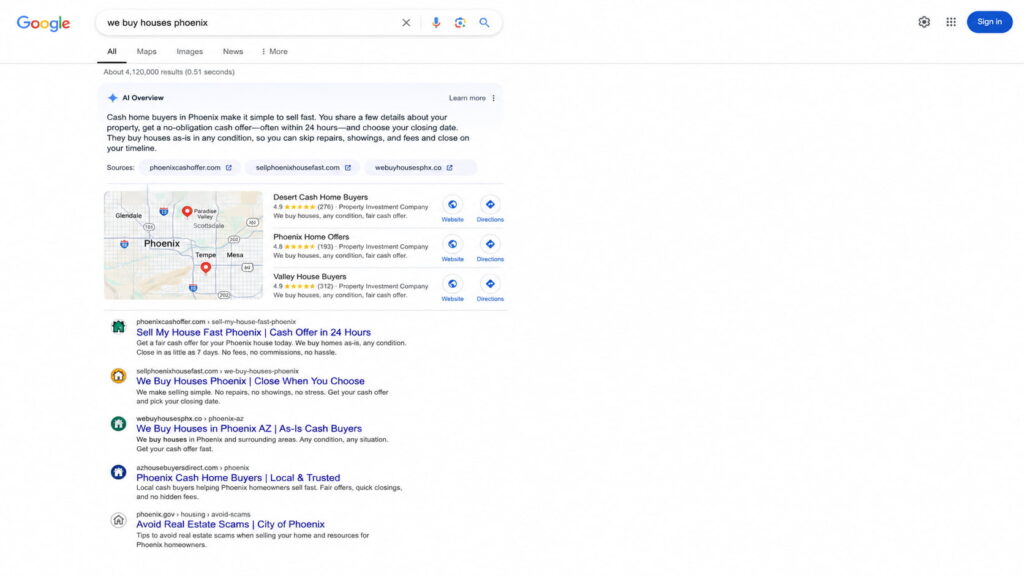
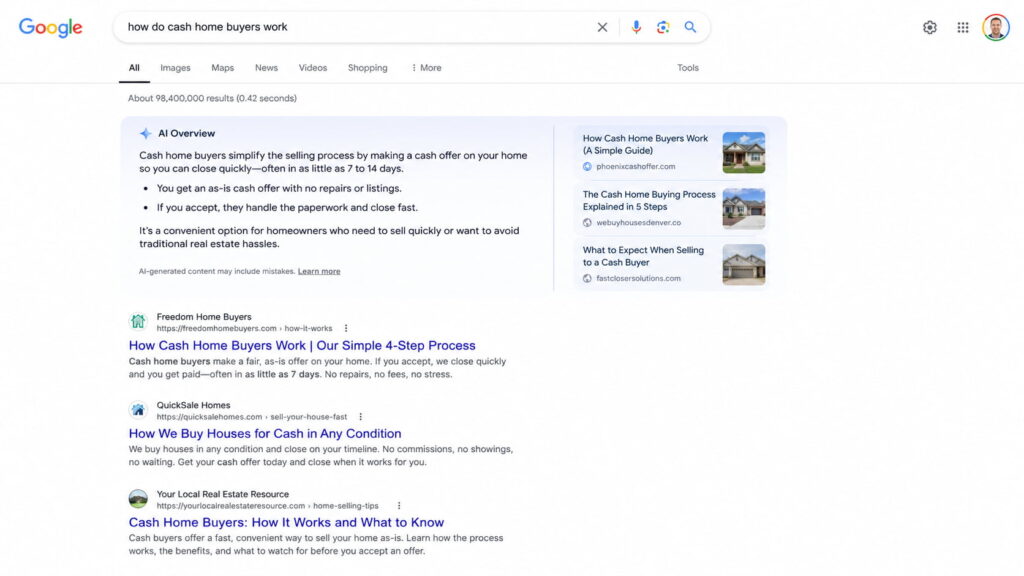
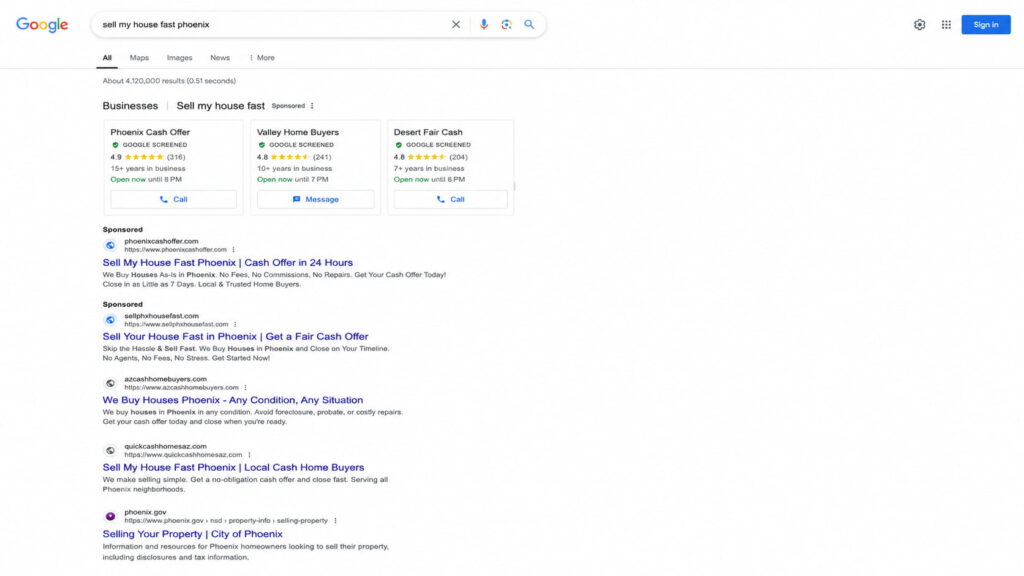
    Google search results page for “we buy houses phoenix” showing an AI Overview, local map listings, and cash home buyer websites.


    A single high-intent seller query in 2026: AI Overview on top, Map Pack below, then organic. Three ways to show up, one page to build.

    “Sell fast” and cash-urgency keywords

    The fastest way to spot a motivated seller is the word fast. Someone in no hurry doesn’t type it. These urgency phrases are the sharpest end of the category:

    • sell my house fast
    • quick house sale
    • sell house for cash now
    • sell my house in 7 days
    • fast cash for my house
    • need to sell my house now
    • sell my house immediately
    • quick cash home sale

    Standing alone, “sell my house fast” is a national bloodbath. Add a city and it isn’t. “Sell my house fast Tampa” is a different, winnable term with the same intent. Pair every urgency phrase with your market and you’re near zero competition.

    Distressed & situational keywords (probate, foreclosure, inherited)

    Situational sellers don’t lead with urgency, they lead with a problem, whether that’s probate, divorce, or buying foreclosures with cash from an owner who’s out of time. Each problem is its own search:

    • sell inherited house
    • probate property buyers
    • stop foreclosure
    • sell house in foreclosure
    • sell fire-damaged house
    • sell rental with tenants
    • divorce house sale
    • sell house with code violations

    Here’s the rule that separates a site that converts from one that doesn’t: each situation deserves its own landing page. A pre-foreclosure seller and a probate seller are searching different things and living different problems. One page can’t speak to both without going vague, and vague doesn’t rank or convert.

    Building a separate page per situation, probate, foreclosure, divorce, inherited, problem tenants, is exactly the seller-situation content that works, because the searcher’s problem is specific and urgent. That’s a chunk of what BASEO builds for cash buyers.

    Cash home buyer & “we buy houses” keywords

    This is the core commercial category for a cash buyer. The searcher isn’t researching, they’re shopping for someone to buy their house:

    • cash home buyers
    • we buy houses [city]
    • sell my house for cash
    • cash offer for my house
    • companies that buy houses for cash
    • as-is home buyers
    • sell house for cash [city]
    • cash house buyers near me

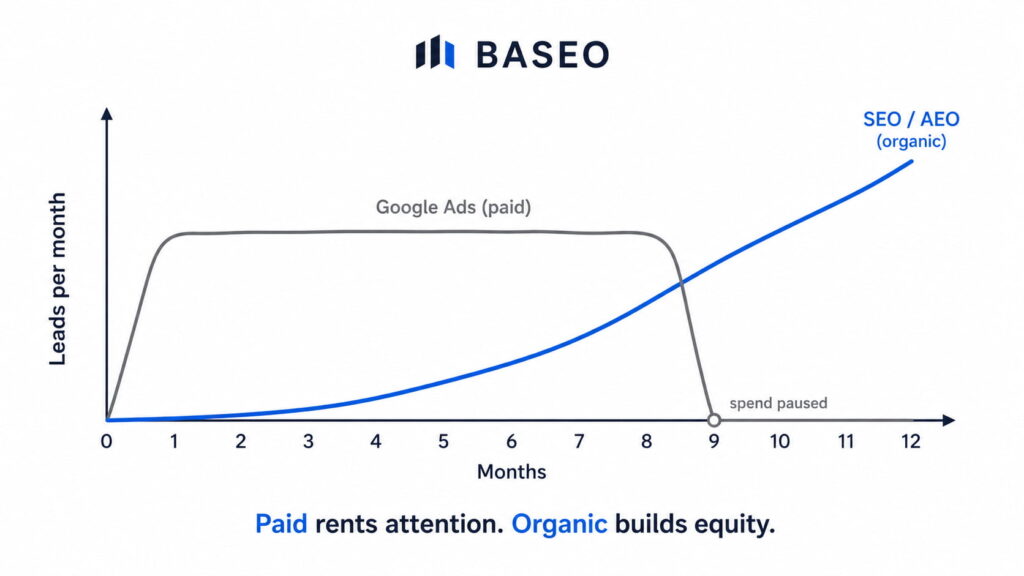
    Because the intent is commercial, these terms cost money in both channels. Cash-buyer keywords run a cost per click of roughly $1.80 and up (Ahrefs estimate), so they matter for SEO and for PPC. The difference is what happens when you stop paying. A paid click for “cash home buyers Dallas” disappears the moment your budget does. An organic ranking for it keeps producing leads after the spend stops. That’s the whole case for building the page instead of only renting the click.

    [TABLE: Cash home buyer keyword targets]

    KeywordIntentNote
    cash home buyersCommercialAdd a city; national term is portal-heavy
    we buy houses [city]Commercial / localHighest-value cash-buyer term per market
    sell my house for cashTransactionalSeller ready to deal
    cash offer for my houseTransactionalBottom of funnel
    companies that buy houses for cashCommercialComparison shopper
    as-is home buyersTransactionalDistressed property signal

    The cash-buyer terms carry commercial intent, which is why they cost the most per click and convert the best organically.

    Wholesaling keywords

    Wholesaling keywords split two ways, and confusing them wastes money.

    • real estate wholesaling
    • wholesale real estate contract
    • how to wholesale a house
    • cash buyers list
    • off-market properties
    • assign a contract

    Some of these are seller-lead or deal-flow terms (“off-market properties,” “cash buyers list”). Most are educational (“how to wholesale a house,” “real estate wholesaling”), and they pull other wholesalers, not sellers. “Real estate wholesaling” runs roughly 3,600 searches a month (Ahrefs estimate), and almost all of it is people learning the business, not people selling a house.

    Don’t build a money page around an education term. Use the education terms for your blog and reserve your city pages for the seller-facing side.

    Fix & flip / rehab keywords

    Flip keywords mix lead-gen with tools and financing:

    • house flipping
    • fix and flip loans
    • fix and flip properties
    • distressed property for sale
    • ARV calculator
    • hard money lender

    The head terms are competitive and mostly owned by lenders and portals. “House flipping” runs around 8,100 a month and “fix and flip loans” around 2,900 (Ahrefs estimates), and the pages ranking are big finance sites, not local operators.

    So don’t fight them head-on. Target the long-tail and geo instead. “Distressed property for sale [city]” beats “house flipping” for a working flipper every time. Note that a couple of these (“hard money lender,” “ARV calculator”) are useful to you as a reader but sit outside what a cash-buyer site should build pages around. Leave them on someone else’s site.

    Rental & buy-and-hold investor keywords

    For the landlords and buy-and-hold side:

    • investment property
    • rental property
    • cap rate calculator
    • BRRRR method
    • turnkey rental property
    • cash flow real estate

    The head terms here are enormous and locked down. “Investment property” runs roughly 18,100 a month (Ahrefs estimate), and it’s owned by Zillow and BiggerPockets. You won’t take it, and you don’t need it.

    Play the long-tail, same as everywhere else. “Turnkey rental property [city]” and “cash flow real estate [market]” have lower volume and are actually winnable. Volume you can’t rank for is worth zero.

    Real estate investing education & how-to keywords

    These are the top-of-funnel content terms:

    • real estate investing
    • how to start real estate investing
    • real estate investing for beginners
    • passive income real estate
    • real estate due diligence

    Be honest with yourself about these. They rarely convert. Someone typing “how to start real estate investing” is a future competitor, not a seller with a house to move.

    They still earn a place, just not on your money pages. Education content builds topical authority and earns the internal links and backlinks that lift the pages that actually convert. Use them for the blog, and let them feed readers toward your city pages. The same logic applies to other awareness channels like reaching sellers on social.

    Local + geo-modified keywords (the conversion engine)

    This is where investors actually win, so read it twice.

    Every high-intent term above gets stronger the second you attach a city or neighborhood. The formula is simple:

    [high-intent term] + [city or neighborhood] = lower difficulty + higher conversion

    Examples: cash home buyers Dallas. Sell my house fast Atlanta. We buy houses Phoenix. Sell inherited house Overland Park.

    It works because hyperlocal phrases carry lower difficulty and higher conversion. The searcher already knows where they are, so the intent is razor-sharp, and even 10 to 30 searches a month convert at rates a head term never will (Luxury Presence). You’re trading volume you can’t win for leads you can win.

    Here’s the repeatable part. Take your 5 money terms. Cross them with every market you buy in. That grid is your city-page target list, built in ten minutes.

    cash home buyers ____ · we buy houses ____ · sell my house fast ____ · sell inherited house ____ · sell house as-is ____

    One catch, and it’s the one that sinks most investors: each city page has to be original to its market. Not a template where you swap the city name and change nothing else. Google’s Scaled Content Abuse policy specifically crushed swap-the-city-name pages, and a Carrot site running the default template is exactly that pattern. Original page per market is what BASEO builds for cash buyers, and if you’re doing it yourself, our step-by-step SEO playbook for a real estate site walks the build.

    Long-tail & question keywords for AEO

    There’s a second search box you can rank in now, and most investors are ignoring it.

    Start with the mechanism, because it matters more than the hype. AI Overviews and the “People also ask” box are built from question-format content. When someone asks a full question, Google and the AI engines pull the page that answers it cleanly and quote it. No clean answer, no citation.

    And these boxes are everywhere. AI Overviews appeared on a large and fast-rising share of US searches through 2025, with trackers reporting anywhere from roughly 15% to 60% depending on the tool and the query type (Semrush). The question box is standard on seller searches.

    The question keywords worth targeting:

    • how do I sell my house without a realtor
    • what is the fastest way to sell a house
    • who buys houses for cash near me
    • how much do cash home buyers pay
    • is selling to a cash buyer worth it
    • do I have to make repairs to sell my house

    The tactic is exact: answer each question in 40 to 55 words, directly under a heading that matches the question. That length is what wins the snippet and gets quoted in the AI answer. The investors formatting for this now are the ones getting cited while everyone else is still arguing about whether AI search is real.

    Formatting pages in that Q&A structure so ChatGPT, Perplexity, and Google’s AI Overviews cite them, then tracking those citations every week, is the AEO work BASEO runs for cash buyers. If you want the deeper mechanics, we wrote a full guide on how to get your pages cited in AI Overviews.

    How to prioritize: building your keyword map

    You’ve got 100+ keywords now. Here’s how to turn them into a plan instead of a spreadsheet you never open.

    1. Pick your model. Wholesaler, flipper, or landlord. This decides your money category. A wholesaler lives in motivated-seller and cash-buyer terms; a landlord in rental terms.
    2. Grab 3 to 5 money keywords. A seller or cash-buyer term crossed with your top markets. “Cash home buyers Kansas City.” “Sell my house fast Kansas City.” These get their own optimized pages.
    3. Add 5 to 10 long-tail supporting terms. Situational and geo variants that feed the money pages. “Sell inherited house Kansas City.” “We buy houses Overland Park.”
    4. Add 3 to 5 education terms for the blog. “How to sell a house in probate.” “What is a cash offer.” These build authority and links.

    Then sort every keyword into a simple three-column map: money page, supporting, or blog.
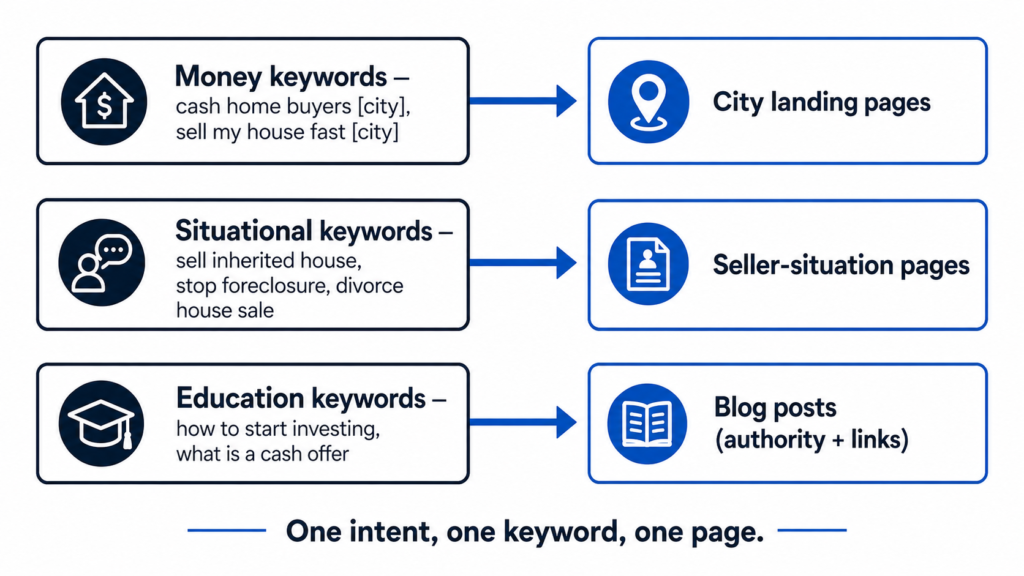
    Keyword mapping diagram showing money, situational, and education real estate keywords connected to their corresponding page types: city landing pages, seller-situation pages, and blog posts.

    The keyword map in one picture: money terms become city pages, situations become situation pages, education becomes blog.

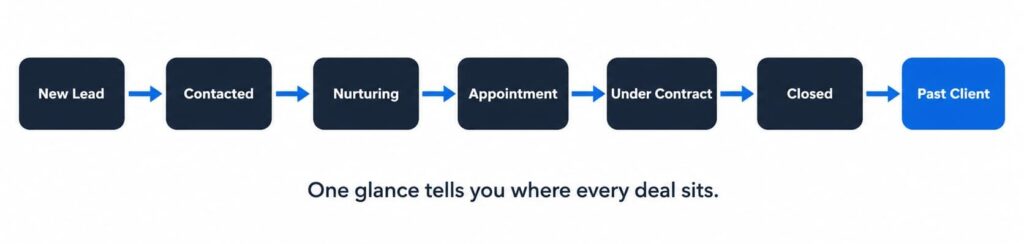
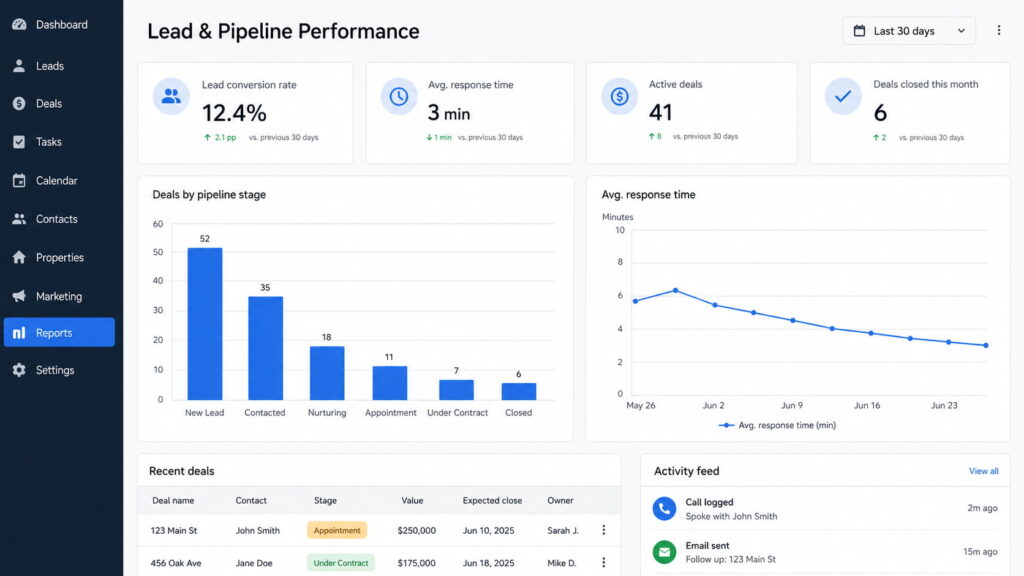
    Worked example, a wholesaler in Kansas City. Money pages: “cash home buyers Kansas City,” “sell my house fast Kansas City.” Supporting pages: “sell inherited house Kansas City,” “we buy houses Overland Park.” Blog: “how to sell a house in probate,” “what is a cash offer.” Six targets, three jobs, zero overlap. When the leads come in, you work them in your CRM so none leak out the bottom.

    Common keyword mistakes investors make

    Most investor sites lose on the same handful of keyword mistakes. Check yours against these:

    • Chasing head terms Zillow owns. “Real estate,” “houses for sale,” “investment property.” You cannot win them, so stop trying.
    • Keyword-stuffing a page instead of matching one clear intent. Repeating “cash home buyers” 30 times doesn’t help. A clean answer to the searcher’s question does.
    • Ignoring local modifiers. The single biggest miss. The city version is easier and converts better, and most investors skip it.
    • Targeting buyer terms when you’re a seller-side investor. “Homes for sale” brings you browsers, not sellers.
    • Making one page rank for every intent. This is the quiet killer.

    That last one deserves a sentence more. When you mix multiple intents on one page, it ranks for none of them. Google can’t tell whether the page is for a seller, a buyer, or a student of wholesaling, so it stops ranking it for anything. One page, one intent, one keyword. That’s not a style preference, it’s how ranking works.

    Turn this list into ranked pages

    A keyword list is step one. Nothing on this page ranks by itself.

    Each money keyword needs its own optimized, AEO-ready page to actually rank and get cited by the AI engines. BASEO builds those SEO, AEO, and programmatic pages for cash home buyers and investors, and works only with this niche, so it already knows your keywords, your competitors, and your seller situations. Some operators run the whole map themselves and do fine. Most would rather spend that time closing deals.

    If you want to know which of these keywords your market can actually rank for, and what your top competitor already owns, that’s what the free audit is for. Written, delivered in about 2 business days, no call required, and it’s yours to keep either way.

    Get your free site audit →

    Frequently asked questions

    Quick answers to the questions investors ask most about keyword strategy.

    What are the best keywords for real estate investors?

    The best keywords for real estate investors combine high seller intent with local modifiers, for example “sell my house fast [city],” “cash home buyers [city],” and “we buy houses [city].” These convert far better than generic terms and face less competition than portal-dominated searches like “homes for sale.”

    How many keywords should a real estate investor target?

    Start with 5 to 15 keywords, not hundreds. Pick 3 to 5 high-intent “money” keywords tied to your market, add 5 to 10 long-tail supporting phrases, and a few educational terms for your blog. Each money keyword should get its own dedicated, optimized page.

    What is the difference between SEO keywords and PPC keywords for investors?

    SEO keywords earn free organic rankings over time and suit long-tail, question, and local terms. PPC keywords are paid and best for high-intent commercial terms you want to rank for instantly, like “cash home buyers.” Most investors use both, matching each keyword to intent.

    How do I find motivated seller keywords?

    Look for terms combining a selling situation with an urgency trigger word, fast, quick, cash, now, or as-is. Examples: “sell inherited house fast,” “sell house as-is for cash.” Use Google autocomplete and the “People also ask” box to expand each into long-tail variations.

    Do keywords still matter for SEO in 2026?

    Yes. Keywords still signal intent and topic to search engines and AI Overviews, but the goal is matching search intent, not stuffing. In 2026, question-format and long-tail keywords also help you get cited in AI answers, making keyword strategy more important, not less.

  • Seller Leads for Real Estate Investors: How to Get More Motivated Sellers in 2026

    Seller leads for real estate investors are the whole game. No motivated sellers, no contracts, no assignment fees, no flips. The problem in 2026 is that the leads most buyers rent get more expensive every quarter and get shared with three competitors the same day. This guide covers where motivated seller leads actually come from, free and paid, what they cost per deal instead of per lead, and how to stop renting a channel and start owning one.

    Real estate investor on a phone call beside a pickup truck, evaluating a for-sale-by-owner house in a suburban neighborhood.

    A steady deal pipeline starts with steady seller leads. The question is whether you rent them or own them.

    What Makes a Seller Lead “Motivated” (and Why It Matters)

    A motivated seller lead is a homeowner with a reason to sell fast. Foreclosure, probate, divorce, a burned-out landlord, a job relocation. Something in their life made the house a problem, and they will trade top dollar for speed and certainty.

    That reason is the only thing that separates a deal from a tire-kicker. A cold owner list is just names and addresses. A motivated lead is a person who already decided to move.

    For a cash buyer, that difference is the business. A motivated lead converts to a signed contract far more reliably than a cold list, and a signed contract is either a flip margin or an assignment fee. Assignment fees nationally average around $10,000 to $13,000 per deal, so a single motivated seller who signs is worth more than a month of most marketing budgets.

    So the goal isn’t more leads. It’s more motivated ones.

    Types of Motivated Seller Leads Investors Target

    Motivated seller leads aren’t all the same temperature. Some sellers are ready today; some need a few months of follow-up. Below are the types with the highest intent and the lowest competition from other buyers, ordered roughly from hottest to warmest.

    Expired Listings

    An expired listing is a seller who already tried to sell and couldn’t. The listing ran, the showings happened, and nothing closed. That owner is frustrated, and frustrated owners are open to a different path: a cash, as-is offer with no showings and no repairs.

    The pool is enormous and growing. Expired listings are the top-performing lead type in 2026, with more than 78,000 listings falling off the MLS every week, up 83% in two years, and over 64,000 active expired leads available weekly (REDX).

    You find them on the MLS through an agent partner, or through an expired-lead service. Move fast. Every buyer in your market is working the same list.

    FSBO and FRBO Leads

    A FSBO (for sale by owner) has already decided to skip the agent commission and sell solo. Then they discover how hard that is: the calls, the lowballs, the paperwork. A clean cash offer that skips the showings and the repairs lands well with a FSBO three weeks into the grind.

    FRBO (for rent by owner) means a landlord advertising a rental themselves. Read that as a tired landlord, worn down by tenants and maintenance, which is a classic cash-buyer target.

    You find both on Zillow’s FSBO filter, on Craigslist and FSBO sites, and through services that aggregate fresh FSBO and FRBO listings daily. A tight, respectful script matters more here than anywhere else.

    Pre-Foreclosure and Distressed Sellers

    Pre-foreclosure owners are running out of time, and time changes what they want. They prioritize speed and certainty over squeezing out the last dollar, which is exactly the offer a cash buyer makes.

    Direct mail is still one of the most effective ways to reach them, along with foreclosure and inherited-property lists. Lead with help, not pressure. These are people in a hard spot, and the buyers who win the deal are the ones who solve a problem instead of circling it. If you’re newer to this niche, start with the basics of buying pre-foreclosure homes before you mail the list.

    Inherited, Absentee, and Tired-Landlord Leads

    Inherited and probate properties, out-of-state absentee owners, and burned-out landlords share a profile: high motivation, low competition. Most buyers never work these lists, so the phone isn’t ringing off the hook when you call.

    You build these lists by stacking public records (probate filings, tax delinquency, out-of-state mailing addresses) and by driving for dollars past neglected properties. PropStream and similar tools let you pull and stack motivated-seller lists from public data.

    They convert because the circumstance is doing the selling for you. An heir who lives three states away doesn’t want to manage a house. He wants it gone.

    How to Get Motivated Seller Leads: Free Strategies

    The cheapest leads are the ones you generate yourself. These channels cost time instead of a per-lead fee, and they’re where most new buyers should start.

    • Sphere and word of mouth. Tell everyone you buy houses. The plumber, the closing attorney, the wholesaler two markets over. Warm referrals close fastest.
    • Cold calling and texting. Pull a list, dial it, text it. High volume, fast feedback, one of the best returns on time in the business.
    • Door-knocking distressed streets. Slow but personal. A conversation on the porch beats a postcard every time.
    • Direct mail. Postcards and letters to targeted lists (pre-foreclosure, probate, absentee). Consistency is the whole trick.
    • Driving for dollars. Log the ugly houses, skip-trace the owners, reach out. The neglect is your signal.
    • Referral alliances. Build a bench: wholesalers, agents who pass on ugly houses, probate attorneys, property managers, contractors. Each one sees motivated sellers you don’t.
    • Your own website. A site that captures “sell my house fast [city]” searches is the one free channel that keeps working after you stop touching it. More on that below.

    One rule cuts across all of it: answer fast. Respond within five minutes and you convert around 5% of leads, against roughly 0.5% once you wait past thirty minutes, which makes a five-minute buyer about 21 times more likely to convert than a slow one (iHomefinder). And 78% of sellers work with the first buyer who calls back (AgentZap). A motivated seller is dialing several buyers at once. The one who picks up wins.

    For the full breakdown of free, paid, and referral channels, see the full motivated-seller-lead playbook.

    Where to Buy Motivated Seller Leads: Platforms Compared

    When time is shorter than budget, you buy leads. The investor stack breaks into a few categories, and the right one depends on whether you want raw data you work yourself or finished leads that ring your phone.

    Platform / typeWhat it’s forExclusive or sharedBest for
    PropStream, ListSourcePull and stack motivated-seller lists from public recordsYou own the dataDIY list builders on a budget
    BatchLeads, DealMachineList building, driving for dollars, skip tracingYou own the dataScaling teams running outreach
    Pay-per-lead marketplaces (MotivatedSellers.com, MotivatedLeads.com, Real Estate Bees, iSpeedToLead)Done-for-you inbound seller leadsExclusive or shared, by planBuyers who want volume now
    Carrot + PPCInbound leads from paid search on your own siteExclusiveBuyers ready to run ads

    Marketplace leads typically run about $29 to $325 each and arrive pre-scored, so you’re paying for someone else’s cold calling, ads, and verification (iSpeedToLead).

    Match the tool to where you are. New or tight on budget, pull your own lists and buy the occasional marketplace lead to keep deals moving. Scaling, layer PPC and list stacking so volume climbs. Established with real budget, that’s when building your own channel starts to beat buying, for reasons the next two sections make plain.

    How Much Do Motivated Seller Leads Cost in 2026?

    Bought motivated seller leads cost roughly $30 to $325 each on marketplaces, while exclusive PPC-sourced leads run $150 to $400 or more. But the number that matters is cost per contract, not cost per lead: a $300 lead that closes at about 6% works out to nearly $5,000 per deal (iSpeedToLead).

    That per-deal math is the part most buyers skip. By channel, marketplace leads land at $29 to $325 depending on whether they’re exclusive or shared. Running your own Google Ads, investor keywords like “we buy houses cash” and “sell my house as-is” run about $2.50 to $5.00 per click, while broad seller terms like “sell my home fast” can hit $65 per click in competitive markets (Promodo).

    Stack the misses on top and paid channels land somewhere around $2,500 to $7,500 per closed deal. Mature organic search runs $500 to $2,000 per deal, and organic leads have been shown to close about twice as profitably as PPC leads (Investor Nitro). Same seller, same keyword, very different math.

    If you want to know which of those seller searches your own market can rank for, and what that would cost against what you pay now, that’s exactly what a free written audit shows you. No call required. See what your market can rank for →

    The Problem With Renting Leads (and the Fix)

    Here’s the part the lead sellers won’t put on their pricing page. Buying leads is renting. You pay every month, the lead is often shared with competing buyers, and the price only climbs.

    Look at what happened to portal leads. They now average around $181 each, national conversion has bottomed out near 0.4% (you buy 250 to close one), and the price is up more than 1,000% since 2015 (REDX). That’s the trajectory of every rented channel: more expensive, more crowded, never yours.

    And the day you stop paying, the phone stops. A rented channel never becomes an asset. It’s a meter running against your margin.

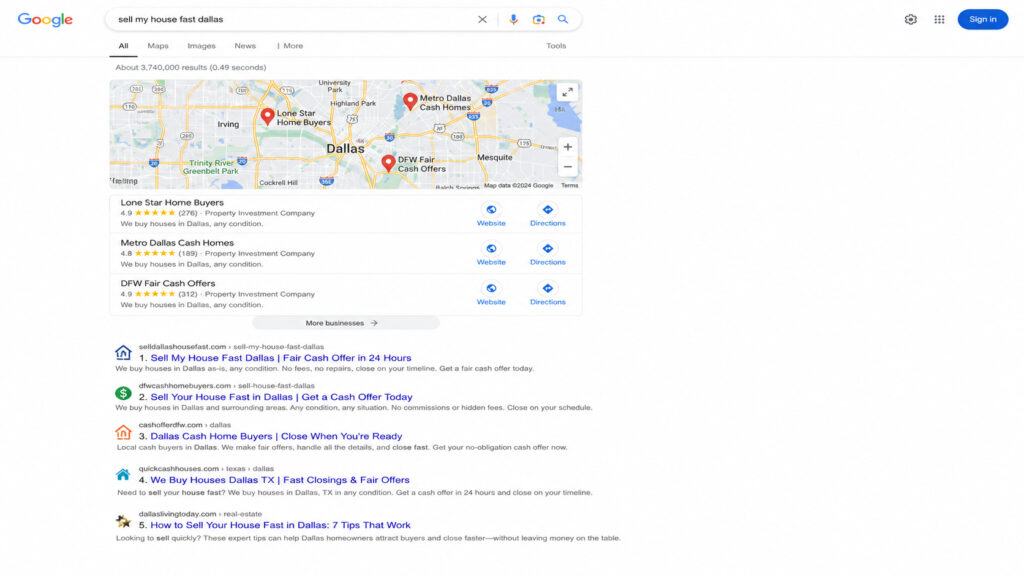
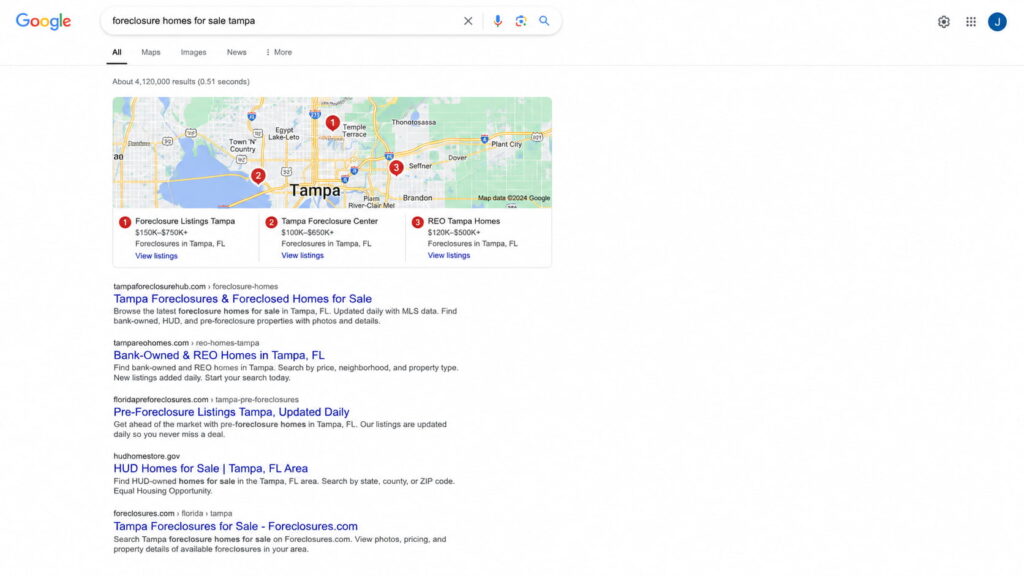
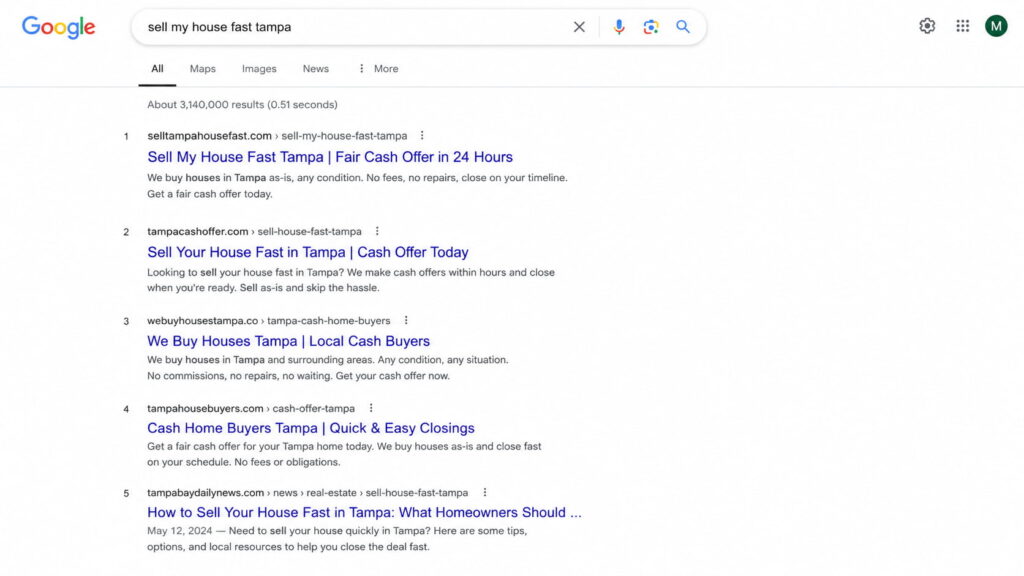
    Google search results page for "sell my house fast tampa" showing cash home buyer websites, local real estate resources, and organic search listings ranking on the first page of Google.

    The owned-channel payoff: your site ranking #1 for the exact search a motivated seller types at 11pm.

    The fix is simple to say and slower to build: own the channel.

    Build a Seller-Lead Engine With SEO and AEO

    Owning the channel means ranking your own site for the searches motivated sellers already type. Two kinds of pages do the work.

    Local pages that rank for “sell my house fast [city]” and “we buy houses [city]” in every market you buy in, plus the other seller-intent keywords your sellers actually type. And seller-situation pages for the searches people type under stress: probate, foreclosure, divorce, inherited property, problem tenants. Each page has to be original to its market. Google’s Scaled Content Abuse policy killed the swap-the-city-name template pages that most investor sites still run, so a page that actually ranks is one written for that city, not copied across fifty. If you want the mechanics, here’s how to do SEO for a real estate website.

    Then there’s the AEO layer. AEO (answer engine optimization) is formatting your pages so AI tools cite them. A growing share of sellers now start in ChatGPT or a Google AI Overview, typing “how do I sell my house fast for cash,” and the AI answers with a short list of companies. AEO is how you become one of the names on that list instead of watching a competitor get cited. That window is still open in most markets, and it won’t stay open. Here’s how to rank in AI Overviews.

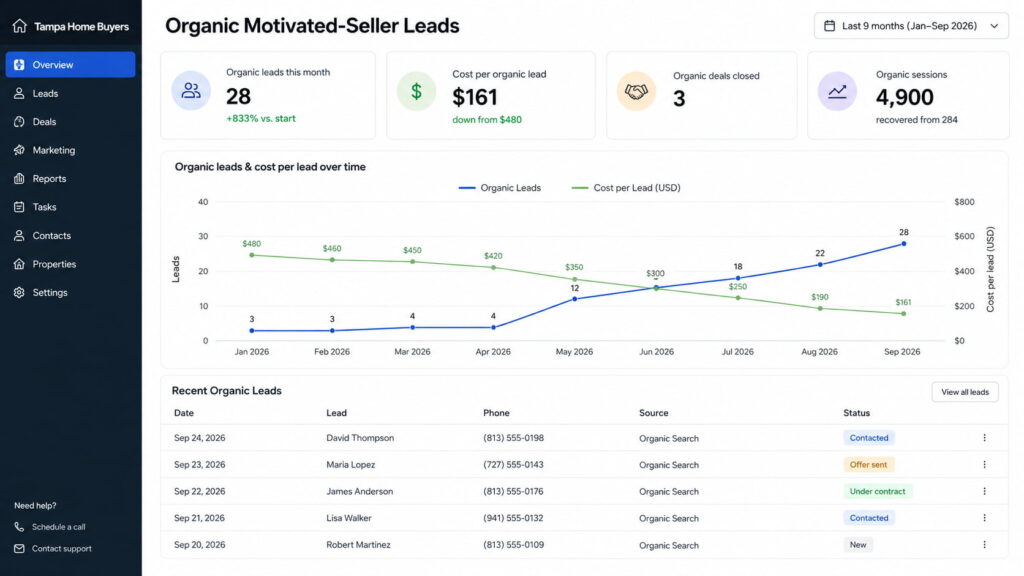
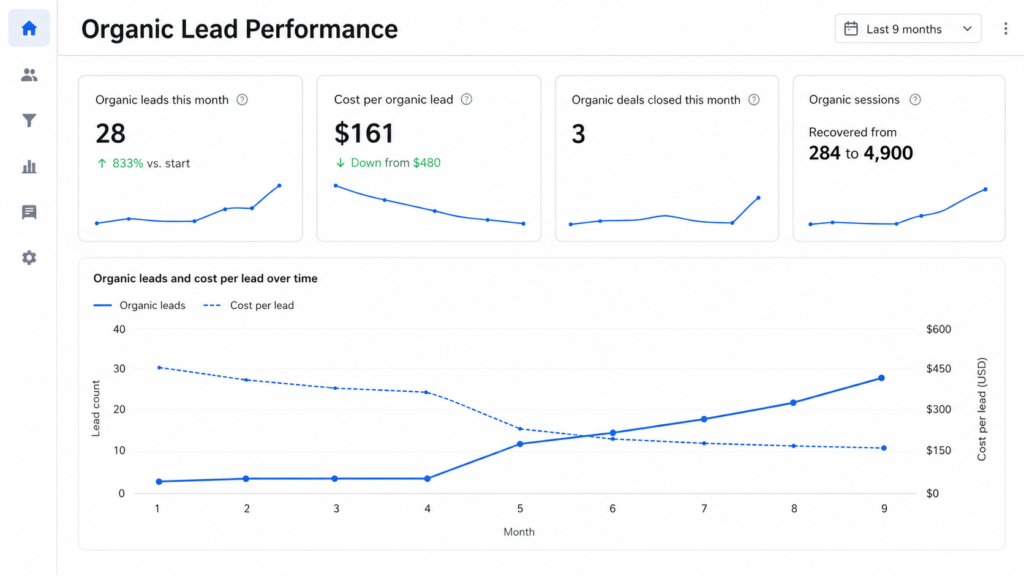
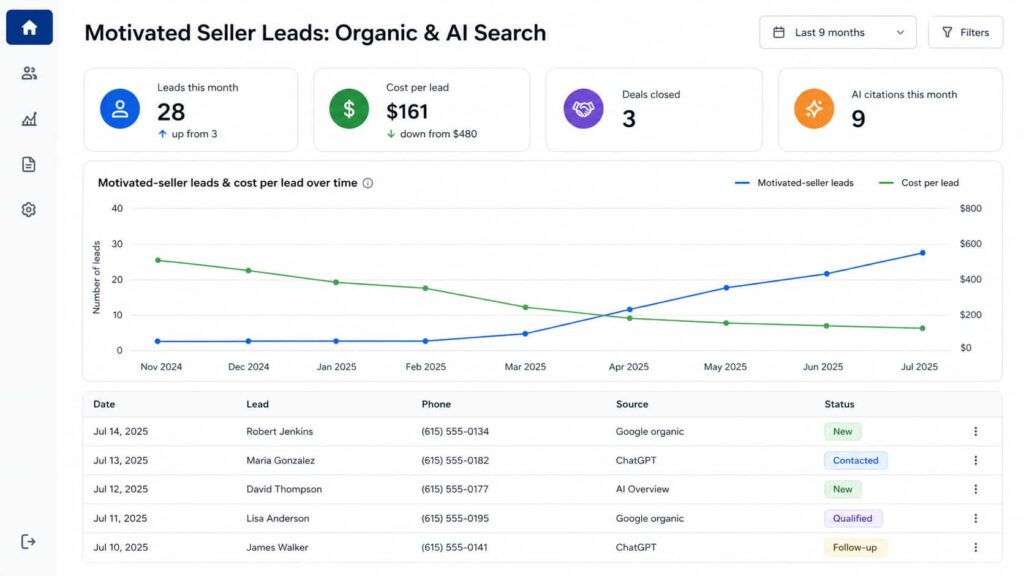
    That’s what BASEO builds for cash buyers: original city pages, seller-situation pages, and AI-search optimization, installed on top of proper lead tracking so every call and form gets counted. One Florida cash buyer went from 3 to 28 motivated seller leads a month in nine months, in the same market, with no extra ad spend, at $161 per organic lead and falling. In month 9 that was 3 organic deals and $54K in profit against a $4,500 invoice (BASEO client data).

    The difference is ownership. Rented leads stop when the payment stops. Organic leads compound: exclusive, cheaper every month as the pages age, working while you sleep.

    How to Convert Seller Leads Into Signed Contracts

    Getting the lead is half the job. Turning it into a contract is the other half, and it’s where most buyers leak money.

    Start with speed. Under five minutes or the deal goes to the buyer who called back first. Then have a script ready for the type of lead: for an expired, you tried the retail path and it didn’t work, here’s a cash offer with no showings; for a FSBO, skip the commission and the open houses; for a pre-foreclosure, speed and certainty before the clock runs out.

    Then follow up like the deal depends on it, because it does. About 80% of deals close between the 5th and 12th contact, yet 44% of people quit after a single follow-up (Spring Forest Media). A simple multi-touch cadence keeps you in the deals everyone else abandoned:

    1. Minute 0: call the second the lead comes in.
    2. Same day: text if no answer.
    3. Day 2: second call, leave a specific voicemail.
    4. Day 4: email or DM with your offer range.
    5. Day 7: check-in call.
    6. Day 14 and beyond: monthly touch until they sell or tell you to stop.

    Run that out of a CRM so nothing slips. If you don’t have one dialed in, start with how to use a CRM to follow up. Remember that your real cost per deal includes all this follow-up time, so a nurturing system is what turns an expensive lead into a profitable one.

    Nine months of an owned channel: leads climbing from 3 to 28, cost per lead falling to $161.

    Get More Seller Leads Without Renting Them

    Free sources work but scale slowly. Paid leads scale but get pricier and shared with every other buyer in your market. An organic SEO and AEO engine gives you exclusive leads that compound, at a cost per deal that falls instead of climbs.

    Some operators build that channel themselves and do fine. Most would rather spend that time closing deals. Either way, the first step is knowing which seller searches your market can actually rank for, and what your top competitor already built that you haven’t. That’s what the audit is for. BASEO does SEO built for cash home buyers and nothing else, so it already knows your keywords, your competitors, and your seller situations. Free, in writing, delivered in about 2 business days, no call required, yours to keep.

    Get your free site audit →

    Frequently Asked Questions

    A few of the questions cash buyers ask most about seller leads.

    What are motivated seller leads?

    Motivated seller leads are homeowners likely to sell soon with a reason to move fast, such as expired listings, FSBOs, pre-foreclosures, and inherited or absentee owners. For cash buyers they convert to signed contracts at higher rates than cold lists because the seller already needs to move.

    How do real estate investors get motivated seller leads?

    Investors get them through free methods (sphere, cold calling, driving for dollars, direct mail, referral alliances) and paid sources (PropStream or BatchLeads lists, pay-per-lead marketplaces, and PPC). Increasingly, investors build their own pipeline with local SEO and seller-situation pages that produce exclusive leads.

    How much do motivated seller leads cost?

    Bought leads run about $30 to $325 each on marketplaces, while exclusive PPC-sourced leads run $150 to $400 or more. The truer number is cost per contract, often near $5,000 on paid channels, versus $500 to $2,000 for mature organic once you count follow-up time.

    What are the best motivated seller leads for investors?

    Expired listings, pre-foreclosures, and inherited or probate leads carry the highest intent and the lowest competition from other buyers. The best source depends on your budget and whether you want rented, shared leads or exclusive ones you own through your own channel.

    Are bought seller leads worth it?

    They’re worth it if you answer within five minutes and follow up consistently. Paid leads scale quickly but get pricier and shared over time. Building your own SEO and AEO pipeline delivers exclusive leads at a lower long-term cost per deal, which is what compounds.

  • Real Estate Facebook Ads: The Complete 2026 Lead-Generation Playbook

    Cash home buyer checking a new motivated seller lead from Facebook ads while standing outside a for-sale-by-owner house in a suburban neighborhood

    A cash buyer checks a fresh Facebook lead between property visits. The channel works, but only if you run it inside the rules.

    Most guides on real estate Facebook ads were written for agents chasing listings. They skip the one rule that gets cash buyers banned: your “we buy houses” ads are housing ads, and Facebook treats them differently from everything else. Get that wrong and the leads never come. Get it right and you have a real motivated-seller channel. Here’s the operator’s version, with real numbers and none of the fluff.

    Why Facebook Ads Still Work for Real Estate in 2026

    Facebook reaches a seller before they ever type a word into Google. You find the tired landlord or the guy behind on payments while he’s scrolling, not while he’s searching. That’s the whole value: interruption. Search catches sellers who already know they want out. Facebook catches them earlier.

    The tradeoff is honest and worth saying up front. That earlier seller is a lower-intent seller, and the moment you stop paying, the leads stop. Facebook is attention you rent, not an asset you own.

    It’s also getting pricier. Metro-market ad costs (CPMs, the price to show your ad 1,000 times) rose 20–35%, and real estate cost per lead climbed roughly 5–10% from 2025 to 2026 (Sotros). It still works. It just rewards operators who run it tight. If you’re weighing it against the free and referral channels, our breakdown of how to get motivated seller leads puts the paid option in context.

    The Special Ad Category That Changed Real Estate Facebook Ads

    Here’s the rule almost every agent guide buries. Because your ads are about housing, Facebook forces them into the Housing Special Ad Category, a restricted classification that strips out most of the targeting you’d normally use (Meta Business Help).

    This isn’t optional and it isn’t a glitch. It came out of a 2022 settlement between Meta and the U.S. Department of Housing and Urban Development over ad targeting that could discriminate in housing (Meta Newsroom). Fair-housing law now shapes how every “we buy houses” ad can be aimed.

    It hits a cash buyer harder than it hits an agent. Your whole pitch is geographic and situational. The Special Ad Category constrains both, so you have to win a different way.

    What You Can No Longer Target

    Inside the Housing category, the levers you’d reach for first are gone or capped (Meta Business Help):

    • No ZIP code targeting. You can target by city, county, or region, but not by postal code.
    • A 15-mile minimum radius. Drop a pin and Facebook automatically widens it to at least 15 miles in every direction (Meta Newsroom).
    • No location exclusions. You can’t carve out neighborhoods.
    • No age or gender targeting. Both are off the table.
    • Lookalike audiences and many interests are limited or unavailable. The precision tools most advertisers lean on are capped.

    What Still Works (and How to Win With It)

    You still pick the metro. You still let Facebook’s algorithm optimize toward the people most likely to act. And you still have the one lever the Special Ad Category can’t touch: your creative. When you can’t aim by demographics, you aim by message. More on that below, because it’s the whole game now.

    How Much Do Real Estate Facebook Ads Cost?

    In 2026, real estate Facebook ads cost about $35 per lead on average, though motivated-seller and home-valuation leads often run $15–$35, and smaller markets can fall to $8–$20. Expect a realistic starting budget of $500–$1,500 a month to gather enough data to know what a lead actually costs you (SuperAds).

    Now translate that into deal math, because cost per lead means nothing until it becomes cost per deal. Say your leads run $30 and you close 1 in 40 Facebook leads (paid social is lower-intent, so a low close rate is normal). That’s $1,200 in ad spend per deal, before you count the assignment fee or the flip. Tighter targeting-by-creative pushes that down. Sloppy ads push it up fast.

    Lead type / marketTypical cost per lead (2026)
    Home-valuation / seller leads$15–$35
    Buyer-form leads$35–$65
    Smaller (Tier-3) markets$8–$20
    Luxury$80–$200+
    Lead-form ad (avg)~$34
    Video ad (avg)~$46

    Real estate Facebook cost per lead, 2026. Motivated-seller and valuation offers sit at the cheap end; forms beat video on raw cost. Source: SuperAds.

    How to Set Up a Real Estate Facebook Ad Campaign (Step by Step)

    You don’t need an agency to launch. You need the steps in the right order and the discipline to declare the Special Ad Category before you do anything else. Here’s the sequence.

    1. Create your Facebook Business Page and ad account.
    2. Declare the Housing Special Ad Category.
    3. Choose your campaign objective.
    4. Build your audience within the rules.
    5. Pick the right ad format.

    Step 1: Create Your Facebook Business Page

    Everything runs through a business Page, not your personal profile. Set up the Page, open Meta Business Suite, and create an ad account under it. Add your payment method and confirm your business details so you’re not scrambling when an ad is ready to launch.

    Step 2: Declare the Housing Special Ad Category

    At the campaign level, Facebook asks whether your ad falls into a special category. For “we buy houses” ads, the answer is Housing, every time (Meta Business Help). Declaring it is mandatory. Skipping it to keep the better targeting is one of the fastest ways to get an ad rejected or an account flagged. Declare it and move on.

    Step 3: Choose Your Campaign Objective

    Your objective tells Facebook what to optimize for. Two fit motivated sellers: Leads (an instant form that opens inside Facebook) and Sales/Conversions (sending people to a landing page on your site). Lead forms are lower-friction and cheaper. Landing pages ask more of the seller and tend to bring higher intent. Pick based on how fast your team can follow up, which we’ll get to.

    Step 4: Build Your Audience Within the Rules

    Set your location to the metro you buy in, knowing the radius will snap to 15 miles minimum. Skip the demographic filters you can’t use anyway. If lookalikes are available in your account, keep them broad. Then let the algorithm do what it’s good at: finding the people in that area most likely to respond to your specific ad.

    Step 5: Pick the Right Ad Format

    Keep it simple. A single clear image or a short video outperforms busy carousels for this audience. Choose between a lead form and a link to your site based on your follow-up speed. On cost, lead-form ads average around $34 per lead versus roughly $46 for video, so forms win on price, but video often brings a warmer, more educated seller (SuperAds).

    The 3-Layer Facebook Ad Structure That Generates Leads

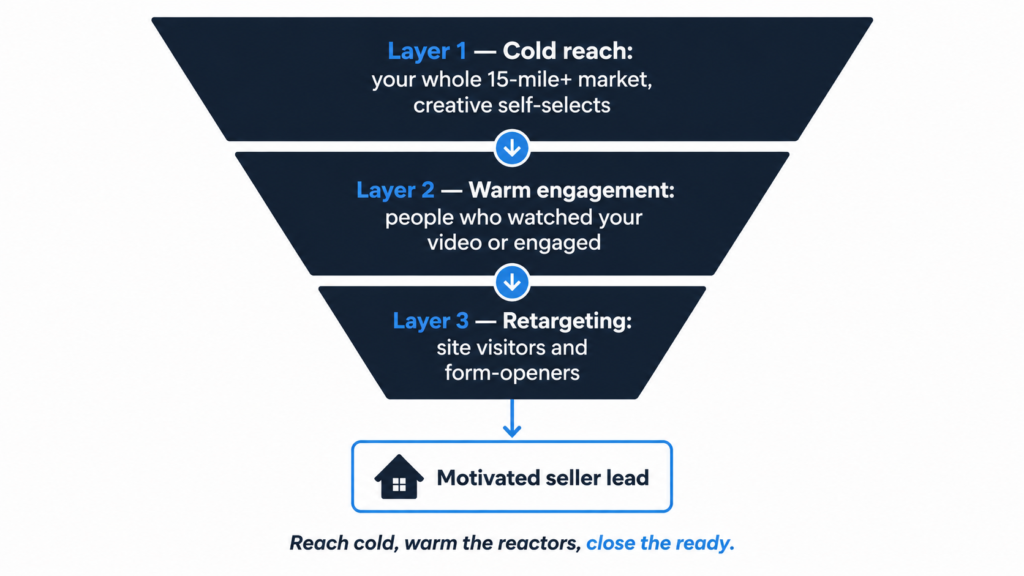
    A single ad blasted at a whole city wastes money. The structure that works is the same funnel you already run in acquisitions: reach a lot of people cold, warm up the ones who react, and close the ones who are ready.

    Real estate Facebook ads funnel showing cold reach, warm audiences, retargeting, and motivated seller leads.

    The three layers: cold reach (often called TOF, top of funnel), warm engagement (MOF), and retargeting the ready seller (BOF). Each layer gets its own ad and its own budget.

    Layer 1 is cold prospecting: broad reach across your market, where the creative does the qualifying. Layer 2 re-engages the people who reacted, like video-viewers, with a stronger offer. Layer 3 is retargeting, the cheapest lead you’ll buy, covered in its own section below. Fund all three. Skipping the middle is why most single-ad accounts stall.

    Facebook Ad Creative: Where the Real Targeting Happens

    Since the Special Ad Category took your demographic targeting, your creative has to do that job instead. The headline and the image are your targeting now. Write for the situation, and only the sellers in that situation raise a hand.

    Speak to the moment, not the market. “Behind on payments and running out of time?” self-selects a pre-foreclosure seller. “Inherited a house you don’t want to keep?” pulls the probate seller. “Done being a landlord?” reaches the tired landlord with a problem tenant. Each ad filters the audience by relevance, which is exactly what you lost at the targeting layer.

    Keep it honest and plain. A phone photo of a real house beats a glossy studio render for this audience, because it reads as a real local buyer, not a national brand. If you want the fuller picture of how paid and organic social fit together, our guide to social media for cash buyers walks through the mix.

    7 Real Estate Facebook Ad Examples That Convert

    Every one of these is built to self-select a motivated seller, and every one is worded to stay inside Facebook’s rules (no “are YOU facing foreclosure” personal-attribute phrasing, which trips policy). Use them as starting angles.

    1. “Facing foreclosure? See your options before the auction date.” Pulls pre-foreclosure sellers who still think they have none.
    2. “Inherited a house you don’t want? We’ll buy it as-is.” Speaks to probate and out-of-state heirs.
    3. “Tired of being a landlord? Sell with the tenant still in place.” Reaches the burned-out buy-and-hold owner.
    4. “We buy houses as-is. No repairs, no agent fees, no showings.” For sellers who can’t or won’t fix up.
    5. “Need to sell fast before a move or divorce settlement?” Timeline-driven sellers who value speed over top dollar.
    6. Short video: “Here’s exactly how a cash offer works, in 60 seconds.” Educates the skeptical seller and warms Layer 2.
    7. “Get a fair cash offer in 24 hours.” The classic speed hook, still the highest-volume angle.

    Facebook Lead Ads vs. Landing Pages: Which Converts Better?

    Neither wins outright. They trade cost for quality, and the right pick depends on how fast your team calls a fresh lead.

    FactorFacebook lead adsLanding pages
    Cost per leadLower (~$34 avg)Higher
    Friction for the sellerLow (form pre-fills)Higher (they leave Facebook)
    Lead intentLowerHigher
    Follow-up urgencyExtreme (minutes)High
    Do you own the asset?NoYes
    Can it earn organic traffic?NoYes

    Lead ads are cheaper because they’re easy: the form pre-fills the seller’s info and they never leave the app. That ease is also the catch. Low friction means lower intent, and 78% of sellers work with the first buyer who responds (iHomefinder). If you can’t call within minutes, cheap leads go cold.

    Here’s the part the ad guides miss. A landing page is an asset you own, and a good one can also rank in Google for the exact searches sellers type when they’re ready. That’s the difference between renting attention and building something that pays you for years. It’s the channel we build for cash buyers, and it’s why a page worth advertising to is also a page worth ranking. If you want the mechanics, start with SEO for a real estate website and the keywords sellers search.

    Retargeting: How to Turn One Click Into a Client

    Most sellers won’t call the first time they see your ad. Retargeting is how you stay in front of the ones who showed interest, and it’s the cheapest lead you’ll ever buy because these people already know your name.

    The mechanics are simple. The Meta Pixel, a small tracking snippet on your website, remembers who visited. You then run ads only to those visitors and to people who watched most of your video. Warm audiences convert at a fraction of cold-audience cost.

    None of it matters without follow-up. About 80% of online leads need more than five follow-up attempts, yet the average operator follows up just 1.3 times (iHomefinder). Retargeting keeps you visible; a real cadence closes the deal. If your follow-up lives in your head instead of a system, a CRM to follow up is the fix.

    Common Mistakes That Get Real Estate Ad Accounts Banned

    A banned account costs you days and sometimes the whole ad account. Almost every ban traces to one of these:

    • Not declaring the Housing Special Ad Category. The single most common trigger. Declare it, always.
    • Personal-attribute language. Ads that imply you know something about the person (“Are you struggling with debt?”) violate Meta’s rules (Meta Transparency Center). Speak to the situation, not the person.
    • Fighting the 15-mile radius. Trying to sneak in ZIP-level targeting gets ads disapproved.
    • Landing-page mismatch. If the ad promises a cash offer and the page pitches something else, Facebook flags it.
    • Overreaching claims. “Guaranteed top dollar, today” reads as a policy violation and as a scam to sellers. Drop it.

    Ready to Scale Your Real Estate Lead Gen?

    Scaling lead gen is not the same as scaling ad spend. Every dollar you put into Facebook stops working the second you stop paying. Turn the ads off and the phone goes quiet the same week.

    The channel that compounds is the seller already looking for you: the one typing “sell my house fast” into Google, or asking ChatGPT who buys houses for cash in his city, at the exact moment he’s ready to deal. That intent is where the cheapest, highest-close leads live, and it’s the channel we build for cash home buyers. Original city pages for every market you buy in, tracking so every call and form is counted, and content formatted so AI search cites you. Not Facebook management, the organic engine underneath it.

    real-estate-facebook-ads-organic-lead-growth-dashboard-2026

    One Florida cash buyer went from 3 organic leads a month to 28 in nine months, same market, no extra ad spend, with organic cost per lead around $161 and falling (BASEO client data).

    That’s the case for running both. Use Facebook to fill the pipeline now, and build the organic and AI Overviews presence that lowers your cost per deal over time. We work only with cash home buyers, so SEO built for cash home buyers already knows your keywords, your competitors, and your seller situations.

    Frequently Asked Questions

    How much do real estate Facebook ads cost?

    In 2026, expect about $35 per lead on average, with motivated-seller and home-valuation leads often at $15–$35 and smaller markets as low as $8–$20 (SuperAds). Plan on a $500–$1,500 monthly budget to gather enough data to know your true cost per lead, then judge it on cost per deal.

    Can I target by ZIP code for real estate ads?

    No. Because “we buy houses” ads fall under the Housing Special Ad Category, Facebook blocks postal-code targeting and enforces a minimum 15-mile radius around any location you pick (Meta Newsroom). You can target by city, county, or region, but not tighter than that.

    What is the Special Ad Category for housing?

    It’s Meta’s required classification for any housing-related ad, including cash-buyer ads. It removes age, gender, ZIP, and lookalike targeting to prevent housing discrimination, following Meta’s 2022 settlement with HUD (Meta Business Help). You must declare it, and it changes how you have to win: with creative, not demographics.

    Do Facebook lead ads work for real estate?

    Yes, for volume. Lead ads are cheaper and lower-friction, which also makes them lower-intent, so they live or die on follow-up speed. With 78% of sellers going to the first buyer who responds, lead ads only pay off if you can call within minutes.

    What budget should I start with?

    Start at $500–$1,500 a month. That’s enough to collect real data without betting the business on an unproven ad. Watch cost per lead first, then cost per deal, and scale only the ads that prove out.

    The bottom line

    Real estate Facebook ads are a real motivated-seller channel in 2026, but only if you respect the Housing Special Ad Category, aim with your creative instead of your targeting, and treat paid social as attention you rent. It fills the pipeline. It does not build equity.

    The leads that get cheaper every month come from the seller already searching for you, not the one you interrupt. Before you pour more into ad spend, it’s worth knowing what’s already working, and what’s broken, on the organic side of your lead gen. That’s what the audit is for. Free, in writing, no call required, yours to keep.

    Get your free site audit →

  • Top Real Estate Keywords for 2026: The Complete List by Search Intent

    Most “top real estate keywords” lists are an alphabetical volume dump. This one is organized by what the searcher actually wants, with real monthly volumes and a usage note on every row. It works whether you’re building SEO pages or buying PPC clicks, and it flags the terms worth chasing versus the ones that will only feed Zillow.

     The keyword list only matters once you know which terms your market can actually rank for.

    How to Use This List (Read This First)

    Every table below gives you three things: the keyword, an approximate US monthly search volume, and a one-line note on intent. Read the note, not just the number. Volumes are third-party estimates, so treat them as directional, not gospel.

    Here is the trap to avoid. High volume means high competition. The broad term “real estate” pulls roughly 450,000 searches a month, and it is locked down by Zillow, Realtor.com, and Redfin (wpresidence). You will not rank for it, and half the people typing it aren’t buyers anyway.

    So filter by relevance to your market. Aim for terms with volume of at least 30 and a keyword difficulty around 30 to 70 percent, and skip the head terms you can’t win. The two sections that pay for this whole article are the local keywords and the AI-search questions. If you’re building pages, start with our step-by-step SEO playbook for a real estate website and pull your targets from here.

    The 4 Types of Real Estate Search Intent

    Before the lists, sort every keyword by what the searcher wants. Four buckets cover it, and the bucket tells you whether the term is worth a page.

    • Informational: the searcher is researching. Examples: “how to buy a house,” “what is escrow.” Answer these with guides and blog posts. They build authority and feed AI answers, but they rarely convert on their own.
    • Navigational: the searcher wants a specific brand. Examples: “zillow login,” “realtor.com.” You can’t win these, and you don’t need to.
    • Commercial: the searcher is comparing options and close to acting. Examples: “best real estate agent in Miami,” “cash home buyers reviews.” High value.
    • Transactional: the searcher is ready to move. Examples: “homes for sale in Dallas,” “sell my house fast.” This is where the qualified leads are.

    Prioritize commercial and transactional terms for lead generation. Use informational content to earn trust and get cited by AI engines, then let it funnel readers toward the pages that convert.

    Top Buyer Keywords (Transactional)

    These are the highest-demand terms in real estate. They’re also the most competitive, because you’re fighting the national portals for every one. The play is to attack the geo-modified and long-tail versions, which we cover below.

    Buyer keywordApprox. US monthly volumeIntent note
    homes for sale near me~368,000Very high competition, portal-dominated, strong local intent
    houses for sale~301,000Very high, broad buyer
    houses for sale near meHighLocal buyer, ready to browse
    condos for sale~110,000Property-type buyer
    for sale by owner~110,000Buyer avoiding agents
    homes for sale by ownerMediumFSBO-focused buyer
    3 bedroom homes for saleMediumMore specific, better qualified
    open houses near meMediumHigh intent, ready to visit
    new listings near meMediumActive, monitoring the market
    cheap homes for saleMediumBudget buyer
    luxury homes for saleMediumHigh-value buyer
    waterfront homes for saleLow to mediumNiche, high value
    foreclosed homes for saleMediumDeal-seeking buyer or investor
    townhomes for sale~40,500Property-type buyer
    fixer upper homes for saleLow to mediumFlip or value buyer
    move in ready homesLow to mediumConvenience buyer
    Head-term volumes from wpresidence; qualitative levels reflect relative competition, not exact counts.

    Top Seller Keywords

    This is where cash buyers and wholesalers live. “Sell my house fast” and “we buy houses” aren’t just seller keywords. They’re your keywords, the exact phrases a motivated seller types before they call someone like you. Searches for “we buy houses [city]” surged past 12,000 a month as more sellers went looking for cash offers (Carrot).

    Seller keywordApprox. US monthly volumeIntent note
    how much is my house worthVery highSeller researching value, early stage
    sell my house fastHigh, motivatedUrgent, motivated seller, prime cash-buyer term
    we buy housesHigh (12,000+ with city)Motivated seller seeking a cash buyer
    home value estimatorHighPre-listing seller
    cash home buyersMedium to highSeller wanting a cash offer
    sell house without realtorMediumCost-conscious or FSBO seller
    sell my house for cashMediumMotivated, ready to act
    cash offer for my houseMediumMotivated, decision-stage
    how to sell my houseMediumSeller in research mode
    sell inherited houseLow to mediumSituation seller (probate)
    sell house in foreclosureLow to mediumDistressed, urgent seller
    best time to sell a houseMediumSeller planning ahead
    The seller terms with cash and speed language are the highest-intent motivated-seller keywords. For the full channel breakdown, see how to get motivated seller leads.

    Top Rental Keywords

    Rental terms carry very strong local intent and high turnover, which makes them a steady traffic source for buy-and-hold operators and property managers. The searcher almost always has a city in mind, even when they don’t type it.

    Rental keywordApprox. US monthly volumeIntent note
    apartments for rent near meVery highLocal renter, ready
    houses for rentVery highBroad renter
    houses for rent near meVery highLocal renter, ready
    pet friendly apartmentsHighFiltered, specific need
    cheap apartments near meHighBudget renter
    studio apartments for rentMediumSegment-specific
    3 bedroom house for rentMediumFamily renter
    1 bedroom apartments for rentMediumSegment-specific
    rooms for rent near meMediumBudget, short-term
    apartments for rent under [price]MediumBudget-qualified
    luxury apartments for rentLow to mediumHigh-value renter

    Real Estate Agent & Broker Keywords

    These are commercial terms with high lead value, which is why they’re some of the priciest in paid search. The generic version is brutally competitive. Add a location and you get a term you can actually own.

    Agent keywordApprox. US monthly volumeIntent note
    real estate agent near me~90,500Very high competition, high commercial value
    realtor near meHighSame intent, high value
    real estate agents near meHighComparison stage
    best real estate agent in [city]MediumCommercial, geo-modified, winnable
    real estate broker near meMediumCommercial
    listing agentMediumSeller-side intent
    buyers agentMediumBuyer-side intent
    top real estate agents [city]Low to mediumComparison, geo
    real estate agent reviewsLow to mediumCommercial, trust stage
    “Real estate agent near me” volume from wpresidence. Chase the geo version, not the generic term.

    Property-Type Keywords

    Property-type terms are the ones you combine with a city or neighborhood to turn a head term into something rankable. “Luxury homes” is a fight. “Luxury homes in Scottsdale” is a page.

    Property-type keywordApprox. US monthly volumeIntent note
    single family homes for saleHighCore buyer, combine with geo
    land for saleHighBuyer or investor
    commercial real estate~110,000Commercial buyer or tenant
    new construction homesHighBuyer, combine with geo
    luxury homesHighHigh-value, combine with geo
    foreclosure homes~74,000Deal-seeker or investor
    townhomes for sale~40,500Property-type buyer
    waterfront homesMediumNiche, high value
    investment property~18,100Investor intent
    multifamily homes for saleMediumInvestor intent
    mobile homes for saleMediumBudget or niche buyer
    Volumes from wpresidence. For the foreclosure angle, see where to find foreclosure listings.

    Local & Geo-Modified Keywords (Highest ROI)

    If you only act on one section, make it this one. Geo-modified keywords are the only realistic way to compete with national portals, and they convert better than any head term on this page.

    Here’s why. Zillow can’t write an authentic page about the best neighborhoods in Austin for young families, or condos near a specific landmark in Tampa. They scale on volume, not local knowledge. That’s the gap you fill. A searcher typing “homes for sale in Tampa FL” or “real estate agent 90210” has already told you their market and their intent. That’s a long-tail term with less competition, a higher click-through rate, and a more qualified lead at the end of it.

    Adding a location to any generic keyword does two things at once. It drops the competition, and it raises the conversion rate, because you’re matching the exact search instead of a broad one. “Condos for sale” is a portal fight. “Waterfront condos for sale in Clearwater” is a lead.

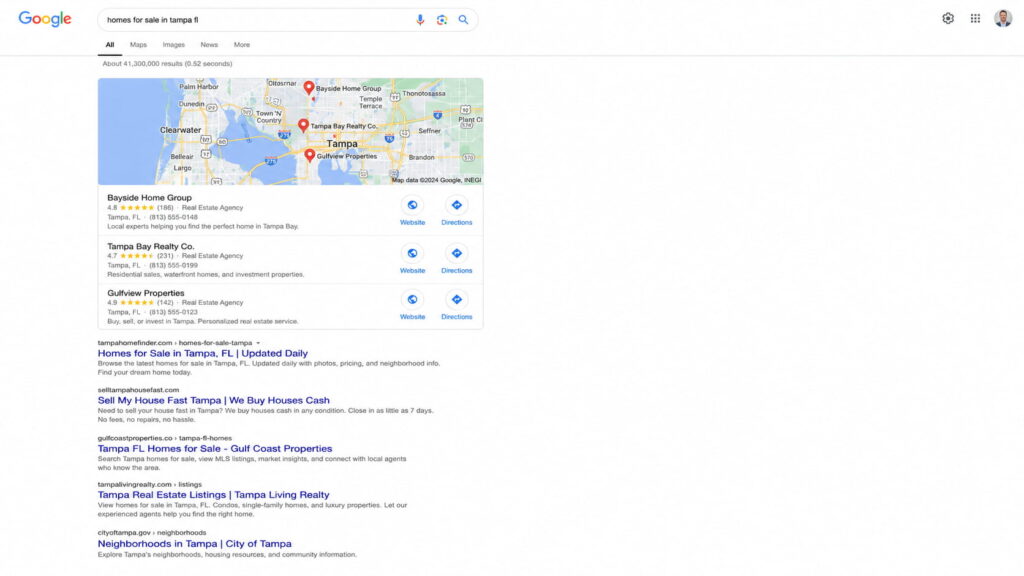
     A geo query surfaces the Map Pack and local sites, not the national portals. That's the opening.

    There’s a catch, and it’s the reason most investor sites fail here. You need a unique page for every market you work, not one template with the city name swapped out. Google’s Scaled Content Abuse policy, tightened in the March 2024 update, specifically targets those near-duplicate location pages. Building an original page per city, with local proof and market-specific content, is exactly what programmatic city pages are, and it’s the core of what BASEO builds for cash home buyers.

    The Location-Modifier Formula

    You don’t need to guess at these. Use one formula: [intent keyword] + [city / neighborhood / ZIP / county / school district]. Each level of specificity trades a little volume for a lot less competition.

    Modifier levelExampleWhy it works
    Cityhomes for sale in Tampa FLRankable, clear local intent
    Neighborhoodcondos for sale in Seminole HeightsLower competition, hyper-local
    ZIP codereal estate agent 90210Precise, low competition
    Countyhouses for sale in Travis CountyBroader-than-city coverage
    School districthomes in Round Rock ISDHigh-intent family buyers

    Apply the formula to any term in the tables above, and you’ve turned a portal fight into a page you can win.

    Long-Tail & Question Keywords for AI Search (AEO)

    This is the section almost nobody in the top results covers, which is exactly why it’s the opportunity. In 2026, people don’t just type fragments into Google. They ask full questions, out loud and in chat, and those questions feed AI Overviews, ChatGPT, and Perplexity.

    The numbers are hard to ignore. AI Overviews now appear on roughly 48% of Google searches, and informational queries trigger them about 39% of the time (The Stacc). Zero-click searches, where the answer is read right on the results page, hit about 68% in early 2026 (Search Engine Land). If you’re not the source the AI quotes, you’re invisible in half the results.

     The AI Overview sits above every organic result and cites only a few sources. AEO is the work of being one of them.

    These are the question keywords worth targeting:

    • how much do cash home buyers pay
    • is it a good time to buy a house
    • what credit score do I need to buy a house
    • how to sell a house by owner
    • how does a cash offer on a house work
    • what are closing costs for a seller
    • how long does it take to sell a house
    • is it better to rent or buy in 2026
    • how much down payment do I need for a house
    • what is a good credit score to buy a house
    • do I pay taxes when I sell my house
    • how do I sell a house that needs repairs

    Here’s the format rule that wins the citation: answer each question directly in about 40 to 55 words, right under a heading that matches the question. That tight, self-contained answer is what a snippet grabs and what an AI engine quotes. Formatting content that way, with question-and-answer structure and citation-friendly schema, is the AEO work BASEO does and tracks for its clients. If you want the mechanics, read our guide on how to get cited in AI Overviews. The window where few competitors are formatting for AI won’t stay open forever.

    Real Estate PPC Keywords (Highest CPC = Highest Intent)

    Cost per click is a confession. When advertisers pay a premium for a term, they’re telling you it converts. That makes the PPC price list a shortcut to the highest-intent keywords in the niche, and those same terms are worth targeting organically, where the click is free.

    The real estate category averaged about $3.22 per click in 2026, up more than 27% year over year, the biggest jump of any industry (WordStream). Seller terms run far above the average, because a motivated seller is worth more than a browser.

    PPC keywordRough CPCIntent signal
    real estate (category average)~$3.22Rising fast, high commercial value
    best keywords for real estate~$2.50Near category average
    homes for sale in [city]$0.50 to $5Broad buyer, longer sales cycle
    sell my house fast$5 to $65Motivated seller, high lead value
    cash offer on houseHigh (seller range)Ready-to-transact seller
    real estate agent near meHigh (lead cost near $100)Premium commercial term
    CPC ranges from WordStream and real estate PPC benchmarks. Seller campaigns commonly run a cost per lead near $100, and past $150 in competitive markets.

    The takeaway isn’t “spend more on ads.” It’s that these are the terms sellers and buyers use when they’re ready. If you want the full paid-search breakdown, see our guide to Google Ads for real estate. Judge every one of them by cost per deal, not clicks.

    Emerging Real Estate Keywords to Watch in 2026

    Search behavior moves, and the terms with the least competition are the ones just starting to climb. A few years ago nobody searched “AI real estate tools.” Now these pull thousands of searches a month, and most local sites haven’t written a word about them.

    Keywords gaining ground right now:

    • virtual home tours
    • AI real estate tools / AI home valuation
    • sustainable and energy-efficient homes
    • remote-work-friendly neighborhoods
    • 55+ communities
    • ADU (accessory dwelling unit) regulations
    • homes with EV charging
    • walkable neighborhoods

    The math here is simple. If you’re the first operator in your market publishing a real page on ADU rules or energy-efficient homes, you rank before anyone else shows up. These terms are small today and larger every quarter. Get the page indexed early and the position is yours to lose.

    How to Find More Keywords for Your Market

    This list is a starting point, not the finish line. Your market has its own terms, and the tools to find them are mostly free.

    Start here: Google Autocomplete (type a seed term and read the suggestions), People Also Ask (every question is a page idea), Google Keyword Planner (basic volume and competition), Google Trends (seasonality and rising terms), and Google Search Console (the keywords you already show up for). For keyword difficulty and competitor gaps, the paid tools Ahrefs and Semrush are worth it once you’re serious.

    The method:

    1. Take a seed term (“cash home buyers,” “homes for sale”) and add your city.
    2. Filter for volume of at least 30 and a keyword difficulty around 30 to 70 percent.
    3. Mine People Also Ask and Autocomplete for long-tail and question variations.
    4. Check the actual search results to see who ranks and whether you can realistically beat them.

    Practitioners like lowfruits and Sierra Interactive run the same play: seed, filter, and mine the questions Google hands you for free.

    Turn These Keywords Into Rankings

    A keyword list doesn’t rank itself. Turning these terms into leads takes optimized pages, technical SEO that Google can read, and enough authority to compete. That’s the gap between “I have the list” and “the phone rings.”

    That’s the whole job we do for real estate cash home buyers: unique city pages, seller-situation content, and AI-search formatting, built around the terms that actually convert. One Florida cash buyer went from 3 motivated seller leads a month to 28 in nine months, same market, no extra ad spend (BASEO client data). Some operators run the playbook themselves and do fine. If you’d rather see the gap before you decide, that’s what the audit is for.

    Send your domain and we’ll send back a free, written audit: your top competitor’s keyword gaps, the geo terms you should own, and the deal-math for your market. No call required, yours to keep. Get your free site audit →

    Frequently Asked Questions

    A few quick answers to the questions operators ask most about real estate keywords.

    What are the best keywords for real estate?

    The best real estate keywords combine high commercial or transactional intent with local modifiers, for example “homes for sale in [city],” “real estate agent near me,” and “sell my house fast.” Local, geo-modified long-tail keywords convert best because they attract buyers and sellers ready to transact in a specific area.

    How many keywords should a real estate website target?

    There’s no fixed number, but most real estate sites target one primary keyword per page plus several related long-tails. Focus on relevance and intent over quantity. A handful of well-chosen local keywords per neighborhood or service page outperforms hundreds of generic terms you can’t realistically rank for.

    What is the highest-converting real estate keyword?

    Localized, transactional keywords convert highest, think “homes for sale in [neighborhood]” or “sell my house fast [city].” These searchers have clear intent and are close to acting. Generic high-volume terms like “real estate” bring traffic but rarely convert without a location or action attached.

    Are long-tail keywords better for real estate?

    Usually, yes. Long-tail real estate keywords are more specific, less competitive, and convert at higher rates because they match decision-stage intent. Adding a location to any keyword automatically makes it long-tail, for example “condos for sale” becomes “waterfront condos for sale in Tampa.”

    How do I find real estate keywords for my city?

    Enter a seed term plus your city (like “homes for sale in Austin”) into a tool like Ahrefs, Semrush, or Google Keyword Planner. Filter by search volume of at least 30 and keyword difficulty of 30 to 70 percent, then mine Google Autocomplete and People Also Ask for local long-tail variations.

  • How To Start Wholesaling Real Estate: A Beginner’s Guide for 2026

    You can start wholesaling real estate with $0 to $2,000 and, in most states, no license. That’s what makes it the lowest-capital way into real estate investing.

    Here’s what the gurus skip: wholesaling is simple to understand and hard to stay consistent at. You don’t buy the house. You get it under contract at a discount, then sell that contract to a cash buyer and keep the difference. Done right, a first deal is realistic in 60 to 90 days.

    This is the honest, step-by-step version. What wholesaling actually is, whether it’s legal in your state in 2026, how much money and time it really takes, and the exact seven steps to your first assignment fee.

    Real estate investor in a casual button-down shirt sitting across a kitchen table from an older homeowner in a modest suburban kitchen, reviewing a contract together with a phone and coffee mug nearby, illuminated by warm natural daylight in a professional, trustworthy meeting setting.

    The real job of a wholesaler happens at the kitchen table: a fair contract with a motivated seller. Everything else is paperwork.

    What Is Real Estate Wholesaling?

    Real estate wholesaling is a middleman business. You find a motivated seller, put their house under contract at a price low enough to leave room for profit, then assign that contract to a cash buyer who closes on it. You collect the difference as a fee.

    The part beginners miss: you never own the house. You don’t need the purchase price, a mortgage, or a rehab budget. What you actually control is the contract, and what you sell is the contract, not the property.

    The right to buy the house that your signed contract gives you is called equitable interest. Transferring that right to another buyer is called an assignment. Get comfortable with those two words, because they’re the whole business.

    Why does this work at all? Because two people both win. Motivated sellers value speed and certainty over top dollar, and cash buyers (flippers and landlords) will pay a finder to bring them discounted houses they don’t have time to hunt for. You sit in the middle and get paid to connect them.

    How Wholesaling Actually Makes You Money (The Assignment Fee)

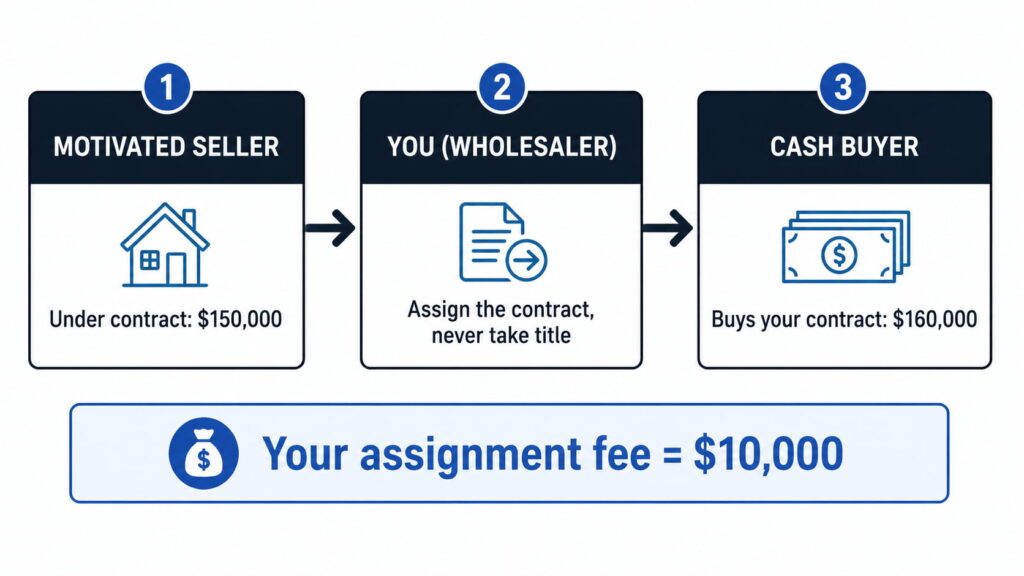
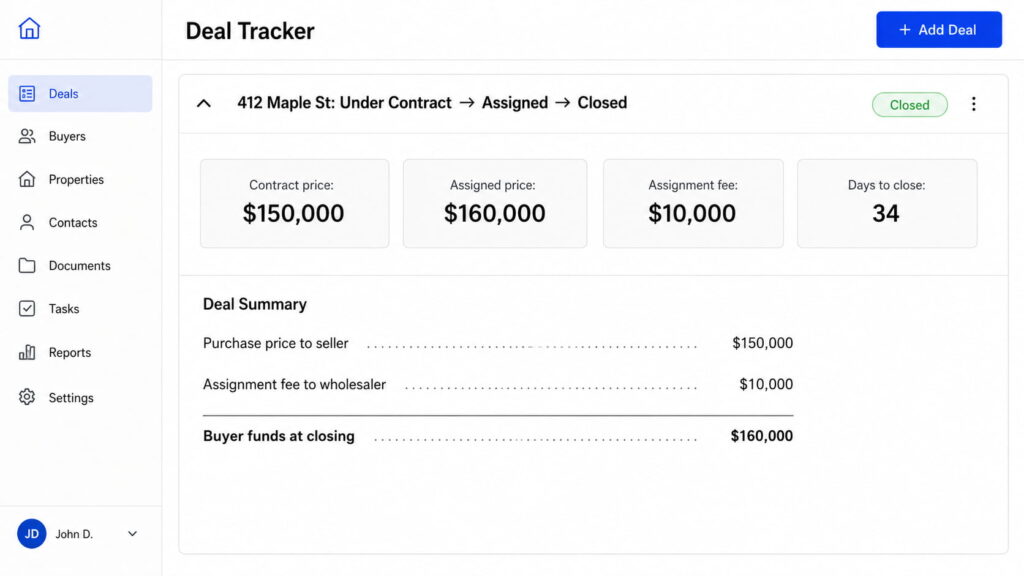
    Say you get a house under contract to buy at $150,000. You find a cash buyer willing to take your spot in that contract at $160,000. You assign the contract, the buyer closes with the seller, and the $10,000 difference is your assignment fee.

    The only money you usually put at risk is earnest money, often a few hundred to a thousand dollars, to make the contract binding. That’s the appeal. Assignment fees average about $13,000 nationally (Real Estate Bees), and you’re capturing that without a loan or a renovation.

    Your fee is simply the spread between what the seller agreed to and what the cash buyer will pay, so the whole game is negotiating a low enough contract price that there’s a healthy gap left for you. Lock the house up too high and there’s no room to assign it.

    Vector infographic explaining a real estate wholesaling assignment fee. Three connected boxes show the process: a motivated seller contracts a property for $150,000, the wholesaler assigns the contract without taking title, and a cash buyer purchases the contract for $160,000. A highlighted banner below shows the wholesaler’s assignment fee of $10,000. Clean navy-and-blue design with arrows illustrating the transaction flow.

    You sell the contract, not the house. The gap between your contract price and the cash buyer’s price is the fee.

    Wholesaling vs. Flipping vs. Buy-and-Hold

    Wholesaling, flipping, and buy-and-hold are three different games with very different capital needs. Wholesaling is the low-capital entry because you never take title, never renovate, and are out of the deal in weeks.

    Flipping means you actually buy the house, renovate it, and resell it. The upside is bigger. The median flip made a gross profit of $65,981 in 2025, but that takes real capital, months of work, and real risk. Buy-and-hold means you buy and rent for years, the highest capital and the longest horizon.

    StrategyCapital neededRiskSpeedWho owns the house
    WholesalingVery low ($0–$2,000)LowDays to weeksNobody (you sell the contract)
    FlippingHigh (buy + rehab)HighMonthsYou, until you resell
    Buy-and-holdHighestMediumYearsYou, long term

    Most successful investors end up doing more than one. Plenty start by wholesaling to build cash and learn how to find deals, then use those skills and that capital to flip or hold later. Wholesaling is the on-ramp, not the ceiling.

    Is Wholesaling Real Estate Legal?

    Yes. Wholesaling is legal in all 50 states. You’re selling your rights to a purchase contract, not the property itself, which is why it doesn’t automatically require a real estate license. But several states tightened the rules in 2026, so what’s legal depends on how you market the deal and where you operate.

    The line that keeps you safe: you can market the contract, meaning your equitable interest in the deal. You generally cannot market the property itself to other buyers without a license, because that looks like brokering real estate you don’t own. Most wholesalers who get in trouble crossed that line.

    There’s a common workaround for stricter states called a double close, where you actually buy the house and resell it minutes later in two back-to-back transactions, so you briefly take title instead of assigning a contract. It costs more (you need transactional funding and two sets of closing costs), but it keeps you clearly on the right side of the “you can’t sell what you don’t own” rule.

    One caveat, and it matters: this is general information, not legal advice. Laws are changing fast. Verify the current rules with a licensed real estate attorney or your state real estate commission before you do a deal.

    Do You Need a Real Estate License to Wholesale?

    In most states, no, as long as you stay within the limits and market the contract rather than the property. That’s the default across the country.

    The exceptions are growing, though. South Carolina effectively requires a license to wholesale. Pennsylvania now requires wholesalers to register and disclose. Illinois limits unlicensed wholesalers to roughly one deal a year before you’re treated as a broker (Real Estate Bees). If you’re in one of those states, the rules are different from what a national YouTube video will tell you.

    A license isn’t automatically a bad idea, either. If you plan to do volume, getting licensed removes the transaction-count worry entirely, gives you MLS access for comps, and lets you legally market properties. Plenty of high-volume wholesalers carry a license for exactly those reasons. For most beginners doing a handful of deals it isn’t required, but know it’s an option, not an obstacle.

    States With Strict or New Wholesaling Laws

    A handful of states have moved from gray area to written rules. Know these before you market a single deal:

    • South Carolina. House Bill 4754 defines wholesaling as brokerage activity, so you need a license. It’s the hardest state to wholesale legally right now.
    • Illinois. Deal in real estate contracts, including assignable contracts, on two or more occasions in any 12-month period and the state treats you as a broker. In practice that caps unlicensed wholesalers at about one deal per year.
    • Pennsylvania. Act 52 now regulates wholesaling with registration and disclosure requirements.

    The trend is broader than those three. Six new wholesaling laws passed in 2025 alone across five states, Connecticut, Maryland, North Dakota, Oklahoma, and Tennessee, mostly adding disclosure and registration rules (Leonine Public Affairs). Roughly a dozen states now regulate wholesaling in some form.

    None of this makes the business illegal, but it does mean the rules where you live are the only ones that count. Most of the new laws boil down to the same idea: tell the seller in writing that you’re a wholesaler and that you intend to assign the contract for a profit. That kind of disclosure is good practice everywhere, even where it isn’t required yet. Check your own state, keep everything in writing, and confirm with an attorney before your first deal.

    How Much Money Do You Need To Start Wholesaling?

    Most beginners start with $0 to $2,000 (Call Porter). Plan for roughly $3,000 spread over the 60 to 90 days it takes to close a first deal, and you’re being realistic rather than optimistic.

    Here’s where the money goes:

    ExpenseTypical early costCan you start nearly free?
    Marketing: driving for dollarsGas + timeYes
    Marketing: direct mail / PPC ads~$0.50–$1.50 per mailer; $20+ per ad leadNo, add later
    Skip tracing (owner contact info)~$0.10–$0.30 per lookupMostly, free tiers exist
    Earnest money per contractA few hundred dollarsRefundable with contingencies
    Contract templates (attorney review)One-time $100–$500Worth paying for

    The pattern is clear: start with the free channels, put a little money into skip tracing and earnest deposits, and only turn on paid marketing once deals are producing cash. The bigger cost isn’t dollars, it’s time. Expect 20 to 40 hours a week finding sellers, running numbers, and building your buyers list. Wholesaling is cheap to start and expensive to do halfway.

    How To Start Wholesaling Real Estate Step by Step

    The model is simple. The execution is a repeatable seven-step loop you run over and over. Here’s the exact order, from studying your market to collecting the fee.

    Step 1: Study Your Local Market

    Before you talk to a single seller, learn your market. What do homes sell for, which neighborhoods have investor activity, and what do typical repairs cost? Those three numbers decide whether a deal is real.

    Zillow and Redfin show you sold prices and days on market. Your county property and recorder records show ownership, sales history, and liens for free. An investor-active neighborhood usually shows the signs: recently flipped houses, LLCs on the ownership records, and homes selling below the block’s average because they needed work. Those are the areas where your deals will actually move.

    Do one thing today: pull the last ten sold comparable homes in one target zip code and write down the price per square foot. That single number will anchor every offer you make, and it’s the fastest way to sound credible the first time a seller asks what their house is worth.

    Step 2: Learn Your State’s Wholesaling Rules

    Before you market anything, learn the rules where you operate. Search your state real estate commission, read the disclosure requirements, and note any limit on how many deals you can do unlicensed. Re-read the wholesaling laws section above and match it against your own state.

    Get a written assignment disclosure ready, and have a local real estate attorney glance at your approach before your first deal. A one-hour consult is cheaper than a violation, and the attorney you meet now is the same one who can close your deals later. It’s a relationship worth starting before you need it.

    Step 3: Find Motivated Sellers

    This is the actual job, and it’s where most beginners fail. A motivated seller is an owner with a reason to sell fast and below market: a looming foreclosure, tax or other liens, an inherited house they don’t want, a divorce, or a tired landlord who’s done with tenants. They aren’t chasing top dollar. They’re chasing a fast, certain, as-is exit, and that’s exactly what you offer.

    You reach them through a mix of channels, and none of them are magic. The main ones:

    • Driving for dollars. Scout target neighborhoods for neglected houses (peeling paint, overgrown yards, code notices, full mailboxes) and log the addresses. Free except for gas and time, and it’s the best on-ramp for a broke beginner.
    • Absentee-owner and distressed lists. Pull lists of out-of-state owners, pre-foreclosures, tax delinquents, and probate filings, then work them consistently.
    • Direct mail. Postcards and letters to those lists. Costs money per piece but scales once you have cash flow.
    • Cold calling and texting. Skip trace the list for phone numbers and reach out. High volume, low cost, thick skin required. Respect the Do-Not-Call Registry and your state’s texting rules.
    • PPC and paid ads. Pay to show up when a seller searches. Fast leads, but you’re bidding against everyone. See Google Ads for real estate for how the costs actually work.

    Work two or three of these consistently instead of chasing all of them badly. For the full breakdown of channels ranked by cost and speed, see how to get motivated seller leads.

    Google desktop search results page for “sell my house fast dallas,” featuring a local map pack with three cash home buyer businesses, ratings and reviews, followed by organic search listings for Dallas cash offer companies and a home-selling guide article.

    When a motivated seller searches “sell my house fast [city],” the buyers on page one get the call. That’s the channel that keeps producing after you build it.

    Every channel above stops the day you stop working it. The one that compounds is being the buyer sellers find when they search “we buy houses [city]” on Google or in ChatGPT. Building that findable, original-per-market presence is what BASEO does for cash home buyers, once you’re established enough to want deal flow coming in instead of chasing it. That’s later. For now, pick two channels and work them daily.

    Step 4: Analyze the Deal (ARV & MAO)

    A deal only works if the numbers leave room for everyone. Two terms run the math. ARV, or After Repair Value, is what the house will be worth fully fixed, estimated from comparable sold homes nearby. MAO, or Maximum Allowable Offer, is the most you can offer the seller and still leave a profit for your cash buyer and a fee for you.

    The standard tool is the 70% rule. The formula:

    MAO = (ARV × 0.70) − repair costs − your wholesale fee

    Run it on a real house. Say the ARV is $200,000, repairs are $30,000, and you want a $10,000 fee:

    MAO = ($200,000 × 0.70) − $30,000 − $10,000 = $100,000

    So $100,000 is your ceiling offer. The 30% the rule holds back isn’t padding, it covers your cash buyer’s profit, holding costs, closing costs, and the surprises every rehab hides (Real Estate Skills). Leave that room and your deals actually sell. Skip it and you’ll tie up houses no investor will touch.

    Two things trip up beginners here. First, repair estimates: until you can walk a house and cost a rehab yourself, lean on a contractor or an experienced buyer, because a $20,000 miss on repairs can erase your whole fee. Second, the percentage isn’t sacred. In cheaper markets buyers may want 65% of ARV to make the margin work; in hot, high-value markets like coastal California they’ll stretch to 80% or more. Ask the cash buyers you’re building relationships with what number they actually use, then price your offers to it.

    Step 5: Get the Property Under Contract

    When the seller says yes, you lock it in with a purchase agreement. Two clauses make it a wholesaling contract. An assignment clause lets you transfer the contract to another buyer. An inspection or exit contingency lets you walk without penalty if you can’t place the deal.

    Put down earnest money, usually a few hundred dollars, to make it binding. And use a purchase-and-assignment template that a local real estate attorney has reviewed. Do not download a random form off the internet and wing it on your first deal. The contract is the asset you’re about to sell, so it has to hold up.

    Be straight with the seller while you’re at it. Tell them plainly that you buy houses to resell, that you may assign the contract to another buyer, and that they’re free to say no. That honesty is now legally required in a growing number of states, and it also protects the deal from falling apart at the closing table when the seller learns something they didn’t expect.

    Step 6: Build Your Cash Buyers List

    Have your buyers lined up before you sign, or right after, never as an afterthought. A contract you can’t assign is a dead deal and a lost earnest deposit.

    Find cash buyers where they already are:

    • Investor-friendly agents who work with flippers and landlords.
    • Local REIA meetings, where active buyers show up in person.
    • County records of recent cash purchases, which name the buyers doing deals in your area.
    • Real estate investor Facebook groups and local forums.

    Then qualify them. What do they buy, in which areas, at what price, and how fast can they close? A short list of ten real cash buyers who close is worth more than a spreadsheet of a hundred tire-kickers. Your best buyers will take down deal after deal, so once you find a few who perform, feed them first and keep them happy. Repeat buyers are how a wholesaling business goes from stressful to predictable.

    Step 7: Assign the Contract and Close

    Now you get paid. Sign an assignment agreement that transfers your contract to the cash buyer for your fee. Then take it to a title company or a real estate attorney who handles assignments, so the closing and the fee disbursement are done correctly.

    At closing, the buyer funds the purchase, the seller sells, and the title company cuts you your assignment fee. Use DocuSign or a similar tool to move signatures fast. Motivated sellers cool off when paperwork drags, so speed protects the deal. If your state or your buyer prefers it, this is also where a double close happens instead of a straight assignment: same outcome, slightly higher cost, cleaner in strict states.

    Screenshot of a real estate deal tracker showing a completed wholesale property transaction at 412 Maple St. The dashboard displays the deal progression from Under Contract to Assigned to Closed, with a $150,000 contract price, $160,000 assigned price, $10,000 assignment fee, and 34 days to close. A closing summary lists seller payment, wholesaler assignment fee, buyer funds at closing, and a green Closed status indicator.

    One closed assignment on a deal tracker: contract at $150k, assigned at $160k, a $10k fee, 34 days start to finish.

    How Much Can You Make Wholesaling Real Estate?

    A typical assignment fee runs $5,000 to $15,000, and the national average is about $13,000 (Real Estate Bees). In most markets, $8,000 to $12,000 is the sweet spot. Hot, high-value markets push $15,000 to $25,000 or more. First-year wholesalers often average $5,000 to $10,000 per deal while they’re still learning.

    Wholesaler stage / marketTypical fee per deal
    First-year beginner$5,000–$10,000
    Most markets (experienced)$8,000–$12,000
    National average~$13,000
    Hot / high-value markets$15,000–$25,000+

    What moves your fee up that table isn’t luck, it’s the size of the spread you negotiate and the quality of your buyers. A bigger discount from the seller and a buyer who sees strong margin means you can charge more. The rule of thumb many wholesalers use: don’t take more than about half of the buyer’s projected profit, or the deal stops being attractive to them and your reputation takes the hit.

    Your first deal is realistic within 60 to 90 days of consistent work. String a few together and a first year can add up to roughly $30,000 to $60,000, which is why so many investors use wholesaling to fund their first flip or rental.

    Now the honest part. Most people who start wholesaling never close a deal, because they quit when finding sellers gets boring. The model is simple. The grind of prospecting every day is what separates the people making assignment fees from the people who bought a course and stopped. The money is real, but it pays consistency, not enthusiasm.

    Tools and Skills Every Wholesaler Needs

    You don’t need much software to start, but a few tools earn their keep fast. A CRM or dialer keeps every seller and follow-up organized. A skip-tracing source turns an address into a phone number. A comps tool speeds up your ARV math, and attorney-reviewed contract templates keep your paperwork clean. If you want a system to manage all of it, here’s how to use a CRM for real estate.

    The skills matter more than the stack. Negotiation, honest rapport with stressed sellers, and disciplined follow-up. Most deals are lost to no follow-up, not to no leads, so speed and persistence beat any piece of software. Answer fast, follow up more than once, and log every conversation. And when you’re ready to be found instead of doing all the chasing, learning SEO for a real estate website is what turns your site into a lead source that works while you sleep.

    Common Wholesaling Mistakes To Avoid

    Most of these quietly cost deals, and every one of them is avoidable:

    • Skipping the state-law check. With rules tightening in 2026, this is the fastest way into real trouble.
    • Over-estimating ARV. Rosy comps make a deal look great and then it never sells.
    • Low-balling your repair estimate. A rehab that costs more than you guessed eats your fee before you ever see it.
    • Signing before you have buyers. Line up your list first, or you’re gambling your earnest money.
    • Promising the seller things outside the contract. If it’s not in writing, it doesn’t exist, and it can sink the deal at closing.
    • Marketing the property instead of the contract. That’s the line that crosses into unlicensed brokering.
    • Quitting before 90 days. Most beginners walk away right before the first deal would have landed.

    Ready To Start Wholesaling Real Estate?

    Wholesaling is the lowest-capital way into real estate, and it rewards consistency far more than cash. Pick one market, learn its rules, run the 70% math on real houses, and start finding sellers this week. Your first deal is closer than it feels, and it usually shows up right after the point where most people quit.

    When you grow past the daily grind and want finding motivated sellers to be a channel that runs while you work, a free, written audit shows exactly where an investor site stands: the biggest issues holding it back, the local keywords competitors rank for that you don’t, and the deal-math for your market. No call required, and it’s yours to keep.

    Get your free site audit →

    Frequently Asked Questions

    Is wholesaling real estate legal?

    Yes, it’s legal in all 50 states. You’re selling rights to a purchase contract, not the property. But several states tightened rules in 2026 with written disclosure, registration, or licensing, so verify your state’s laws with an attorney or your real estate commission first.

    Do you need a license to wholesale real estate?

    In most states, no, if you only market the contract, not the property. Exceptions are growing: South Carolina and Pennsylvania now require licensing or registration, and Illinois limits unlicensed wholesalers to about one deal per 12 months. Check your state commission before you start.

    How much money do you need to start wholesaling real estate?

    As little as $0 to $2,000, mostly for marketing, skip tracing, and earnest money. Many beginners spend around $3,000 over 60 to 90 days to close a first deal, which typically returns a $5,000 to $15,000 assignment fee. The bigger investment is time.

    How much do wholesalers make per deal?

    A typical assignment fee runs $5,000 to $15,000, and the national average is about $13,000. In most markets, $8,000 to $12,000 is the sweet spot, while hot, high-value markets reach $15,000 to $25,000 or more. First-year wholesalers often average $5,000 to $10,000 per deal.

    How long does it take to close your first wholesale deal?

    Most close within 60 to 90 days of consistent marketing, though some take six months. The main investment is time, not money: expect 20 to 40 hours a week finding sellers, analyzing deals, and building a buyers list before that first fee lands.

    What is ARV in wholesaling?

    ARV, or After Repair Value, is what a property is worth after repairs, estimated from comparable sales. It anchors your Maximum Allowable Offer: MAO = (ARV × 70%) − repair costs − your wholesale fee. Get the ARV wrong and every number after it is wrong too.

  • Marketing for Real Estate Agents: The Operator’s Playbook to Win More Deals

    Most marketing for real estate agents is a listicle of tactics nobody ranks in order. You have roughly 1.5 million licensed competitors, and the market got tighter: first-time buyers fell to a record-low 21% of buyers, the median buyer is now 40, and all-cash buyers hit an all-time high (NAR). Fewer, choosier sellers, more people fighting for each one. This playbook orders the work by what actually makes the phone ring, and it tells you the one hard truth most agent-marketing advice skips: social, ads, and portals rent you attention. Search and AI search build an asset you own.

    Real estate investor standing outside a suburban home with a For Sale sign, talking on the phone while evaluating the property and holding a clipboard on a residential street.


    Marketing is what turns a stranger into the seller who calls you first.

    Why real estate marketing matters more than ever

    The market tightened, and that raises the stakes on how you market. First-time buyers dropped to a record-low 21% of buyers, the median buyer age climbed to 40, and all-cash buyers hit an all-time high (NAR Profile of Home Buyers and Sellers). Fewer easy deals, more competition for each one.

    The bigger shift is where people look first. Sellers and buyers now research you online before they ever pick up the phone. For a growing share, the internet, not a referral, is where they first find the person they work with (NAR). If a motivated seller in your market can’t find you on Google, you’re not in the running, no matter how many deals you’ve closed.

    So marketing is not decoration on top of the job. It is the job of being findable and trusted the moment someone in your market decides to move. Chase listings one at a time and you compete on inventory. Build a marketing engine and you compete on trust, and trust is what gets the call.

    Step 1: Define your niche and personal brand

    Trying to be everyone’s agent makes you no one’s first call. The operators who get referred are the ones people can describe in a sentence: “she’s the first-time-buyer specialist on the east side,” “he’s the guy who buys houses fast in any condition.”

    Pick a lane you can own. A geographic farm (a specific set of neighborhoods or ZIPs you dominate), a client type (first-time buyers, downsizers, investors), or a situation you specialize in (probate, foreclosure, inherited, tired landlords). Choose where you already have traction, because you’ll be talking about it for years.

    Then build a brand that matches. A professional headshot, a simple logo, two or three consistent colors, a short tagline, and a one-line positioning statement (“I buy houses fast, as-is, anywhere in Tampa Bay”). Run the same look and message across your yard signs, your Instagram, and your email signature. Consistency is what makes a brand stick.

    Run this quick self-audit before you move on:

    • Who exactly do I serve, and can I name them in one sentence?
    • What do I want to be known for in my market?
    • Do my headshot, logo, and colors actually match that positioning?
    • If a stranger landed on my profile, could they tell in five seconds?

    Step 2: Build a lead-generating website and local SEO foundation

    Your website is the hub every other channel points to. Social posts, ads, and emails all send people somewhere, and you want that somewhere to be an asset you own, not a profile on a portal that also advertises three competitors next to your name.

    A lead-generating site needs a handful of things done well: IDX listings (a live feed of MLS homes embedded on your site), clear lead-capture forms, local pages for every market you work, real testimonials, and a fast mobile load. Most of your visitors are on a phone, and a slow page loses them before they see a thing.

    But here’s the order most people get wrong. Before content can pull leads, you need a foundation that makes leads countable. That means call tracking and form tracking installed, Google Analytics and Search Console set up (often for the first time), schema markup added (labels that tell Google exactly what your pages are), and your Google Business Profile rebuilt. This is the base layer BASEO installs first, because seller-situation pages without tracking is exactly how your last agency hid for eight months. The order matters: tracking first, then content, so every call and form gets counted from day one.

    Not sure which of these is missing on your site? A free written audit shows you the three biggest issues in about two business days, no call required, and you keep it either way. For the full technical walkthrough, here’s our guide to SEO for a real estate website.

    Local SEO and Google Business Profile

    Most buyers and sellers begin on search, and a lot of that search is local: “[city] homes for sale,” “sell my house fast [city],” “cash home buyers near me.” Local SEO is how you show up for those.

    Start with your Google Business Profile, the free business listing that appears in Google Maps and the local “map pack” of results. Rebuild it properly: correct category, service area, real photos, and a steady cadence of posts. Keep your NAP consistent, meaning your name, address, and phone number are identical everywhere online, because mismatches make Google trust you less. One client saw a 430% increase in Google Business Profile direction requests after the rebuild (BASEO client data), which is people literally pulling up directions to a business.

    Then work reviews relentlessly. Ask every closed client, make it one click, and respond to all of them. Reviews lift your local ranking and the odds a searcher picks you over the operator next to you.

    Google search results page for “cash home buyers tampa” showing a local map pack with three property investment companies, including ratings, review counts, map locations, and options for directions and website access.


    The local map pack is where “near me” searches get decided, and Google Business Profile is how you get into it.

    Content and blogging for search visibility

    Search-optimized content is a slow asset that pays for years. The pages that actually pull leads on an operator’s site aren’t the homepage. They’re local pages for every market you work, and seller-situation pages that match the searches motivated sellers type under stress: probate, foreclosure, divorce, inherited property, problem tenants.

    Two rules make it work. Each page has to be original to its market, not a template with the city name swapped, because Google’s March 2024 update specifically went after duplicate, template content and buried the sites using it. And it has to compound: two to four genuinely useful pieces a month, organized into clusters, is what builds a moat. One client had watched organic traffic collapse from 10,000 sessions to 284 under a previous agency, then reversed that 97% drop within nine months of rebuilding it right (BASEO client data).

    The newer wrinkle is AI search. The AI-generated answers now sitting at the top of Google pull from well-structured, genuinely useful pages, so being cited in AI Overviews is becoming its own lead source. Nobody controls whether an AI cites you, and anyone promising page-one rankings on a timeline is guessing. But a year of consistent, local, honest content builds something a competitor can’t buy overnight.

    Step 3: Choose 2–3 social media platforms and go deep

    The fastest way to burn out on social is to try to be everywhere. Pick two, maybe three, platforms where your ideal clients actually spend time, and go deep instead of wide.

    Match the platform to your market. Local community and sphere reach still run through Facebook. Lifestyle and before-and-after deals play well on Instagram. Referral partners and relocation business live on LinkedIn. And keep the frame honest: social builds trust and reach, but it rents attention. The day you stop posting, the reach stops, which is exactly why it works best on top of the compounding search asset, not instead of it. For the deeper version, here’s our take on social media for real estate.

    Instagram and Facebook for listings and reach

    Instagram and Facebook are where most operators get their first traction, because the formats reward what you already have: properties and a local point of view.

    Lean on Reels (short vertical videos), before-and-after deal showcases, quick behind-the-scenes clips, and local spotlights on a business or park in your farm area. On Facebook, staying active in local community groups keeps you top of mind without paying for reach. The goal is to look like the operator who obviously knows this area, because that’s who gets the message when someone’s cousin needs to sell fast.

    A sustainable weekly mix might look like:

    • Monday: a quick market stat or “just closed” Reel.
    • Wednesday: a before-and-after or behind-the-scenes clip.
    • Friday: a local spotlight (a business, a neighborhood feature).
    • Sunday: a client win or a helpful seller tip.

    LinkedIn and video for authority

    LinkedIn is underrated for operators. It’s where referral partners, relocation business, and your professional sphere (agents, attorneys, property managers, lenders) actually pay attention. A steady presence turns your network into a referral pipeline.

    Video builds authority faster than any other format. YouTube is especially strong because neighborhood tours and “what it’s like to sell in [area]” videos are evergreen: they rank, they keep getting found, and they do the trust-building before you meet anyone. It’s worth putting video and 3D tours on your property pages too. Listings with video and interactive 3D walkthroughs tend to draw more views and more serious inquiries than photos alone, because someone who’s “walked” the home is already qualifying themselves before they call.

    Step 4: Nurture leads with email and CRM follow-up

    Most of your leads are not ready today, and that’s the whole point. The money is in staying useful for the months between “just looking into it” and “let’s do it.” Operators who win the long game have a system; the ones who don’t lose those leads to whoever followed up.

    That system starts with a CRM, a contact database that tracks every lead and automates follow-up so nothing slips. Everyone goes in: web inquiries, form fills, past sellers, your sphere. If you’re setting one up, our step-by-step on how to use a CRM for real estate walks through it. This is your tool to own, not something BASEO sells, but it’s non-negotiable for making the rest of this pay off.

    From there, nurture on a few simple tracks: a monthly market-update email, saved-search alerts for active buyers, and drip campaigns (automated email sequences that go out over time) for newer leads. Anniversary and check-in touches keep past sellers warm.

    One thing to fix today: speed to lead. When a new inquiry comes in, minutes matter. Responding in a few minutes instead of a few hours sharply improves your odds of connecting while the person is still paying attention. A CRM with instant notifications makes that automatic instead of luck.

    Step 5: Run paid ads to accelerate lead flow

    Ads buy speed. Organic builds an asset. That difference is the whole game: the day you stop paying, the ads stop, so use paid to accelerate lead flow, not as your entire plan.

    Two engines cover most operators. Google Ads captures intent: someone typing “sell my house fast [city]” is already looking, and you pay to sit at the top of that moment. Meta ads (Facebook and Instagram) work the other way, on audience targeting: you reach people by location, demographics, and behavior before they’ve searched. Retargeting sits on top of both, showing ads to people who already visited your site and left.

    Here’s the math that matters. Track cost per lead and cost per deal, never clicks or impressions. Paid leads for seller keywords run expensive and get pricier every year, and the moment you stop, they vanish. Organic goes the other way. One client reached $161 per organic lead by month nine, and it kept declining (BASEO client data), while their paid cost per lead stayed flat. The honest play isn’t killing PPC on day one, it’s running it well while organic compounds, then shrinking paid spend as the free channel takes over. BASEO runs both under the same cost-per-deal lens, and most clients cut paid spend meaningfully once organic is doing the heavy lifting.

    Google AdsMeta Ads (Facebook/Instagram)
    Best forCapturing active searchersBuilding awareness, seller leads
    TargetingSearch intent (keywords)Audience (location, demographics, interests)
    Typical use“sell my house fast [city]” campaignsHome-value offers, brand awareness
    Watch out forRising cost per click on seller termsNeeds strong creative; lower buying intent

    Step 6: Sharpen your listing presentation (photo, video, 3D)

    Here’s the part sellers actually judge you on: your last deals. Before a homeowner works with you, they look at how you marketed the properties you already handled. Your listings and case studies are your portfolio, and mediocre photos tell a prospective seller exactly how their home would be treated.

    So invest where it shows. Professional photography is the baseline. Video walkthroughs and interactive 3D tours go further, turning browsers into inquiries by letting someone experience the property before they visit. Deals presented this way attract more, and more serious, interest.

    Treat every property as an audition for the next one. When a seller down the street sees a well-marketed home with your sign in the yard, you’ve already made your pitch.

    Professional real estate marketing image featuring a bright, modern living room with large windows, natural light, neutral furnishings, and a staged interior. A virtual-tour interface appears alongside the room, displaying a dollhouse-style 3D floor plan and navigation controls, illustrating an interactive home walkthrough experience for property listings.


    Sellers judge your marketing by your last deals. Photo, video, and 3D are the audition.

    Step 7: Systematize referrals and past-client marketing

    Referrals and repeat business are the highest-return marketing you have, and the channel most operators leave entirely to chance. Past clients and their referrals make up a large share of experienced operators’ business (NAR), yet most go quiet the moment a deal closes.

    Systematize it instead of hoping. Build a repeatable cadence of value and asks, so staying in touch isn’t something you “get around to.” A simple past-client engine:

    • At close: ask for the review while the good feeling is fresh, and make it one click.
    • Quarterly: a genuinely useful email (market update, home-maintenance tip), not a “just checking in.”
    • Anniversary: a personal note on the date the deal closed.
    • Annually: a client event or a “state of your neighborhood” value piece.
    • Always: ask directly. “Who’s the next person you know thinking about a move?”

    Those review requests do double duty, feeding the local authority you built in Step 2. Real editorial links and citations from local chambers, REIAs, and local news outlets are the kind of authority that moves rankings, and it’s the sort of thing BASEO builds for the markets you work, with no link farms or paid schemes. The referral you earn today is the deal you close next quarter.

    How to build a 90-day real estate marketing plan

    Seven steps is a lot to do at once, so don’t. Sequence them. Build the foundation first, then the content and social engine, then paid and referrals on top. Here’s a 90-day rollout you can copy:

    1. Days 1–15: Install the foundation first: call and form tracking, Analytics and Search Console, and a rebuilt Google Business Profile.
    2. Days 1–15: Lock your niche and brand basics (headshot, logo, colors, positioning statement).
    3. Days 15–45: Choose two social platforms and start a weekly cadence you can sustain.
    4. Days 15–60: Publish your first local page and seller-situation pages (probate, foreclosure, inherited), original to your market.
    5. Days 30–60: Put every lead into a CRM with instant notifications and an automated follow-up sequence.
    6. Days 60–90: Launch one small paid campaign on Google or Meta and track cost per lead.
    7. Days 60–90: Set up your referral and past-client touch cadence and start asking for reviews.
    8. Days 90+: Review by cost per lead and cost per deal, then double down on the channel that’s working.
    Professional vector infographic titled “90-Day Real Estate Marketing Plan” displaying a horizontal three-phase timeline. The first phase, Days 1–30: Foundation, highlights tracking and analytics setup, brand development, and Google Business Profile optimization. The second phase, Days 30–60: Content & Social, focuses on publishing city and situation pages, consistent social media posting, and CRM follow-up sequences. The third phase, Days 60–90: Ads & Referrals, covers paid advertising tests, past-client outreach, and referral generation. Each phase is represented by a rounded timeline segment with a corresponding icon, connected in sequence using a clean navy and blue design on a white background.


    Build in order: foundation first, then the engine, then the accelerators.

    Real estate marketing tools and budget benchmarks

    You don’t need every tool, and you definitely don’t need the most expensive one. You need one solid pick per category and the discipline to use it. A common rule of thumb is to reinvest roughly 10% of your income into marketing, with newer operators spending more upfront to get visible and established ones spending less as referrals carry more of the load.

    Here’s a vendor-neutral starting map:

    CategoryExample toolsRough monthly costNote
    CRMFollow Up Boss, HubSpot, REsimpli$0–$150Start lean; upgrade as lead volume grows
    Social schedulerLater, Buffer, Metricool$0–$40Batch a week of posts in one sitting
    DesignCanva$0–$15Templates for deals, stories, flyers
    Website / IDXCarrot, AgentFire, WordPress + IDX$30–$150Own the hub; IDX pulls in live listings
    Email marketingMailchimp, MailerLite$0–$50Newsletters and drip campaigns

    Budget bands, monthly: a newer operator can run a credible program on roughly $150–$500 in tools plus sweat equity on content and social. Done-for-you SEO is its own line: across the industry, investor SEO retainers typically run $2,000–$6,000 a month, which is why the cost-per-deal math matters so much. Judge every dollar by cost per lead and cost per deal, not by how busy it makes you feel. One deal usually covers many months of the investment.

    Ready to get found by more sellers?

    That’s the whole playbook, and every piece of it is work, every month. Some operators run it themselves and do fine. Most would rather spend that time closing deals.

    If you want to know which pieces your site is missing before you decide either way, that’s what the audit is for. BASEO works only with cash home buyers, so it already knows your competitors, your keywords, and your seller situations. You send the domain, you get the three biggest issues, your competitor’s keyword gap, and the deal math for your market, in writing, in about two business days. No call required, and you keep it whether we ever speak or not.

    Get your free site audit →

    Frequently asked questions

    A few of the questions operators ask most about marketing themselves.

    How much should a real estate agent spend on marketing?

    Most agents invest roughly 10% of their income into marketing, though newer ones often spend more upfront to build visibility. Start with a lean budget focused on a tracked website, one paid channel, and a CRM, then reinvest as leads convert into closed deals. Done-for-you SEO across the industry tends to run $2,000–$6,000 a month, so judge it by cost per deal, not sticker price.

    What is the best marketing strategy for a new real estate agent?

    For newer operators, the fastest path is combining a defined niche, a rebuilt Google Business Profile, and consistent posting on two social platforms, all sitting on a tracked website. Pair that with disciplined follow-up in a CRM. Local SEO and referrals compound over time and cost little beyond effort, which is why they beat paid over the long run.

    Do real estate agents need a website?

    Yes. Sellers and buyers now research you online before they reach out, so a website is the hub that captures leads and builds credibility. It hosts your local pages, testimonials, and seller-situation content, and gives paid ads and social posts a destination you own that converts visitors into inquiries, instead of sending them to a portal.

    How do real estate agents get leads online?

    Operators generate online leads through local SEO, a tracked lead-capture website, social media, paid ads, and email nurture. Search and referrals produce the highest-intent leads, while paid ads accelerate volume. The key is consistent follow-up, since most leads convert weeks or months after first contact.

  • Questions to Ask Motivated Sellers: The Complete Script to Qualify Deals

    The questions to ask motivated sellers are the difference between a 20-minute call that goes nowhere and one that tells you exactly whether there’s a deal here. The call is where you win or lose the deal, not the offer.

    Ask the right things in the right order and you pull motivation, equity, and timeline out of the seller without it feeling like an interrogation. This guide gives you 30+ questions grouped by what they qualify, plus a copy-paste phone script you can read on your next call.

    An investor works a live seller call the way it should be worked: listening first, notes in hand, no rush to the number

    Why the Right Questions Matter More Than the Right Script

    A script you read word for word, in a flat voice, off a sheet, loses the seller in the first minute. The words matter less than knowing what each question is actually pulling out of them.

    Here’s the frame that makes qualifying motivated sellers simple. Every question you ask is doing one of four jobs: reading their motivation, sizing the condition of the house, mapping the equity and money, and pinning down the timeline. Four axes. That’s the whole call.

    The best acquisition people talk less than the seller does. Aim for the seller doing about 70% of the talking and you doing 30%. The six-figure wholesalers Carrot profiles run almost entirely on open-ended questions and then get out of the way (Carrot).

    And qualifying is rarely one and done. A real deal is a process across a few touches, not a single perfect call. Your job on the first call isn’t to close. It’s to find out if there’s anything here worth closing.

    The four axes are the spine of the call. Group your questions by these and you always know what you still need to learn.

    How to Open the Call: Rapport and Control

    The first 60 seconds set the tone for everything after. Lead with something genuine about the house or the neighborhood, keep your voice easy, and sound like a person, not a call center.

    Then take control. Not by talking more, but by asking the first soft questions so the seller settles into answering. Don’t open with price, and don’t open with your pitch. You steer the call by asking, not by presenting. The two questions below are how you get the wheel.

    Are You the Decision-Maker?

    Ask this early, because nothing wastes a call like a great 20-minute conversation with someone who can’t actually sell. A clean way to ask: “Is the house jointly owned, or are you the only one who’d make the decision to sell?”

    If there’s a spouse, siblings who inherited together, or a business partner, you want them on a call before you spend real time. It’s not rude to ask. It’s respect for everyone’s time, and motivated sellers appreciate that you’re organized.

    How Did You Hear About Us?

    Before you get into it, ask how they found you. It breaks the ice, it hands the seller the microphone, and it quietly sets the pattern that they answer and you listen.

    There’s a bonus: their answer tells you which of your marketing channels actually produced this lead. Over enough calls, that’s real data on where your deals come from.

    Questions That Uncover Motivation

    This is the most important block on the call. Without real motivation, there is no reason for a seller to take a cash offer below retail, and no deal for you.

    Motivation isn’t curiosity. “I just wanted to see what I could get” is not motivation. Motivation is a reason with urgency behind it. The common ones show up again and again: divorce, pre-foreclosure, an inherited house nobody wants to manage, a job relocation, a property they can’t afford to repair, or a landlord who is simply done.

    Why Are You Selling?

    This is the central question of the whole call. Ask it open: “What’s got you thinking about selling right now?” Then stop talking.

    The first answer is usually the surface answer. The real reason, the one that tells you how motivated they are, tends to land in the second or third sentence, once they keep going. So let the silence sit and let them fill it.

    Listen for the specifics. “My brother and I inherited it and we both live out of state” signals high motivation plus carrying-cost pressure they’d love to end. “We’re thinking about upgrading in a year or two” signals a tire-kicker who is early. Same question, completely different deal.

    What Happens If the House Doesn’t Sell?

    This is the question that separates people who can qualify from people who just collect answers. It’s one of the most underrated questions in the business, and almost nobody asks it.

    The way they answer tells you their real motivation. Panic is gold: “I don’t know, I can’t keep making these payments.” That’s a seller with a problem you can solve. Indifference is a flag: “Then I guess I’ll just keep it or rent it out.” That seller has options and no urgency, which means little room on price.

    What’s Your Timeline to Sell?

    Timeline is urgency in plain numbers. Ask it simply: “Ideally, when would you want this handled?”

    “Yesterday” or “before the end of the month” is a motivated seller. “Sometime this year, no rush” is warm at best. And timeline feeds directly into price: the faster they need it handled, the more your speed and certainty are worth, and the more room there usually is to make the math work.

    Questions About the Property

    These questions estimate your repair number, the rough gap between after-repair value and what the house needs, and they flag closing complexity before you ever walk the property.

    What Condition Is the Property In?

    Start open and let them describe it in their own words. Then push for specifics: roof, HVAC, plumbing, kitchen and baths, any water damage or foundation issues.

    Take the seller’s description as a starting point, not gospel. Sellers almost always underestimate the damage, sometimes badly, and you verify everything in person before it means anything to your offer.

    How Long Have You Owned It?

    Long ownership usually means more equity, which means more room for a cash offer that still works for both of you. It can also mean deep emotional attachment, which changes how you talk about price.

    Either way, the answer helps you gauge how much margin might exist before you’re anywhere near a number.

    Is Anyone Living There Now?

    A vacant house is the simplest close. Owner-occupied means you’ll help them plan the move. Tenant-occupied means you inherit a lease and a person, so ask about the lease term and whether the tenant is current.

    Occupancy shapes both your timeline and your exit. It’s a small question that quietly changes the whole deal.

    Questions About the Money

    This is where the deal math actually closes or falls apart. Ask these after you’ve built rapport and understood their situation, never at the top of the call. Money questions land fine once the seller trusts you and feel like an ambush when they don’t.

    QuestionWhat a strong (motivated) answer sounds likeWhat it signals
    Why are you selling?“We inherited it and live out of state.”A reason with urgency behind it
    What happens if it doesn’t sell?“I can’t keep making the payments.”Real distress, room on price
    What’s your timeline?“As fast as possible.”High urgency, speed has value
    What’s the condition?“It needs a roof and the kitchen’s dated.”Repair estimate, offer range
    Any mortgage or liens?“Almost paid off, no liens.”Clean title, more equity
    What price do you have in mind?“I’m flexible, just want it handled.”Wide gap to a workable offer

    A qualifying call in one view: the answer tells you the axis, and the axis tells you whether to keep going.

    Is There a Mortgage or Any Liens?

    This is the base for your equity math. Ask it directly but softly: “Do you still owe anything on it, a mortgage, or any liens or back taxes?”

    Liens are debts attached to the house, things like back property taxes, a contractor’s mechanic’s lien, or unpaid HOA dues. They matter because they have to be cleared for clean title, and they come out of the money at closing. A house with $40K in liens is a different deal than one that’s free and clear.

    Are the Payments Current?

    If they’re behind on the mortgage, that’s one of the strongest urgency signals you’ll hear, and often a sign of pre-foreclosure. Handle it with care.

    This is a stressful spot for the seller, so drop any “I found a deal” energy. Talk about how a fast, certain close can stop the bleeding. You’re solving a real problem, and that’s the honest reason they’ll pick you over waiting on a retail sale.

    What Price Do You Have in Mind?

    Let the seller name a number first. A clean way in: “Have you had it appraised, or do you have a number in mind?” Whoever anchors first gives up information, and you want it to be them.

    This is where the idea of a squeal point comes in. The squeal point is the lowest price a seller would realistically accept, and it’s the single most useful number in any motivated seller script. Knowing it tells you exactly how much room you have to write an offer that still leaves margin for your end buyer. You don’t get there by pushing. You get there by letting them name a price, then gently testing how firm it is.

    Closing Questions That Set Up the Offer

    You’ve read their motivation, sized the house, and mapped the money. These last two questions confirm urgency and set up a clean handoff to your offer.

    If We Agreed on a Fair Price, How Fast Could You Close?

    This is a hypothetical, which is exactly why it works. It measures how ready the seller really is without committing you to any number yet.

    A fast, concrete answer (“this week if it’s fair”) is a seller who is ready to act. A vague one (“I’d have to think about it”) tells you motivation is softer than it sounded. In one question you’ve tied together timeline, motivation, and willingness to move.

    What Form of Payment Do You Prefer?

    Ask it open and let them talk about their bottom line. Some sellers want the most cash the fastest. Others care more about the total number and would trade speed for more money over time.

    That answer can quietly open the door to creative financing, where terms solve a deal that a straight cash number couldn’t.

    The Full Motivated Seller Phone Script (Copy/Paste)

    Here’s the whole thing in order, ready to read on your next call. Rapport first, then decision-maker, then motivation, then the house, then the money, then the close. Keep your tone easy and let them talk.

    1. “Hi [Name], this is [You]. Thanks for reaching out about the house on [Street]. Nice street, how long have you been over there?”
    2. “Before we get into it, how’d you come across us?”
    3. “Just so I don’t leave anyone out, is the house jointly owned, or are you the only one who’d make the decision to sell?”
    4. “So what’s got you thinking about selling right now?”
    5. “Got it. And if the house didn’t end up selling, what would you do?”
    6. “Ideally, when would you want this whole thing handled?”
    7. “Tell me about the house itself, what kind of shape is it in?”
    8. “Anything going on with the big stuff, roof, HVAC, plumbing, any water damage?”
    9. “How long have you owned it?”
    10. “Is anyone living there right now, you or a tenant?”
    11. “Do you still owe anything on it, a mortgage, or any liens or back taxes?”
    12. “Are the payments current, or have things gotten a little behind?”
    13. “Have you had it appraised, or do you have a number in mind?”
    14. “If we agreed on a fair price, how fast could you close?”
    15. “And what matters more to you, the most cash as fast as possible, or the highest total number?”
    16. “This is really helpful. Let me run the numbers and I’ll come back to you with something real.”

    Want this as a one-page PDF to keep by the phone? Grab the printable script and work it on your next call.

    Mistakes That Kill the Call

    Most guides stop at the questions. But how you ask matters as much as what you ask, and these are the errors that quietly sink calls that should have turned into deals.

    • Talking more than the seller. If you’re doing most of the talking, you’re not qualifying. Aim for 30/70 and let them fill the silences.
    • Jumping to price before rapport. Numbers land fine once they trust you and feel like an ambush when they don’t. Earn the number.
    • Sounding like a robot reading a sheet. Know what each question reveals so you can ask it like a human, not recite it.
    • Showing “I won” excitement. The second you sound thrilled, the seller senses they’re leaving money on the table. Stay flat and calm.
    • Not confirming the decision-maker. Find out in the first two minutes who can actually say yes, or risk running the whole call twice.
    • Firing closed yes/no questions. “Do you want to sell?” gets you a wall. Open-ended questions get you the story, and the story is where the deal is.

    Get More Motivated Seller Leads to Actually Call

    Here’s the honest part most of these guides skip. The sharpest script in the world can’t create a deal if the phone isn’t ringing. Great questions only matter when there’s a motivated seller on the line.

    And not all leads qualify the same. A seller who typed “sell my house fast” into Google or asked ChatGPT how to sell a house for cash, then called you, is already halfway qualified. They have a problem, they came looking, and they picked you. Compare that to a cold, skip-traced number where you’re interrupting a stranger who never raised a hand. Inbound sellers close warmer, and the data backs it up: in one 2025 case study, visitors arriving from ChatGPT converted at 15.9% versus 1.76% for Google organic search, nearly nine times the rate (Seer Interactive).

    That inbound flow is what BASEO builds for cash home buyers. We build the city and seller-situation pages that rank when a motivated seller searches, and we format them to get cited by AI search, so the seller asking ChatGPT or an AI Overview finds you in the answer. That’s the difference between chasing leads and having them call you. If you’d rather build your own, plenty of operators do fine, and this playbook on how to get more motivated seller leads and this one on how to get cited in AI Overviews are a solid start.

    If you’d rather just see where your own site is leaking seller calls, that’s what the free audit is for. You’ll get it in writing in about 2 business days. No call required, and it’s yours to keep. Get your free site audit →

    Inbound seller leads compound: the same market went from 3 to 28 motivated seller leads a month over nine months, with cost per lead falling the whole way (BASEO client data).

    Frequently Asked Questions

    What are the most important questions to ask a motivated seller?

    The three highest-value questions are “Why are you selling?”, “What’s your timeline?”, and “What happens if it doesn’t sell?” Together they reveal true motivation and urgency. From there, cover property condition, existing mortgage or liens, and the seller’s price expectation to qualify the deal fully.

    How do you know if a seller is truly motivated?

    A truly motivated seller has a specific reason and a real deadline: divorce, pre-foreclosure, inherited property, or a job relocation. Listen to how they answer “What happens if the house doesn’t sell?” Panic or urgency signals high motivation. Indifference signals a tire-kicker just testing the market.

    What should you say first when calling a motivated seller?

    Open with rapport, not numbers. Give a genuine compliment about the home, keep your tone relaxed, then confirm you’re speaking with the decision-maker. A soft opener like “How did you hear about us?” breaks the ice and hands the conversation flow to you before you ask qualifying questions.

    What is a seller’s “squeal point”?

    The squeal point is the lowest price a seller will realistically accept. Knowing it tells you how much room you have to make an offer that still leaves margin for your end buyer. You uncover it by letting the seller name a price first, then gently probing their flexibility.

    How many questions should you ask on the first call?

    Aim for 8 to 12 core questions covering motivation, timeline, condition, finances, and decision-makers. The goal isn’t to fire off a checklist. It’s a conversation where the seller talks about 70% of the time. Ask open-ended questions and let their answers guide your follow-ups.

  • Google Ads for Real Estate: The 2026 Guide to High-Intent Leads

    Google Ads put you in front of people who are searching to buy or sell a house right now. Not next year. Today. That is the whole appeal, and it is why real estate keeps spending on paid search even as clicks get pricier.

    The good news: real estate has some of the cheapest clicks of any industry. The average cost per click sits around $3.22 in 2026 (WordStream), and more than 90% of buyers use the internet somewhere in their search (NAR data via Axios). The bad news: cheap clicks are not the same as cheap leads.

    This guide covers what Google Ads actually cost in 2026, the four campaign types, the keywords that convert, and the one policy that quietly shuts down new investor accounts: the Housing Special Ad Category. No promises of easy money. Just the math.

     An operator checking a fresh lead. The click is cheap. The lead only pays off if someone calls it back fast.

    Do Google Ads actually work for real estate?

    Yes, but only if you have three things first: a landing page built to capture leads, a CRM to follow up, and the discipline to call every lead within five minutes. Google Ads reach buyers and sellers with high, bottom-of-funnel intent. Without those three, the clicks convert to nothing.

    Start with the landing page. Your homepage is not it. A homepage asks the visitor to browse. A landing page asks for one thing: the phone number or the address. Send paid clicks anywhere else and you pay for traffic that wanders off.

    Then the follow-up. A lead you do not call is money you set on fire. Responding within five minutes makes you roughly 900% more likely to reach the lead than waiting even a little longer (speed-to-lead research). A CRM is how you make that happen every time instead of when you remember.

    When all three are in place, the numbers get good. Well-run real estate campaigns report a return near 8:1 (Avenue). That is eight dollars back for every dollar in. But read the word “well-run” twice. The 8:1 is the ceiling for operators who did the boring prep, not a starting point.

    What Google Ads cost for real estate in 2026

    There is no single price. What you pay depends on three levers: the keyword you bid on, the campaign type you run, and how competitive your market is. A buyer click in a quiet market and a “sell my house fast” click in a major metro are not in the same universe. Here is how each one breaks down.

    Cost per click by keyword type

    Real estate clicks are cheap on average. The 2026 average cost per click is about $3.22, one of the lowest of any industry (WordStream). But the average hides a wide spread, because a buyer browsing listings and a seller in distress are worth very different amounts.

    Keyword typeExampleTypical CPCWhy
    Buyer intent“homes for sale in phoenix”$0.50–$5High volume, lower urgency, plenty of free organic competition
    Seller intent“sell my house fast dallas”$5–$65Each lead can be a deal worth thousands, so investors bid hard
    Premium niche“luxury waterfront homes”$100+ per leadSmall audience, high value, few advertisers willing to pay

    Seller keywords cost the most for a simple reason: a motivated seller can turn into an assignment fee or a flip. The commercial value per click is high, so more investors crowd the auction and the price climbs. That is the trade. You pay more per click for the searches most likely to become a deal.

    Cost per lead: seller vs. buyer campaigns

    Cost per click is not cost per lead. The gap between them is your landing page and your follow-up. In a well-optimized campaign, seller leads run about $15–$20 each in the US and Canada. That is the low end, and it takes tight message match and fast follow-up to hit it.

    Buyer campaigns work differently. At a $20–$25 cost per click and a 10–15% conversion rate, your cost per lead lands closer to $200–$250. Higher, because buyer intent is softer and the sales cycle is longer.

    Generic industry averages sit in between, around $100 to $116 per lead (WordStream). The spread is enormous because cost per lead real estate Google Ads numbers depend on everything downstream of the click: keyword intent, page quality, market, and how fast you call. Two investors bidding on the same keyword can see a 10x difference in cost per lead based on nothing but their landing page and phone habits.

    How much should you budget per month?

    You need enough budget to give Google’s algorithm data to learn from. Too little and it never optimizes.

    A working floor is $500 to $1,000 per month just to start collecting real numbers. A solo operator who wants consistent lead flow usually needs $900 to $2,000 per month. In large, competitive markets, expect $2,000 to $3,000 or more to stay visible against investors who have been bidding for years.

    The trap is going in under the floor. On a tiny budget, you get a handful of clicks, almost no leads, and no signal for the algorithm to improve on. You are not testing Google Ads at that point. You are just donating to Google.

    The 4 Google Ads campaign types for real estate

    Google gives you four ways to run real estate ads: Search, Local Service Ads, Performance Max, and Display or Remarketing. They are not equal for lead generation. If you are starting out, put your money into Search and Local Service Ads first. That is where the intent, and the ROI, live.

     Local Service Ads sit above everything, then Search Ads, then organic. The order on the page is the order of intent.

    Search Ads

    Search Ads are the text ads that show when someone types a query. They carry the highest intent of any ad type, because the person is actively searching for exactly what you offer. Typical cost per lead runs $50 to $70. Use them as your foundation. A seller-intent Search Ad for “sell my house fast Dallas” might read: “Sell Your Dallas House Fast, Fair Cash Offer in 24 Hours, No Repairs, No Fees.” Keyword in the headline, promise in the description, one clear action.

    Local Service Ads (LSAs)

    Local Service Ads run on a different model. You pay per lead, not per click, so you only pay when someone actually calls or messages you (Google). They sit above the regular Search Ads at the very top of the page, and they carry a “Google Screened” badge once you pass Google’s verification. For a local operator, that badge plus the top spot is close to gold. The catch is the verification step, which takes time and documentation, so start it early.

    Performance Max

    Performance Max is Google’s fully automated, multichannel campaign. It spreads your budget across Search, Display, YouTube, and more, and lets the algorithm decide. It only works once you already have solid conversion data loaded, because the automation needs something to optimize toward. This is not a beginner tool and it is not for small budgets. Run it after your Search campaigns are producing steady leads, not before.

    Display & Remarketing

    Display and Remarketing ads are the banners that follow people around the web. They are best for awareness and for re-touching visitors who came to your site and did not convert. Clicks are cheap, but intent is low, so treat these as a support layer, not a lead source. The right job for Display is reminding a seller who already visited your page, not finding a new one cold.

    Best keywords for real estate Google Ads

    Your keyword list is really three lists: seller-intent keywords, buyer-intent keywords, and the negative keywords that stop you from paying for junk. Seller keywords convert hardest and cost most. Buyers are cheaper but slower. And negatives protect the whole budget.

    Seller-intent keywords

    These are the searches a motivated seller types when they want out. They convert best and cost most, so bid on them deliberately:

    • “sell my house fast [city]”
    • “what is my home worth [zip]”
    • “home value estimate”
    • “cash offer for my house”

    Every one of these signals a person ready to act, which is why the click is expensive and worth it. If you want the full channel picture around these searches, our guide on how to get motivated seller leads covers where paid fits next to free and referral sources.

    Buyer-intent keywords

    Buyer keywords pull more volume at a lower cost per click, but the sales cycle is longer, so plan for more follow-up before a deal:

    • “homes for sale in [city/neighborhood]”
    • “best real estate agent near me”
    • “[city] condos for sale”

    These are cheaper to click but softer in intent. A buyer searching listings may be months from a transaction, so nurture beats hard-sell here.

    Negative keywords you must add

    Negative keywords tell Google which searches to ignore. Skip them and you pay for clicks that will never become a deal. Add these on day one, at minimum:

    • “jobs”
    • “salary”
    • “careers”
    • “free”
    • “zillow”
    • “realtor.com”
    • “for rent”
    • “rental”
    • “how to become a realtor”
    • “real estate license”
    • “real estate school”
    • “diy”

    Each of these catches a searcher who wants a job, a rental, or a course, not your service. Blocking them is the fastest way to stop your budget from bleeding on the wrong clicks.

    The Housing Special Ad Category: what breaks most accounts

    This is the part most new real estate advertisers miss, and it is the one that costs them their account. Google classifies real estate as a Special Ad Category for housing in the US and Canada (Google Ads policy). That classification changes the rules on you.

    Two things happen. First, Google restricts how you can target. Second, and this is the one that surprises people, Google reviews both your ad and your landing page for compliance (Google Ads policy). Your ad can be spotless and still get flagged for what is on the page it points to.

    Ignore this and the consequences escalate fast: ad disapprovals, limited delivery, or a full account restriction that is painful to reverse. Carrot has warned investors about exactly this in its Housing policy coverage. Treat the Special Ad Category as the first thing you handle, not a surprise you discover after your account gets limited.

    What targeting you lose

    Under the Housing category, you cannot target or exclude people by age, gender, parental status, marital status, or ZIP code, and housing-related interest targeting is restricted (Google Ads policy). The fine-grained audience controls other advertisers rely on are off the table.

    That sounds like a handicap. It is really a forcing function. Since you cannot win with narrow targeting, you win with message and keyword instead. The right keyword already filters for intent, and a sharp ad does the qualifying that demographics used to. Build around the search, not the person.

    Fair Housing language on your landing page

    Because Google reads your landing page too, the words on it matter as much as the words in your ad. Certain phrases trigger a Fair Housing flag on sight. Never use language like:

    • “exclusive community”
    • “no children”
    • “English-speaking only”
    • “Christian neighborhood”

    The rule reaches further than most people expect. Even a testimonial that mentions a demographic characteristic can violate the policy. Audit every line of your landing page copy with a Fair Housing lens, cut anything that describes who a neighborhood is “for,” and use inclusive imagery. When in doubt, describe the house and the offer, never the buyer.

    How to set up your first campaign (step by step)

    Setting up a compliant, lead-focused campaign is a sequence. Follow it in order, and do not skip step two.

    1. Create your Google Ads account. Use a business email and set your billing before you build anything.
    2. Declare the Housing Special Ad Category at campaign creation. This is non-negotiable. Real estate campaigns must be flagged as housing when you create them. Skip it and you are out of compliance from the first click.
    3. Choose your objective. For lead generation, pick Leads or Website traffic, not brand awareness.
    4. Set your geography and daily budget. Draw the target area around the markets you actually buy or sell in, and set a daily budget that adds up to your monthly floor.
    5. Build ad groups by intent. Keep seller keywords and buyer keywords in separate ad groups so each gets its own tailored ad and its own budget.
    6. Write responsive search ads with the keyword in the headline. Match the ad to the search. “Sell My House Fast [City]” in the headline tells both Google and the seller they are in the right place.
    7. Connect conversion tracking before you spend a dollar. Track calls and form fills. Without conversion tracking, you are flying blind and the algorithm has nothing to optimize toward.

    Step two is the one that saves accounts. Declare the Housing category up front and the rest of the build is ordinary Google Ads work.

    Landing pages that convert real estate ad clicks

    A great ad pointed at a weak page is wasted money. The page is where the click becomes a lead, and a few rules decide whether it does.

    Start with message match. The headline on your landing page should echo the ad and the keyword almost word for word. If the ad said “Sell Your Dallas House Fast,” the page should open with the same promise. When the message matches, Google rewards you with a higher Quality Score, and a higher Quality Score lowers your cost per click. Message match is not just conversion hygiene. It is a discount on every click.

    Then, one audience per page. A buyer running an IDX property search and a seller wanting a home valuation need different pages. Do not make one page try to serve both. Keep the form short, load fast on mobile, and make the single next action obvious.

    Keep the social proof compliant. Reviews and results are fine, but per the Housing rules above, drop any testimonial that references demographics. Describe the outcome, never who the customer was.

    How to know if your campaigns are working

    Give it time before you judge it. Most operators see their first leads within 7 to 14 days. The first 30 to 60 days are the learning phase, when Google collects conversion data and figures out who to show your ads to. Full efficiency usually arrives around 60 to 90 days. The biggest early mistake is tinkering with the campaign every day during the learning phase, which resets the algorithm’s progress.

    Watch the numbers that actually predict deals, not vanity metrics. Here is where a healthy real estate campaign lands:

    Metric2026 real estate benchmarkWhat good looks like
    Click-through rate (CTR)~7.6–8% (WordStream)At or above benchmark means your ad and keyword match
    Conversion rate~3.3% (WordStream)Above 3.3% means your landing page is doing its job
    Cost per lead~$100+ average; $15–$20 for tight seller campaignsFalling over time as the algorithm learns
    Cost per acquisitionYour CPL divided by close rateThe number that tells you if a deal actually pays

    CTR and conversion rate tell you if the front end works. Cost per lead and cost per acquisition tell you if the business works. If clicks are cheap but leads are not converting, the problem is almost always the landing page, not the bid.

    Should you run Google Ads yourself or hire help?

    You can absolutely run this yourself. If you have the time to learn the platform and a budget you can afford to spend while you figure it out, DIY is a real option, especially for a single market. Plenty of operators run their own Search campaigns and do fine.

    Hiring help makes sense when the cost of mistakes outweighs the fee. The Housing Special Ad Category, wasted spend on the wrong keywords, and a slow landing page can quietly cost more than a manager would. This is the lens BASEO uses on paid: motivated-seller campaigns run under the same measure as everything else, leads and cost per deal, never clicks or impressions as a scorecard. If your current PPC manager does not know a real estate account from a plumber’s, that is usually where the money leaks. Whatever you decide, the honest math should drive it, not a sales pitch.

    Get more leads without paying per click

    Here is the limit of Google Ads, and it is a real one. The day you pause your spend, the leads stop. Paid search rents attention. You are only visible while the meter runs.

    Organic search works the other way. SEO and AI search optimization (AEO) build traffic that compounds, so the pages you rank keep pulling leads at a falling cost per lead long after they are published. One Florida cash buyer we work with went from 3 to 28 motivated seller leads a month in nine months, same market, no extra ad spend (BASEO client data). That is the difference between renting attention and owning the asset.

    The strongest setup uses both: ads for immediate flow while your organic engine builds. If you want to see what your market’s organic lead math looks like next to your ad spend, that is what our free audit is for. It covers SEO for a real estate website and how to rank in AI Overviews in your specific market. Written, delivered in about 2 business days, no call required, yours to keep.

    Get your free site audit →

    Paid leads stop the moment you stop paying. Organic keeps compounding after the work is done.

    Frequently asked questions

    Quick answers to the questions real estate advertisers ask most about Google Ads.

    Are Google Ads worth it for realtors?

    Yes, if you have three things first: a lead-capture landing page, a CRM, and the discipline to call every lead within five minutes. Well-run real estate campaigns report ROI near 8:1 because Google Ads reach buyers and sellers with high, bottom-of-funnel intent. Without those prerequisites, results disappoint.

    How much do real estate leads cost on Google Ads?

    Seller leads typically cost $15 to $20 each in well-optimized US and Canadian campaigns, while buyer leads run higher, often $200 to $250, because of longer sales cycles. Generic industry averages land around $50 to $110 per lead. Premium niches like luxury or waterfront homes can exceed $100 per lead.

    How long until Google Ads generate leads?

    Most agents see their first leads within 7 to 14 days of launching a Search campaign. The first 30 to 60 days are the algorithm’s learning phase, when Google collects conversion data. Expect 60 to 90 days before a campaign reaches full efficiency, so avoid major edits early on.

    What is the Housing Special Ad Category?

    It is Google’s rule that treats real estate ads like credit and employment ads. You lose targeting by age, gender, ZIP code, and housing-related interests, and Google reviews both your ad and landing page for Fair Housing compliance. Ignoring it risks disapprovals or account restrictions.

    Google Ads or SEO for real estate?

    Google Ads deliver leads fast but stop the moment you pause spending. SEO and AEO build compounding organic traffic that keeps generating leads without per-click costs. The strongest approach uses ads for immediate flow while SEO builds a durable, lower-cost lead engine over time.

  • Where to Find Foreclosure Listings in 2026

    Knowing where to find foreclosure listings is half the battle in this business. There are dozens of sources, but they sort into five buckets: government portals, major real estate sites, bank REO pages, auction platforms, and county records. Some are free. Some charge a monthly subscription. This guide walks all five and tells you which ones are worth your time and which ones you can skip.

    An hour in the right sources beats a week refreshing the wrong ones.

    Quick Answer: The Best Places to Find Foreclosure Listings

    The best free foreclosure listings come from government portals (HUDHomeStore.gov, Fannie Mae HomePath), Zillow’s foreclosure filter, and your county recorder’s records. The top paid services are Foreclosure.com and Auction.com, which is the largest auction marketplace in the country.

    Here are the sources worth knowing:

    • HUDHomeStore.gov: federal FHA foreclosures, free
    • Fannie Mae HomePath: Fannie Mae REO homes, free
    • Freddie Mac HomeSteps: Freddie Mac REO homes, free
    • Zillow: filter foreclosures, free to view
    • County recorder records: pre-foreclosure filings, free
    • Bank REO pages: buy direct from the lender, free
    • Auction.com: biggest foreclosure auction marketplace
    • Foreclosure.com: largest paid distressed database

    Free Government Foreclosure Listings

    Government sources are the most reliable listings you’ll find, and they cost nothing. When a federally backed loan goes into foreclosure, the agency behind it ends up owning the house. That agency then lists the property itself, so you’re looking at real inventory from the actual owner. There is no access fee, ever. Anyone charging you to access a government foreclosure list is selling you something you can get for free.

    HUD Home Store (HUDHomeStore.gov)

    HUD Home Store is the official portal for homes that had an FHA-insured mortgage, went into foreclosure, and reverted to the U.S. Department of Housing and Urban Development. It’s free to search by state and ZIP code, and every property runs through a sealed-bid system rather than a fixed price.

    Two things to know before you get excited. First, HUD prioritizes owner-occupants: for roughly the first 15 days a listing is live, only buyers who will live in the home (and certain nonprofits) can bid, and investors wait for the extended period. Second, you can’t bid yourself. Offers have to go through a HUD-registered real estate broker.

    One more warning. Sites with names like USHUD charge a subscription for “HUD listings” despite the name. The real thing is HUDHomeStore.gov, and it’s free.

    Fannie Mae HomePath

    Fannie Mae HomePath lists homes Fannie Mae owns after foreclosure or deed-in-lieu. It’s free, you can search by location without an account, and creating one lets you save searches and get email alerts when new inventory hits.

    Like HUD, HomePath runs a “First Look” window where owner-occupants get first crack before investors can make offers. Fannie Mae also runs occasional incentives for buyers who plan to live in the home, so read each listing’s terms.

    Freddie Mac HomeSteps

    Freddie Mac HomeSteps is the Freddie Mac version of the same thing: houses Freddie Mac took back and now sells directly. It’s free, you can browse without an account, and an account gets you alerts. It runs a First Look Initiative that favors owner-occupants early, just like the other two. Same model, different agency, worth checking alongside HomePath.

    VA & USDA Foreclosures

    These two are where you find inventory almost nobody else is looking at. The VA sells homes it takes back on defaulted VA loans, and those sales are open to any buyer, not just veterans; they’re handled through a VA REO servicer. The USDA lists foreclosed rural properties at resales.usda.gov. Both are free.

    Most foreclosure guides never mention either one, which is exactly why they’re worth a look. Less competition on a listing is less competition on price.

    Foreclosure Listings on Major Real Estate Portals

    The big consumer portals carry foreclosures too, but they’re mixed in with normal listings, so you have to filter to surface them. All of these are free to view. The catch is data freshness, which varies a lot by listing type.

    Zillow

    On Zillow, foreclosures live behind a filter. Open the “More” filter and check the listing-type categories: foreclosures, foreclosed, pre-foreclosures, and auctions. On many listings Zillow will show the unpaid loan balance and the scheduled auction date, which is useful context before you dig deeper.

    One caution: Zillow’s pre-foreclosure data can be out of date. Those homes aren’t officially for sale, so the status you see may have changed weeks ago. Treat it as a lead, not a fact, and confirm before you act. You can reach the foreclosure view directly at zillow.com/foreclosures.

    Foreclosures on the major portals are mixed into regular results. The filter is the whole game.

    Realtor.com & Redfin

    Both Realtor.com and Redfin let you filter for foreclosures and bank-owned homes, and both pull their data from the MLS. That makes them reliable for REO that a listing agent has already put on the market. If a bank-owned home is actively for sale, you’ll usually find accurate details here, including status, price, and photos.

    MLS.com

    Don’t confuse MLS.com with “the MLS.” It isn’t the multiple listing service agents use; it’s a public-facing portal that happens to include a foreclosures-by-state section. It’s a fine free starting point for a quick scan of what’s out there, but treat it as a jumping-off point, not a source of truth.

    Bank & Lender REO Listings

    When a house doesn’t sell at auction, it goes back to the bank as REO, short for real estate owned. Plenty of lenders publish that inventory directly on their own sites. Bank of America runs its Real Estate Center, Wells Fargo lists REO through its Premier Asset Services / PEMCO channel, and Chase publishes bank-owned homes too.

    Buying REO straight from the lender can cut out a layer of middlemen, and banks are often motivated to move these off their books. The trade-off is that each lender’s inventory is its own silo, so you’re checking several sites instead of one. If you already know you want to buy a foreclosure with cash, a clean REO purchase from the bank is one of the simpler ways to do it.

    Foreclosure Auction Platforms

    Auctions are where the deepest discounts live, and also the most risk. You’re often bidding on a property you can’t walk through first, and winning bids usually need cash or certified funds fast. This is the channel for buyers who know their numbers cold and can move money quickly, not for someone testing the waters.

    Auction.com

    Auction.com is the largest online foreclosure and bank-owned auction marketplace in the country, with properties across all 50 states. It runs both online auctions and on-site courthouse sales, and many of those require the winning bidder to pay in cash or certified funds within a tight window.

    There’s more inventory coming, too. Foreclosure auction volume climbed about a third year over year in early 2026, a sign the pipeline is filling back toward normal levels. More listings means more chances to find something that pencils out, if you’re ready to compete on price and speed.

    Hubzu & Xome

    Hubzu and Xome are the two main alternatives to Auction.com. Hubzu, run by Altisource, and Xome both list foreclosure and bank-owned properties, and both are free to browse. If you’re serious about auctions, watch all three; the same property doesn’t always show up on every platform, and inventory rotates.

    Paid Foreclosure Listing Services

    Here’s the honest version. Paid services aggregate pre-foreclosure and auction data, and they often surface it earlier than the free sites do. That head start has real value. But you’re paying a monthly subscription for it, and that math only works if you’re buying enough volume to justify the cost. A casual buyer doesn’t need one.

    Foreclosure.com

    Foreclosure.com is the largest distressed-property database out there, with close to two million listings spanning foreclosures, pre-foreclosures, bankruptcies, and tax liens, updated daily. It runs a free trial that then converts to a subscription of about $40 a month. That’s the trade: broad, early data behind a paywall. Worth it if you’re sourcing constantly, overkill if you’re not.

    RealtyTrac

    RealtyTrac is similar, with more than a million properties updated daily, but it leans into historical and trend data on top of the listings. That extra layer makes it useful for the due-diligence side of a deal, not just finding one. Pricing runs around $50 a month after a trial. For an investor who wants context on a market before committing, it earns its keep.

    How to Find Pre-Foreclosure Listings for Free (County Records)

    This is the channel most guides mention in a single sentence and move on. It’s also where the earliest, least-crowded leads are.

    Every foreclosure is a legal process, and that process is public record. When a lender starts foreclosing, filings hit the county recorder or clerk’s office, often weeks or months before the property shows up on any portal. You can search those filings yourself, for free, and get to owners before your competition even knows the house exists.

    Three documents matter:

    • Notice of Default (NOD): the lender has formally started foreclosure because the borrower fell behind. This is the earliest public signal.
    • Lis pendens: Latin for “suit pending,” this is filed when a judicial foreclosure lawsuit begins. It means litigation is underway on the property.
    • Notice of Sale (or Notice of Trustee’s Sale): the auction is scheduled, with a date. This is the last stop before the property sells.

    Many counties put these online. Dallas County, for example, publishes foreclosure notices you can pull without leaving your desk. Others still require a visit to the clerk’s office, but the information is always public.

    Why bother when portals exist? Because the county record is the source everything else copies from, and it’s first. Reaching an owner right after a Notice of Default, while they still have room to negotiate, is a very different conversation than bidding against a crowd at auction. If you want the full picture of that window, here’s what pre-foreclosure means for a buyer.

    Free vs. Paid Foreclosure Sources: Which Should You Use?

    For most buyers, the free sources are enough. Government portals, Zillow’s filter, and your county records will keep a steady pipeline in front of you without a single subscription. The paid tools earn their place when you’re buying at volume and the value of getting data a few days early outweighs the monthly cost.

    SourceCostBest forUpdate frequency
    Government portals (HUD, HomePath, HomeSteps, VA, USDA)FreeReliable REO from the actual ownerWeekly
    Major portals (Zillow, Realtor.com, Redfin)FreeCasual browsing; REO already listedDaily (REO); pre-foreclosure lags
    Bank REO pages (BofA, Wells Fargo, Chase)FreeBuying direct from the lenderVaries by lender
    Auction sites (Auction.com, Hubzu, Xome)Free to browseDeepest discounts; cash buyersDaily
    County recordsFreeEarliest pre-foreclosure leadsAs filed
    Paid services (Foreclosure.com, RealtyTrac)~$40–$50/moVolume buyers; early dataDaily

    A simple rule: casual buyers stick to free government portals, Zillow, and county records. Serious investors combine a paid service with county records, so they get both the aggregated feed and the raw filings before anyone else.

    How to Verify a Foreclosure Listing Before You Act

    A foreclosure listing is a starting point, not a guarantee. Listings on free and third-party sites especially can be sold, withdrawn, or simply stale, and acting on old data wastes time or worse.

    Verify in three steps. First, check the county records for the property’s current status; that’s the source of truth on where it sits in the process. Second, confirm the listing on the official owner’s portal, whether that’s HUD, a GSE like Fannie Mae, or the bank that holds the REO. Third, contact the listing agent or servicer directly to confirm it’s still available and get the real condition and terms. Five minutes of verification saves you from chasing a house that closed last month.

    Ready to Sell a Property Fast Instead?

    If you landed here because you’re the one facing foreclosure, or you inherited a house you never wanted and don’t want to pour money into, there’s a simpler path than watching it head to auction. Selling directly to a cash buyer lets you skip the listing process, the repairs, and the auction timeline entirely, and close on a date that works for you.

    No obligation, no pressure. Request a free cash offer and see what your house is worth as-is.

    Frequently Asked Questions

    A few of the questions buyers ask most about finding foreclosure listings.

    Is there a completely free way to find foreclosure listings?

    Yes. Government portals like HUDHomeStore.gov, Fannie Mae HomePath, and Freddie Mac HomeSteps list foreclosures for free, with no access fees. County recorder offices also publish Notice of Default and auction filings for free, and Zillow lets you filter foreclosures at no cost.

    What is the best website for foreclosure listings?

    It depends on your goal. For free official listings, HUDHomeStore.gov and Fannie Mae HomePath are best. For the widest selection, Foreclosure.com (paid) lists close to two million properties. For auctions, Auction.com is the largest. Casual buyers often start with Zillow’s foreclosure filter.

    Are foreclosure listings on Zillow accurate?

    Zillow’s bank-owned (REO) listings are usually accurate because they come from the MLS. However, its pre-foreclosure data can be outdated, since those homes aren’t officially for sale yet. Always confirm status through county records or the listing agent before acting.

    How do I find foreclosures before they hit the market?

    Search your county recorder or clerk’s office for Notice of Default (NOD) and lis pendens filings; these appear before a property is publicly listed. Paid services like Foreclosure.com and RealtyTrac also aggregate pre-foreclosure data earlier than free portals.

    Do you need a realtor to buy a foreclosure?

    Not always, but it helps. Some sources, like HUD Home Store, require a registered agent to submit bids. Bank REO purchases and auctions can sometimes be done directly, though an agent experienced with foreclosures helps you avoid title and condition risks.

  • How to Use a CRM for Real Estate: A Step-by-Step Guide

    You’ve got 30-plus leads in your phone, five deals open at different stages, and a stack of past sellers you keep meaning to call back. One lead came in from a Facebook ad, one from your site, two from a mailer, and you honestly can’t remember which is which. Something always slips. A seller you talked to three weeks ago just sold to the guy who called them back, and you didn’t.

    That’s the problem a CRM solves. This guide walks through how to use a CRM for real estate the way an operator actually runs one: from the moment a lead hits your system to the closing table, and on into the past-client pipeline that feeds your next deal. Not a tour of buttons. The real workflow, and the reason each step matters in leads, calls, and closings.

    Real estate investor seated at a modest home-office desk, calmly checking a lead notification on his smartphone. An open laptop beside him displays a blurred sales pipeline board, while a coffee mug, notepad, and documents rest on the desk. Soft natural daylight streams through a window in the background, creating a warm, professional, and authentic workspace atmosphere with ample negative space on the left side of the image.


    The lead notification is the easy part. Not losing the lead after it comes in is the whole job.

    In this guide:

    What Is a Real Estate CRM (and What It Actually Does)

    CRM stands for Customer Relationship Management. In real estate it’s one system that holds every lead, every open deal, and every past client, and tells you what to do next with each of them.

    It captures leads automatically from your website and portals, including the IDX feed (the live MLS listings that show on your site). It tracks each deal as it moves through your pipeline. It syncs with your email and calendar so a follow-up call lands on your task list instead of in your memory. When a seller fills out your “we buy houses” form at midnight, the CRM logs the lead, tags where it came from, and drops a task on your phone before you’ve had coffee.

    Here’s the difference that matters. A spreadsheet stores names. Your phone contacts store numbers. A CRM stores the whole relationship and then reminds you to work it: who to call today, who went quiet, which seller’s timeline is about to turn hot. A spreadsheet needs you to remember to open it. A CRM comes looking for you. That shift, from a list you have to check to a system that pushes the next action at you, is the entire point.

    Why Investors Who Use a CRM Earn More

    The gap between operators who use a CRM and those who don’t shows up in the income numbers. Around 60% of agents earning $100,000 or more a year use a CRM, while 65% of those earning under $35,000 don’t (LLCBuddy). The top earners aren’t necessarily working more leads by hand. They’re not losing the ones they’ve already got.

    At this point the tool is close to standard equipment. About 78% of real estate firms now run on cloud-based CRM software to keep their data in one place and automate the busywork (LLCBuddy). When most of the field is organized and you’re working off memory and a legal pad, the disorganized operator is the one leaving deals on the table.

    Think about it in your own numbers. If you generate 40 leads a month and let even three good ones go cold because nobody followed up, that’s three shots at an assignment fee or a flip, gone, on leads you already paid to get. None of this replaces the human side of the business. The CRM doesn’t make the call, build the rapport, or close the deal. It just makes sure the call actually happens, so the opportunities you paid to generate stop slipping through the cracks.

    How to Set Up Your Real Estate CRM in 5 Steps

    Setting up a CRM isn’t a weekend of clicking every button in the settings menu. It’s five steps, in order, and the order matters because each one feeds the next. Do them in sequence and the system runs itself. Skip step one and everything after it inherits the mess.

    1. Import and clean your contact data.
    2. Connect your lead sources.
    3. Build your sales pipeline stages.
    4. Set up automated follow-ups.
    5. Define the KPIs you’ll track.
    Real estate sales pipeline diagram showing seven stages—New Lead, Contacted, Nurturing, Appointment, Under Contract, Closed, and Past Client—connected by arrows in a horizontal workflow, with the caption “One glance tells you where every deal sits.”


    The seven stages every real estate deal moves through, from first contact to repeat referral.

    Step 1: Import and Clean Your Contact Data

    Bring in every contact, but bring them in complete. Each record should carry the contact’s preferred method of contact, property type, price range, timeline, and the original lead source. Those fields are what make everything later actually work. The “original source” field alone tells you six months from now whether your PPC or your direct mail is really producing deals.

    Before you import, clean the list. Remove duplicates and verify phone numbers and emails, because a drip campaign sent to a dead address is worse than no campaign at all. Then segment: motivated sellers, cash-buyer list, past clients, and sphere. Say you’re importing 1,200 old contacts from three spreadsheets and a shoebox. If 200 are duplicates and 150 have dead numbers, you want that cleaned up now, not discovered when a seller replies “who is this?” to your automated text. Dirty data poisons every automation you build on top of it.

    Step 2: Connect Your Lead Sources

    The goal is leads that land in the CRM on their own, so you’re never retyping a name at 9pm. Connect your website and IDX, your social profiles, your paid ads, the portals like Zillow and Realtor.com, your open houses, and your referral sources. If you’re still figuring out which channels actually produce, start with how to get motivated seller leads and where social media fits as a lead source.

    Then wire in the tools around it: email, calendar, your MLS, and transaction management. Manual entry is where leads go to die. Every hand-typed lead is a chance to fat-finger a digit or forget to enter it at all, and the one you forget is always the one that would have closed. Picture a Saturday with two showings and an open house: the leads you collect on paper won’t get typed in until Monday, and by Monday two of them have already called a competitor. Direct integration closes that gap to zero.

    Step 3: Build Your Sales Pipeline Stages

    A deal isn’t one thing. It’s a sequence, and your CRM should show it as one. Build clear stages: New Lead, Contacted, Nurturing, Appointment, Under Contract, Closed, and Past Client. When every deal sits in exactly one stage, your sales pipeline for real estate tells you at a glance where your business actually is, not where you hope it is.

    Most CRMs let you save workflow templates by deal type, so a “First-Time Home Buyer,” a “Luxury Listing,” and a “Commercial Lease” each move through their own tailored steps. A probate lead and a tired-landlord lead don’t need the same touches or the same timeline, and templates let you honor that difference without rebuilding the process every time. Set those up once and every new lead of that type drops into the right track automatically.

    Pipeline stageWhat it meansExample CRM action
    New LeadJust came in, not yet contactedAuto-assign + instant welcome text
    ContactedYou’ve made first contactLog the call, set next task
    NurturingInterested but not readyDrip sequence + timed check-ins
    AppointmentMeeting or call bookedCalendar sync + reminder
    Under ContractDeal signed, in processTask checklist to closing
    ClosedDeal doneMove to past-client track
    Past ClientClosed, now a relationshipQuarterly check-in + referral ask

    Step 4: Set Up Automated Follow-Ups

    This is the step that pays for the whole system. Set an automated response, text or email, to fire within seconds of a new lead hitting the CRM. Speed to lead is not a nice-to-have. Responding within five minutes can lift your contact and conversion rate by up to 900%, and 78% of buyers end up working with whoever answered first (AgentZap). The lead’s attention is never hotter than the second after they hit submit.

    Then layer in the automation behind it. A simple trigger looks like this: new lead comes in, they get an instant welcome message, a call task drops onto your phone, and if they go quiet a timed drip series keeps the thread warm. Tools like HubSpot, Follow Up Boss, and Pipedrive all handle this out of the box. Build the sequence once and it runs on every lead, at 2am, while you’re asleep, so the seller who filled out your form at midnight already has a reply waiting when they wake up. That reply is often the only reason they call you back instead of the next name on their list.

    Step 5: Define the KPIs You’ll Track

    A CRM full of activity you never measure is just a fancier address book. Pick the numbers that tell you whether the machine is working: lead conversion rate, response time, call volume, deals in each pipeline stage, and the return on each lead source.

    That last one is where the money decisions live. When you can see cost and closings per source, you know which channel deserves more budget and which is quietly burning it. If your mailers cost $40 a lead and close at 2%, and your organic leads cost a fraction of that and close at 8%, the dashboard just told you where next month’s budget should go. Review it weekly, then fix the workflow behind any number that’s off. The dashboard’s job isn’t to look impressive. It’s to turn a week of activity into next week’s decision.

    Real estate CRM dashboard showing lead conversion rate, response time, active deals, and closed deals, with pipeline stage performance and response-time trend charts for the last 30 days.

    A CRM dashboard built around leads, response time, and deals by stage, the numbers that actually drive decisions.

    How to Capture and Score Leads in Your CRM

    Two jobs happen at the front of the CRM. Lead capture is the form, portal, or tracked call that drops a new lead into the system automatically, no typing required. Lead scoring is the CRM ranking those leads by behavior so you know, without guessing, who’s actually ready.

    The scoring signals are behavioral: how often they visit your site, whether they open your emails, which properties they save or view. A lead who views five listings in the same ZIP code in one evening is telling you something a cold name in a spreadsheet never could. That’s the one you call first. Compare two leads that came in the same hour: one downloaded your “sell your inherited house” guide and opened three of your emails, the other filled out a form and went dark. Same timestamp, very different temperature, and scoring is what surfaces that so you spend your first call on the right one.

    The rule is simple. Work the hot leads first. A scored list beats a first-in-first-out list every time, because the freshest lead isn’t always the readiest one. Scoring by intent is the same logic behind how BASEO classifies inbound form-fills against motivated-seller signals in its reporting, so the highest-intent seller rises to the top of the call list instead of getting buried under a week of tire-kickers.

    How to Nurture Leads with Automated Follow-Ups

    Real estate lead nurturing is regular, useful contact with a lead from the first inquiry all the way through the close and beyond. Most sellers aren’t ready the day they fill out your form. The house isn’t cleared out yet, the probate isn’t final, the spouse isn’t on board. Nurturing is how you stay the person they call when they finally are.

    The math here is brutal for anyone who gives up early. Around 80% of sales close after the fifth contact, yet 48% of people never follow up even once (ProfitOutreach). The deal is usually sitting in the follow-up nobody bothered to send. If half your competitors quit after one touch, consistent follow-up alone puts you ahead of them without generating a single extra lead.

    A model sequence runs three to five messages over one to two weeks:

    1. A short, personal intro with one real question about their goal or timeline.
    2. A curated market update or a relevant opportunity for their area or situation.
    3. A low-pressure nudge toward a quick call.

    The rule that makes it work: every message gives something. A number, an answer, an option they didn’t have before. A message that says “here’s what three houses on your street sold for last month” gets read. A fifth message that just says “still thinking about selling?” gets deleted. If all your touches only ask for the appointment, you’ve built a nagging machine, not a nurturing one. Give value, and the call gets easy.

    How to Manage Your CRM Pipeline Day to Day

    The daily routine is short and the same every morning. Open the CRM, work today’s task list, move any deals that advanced into their new stage, and log every conversation in a sentence or two.

    That last habit is the one people drop, so protect it. Logging a call should take seconds, not a twelve-field form. If capturing what just happened feels like paperwork, you’ll skip it, and a pipeline you don’t log is a pipeline you’re guessing at. A quick “spoke to seller, wants to close after probate clears in March, follow up Feb 15” is all it takes, and future-you will thank present-you when that task pops up on the right day.

    The payoff is the view. A visual pipeline shows you at a glance who’s stuck where, and three deals parked in “Appointment” for two weeks is a signal you’d never spot in a spreadsheet. That kind of stall usually means a follow-up got dropped, and the board catches it before the deal goes cold. And because the good CRMs have a mobile app, you can log the call from the truck right after a drive-for-dollars stop, while the details are still fresh instead of half-forgotten by dinner.

    How to Personalize Client Communication at Scale

    The data you captured back in step one is what lets you sound like you remember everyone, even at a hundred contacts. A seller’s situation and timeline, a property’s condition, a buyer’s must-have school district: pull those into your outreach and a generic check-in becomes a message that reads like it was written for one person.

    That’s the trick a CRM makes possible. The template stays consistent, the details stay personal, and you don’t have to choose between reaching everyone and sounding human. “Hi Karen, last time we talked the roof was the holdup on the Maple Street place, how’s that going?” takes the CRM two seconds to tee up and lands like you’ve been thinking about her deal all week. You get both scale and the personal touch.

    The clearest example is the match alert. Set the CRM to flag when a new listing or opportunity fits a client’s saved criteria, and you can reach out the same day with something they genuinely want, instead of a “just checking in” that lands like every other one in their inbox. That single timely message often restarts a conversation that had gone quiet for months.

    Common Real Estate CRM Mistakes to Avoid

    A CRM only helps if you use it the way it’s built to be used. Here’s where operators waste the tool:

    • Not logging activity, so the CRM is always working half-blind and its reminders drift out of sync with reality.
    • Buying a generic CRM built for no industry in particular instead of one made for real estate, then fighting it forever.
    • Over-automating until every message sounds like a bot and your leads start tuning you out.
    • Never cleaning the data, so the list slowly fills with dead numbers and duplicates.
    • Ignoring past clients and your sphere, which is the cheapest repeat-and-referral deal flow you’ll ever have.
    • Never opening the KPI dashboard, so you’re collecting numbers you never turn into decisions.

    The thread running through all six: the CRM does exactly what you put into it and nothing you don’t. Feed it clean data and honest logging, and it pays you back in deals you’d otherwise have forgotten. Neglect it, and it becomes another subscription you resent.

    Get Your CRM Found by AI and Search

    Here’s the honest part nobody selling you software leads with. A CRM only multiplies the leads you already have. A perfect pipeline with an empty top is just a very organized way of catching nothing.

    So the real question is where the new leads come from. Sellers still search Google, and now a growing share of them ask ChatGPT and Google’s AI Overviews how to sell a house fast for cash. That traffic is worth paying attention to: ChatGPT visitors convert at 15.9%, against 1.76% for Google organic (Seer Interactive), because the AI already qualified them before they clicked.

    Getting your site to show up in that organic search and in those AI answers is a completely different job from running your CRM, and it’s the one BASEO does for cash home buyers. If you want the deeper version, here’s how SEO for a real estate website actually works. Fill the top of the funnel, and the CRM you just built finally has something to run on.

    Frequently Asked Questions

    What does CRM stand for in real estate?

    CRM stands for Customer Relationship Management. In real estate, it’s software that centralizes leads, contacts, and transactions, capturing leads from portals and your website, tracking deals through your pipeline, and integrating with MLS, email, and calendars so no client or follow-up slips through the cracks.

    Do real estate investors really need a CRM?

    Yes. More than 60% of agents earning over $100,000 a year use a CRM, while 65% of those earning under $35,000 don’t. For an investor juggling dozens of motivated-seller leads, a CRM makes consistent follow-up possible at scale, which is where most deals are won or lost.

    How much does a real estate CRM cost?

    Real estate CRMs range from free plans to roughly $25–$500+ per user per month, depending on features like automation, IDX website integration, and AI lead scoring. Many investors start on a low-cost or free tier and upgrade as their lead volume and team grow.

    What’s the best CRM for real estate investors?

    The best CRM depends on your workflow, but popular real estate options include Follow Up Boss, HubSpot, Pipedrive, Zoho, and Propertybase. Prioritize lead capture, automated follow-ups, pipeline management, a strong mobile app, and integrations with your MLS and marketing tools.

    How long does it take to set up a real estate CRM?

    A basic setup takes a few hours: import and clean contacts, connect lead sources, and build pipeline stages. Full setup with automations, drip campaigns, and team training typically takes one to two weeks before the system runs smoothly on its own.

    Final thoughts

    A CRM doesn’t create deals. It stops you from losing the ones already in the door, and used right it’s the whole difference between the operator who closes on the fifth touch and the one who quit after the second. Import clean data, connect your sources, build real stages, automate the follow-up, and watch the numbers that matter.

    Then check the top of the funnel. The best-run CRM in your market is still only as good as the leads flowing into it, so if you can’t say exactly where your organic and AI-search leads come from, that’s the gap to close first. If you want to know that before you build the machine to catch them, that’s what the audit is for. Free, in writing, no call required, yours to keep.

    Get your free site audit →